
- iMovie Compressor: Integrated, free, and user-friendly for basic video compression on Mac.
- Value Proposition: Ideal for casual users needing quick sharing of personal videos without complex settings.
- Limitations: Lacks advanced controls, batch processing, and extensive format support compared to dedicated tools.
- Quality Trade-off: Aggressive compression can lead to noticeable quality degradation; choose wisely for critical projects.
- Alternatives: UniConverter offers superior control, batch processing, and broader format support for professional needs.
- Decision Factor: Prioritize iMovie for simplicity; opt for UniConverter for efficiency, quality, and advanced features.
In this article
- Part 1: What is iMovie Video Compressor?
- Part 2: iMovie Video Compressor: Core Features, Pros, and Cons
- Part 3: iMovie Video Compressor: Ideal Users and Scenarios
- Part 4: iMovie Video Compressor vs. Competitors
- Part 5: Risks and Pitfalls of Using iMovie Video Compressor
- Part 6: How to Use UniConverter to Compress Efficiently
- Part 7: Conclusion
- Part 8: FAQs
When you're working with video on a Mac, you inevitably run into the need to manage file sizes. Whether it's for sharing, storage, or faster uploads, iMovie Video Compressor review is a tool many Mac users encounter. This review dives deep into its capabilities, comparing it against other options to help you understand where it shines and where you might need a more robust solution. I'll explore its features, ideal use cases, potential pitfalls, and offer a comprehensive comparison with alternatives, ensuring you can make an informed decision about your video compression needs.
Part 1: What is iMovie Video Compressor?
iMovie Video Compressor isn't a standalone application you download; rather, it’s an integrated feature within Apple's iMovie video editing software. When you finish editing a video in iMovie and choose to export it, you're presented with various export settings, including options to adjust the quality and resolution, which inherently control the compression applied to your video. This built-in functionality makes it incredibly convenient for anyone already using iMovie for their video projects. It’s designed to simplify the process of making your videos smaller for sharing or storage, without requiring you to learn complex compression algorithms or use third-party software.
The core problem it addresses is the ever-growing size of video files, especially with the prevalence of high-definition and 4K recording. Without effective compression, sharing a short home video with family can become a tedious task, and storing a library of personal footage can quickly consume your hard drive space. This review aims to clarify whether iMovie's built-in compressor is sufficient for your needs or if you should look elsewhere for more powerful solutions.
The Landscape of Video Compression for Mac Users
* Growing File Sizes: Modern cameras and smartphones record in higher resolutions, leading to significantly larger video files.
* Sharing Limitations: Large files are difficult to email, upload to social media, or share via messaging apps due to bandwidth and file size limits.
* Storage Constraints: Uncompressed or lightly compressed videos quickly fill up local storage and cloud services.
* Performance Demands: Smaller files are easier to stream, play back, and process on devices with limited resources.
Part 2: iMovie Video Compressor: Core Features, Pros, and Cons
iMovie's video compressor is an integral part of its export function, offering a straightforward approach to reducing video file sizes. Its core capability lies in its ability to transcode your edited iMovie project into a more compressed format, primarily H.264, with various resolution and quality presets. You can choose from options like "Low," "Medium," "High," or "Best (ProRes)" quality, and select resolutions ranging from 540p to 4K, depending on your original footage. The processing speed is generally good for typical home videos, leveraging Apple's hardware optimization. It supports common video formats that iMovie itself handles, mainly MOV and MP4 for output.
Pros:
* Seamless Integration with Apple Ecosystem: As a built-in feature of iMovie, it offers a smooth, uninterrupted workflow for Mac users.
* User-Friendly Interface for Beginners: The export options are clearly labeled and easy to understand, even for those new to video editing.
* Free and Built-in for Mac Users: No additional cost or software installation is required if you already use iMovie.
Cons:
* Limited Advanced Compression Options: You don't get granular control over bitrate, codecs, or other advanced compression parameters.
* Output Quality Compromises for Smaller Files: Aggressive compression often leads to noticeable degradation in video quality, especially for detailed footage.
Part 3: iMovie Video Compressor: Ideal Users and Scenarios
The iMovie Video Compressor is perfectly suited for a specific segment of Mac users who prioritize simplicity and convenience over advanced control and pristine quality. If you're a casual user who primarily creates personal videos and needs a quick way to make them shareable, this tool is designed for you.
Best Use Case: Quick Sharing of Personal Videos
Imagine you've just returned from a family vacation and have hours of home videos. You've edited a highlight reel in iMovie and want to share it with family and friends who live far away. Using the iMovie Video Compressor, you can easily export a version that's small enough to email, upload to a private YouTube link, or share on social media platforms like Facebook or Instagram without waiting hours for the upload or encountering file size limits. It's about getting your memories out there quickly and efficiently, even if it means a slight dip in visual fidelity.
Limited Use Case: Professional Video Production with Specific Quality Demands
However, if you're a content creator, a professional videographer, or someone working on client projects where maintaining high-fidelity video is paramount, the iMovie Video Compressor will likely fall short. For instance, if you're preparing a video for broadcast, a film festival submission, or a client presentation where every pixel matters, the limited control and potential quality loss of iMovie's compressor won't meet your stringent requirements. In these scenarios, you need tools that offer precise control over every compression parameter to ensure the best possible balance between file size and visual integrity.
Part 4: iMovie Video Compressor vs. Competitors
When it comes to video compression on a Mac, iMovie's built-in tool is just one option. Let's see how it stacks up against some popular alternatives like UniConverter, HandBrake, and Adobe Media Encoder.
| Feature/Tool | iMovie Video Compressor | UniConverter | HandBrake | Adobe Media Encoder |
| Compression Ratio | Moderate | High | High | High |
| Output Quality Control | Basic | Advanced | Advanced | Advanced |
| Batch Processing | No | Yes | Yes | Yes |
| Supported Formats | Limited (MOV, MP4) | Extensive (1000+) | Extensive (MP4, MKV, WebM) | Extensive (ProRes, H.264, H.265, etc.) |
| Price | Free | Paid/Freemium | Free | Paid (Subscription) |
Key Differentiators: Simplicity vs. Power
iMovie's compressor excels in simplicity and integration. It's free, built-in, and requires minimal technical knowledge. However, for serious compression needs, UniConverter, HandBrake, and Adobe Media Encoder offer far greater power. UniConverter provides a user-friendly interface with extensive format support and batch processing, making it a strong all-rounder. HandBrake is a free, open-source powerhouse for advanced users who need fine-grained control over codecs and settings. Adobe Media Encoder, part of the Creative Cloud suite, is the professional standard, offering unparalleled control and integration with other Adobe applications. If you need to compress many videos, convert to obscure formats, or maintain specific quality levels, these alternatives will outperform iMovie significantly.
Part 5: Risks and Pitfalls of Using iMovie Video Compressor
While the iMovie Video Compressor offers convenience, it's crucial to be aware of its limitations and potential drawbacks, especially if you have specific quality or format requirements. Relying solely on iMovie for all your compression needs can lead to several frustrations.
Potential Loss of Video Quality
The most significant risk is the irreversible degradation of your video's quality. When you choose a smaller file size in iMovie's export settings, it achieves this by reducing the bitrate, which means less data is used to represent each frame. This can result in noticeable artifacts, blockiness, or a general "softening" of the image, especially in areas with fine detail or fast motion. If you're compressing a video for archival purposes or for a high-quality presentation, this loss can be unacceptable.
Limited Format Support
iMovie primarily exports to MOV and MP4 formats, using the H.264 codec. While these are widely compatible, you might encounter situations where you need a different codec (like H.265 for better efficiency) or a specific container format (like MKV for certain media players). iMovie simply doesn't offer these options, forcing you to seek external tools for format conversion after compression, adding an extra, often quality-reducing, step.
No Batch Processing Capability
A major time-sink with iMovie's compressor is its lack of batch processing. If you have multiple videos that need to be compressed, you have to open each project individually, go through the export process, and wait for each one to complete before starting the next. This can be incredibly inefficient and tedious, especially for content creators or those managing large video libraries.
Lack of Advanced Customization
For users who understand video compression, the absence of advanced settings is a significant drawback. You cannot manually adjust parameters like bitrate (CBR/VBR), GOP structure, B-frames, or audio codecs. This means you're stuck with iMovie's predefined presets, which might not offer the optimal balance between file size and quality for your specific content or target platform. This lack of control can lead to unnecessarily large files or excessive quality loss.
Part 6: How to Use UniConverter to Compress Efficiently
When iMovie starts to feel limiting—especially if you need batch compression, more control over output quality, or wider format compatibility—I’d recommend UniConverter as a more capable alternative. It offers a clean, ad-free workflow and works particularly well as a dedicated video compressor for handling different types of media files more efficiently. With support for a wide range of formats, GPU acceleration for faster processing, and the ability to compress videos without quality loss as much as possible, it delivers a better balance between file size and quality. Its batch processing features are also useful for compressing multiple files at once, making it a practical all-in-one solution for video, audio, and even image compression.
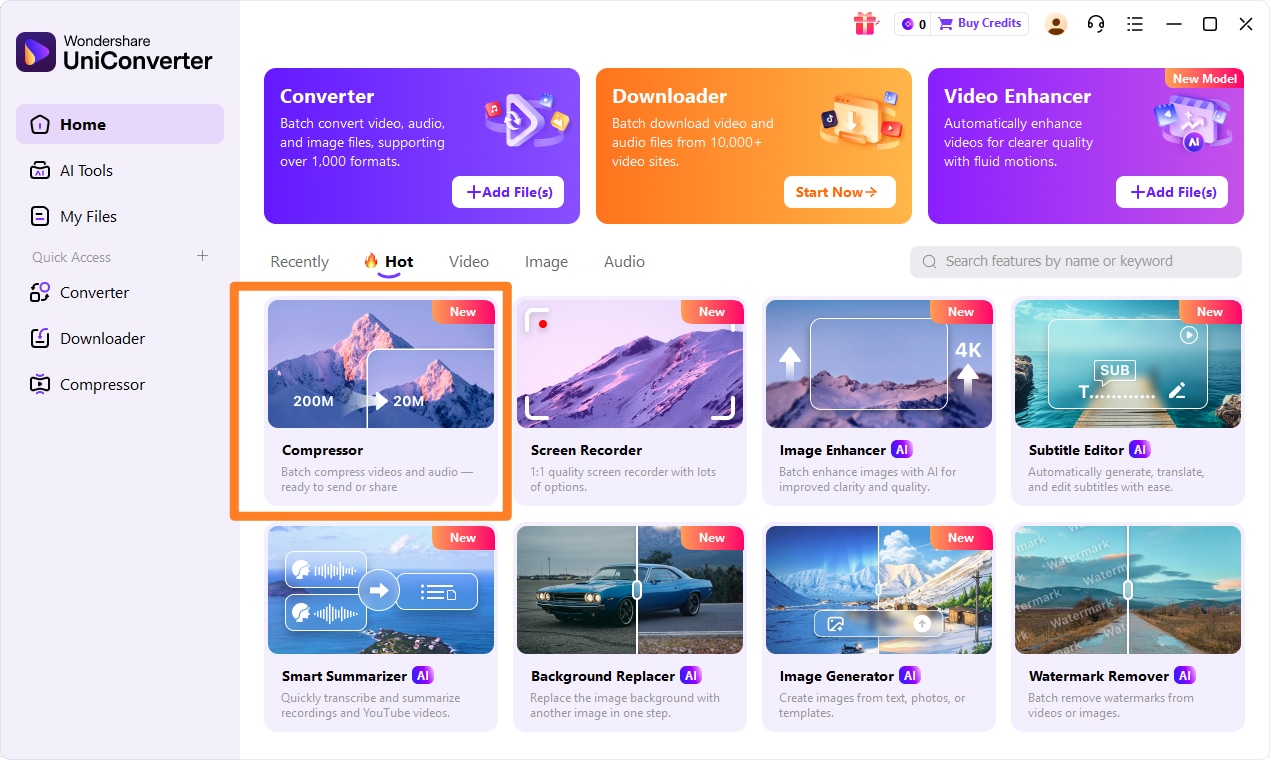
Step 1: Open UniConverter and Choose Compressor
Launch UniConverter on your Mac. From the main interface, navigate to the "Toolbox" section and select the "Video Compressor" option.
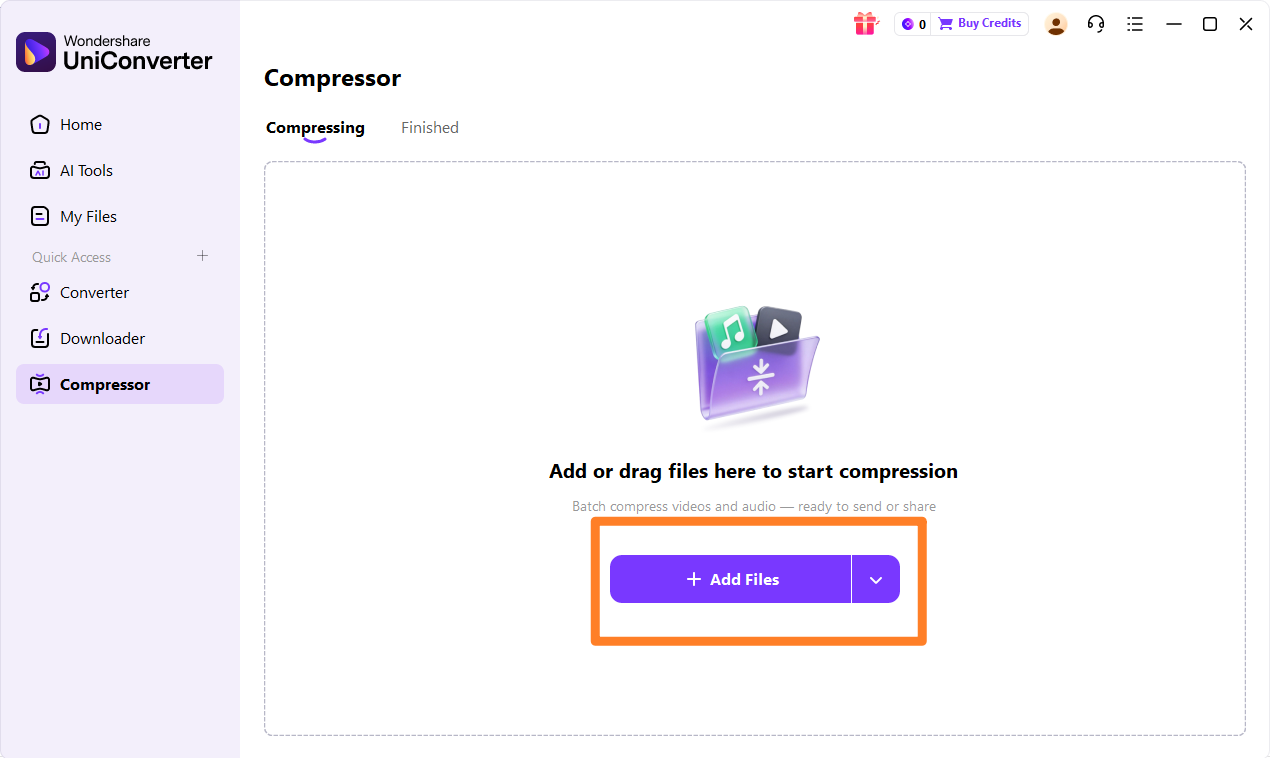
Step 2: Upload the Video, Audios or Images
Click the "Add Files" button or drag and drop your video, audio, or image files directly into the UniConverter window. You can add multiple files for batch compression.
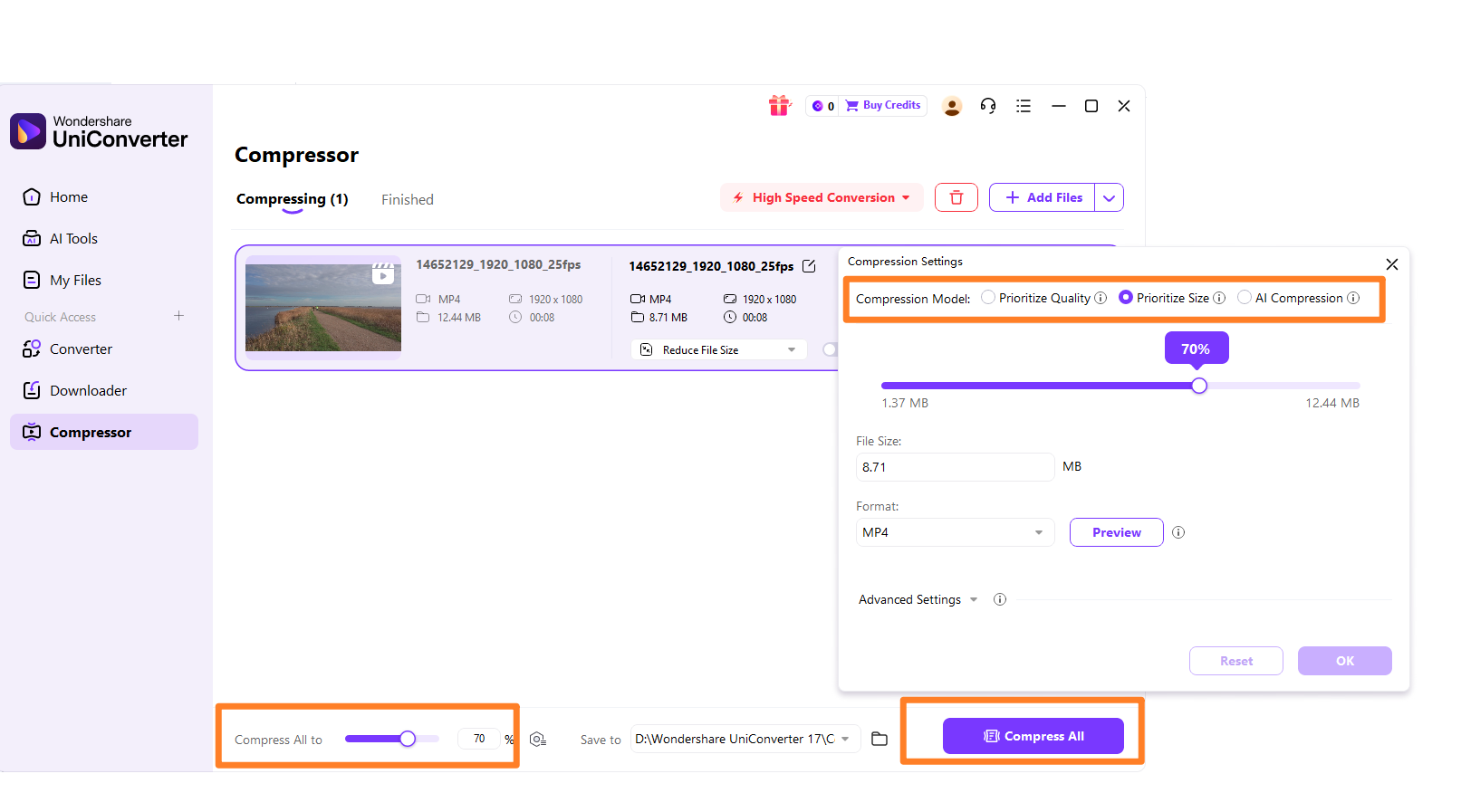
Step 3: Choose Required Parameters
Once your files are loaded, you can adjust compression settings. UniConverter allows you to customize file size, format, resolution, bitrate, and quality. You can preview the changes before applying them.
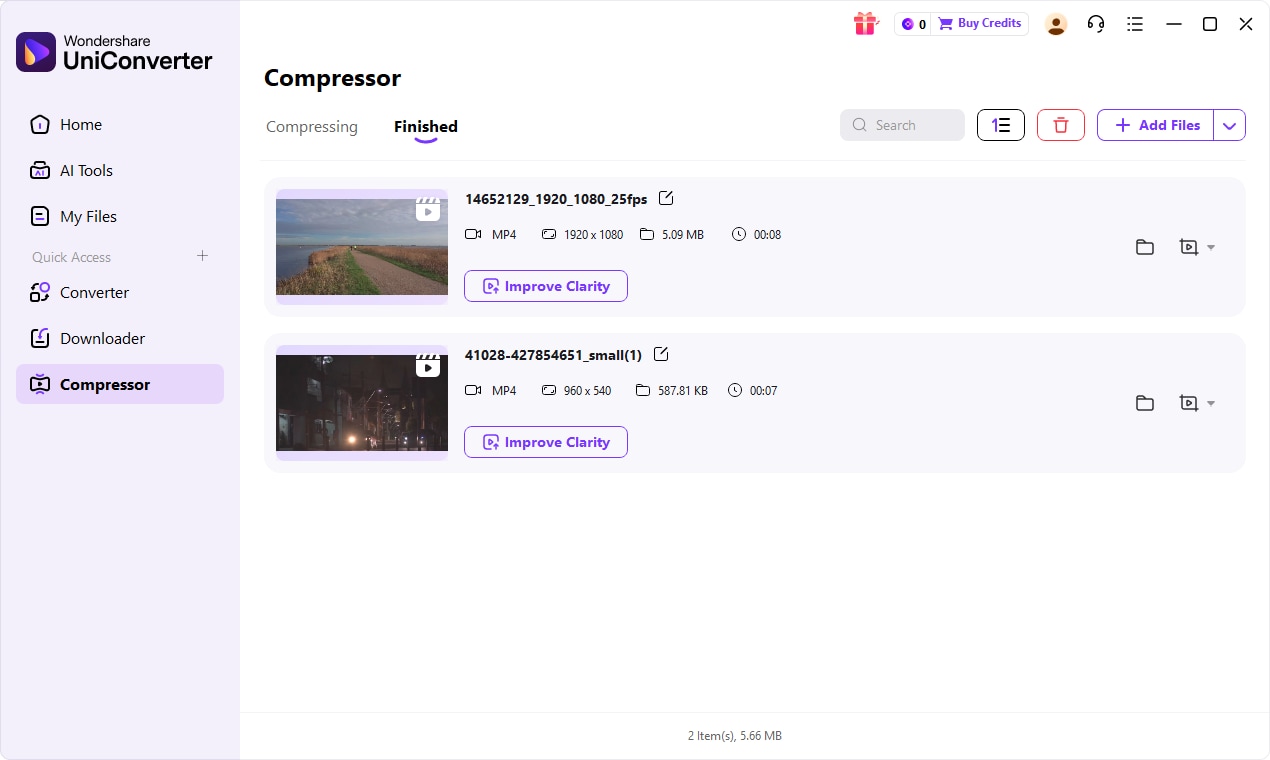
Step 4: Save the Compressed File
After configuring your desired settings, choose an output folder for your compressed files. Click the "Compress" button to start the process. UniConverter will quickly process your files, maintaining optimal quality.

Need a Better iMovie Video Compressor Alternative?
Part 7: Conclusion
In conclusion, the iMovie Video Compressor review reveals it to be a convenient, free, and user-friendly tool perfectly integrated into the Apple ecosystem for basic video compression needs. It excels for casual Mac users who want to quickly share personal videos with family and friends via email or social media, prioritizing ease of use over granular control. However, for content creators, professionals, or anyone with specific quality demands, advanced format requirements, or a need for batch processing, iMovie's built-in compressor falls short. Its limitations in advanced settings, potential for quality degradation, and lack of batch capabilities necessitate exploring more powerful alternatives. Ultimately, your choice should hinge on your specific use case: if simplicity and quick sharing are paramount, iMovie suffices; if professional-grade control, extensive format support, and efficient batch processing are crucial, investing in a dedicated tool like UniConverter or HandBrake will provide a much more satisfactory experience. Always prioritize quality versus file size based on the intended purpose of your video.
Part 8: FAQs
-
1. Can iMovie compress 4K videos effectively?
While iMovie can compress 4K videos, the level of compression and quality retention might not meet professional standards. For critical 4K projects, a dedicated compression tool offers more control.
-
2. Does iMovie support batch video compression?
No, iMovie does not offer batch compression. You need to process videos one by one, which can be time-consuming for multiple files. For batch processing, consider alternatives like UniConverter.
-
3. What are the common output formats for iMovie compressed videos?
iMovie primarily outputs to MP4 and MOV formats, using the H.264 codec. These are widely compatible but limit your options for other specific formats or codecs.
-
4. Will using iMovie Video Compressor significantly degrade my video quality?
For typical sharing purposes, the degradation is often acceptable. However, for critical applications or if you choose aggressive compression settings, you might notice a significant difference in visual quality, such as blockiness or loss of detail.
-
5. Is there a way to compress videos in iMovie without losing much quality?
You can choose higher quality settings during export in iMovie, but this will result in larger file sizes, which might defeat the purpose of compression. For better quality retention with smaller files, a tool like UniConverter allows more precise control over compression parameters.
