
- FreeConvert Overview: A web-based tool for quick audio compression, ideal for basic, one-off tasks.
- Core Features: Offers drag-and-drop, multi-format support, adjustable compression, and cloud-based processing.
- Pros & Cons: User-friendly and no installation needed, but limited customization and slower for large files.
- Target Audience: Best for users needing simple compression for social media or email, without technical expertise.
- Limitations: Not suitable for professional audio production or efficient batch processing of many large files.
- Comparison Insight: FreeConvert is simple; UniConverter offers advanced features, batch processing, and superior quality.
- Risks to Consider: Data privacy, potential quality loss, reliance on internet, ads, and limited customer support.
- UniConverter Advantage: Robust desktop alternative for stable, lossless, fast batch compression with advanced controls and no ads.
- Decision Factor: Choose FreeConvert for quick, basic needs; UniConverter for professional, frequent, or large-scale tasks.
In this article
- Part 1: What is FreeConvert Audio Compressor?
- Part 2: FreeConvert Audio Compressor: Core Features, Pros, and Cons
- Part 3: FreeConvert Audio Compressor: Who is it For? Use Cases and Limitations
- Part 4: FreeConvert Audio Compressor & Competitors: A Head-to-Head Comparison
- Part 5: Risks and Pitfalls to Consider
- Part 6: How to Use UniConverter to Compress Audio and Video Efficiently
- Part 7: Conclusion
- Part 8: FAQs
In today's digital age, sharing audio files often comes with the challenge of large file sizes, making them cumbersome for email, social media, or storage. This is where online audio compressors like FreeConvert Audio Compressor review come into play, offering a quick and accessible solution to reduce file sizes without the need for complex software. This article delves into a comprehensive review and comparison of FreeConvert Audio Compressor against its competitors, providing you with the insights needed to make an informed decision for your audio compression needs. We'll explore its features, ideal use cases, potential pitfalls, and even suggest a robust alternative for more demanding tasks.
Part 1: What is FreeConvert Audio Compressor?
FreeConvert Audio Compressor is a web-based tool designed to reduce the file size of audio files. It's part of the broader FreeConvert suite of online conversion and compression tools, aiming to provide a straightforward solution for users who need to shrink their audio files quickly and efficiently. My initial impression is that it positions itself as a user-friendly option for those without technical expertise, focusing on accessibility and ease of use. This review aims to address the core question: how well does FreeConvert Audio Compressor perform compared to other available options, especially for different user needs and scenarios?
The Rise of Online Audio Compression Tools
The demand for online audio compression tools has surged due to several key factors:
* Increasing Digital Content Creation: More people are creating and sharing audio content, from podcasts to voice notes, requiring efficient file management.
* Limitations of File Sharing Platforms: Many email services and social media platforms have strict file size limits, necessitating compression before sharing.
* Convenience and Accessibility: Online tools eliminate the need for software installation, making them accessible from any device with an internet connection.
* Storage Optimization: Smaller audio files consume less storage space on devices and cloud services.
Part 2: FreeConvert Audio Compressor: Core Features, Pros, and Cons
FreeConvert Audio Compressor offers a streamlined approach to reducing audio file sizes. Its core capabilities revolve around simplifying the compression process for a wide audience.
Here are its key features:
* Drag-and-Drop Interface: Easily upload files by dragging them into the browser window.
* Multiple Format Support: Handles a broad spectrum of audio formats, including MP3, WAV, FLAC, and OGG.
* Adjustable Compression Levels: Allows me to choose between different quality settings to balance file size and audio fidelity.
* Output Format Selection: I can convert the audio to a different format during compression if needed.
* Cloud-Based Processing: All compression happens on their servers, freeing up my local machine's resources.
Pros
* User-friendly interface for quick compression
* Supports a wide range of audio formats
* No software installation required
Cons
* Limited advanced customization options
* Potential for slower processing with larger files or high server load
Part 3: FreeConvert Audio Compressor: Who is it For? Use Cases and Limitations
FreeConvert Audio Compressor is designed with a specific user base and set of scenarios in mind. I find it particularly useful for quick, no-fuss tasks.
Best Use Cases
* Quick, one-off audio compression for social media or email attachments: When I need to send a voice memo or a short audio clip via email or upload it to social media, FreeConvert is my go-to. It's fast and gets the job done without any hassle.
* Users needing basic compression without technical expertise: If I'm not an audio engineer and just need to reduce a file size without diving into bitrate or sample rate settings, FreeConvert's straightforward options are perfect.
Scenario Limitations
* Professional audio production requiring precise control over compression parameters: For my more serious audio projects where I need to maintain specific audio quality standards or apply nuanced compression, FreeConvert simply doesn't offer the granular control I require.
* Batch processing of numerous large audio files: When I have a folder full of large audio files that all need compression, processing them one by one on FreeConvert becomes incredibly time-consuming and inefficient.
Part 4: FreeConvert Audio Compressor & Competitors: A Head-to-Head Comparison
When I look at FreeConvert Audio Compressor, I always compare it to other tools I've used. Here's how it stacks up against some popular alternatives like Online Audio Converter, XConvert, and UniConverter.
| Feature/Tool | FreeConvert Audio Compressor | Online Audio Converter | XConvert | UniConverter |
| Ease of Use | Very High | High | Medium | High |
| Supported Formats | Extensive | Extensive | Good | Extensive |
| Advanced Settings | Limited | Moderate | Moderate | Extensive |
| Batch Processing | No | Yes (some) | Yes (some) | Yes |
| File Size Limit | Moderate | Varies | Varies | Very High |
| Ads | Present | Present | Present | None |
| Output Quality | Good | Good | Good | Excellent |
| Processing Speed | Moderate | Moderate | Moderate | Very Fast |
| Security | Standard | Standard | Standard | High |
| Customer Support | Limited | Limited | Limited | Excellent |
Key Differentiators
From my experience, FreeConvert's main strength is its sheer simplicity, which makes it incredibly accessible for basic tasks. However, when I need more control over my audio or have multiple files to process, tools like Online Audio Converter and XConvert offer slightly more advanced settings and some batch processing capabilities, making them a bit more versatile for intermediate users. UniConverter, on the other hand, stands out for its comprehensive features, superior output quality, and lack of intrusive ads, making it my preferred choice for professional or frequent use. The varying levels of intrusive advertising are also a significant factor; while FreeConvert and others often have ads, UniConverter provides an ad-free experience.
Part 5: Risks and Pitfalls to Consider
Using online tools like FreeConvert Audio Compressor, while convenient, isn't without its potential downsides. I've learned to be cautious, especially when dealing with sensitive or important audio files.
Data Privacy Concerns with Online Tools
When I upload my audio files to an online compressor, I'm essentially entrusting my data to a third-party server. I always wonder about their data retention policies and how securely they handle my files. There's always a risk, however small, that my audio could be accessed or stored longer than I'd like, potentially raising privacy issues, especially for personal or confidential recordings.
Potential for Quality Loss in Aggressive Compression
The primary goal of compression is to reduce file size, but aggressive compression settings can lead to a noticeable drop in audio quality. I've experienced situations where my compressed audio sounds tinny, muffled, or loses important nuances. While FreeConvert offers different quality settings, it's a delicate balance, and sometimes the "compressed" version just isn't good enough for my needs, forcing me to re-evaluate my approach.
Reliance on Internet Connection and Server Availability
Since FreeConvert is an online tool, my ability to use it is entirely dependent on my internet connection and the availability of their servers. If my internet is spotty or their servers are experiencing high traffic or maintenance, I'm out of luck. This can be a significant bottleneck when I'm on a tight deadline or working in an area with unreliable connectivity.
Presence of Advertisements and Pop-ups
As a free service, FreeConvert often relies on advertisements to sustain itself. While I understand this model, I sometimes find the ads intrusive, distracting, or even leading to unwanted pop-ups. This can disrupt my workflow and make the user experience less pleasant, especially when I'm trying to quickly get a task done.
Limited Customer Support for Free Services
If I encounter an issue or have a question while using FreeConvert, the customer support options are typically very limited, if they exist at all. Unlike paid software, free online tools rarely offer dedicated support channels, leaving me to troubleshoot problems on my own or search through community forums, which can be frustrating and time-consuming.
Part 6: How to Use UniConverter to Compress Audio and Video Efficiently
For tasks that demand reliable batch compression and better control over output quality, UniConverter is the option I usually go with. Unlike many free web-based services, it offers a cleaner, ad-free workflow and handles video compression, audio compression, and image compression in one place. Its broad format support and GPU acceleration also make processing much faster, while features designed to compress videos without quality loss help preserve quality as much as possible. When stability, speed, and true batch processing matter, it works well as a practical all-in-one media solution.
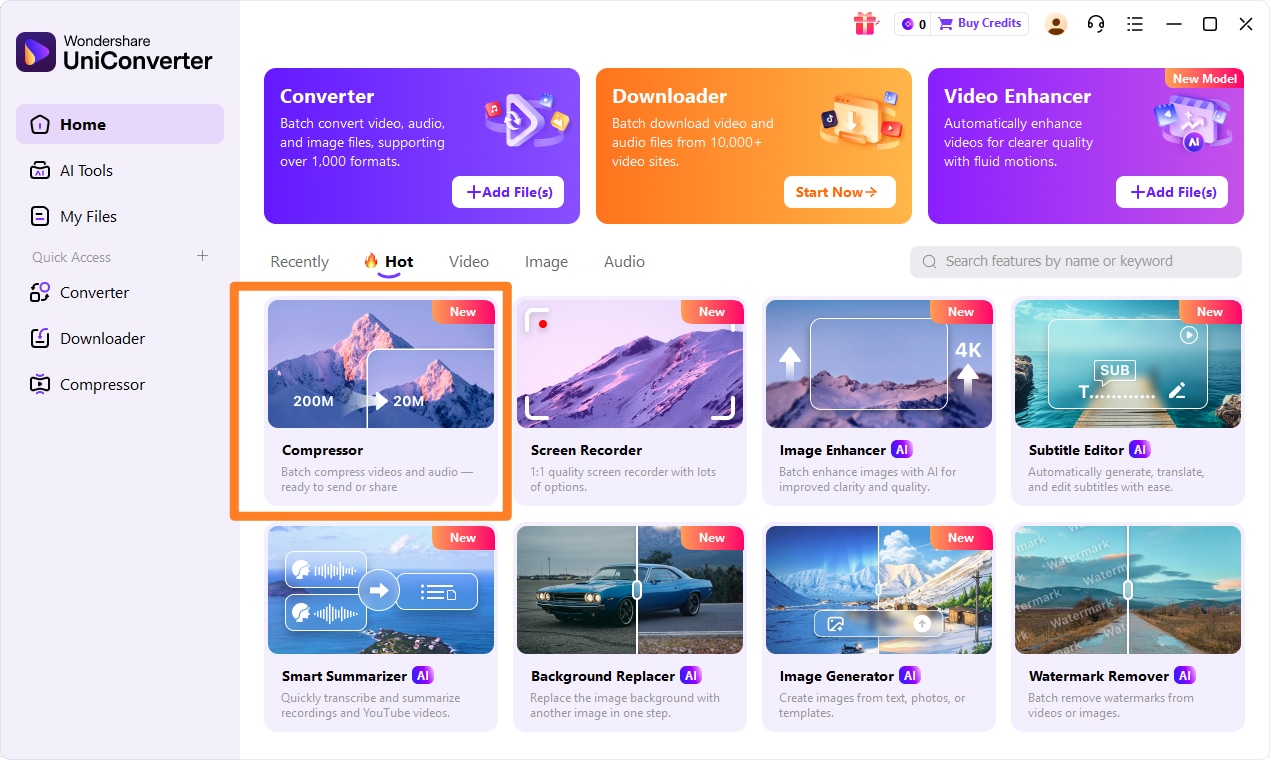
Step 1: Open UniConverter and Choose Compressor
First, I launch UniConverter on my computer and navigate to the "Compressor" module from the main interface.
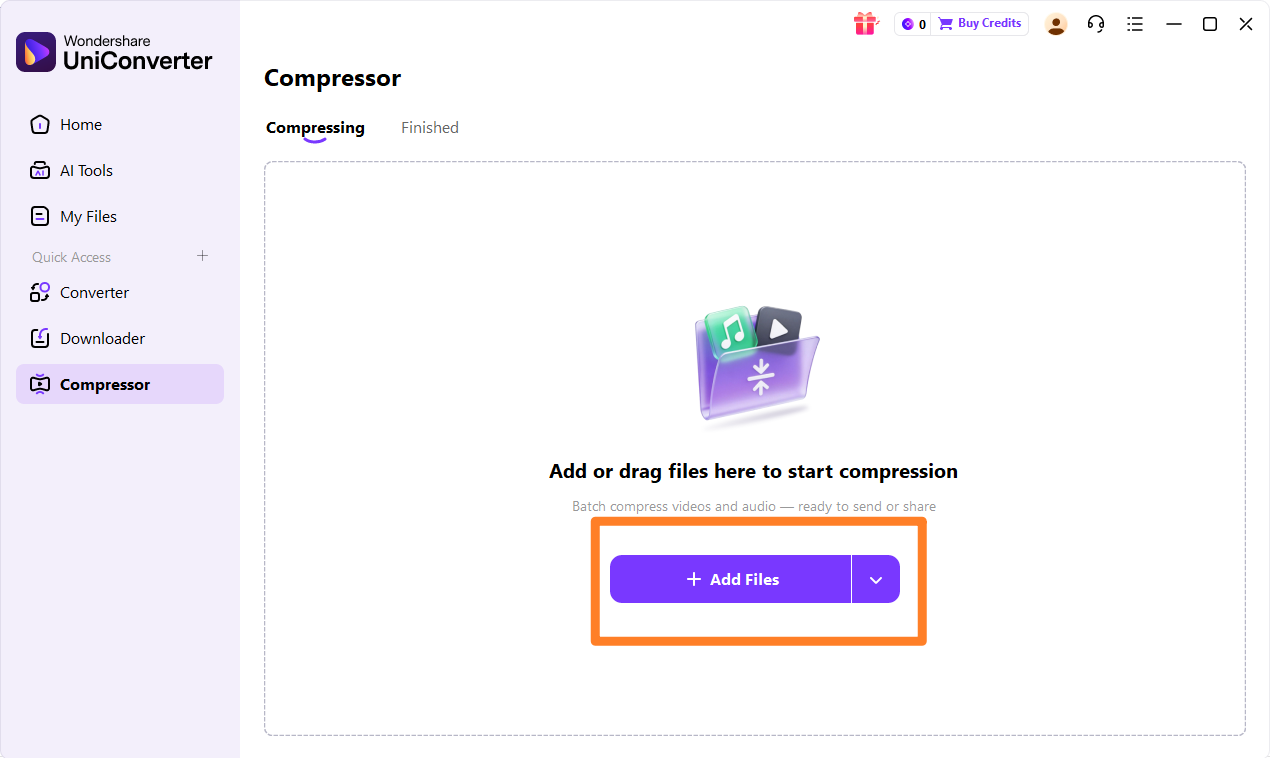
Step 2: Upload the Video, Audios or Images
Next, I drag and drop my audio files directly into the UniConverter window. I can also click "Add Files" to browse and select them.
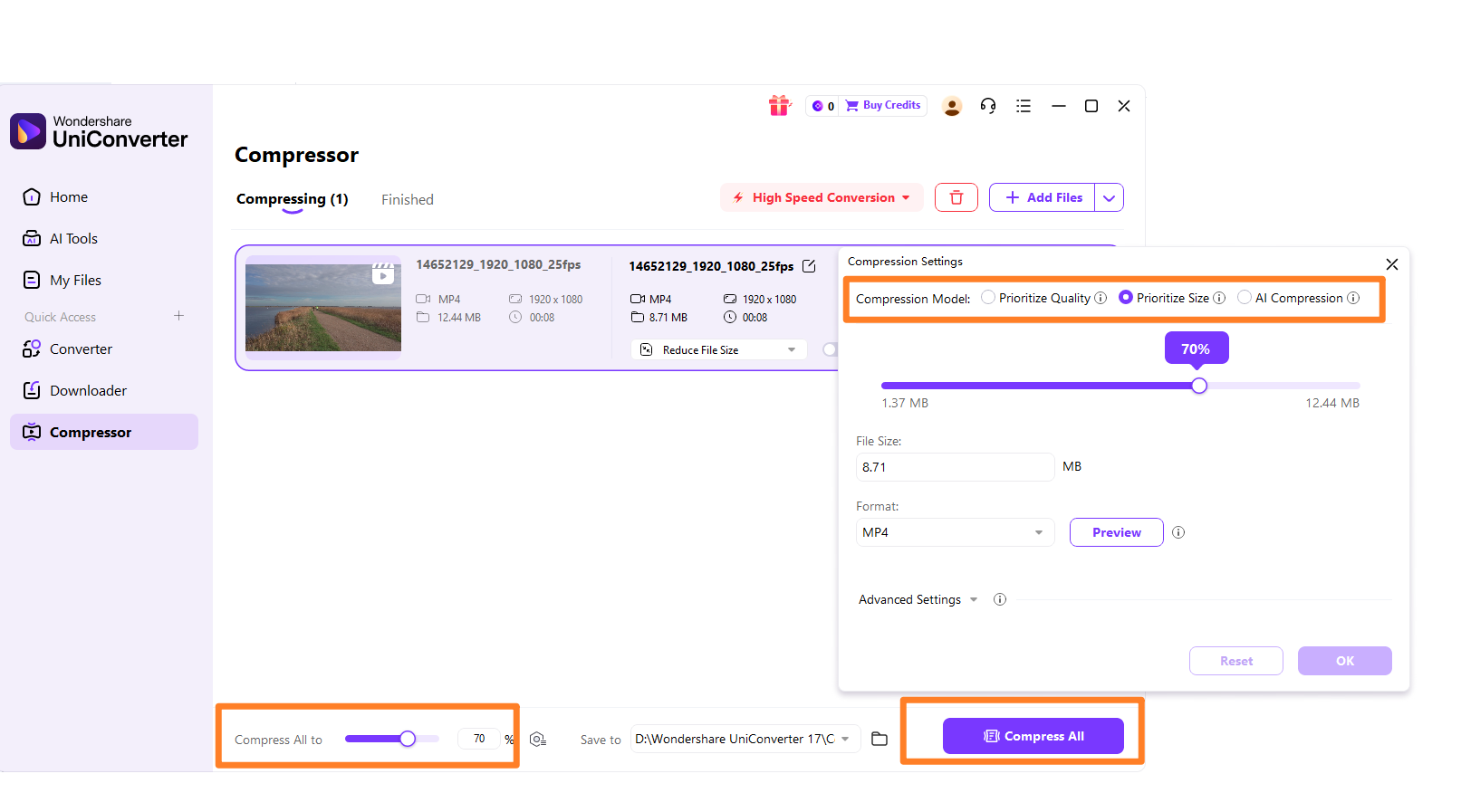
Step 3: Choose Required Parameters
Once my files are loaded, I can adjust the compression settings. UniConverter allows me to choose the output format, quality, and even preview the compressed file size before processing.
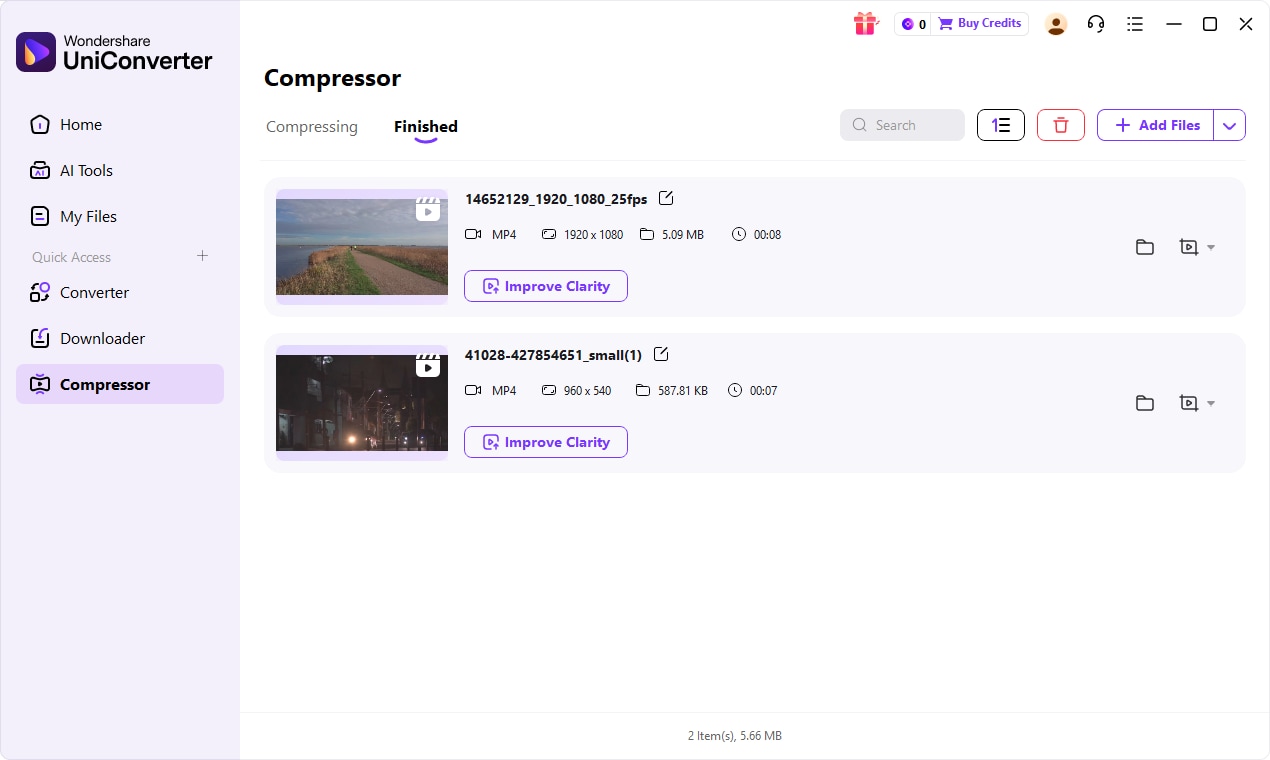
Step 4: Save the Compressed File
Finally, after setting my desired parameters, I click the "Compress" button. UniConverter quickly processes the files, and I can then save the compressed audio to my preferred location.

Need a FreeConvert Audio Compressor Alternative?
Part 7: Conclusion
After thoroughly reviewing and comparing FreeConvert Audio Compressor review with its alternatives, it's clear that its suitability largely depends on individual needs and usage patterns. For casual users who occasionally need to compress a single audio file for email or social media, FreeConvert offers a convenient, free, and straightforward solution. Its user-friendly interface and lack of software installation make it an accessible starting point. However, for professionals or regular users who require precise control over compression parameters, batch processing capabilities, higher output quality, or an ad-free experience, investing in dedicated desktop software like UniConverter is a far superior choice. While FreeConvert is a good entry-level option, it's crucial to prioritize privacy and quality for sensitive projects and consider the efficiency gains offered by more robust tools when dealing with numerous or large audio files.
Part 8: FAQs
-
1. Is FreeConvert Audio Compressor truly free?
Yes, FreeConvert Audio Compressor offers a free tier with certain limitations, such as file size caps and the presence of advertisements.
-
2. Does FreeConvert reduce audio quality significantly?
The degree of quality reduction depends on the compression settings you choose. Aggressive compression can lead to noticeable quality loss, so it's a balance between file size and fidelity.
-
3. Can I compress multiple audio files at once with FreeConvert?
FreeConvert's free online tool typically processes files one by one, lacking true batch processing capabilities. For batch compression, I'd recommend a desktop application like UniConverter.
-
4. Are there any file size limits for FreeConvert Audio Compressor?
Yes, FreeConvert usually has file size limits for its free service, which can vary. For larger files, I often find myself needing a more robust solution.
-
5. How does FreeConvert compare to desktop audio compressors?
Online tools like FreeConvert are convenient but generally lack the advanced features, speed, and privacy of dedicated desktop software like UniConverter, which offers more control and an ad-free experience.
