
- FFmpeg Overview: Powerful, open-source command-line tool for advanced multimedia processing.
- Core Features: Unrivaled customization, extensive format support, batch processing, and high-quality output.
- Pros & Cons: Free, cross-platform, and highly customizable, but has a steep learning curve and no GUI.
- Ideal Users: Best for developers and system administrators needing automation and precise control.
- Comparative Analysis: FFmpeg offers unmatched control; UniConverter provides user-friendly power and quality.
- Risks: Potential for quality degradation, security concerns with untrusted scripts, and significant learning time.
- UniConverter Alternative: Offers a user-friendly GUI, stable compression, and excellent output quality.
- Decision Guide: Choose FFmpeg for control, UniConverter for ease and quality, or HandBrake for a balance.
In this article
- Part 1: What is FFmpeg Video Compressor?
- Part 2: FFmpeg Video Compressor: Core Features, Pros, and Cons
- Part 3: FFmpeg Video Compressor: Ideal Users and Use Cases
- Part 4: FFmpeg Video Compressor & Competitors: A Comparative Analysis
- Part 5: Risks and Pitfalls to Consider
- Part 6: How to Use UniConverter to Compress Efficiently
- Part 7: Conclusion
- Part 8: FAQs
FFmpeg Video Compressor: A Deep Dive into its Capabilities and Alternatives
When it comes to video compression, the name FFmpeg Video Compressor often surfaces, particularly among those with a technical bent. It's a powerful, open-source command-line tool that has become an industry standard for handling multimedia files. This FFmpeg Video Compressor review aims to cut through the noise, providing you with a clear, scenario-based comparison of FFmpeg against its popular alternatives like HandBrake, UniConverter, and various online converters. I'll explore its core features, ideal use cases, and the potential pitfalls, helping you decide if FFmpeg is the right tool for your video compression needs, or if a more user-friendly option might serve you better.
Part 1: What is FFmpeg Video Compressor?
FFmpeg is a free and open-source project consisting of a vast suite of libraries and programs for handling video, audio, and other multimedia files and streams. At its core, it's a command-line tool, meaning you interact with it by typing commands into a terminal rather than clicking buttons in a graphical interface. This gives it immense power and flexibility, allowing for highly customized and complex operations that are often impossible with simpler software. My goal here is to demystify FFmpeg and help you understand its place in the world of video compression, especially when compared to more accessible alternatives.
The Power of Command-Line Video Processing
* Unrivaled Customization: FFmpeg offers granular control over every aspect of video and audio encoding.
* Automation Capabilities: Its command-line nature makes it perfect for scripting and automating repetitive tasks.
* Broad Format Support: It supports virtually every video and audio format imaginable.
Part 2: FFmpeg Video Compressor: Core Features, Pros, and Cons
FFmpeg is a beast when it comes to video compression, offering a level of control that few other tools can match. I've used it for everything from simple format conversions to complex video manipulations. Its core capabilities include:
* Extensive Codec Support: It handles almost any video and audio codec you can throw at it.
* High-Quality Output: With the right parameters, you can achieve excellent compression quality.
* Batch Processing: Its command-line interface excels at processing multiple files simultaneously.
* Streaming Capabilities: It can be used for live streaming and recording.
* Filtering and Effects: A wide array of video and audio filters are available for advanced editing.
- Pros:
- Unparalleled Customization and Control over Compression Parameters
- Open-Source and Free, Offering Cost-Effective Solutions
- Cross-Platform Compatibility for Diverse Operating Environments
- Cons:
- Steep Learning Curve for Beginners and Non-Technical Users
- Lack of a User-Friendly Graphical Interface
Part 3: FFmpeg Video Compressor: Ideal Users and Use Cases
From my experience, FFmpeg isn't for everyone, but for the right user, it's an indispensable tool. If you're comfortable with command-line interfaces and need precise control over your video compression, then FFmpeg is your go-to.
- Best Use Case: Batch Processing and Automation for Experienced Developers and System Administrators. I've personally used FFmpeg to automate the compression of hundreds of video files for a website, saving countless hours. Its scripting capabilities are a game-changer for repetitive tasks.
- Limited Use Case: Quick, One-Off Compressions for Casual Users or Those Without Technical Expertise. If you just need to compress a single video for a quick upload to social media, diving into FFmpeg's command-line syntax is overkill and frankly, frustrating. For these scenarios, a GUI-based tool is far more efficient.
Part 4: FFmpeg Video Compressor & Competitors: A Comparative Analysis
When I look at video compression tools, I always weigh control against convenience. Here's how FFmpeg stacks up against some popular alternatives:
| Feature/Tool | FFmpeg Video Compressor | HandBrake | UniConverter | Online Converters |
| Ease of Use | Command-line | GUI-based | GUI-based | Web-based |
| Customization | High | Medium | Medium | Low |
| Batch Processing | Excellent | Good | Excellent | Limited |
| Output Quality | User-defined | Good | Excellent | Variable |
| Price | Free | Free | Paid | Free/Paid |
Key Differentiators: Control vs. Convenience
FFmpeg stands out for its unmatched customization. If you know exactly what bitrate, codec, and filter you need, FFmpeg gives you that power. HandBrake offers a good balance of customization and ease of use, making it a popular choice for many. UniConverter, while paid, provides a very user-friendly experience with excellent output quality and robust batch processing. Online converters are the easiest, but they sacrifice customization, often have file size limits, and their output quality can be inconsistent. For me, if I need absolute control and am doing a large batch, FFmpeg is my first choice. For a quick, high-quality conversion without the hassle, UniConverter is a strong contender.
Part 5: Risks and Pitfalls to Consider
While FFmpeg is incredibly powerful, it's not without its challenges. Based on my own experiences and observations, here are some risks and pitfalls you should be aware of:
Potential for Quality Degradation with Incorrect Settings
This is perhaps the biggest pitfall. FFmpeg offers so many parameters that it's easy to get lost. If you don't understand what you're doing, you can easily end up with a video that's either too large, has poor quality, or even becomes unplayable. I've certainly made my share of mistakes, resulting in pixelated videos or audio sync issues. It requires a good understanding of video encoding principles to get the best results.
Security Concerns with Untrusted Scripts or Builds
Because FFmpeg is open-source, you might find various scripts or pre-compiled builds online. Using untrusted sources can pose a security risk. Malicious code could be embedded, potentially compromising your system. Always download FFmpeg from its official website or trusted repositories to ensure you're getting a clean and secure version.
Time Investment for Learning and Troubleshooting
The learning curve for FFmpeg is steep. It takes time to understand the syntax, the various codecs, and the multitude of options available. When something goes wrong, troubleshooting can be a lengthy process, often involving searching forums and documentation. This time investment can be a significant barrier for casual users or those with urgent deadlines.
Lack of Dedicated Customer Support
Being an open-source project, FFmpeg doesn't offer dedicated customer support. If you encounter an issue, you're reliant on community forums, documentation, and your own problem-solving skills. While the community is generally helpful, it's not the same as having a dedicated support team to assist you.
Part 6: How to Use UniConverter to Compress Efficiently
Sometimes, the complexity of tools like FFmpeg can be overwhelming, or you might encounter issues such as unstable compression or significant quality loss. In such cases, UniConverter offers a refreshingly straightforward and powerful alternative for video, audio, and image compression. It's designed to be an all-in-one solution, boasting a user-friendly interface, no ads, extensive format support, GPU acceleration for speed, stable and lossless compression options, and robust batch processing capabilities.
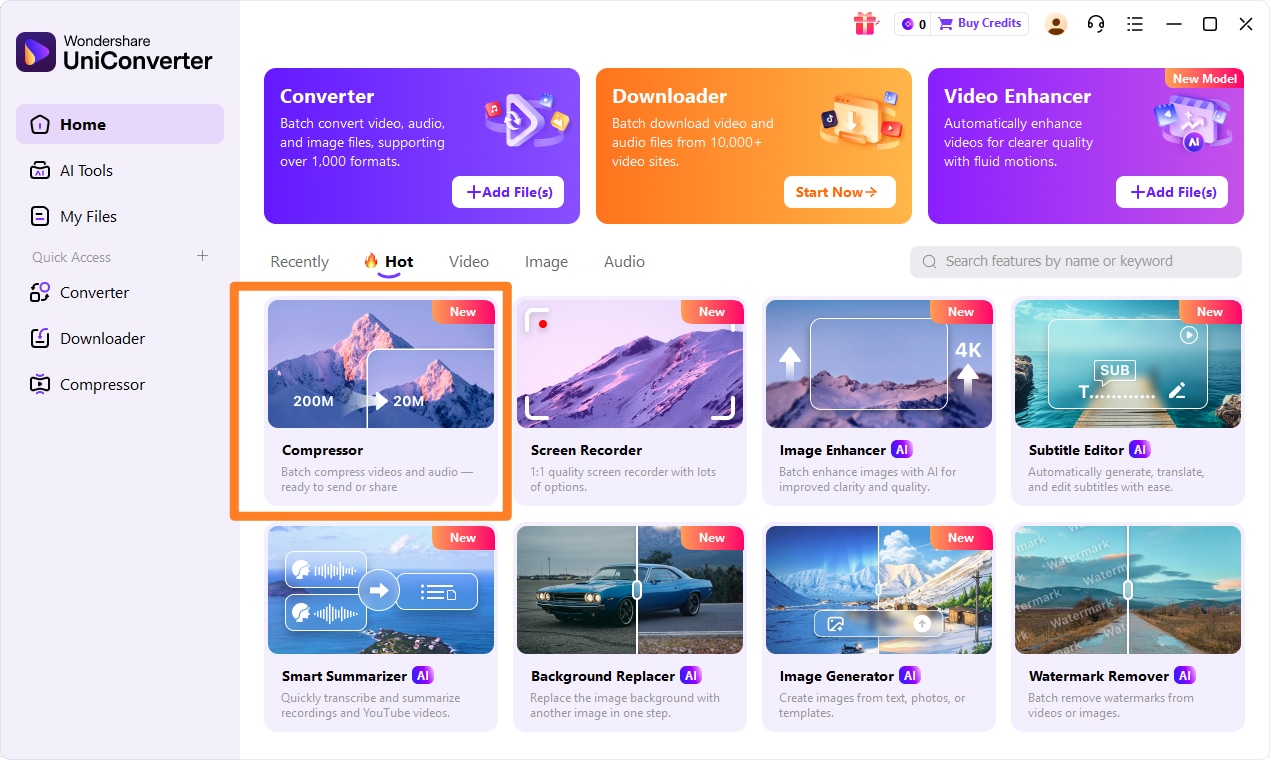
Step 1: Open UniConverter and Choose Compressor
Launch UniConverter on your computer. From the main interface, navigate to the "Compressor" tool.
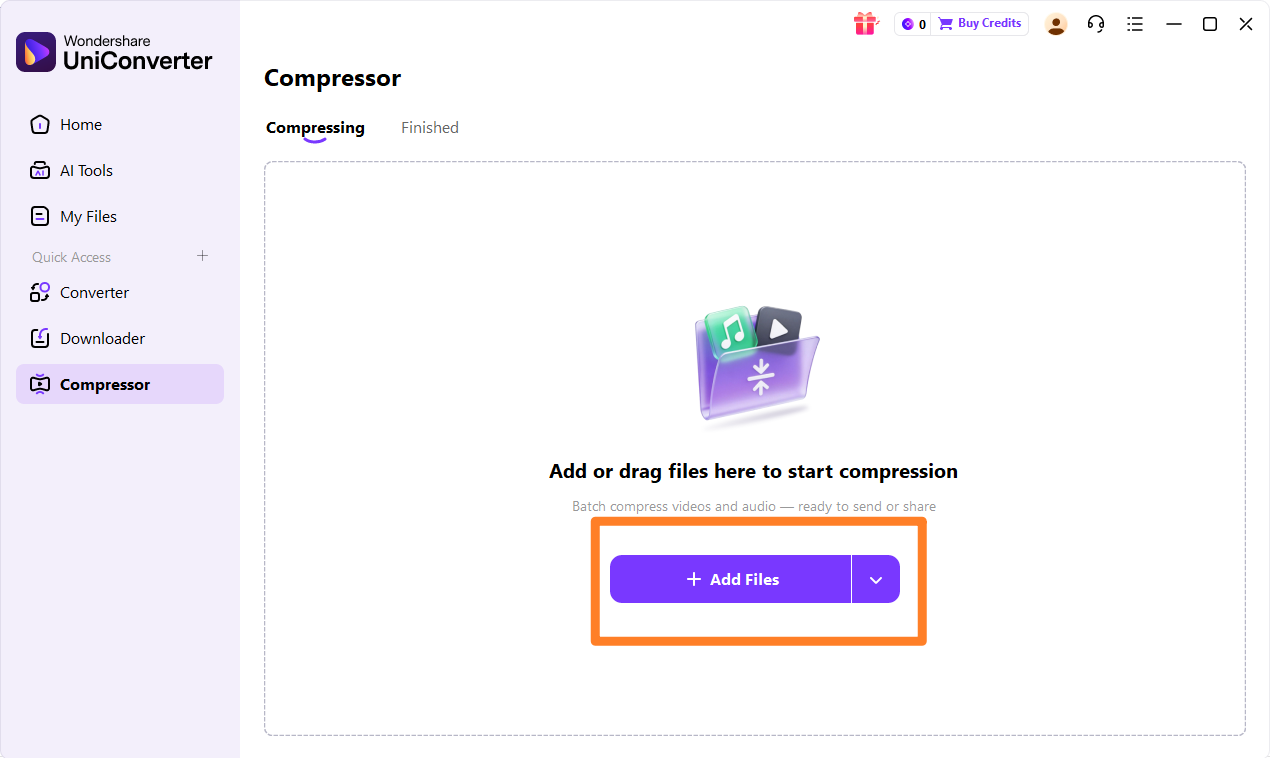
Step 2: Upload the Video, Audios or Images
Click on the "Add Files" button or simply drag and drop your video, audio, or image files into the UniConverter window.
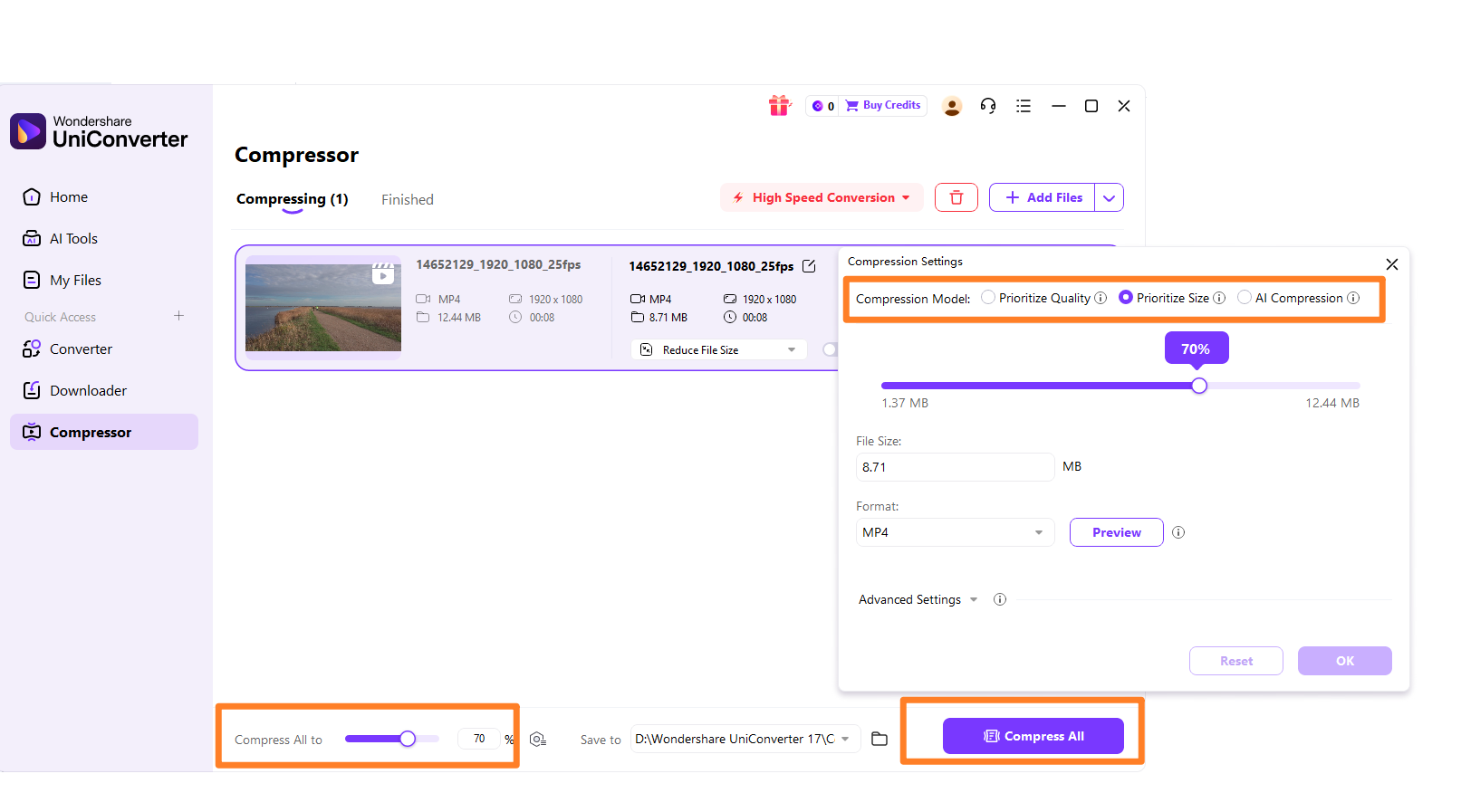
Step 3: Choose Required Parameters
Once your files are loaded, you can select your desired output format, resolution, bitrate, and size. UniConverter provides presets or allows for custom adjustments to achieve your preferred compression level.
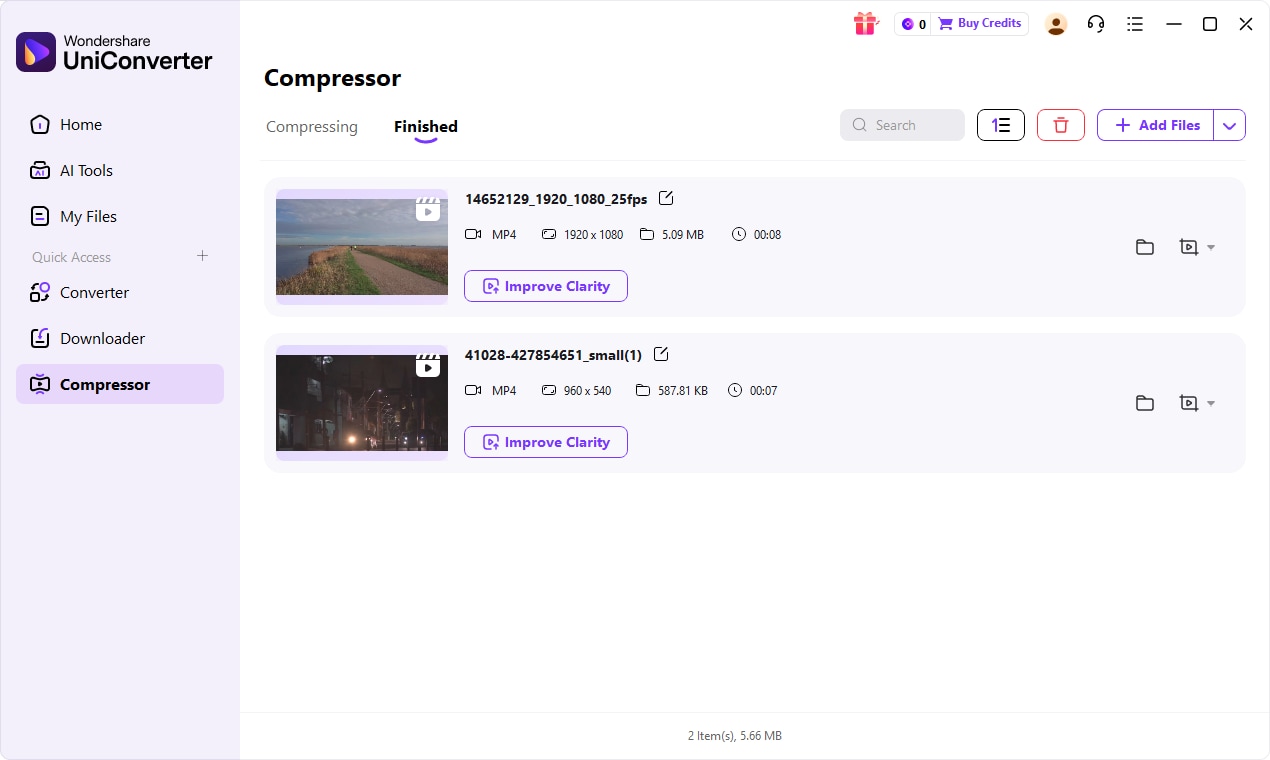
Step 4: Save the Compressed File
After configuring your settings, click the "Compress" button. UniConverter will then process your files, and you can choose the destination folder for your compressed output.

Need an Easier FFmpeg Video Compressor Alternative?
Part 7: Conclusion
In conclusion, the choice of a video compressor heavily depends on your technical proficiency and specific needs. FFmpeg Video Compressor remains an incredibly powerful and versatile tool for those who are comfortable with command-line interfaces and require granular control over every aspect of their video compression. Its open-source nature and extensive capabilities make it a favorite among developers and system administrators for batch processing and automation. However, its steep learning curve and lack of a graphical interface can be a significant barrier for casual users or those who prioritize ease of use. For beginners and those needing quick, one-off compressions, a GUI-based solution like HandBrake or UniConverter is far more suitable. Professionals who demand both advanced features and a user-friendly experience, along with reliable output quality and customer support, would find UniConverter to be an excellent investment. Ultimately, understanding your own technical comfort level and the specific demands of your project will guide you to the best video compression solution.
Part 8: FAQs
-
1. Is FFmpeg Video Compressor completely free to use?
Yes, FFmpeg is entirely free and open-source. You can download, use, and even modify its source code without any cost.
-
2. Can FFmpeg compress videos without losing quality?
FFmpeg can perform "lossless" compression for certain formats, but typically, video compression involves some degree of quality loss (lossy compression) to achieve smaller file sizes. With the right settings, you can achieve a high-quality output that is visually indistinguishable from the original, but it's rarely truly "lossless" in the sense of identical data.
-
3. What are the common command-line parameters for video compression in FFmpeg?
Some common parameters include `-i` for input file, `-o` for output file, `-c:v` for video codec (e.g., `libx264`, `libx265`), `-crf` for constant rate factor (quality setting), `-b:v` for video bitrate, `-s` for resolution, and `-preset` for encoding speed/efficiency. For example, `ffmpeg -i input.mp4 -c:v libx264 -crf 23 -preset medium output.mp4` is a common command.
-
4. How does FFmpeg compare to online video compressors?
FFmpeg offers far greater control, customization, and often better quality than most online video compressors. Online tools are convenient for small, quick tasks but often have file size limits, limited options, and variable output quality. For serious compression work, FFmpeg is superior. If you need a balance of ease and quality without installing software, UniConverter's desktop application is a better choice than online tools.
-
5. Is there a graphical user interface (GUI) available for FFmpeg?
While FFmpeg itself is command-line, there are several third-party GUIs that act as front-ends for FFmpeg, making it more accessible. Examples include HandBrake (which uses FFmpeg libraries), Shutter Encoder, and various custom scripts. However, these GUIs often don't expose the full range of FFmpeg's capabilities. For a comprehensive GUI experience with powerful compression features, UniConverter is a highly recommended alternative.
