
- FFmpeg Power: Open-source, command-line tool for unparalleled audio/video processing and compression.
- FFmpeg Pros: Offers extensive customization, is free, and cross-platform; ideal for advanced users.
- FFmpeg Cons: Steep learning curve, lacks visual feedback, and requires command-line proficiency.
- Ideal Users: Best for professional audio engineers and developers needing granular control and scripting.
- Casual User Limitation: Overkill for simple tasks; GUI tools offer better ease of use for quick adjustments.
- FFmpeg vs. Competitors: Unmatched control, but GUI alternatives like UniConverter offer user-friendliness.
- Risks: Complex syntax, no dedicated support, potential quality loss, and significant learning time.
- UniConverter Solution: Simplifies audio compression with an intuitive GUI, batch processing, and stable results.
- Decision Point: Choose FFmpeg for ultimate control and scripting, UniConverter for ease and efficiency.
In this article
- Part 1: What is FFmpeg?
- Part 2: FFmpeg Audio Compressor: Core Features, Pros, and Cons
- Part 3: FFmpeg Audio Compressor: Ideal Users and Real-World Scenarios
- Part 4: FFmpeg Audio Compressor vs. Competitors
- Part 5: Risks and Pitfalls When Using FFmpeg for Audio Compression
- Part 6: How to Use UniConverter for Simplified Audio Compression
- Part 7: Final Verdict and Recommendations
- Part 8: FAQs
Part 1: What is FFmpeg?
FFmpeg is a powerful, open-source multimedia framework that can decode, encode, transcode, mux, demux, stream, filter, and play virtually any media file. At its core, it's a command-line tool that offers unparalleled control over audio and video processing. For audio compression specifically, FFmpeg allows you to manipulate various parameters like bitrate, sample rate, and codecs to achieve the desired balance between file size and sound quality.
This review aims to address the common challenges faced by users when dealing with audio compression, particularly in scenarios where quality preservation and efficiency are paramount. Many struggle with finding a tool that offers both granular control and ease of use, often having to compromise on one for the other.
The Role of Audio Compression in Modern Media
The need for efficient audio compression has never been greater. I constantly find myself needing to:
* Reduce file sizes for faster streaming and downloads: Large audio files can significantly impact website loading times and mobile data consumption.
* Optimize audio for specific platforms and devices: Different platforms have varying requirements for audio formats and bitrates, necessitating tailored compression.
* Manage storage space effectively: For creators with extensive media libraries, efficient compression is crucial for keeping storage costs down.
* Improve workflow efficiency in production: Quickly compressing audio without sacrificing quality is essential for meeting tight deadlines in professional environments.
Part 2: FFmpeg Audio Compressor: Core Features, Pros, and Cons
FFmpeg's strength lies in its comprehensive set of audio processing capabilities. I've found it to be incredibly versatile, allowing me to:
* Convert between a vast array of audio formats: From MP3 to AAC, FLAC to WAV, FFmpeg handles almost any format you throw at it.
* Adjust audio bitrate and sample rate: This is crucial for fine-tuning the balance between file size and audio fidelity.
* Apply various audio filters: I can normalize volume, remove noise, or even apply equalization directly through FFmpeg commands.
* Extract audio from video files: A common task for me, and FFmpeg makes it straightforward.
* Perform batch processing on multiple audio files: This saves me a tremendous amount of time when dealing with large projects.
Pros:
* Unparalleled Customization and Control over Audio Parameters: I can tweak every aspect of the compression process, giving me complete creative freedom.
* Open-Source and Free, Offering Cost-Effective Solutions: As a freelancer, the fact that it's free is a huge advantage, eliminating subscription costs.
* Cross-Platform Compatibility for Diverse Operating Environments: I can use it on my Windows PC, my Mac, and even my Linux server without any issues.
Cons:
* Steep Learning Curve for Beginners and Non-Technical Users: It took me a while to get comfortable with the command-line interface and syntax.
* Command-Line Interface Lacks User-Friendly Visual Feedback: Without a GUI, it's harder to visualize the impact of my commands until I play the output.
Part 3: FFmpeg Audio Compressor: Ideal Users and Real-World Scenarios
FFmpeg is definitely not for everyone, but for those who embrace its power, it's an indispensable tool. I've found it most beneficial for:
Best Use Case: Professional Audio Engineers and Developers Requiring Granular Control
As an audio engineer, I often need to perform very specific and precise audio manipulations that off-the-shelf software simply can't handle. For instance, I might need to compress a series of audio tracks to a very specific bitrate and sample rate for a mobile game, ensuring optimal performance without sacrificing too much audio quality. FFmpeg allows me to script these complex operations, making my workflow incredibly efficient. Developers integrating audio processing into their applications also benefit immensely from FFmpeg's robust API and command-line capabilities.
Limitation Scenario: Casual Users Needing Quick and Simple Audio Adjustments
If you're just looking to quickly reduce the file size of a single MP3 for an email attachment or convert a WAV file to MP3 for your car stereo, FFmpeg can feel like overkill. The time it takes to learn the commands and ensure correct syntax far outweighs the benefit for such simple tasks. For these users, a graphical user interface (GUI) based tool that offers straightforward "drag and drop" functionality and preset compression options would be much more suitable and less intimidating.
Part 4: FFmpeg Audio Compressor vs. Competitors
When I look at audio compression tools, I consider several factors. Here's how FFmpeg Audio Compressor stacks up against some popular alternatives:
| Feature/Product | FFmpeg Audio Compressor | Audacity | HandBrake | UniConverter |
| Ease of Use | Command-line | GUI-based | GUI-based | GUI-based |
| Customization | High | Medium | Medium | High |
| Cost | Free | Free | Free | Paid/Freemium |
| Platform Support | Cross-platform | Cross-platform | Cross-platform | Cross-platform |
| Batch Processing | Yes | Limited | Yes | Yes |
| Output Quality | Excellent (with correct settings) | Good | Good | Excellent |
| Customer Support | Community | Community | Community | Dedicated |
Key Differentiators:
FFmpeg's command-line power is its defining characteristic, offering a level of control that GUI-based tools like Audacity and HandBrake simply can't match. While Audacity is excellent for basic editing and compression, and HandBrake excels at video transcoding with audio options, neither provides the same depth of audio parameter control as FFmpeg. The open-source nature of FFmpeg also stands in stark contrast to proprietary software like UniConverter, which offers a more polished user experience and dedicated support, but at a cost. For me, the depth of audio parameter control offered by FFmpeg is its biggest draw when I need precise results.
Part 5: Risks and Pitfalls When Using FFmpeg for Audio Compression
While FFmpeg is incredibly powerful, it's not without its challenges. I've personally encountered several pitfalls that new users should be aware of:
Complexity of Command Syntax Leading to Errors
The biggest hurdle for me was mastering the command-line syntax. A single misplaced character or incorrect flag can lead to errors, failed conversions, or even corrupted files. It requires careful attention to detail and a good understanding of the various parameters. I've spent hours troubleshooting commands only to find a tiny typo was the culprit.
Lack of Dedicated Customer Support
Since FFmpeg is open-source, there's no official customer support line to call. While the community forums are incredibly helpful, getting a direct answer to a very specific or complex problem can sometimes take time. This can be frustrating when you're on a tight deadline and need immediate assistance.
Potential for Quality Degradation if Parameters are Incorrectly Set
With great power comes great responsibility. If you don't understand the implications of different codecs, bitrates, and sample rates, you can easily compress your audio to the point where it sounds terrible. I've definitely made the mistake of over-compressing in the past, resulting in noticeable artifacts and a significant loss of fidelity. It requires a good ear and some experimentation to find the right balance.
Time Investment Required for Learning and Troubleshooting
Learning FFmpeg is an ongoing process. It's not a tool you can just pick up and master in an afternoon. The initial learning curve is steep, and even experienced users like myself still encounter new challenges and need to consult documentation or community resources. This time investment needs to be factored in, especially if you have urgent projects.
Part 6: How to Use UniConverter for Simplified Audio Compression
For anyone who wants the power of media compression without dealing with FFmpeg’s learning curve, UniConverter is a much more approachable alternative. It offers a smoother workflow for audio compression, video compression, and even image compression, making it easier to manage different file types in one place. I also like that it supports batch processing, broad format compatibility, and GPU acceleration for faster performance. For video tasks in particular, it can help compress videos without quality loss as much as possible, so it works well as a practical all-in-one solution when speed, simplicity, and output quality all matter.
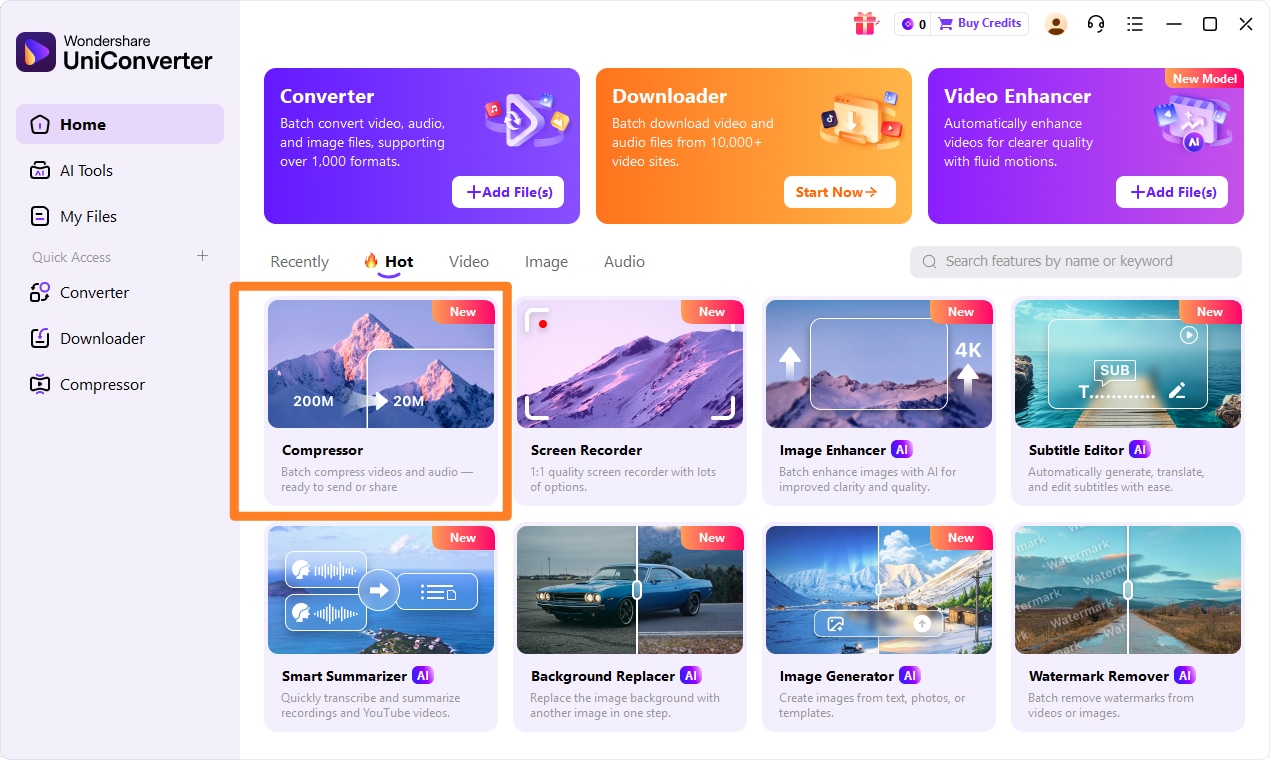
Step 1: Open UniConverter and Choose Compressor
Install UniConverter from the official website, and locate Compressor on the dashboard.
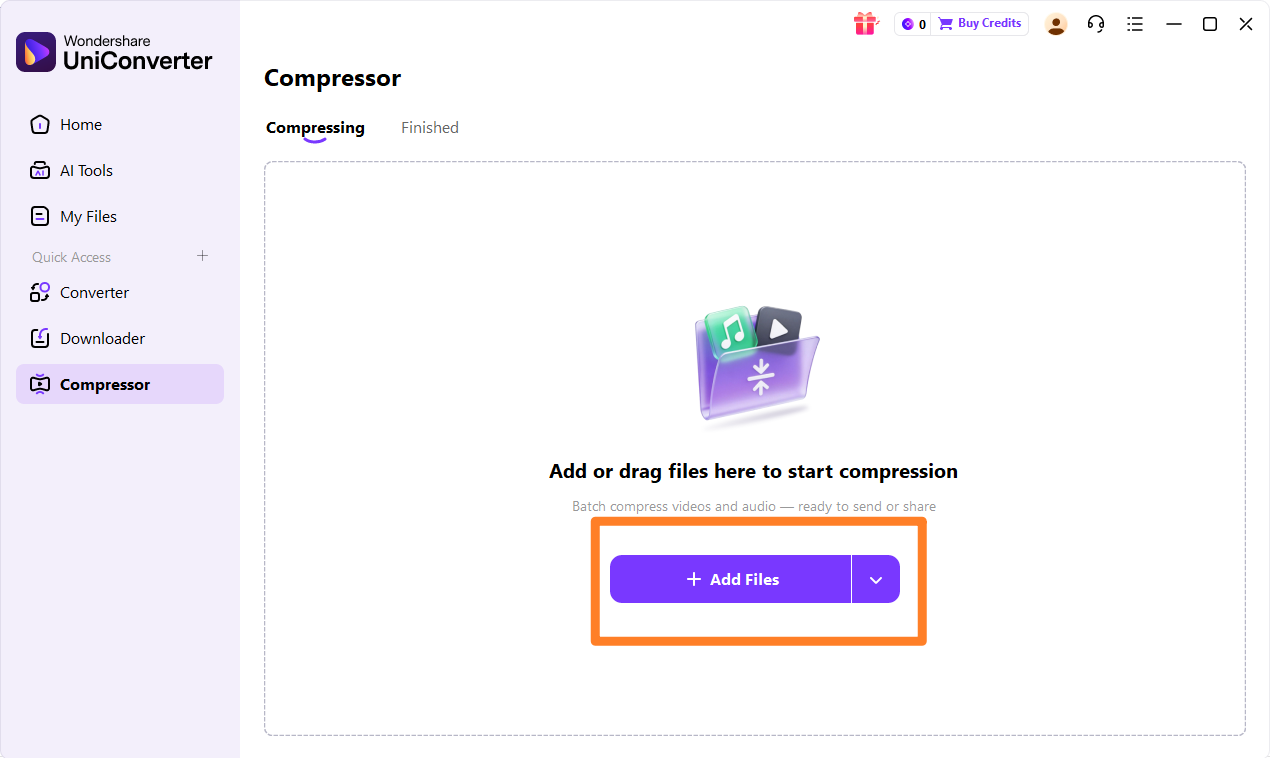
Step 2: Upload the Video, Audios or Images
Click Add Files to upload videos, audios, or images needed to be compressed.
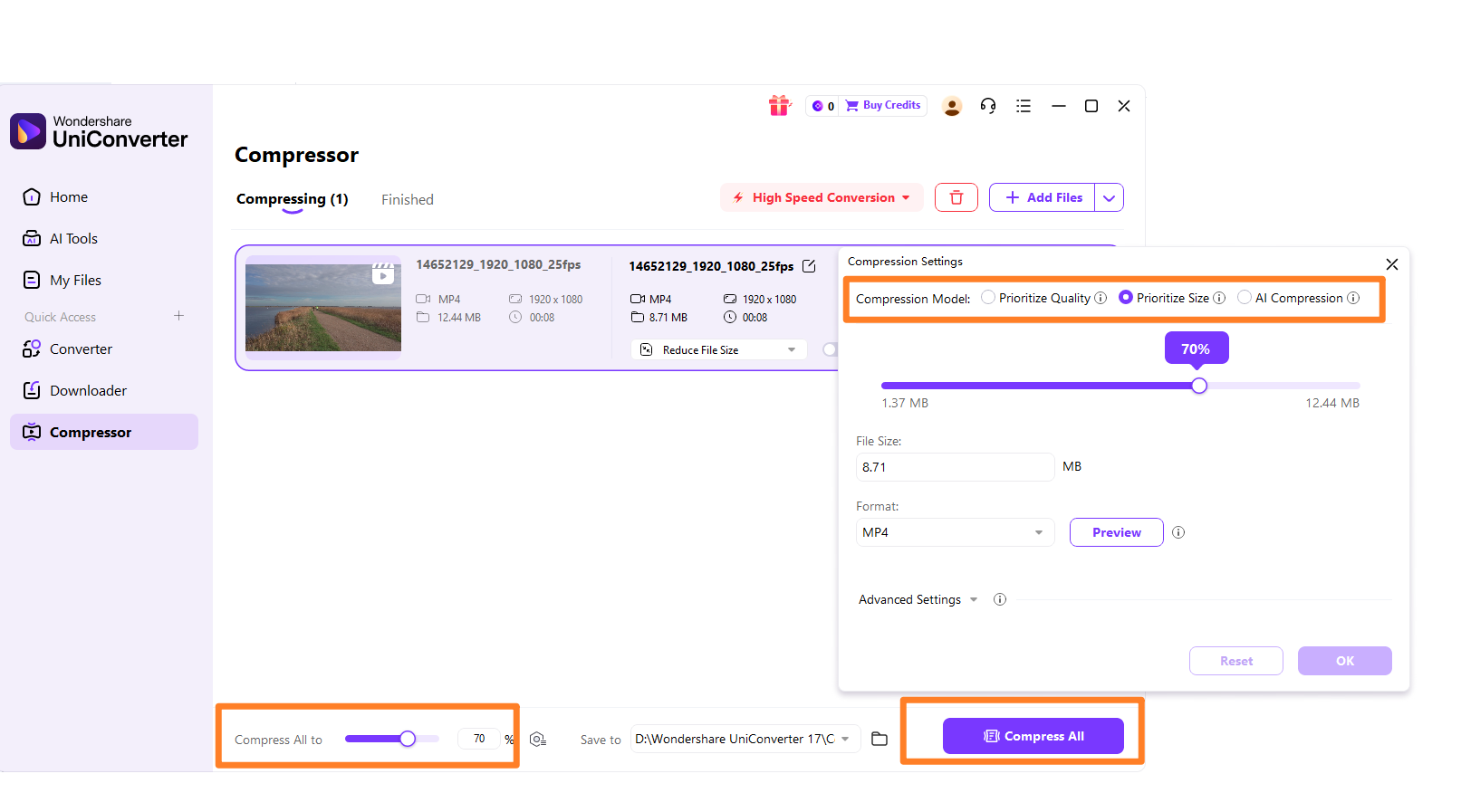
Step 3: Choose Required Parameters
Click the scroll bar to choose the ratio you need to compress files to.
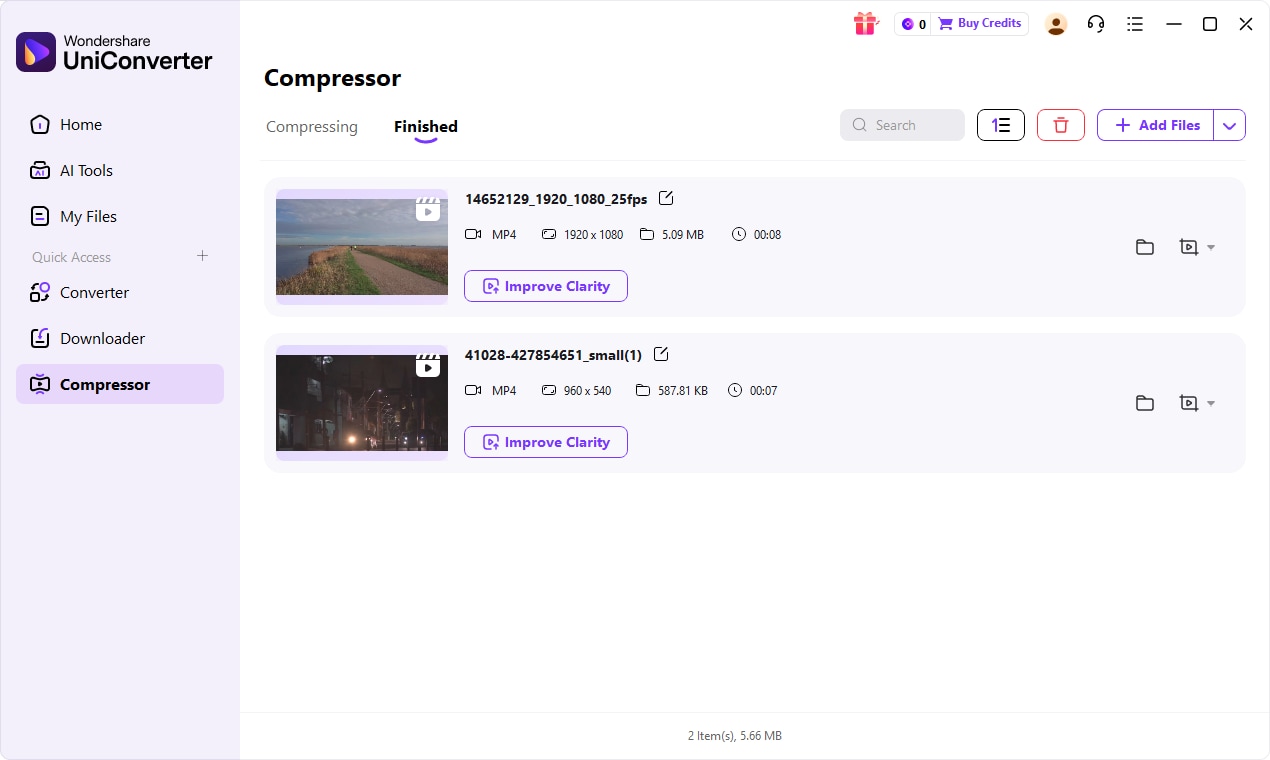
Step 4: Save the Compressed File
You can find compressed files in the 'Finished' tab.

Struggling with FFmpeg Audio Compression?
Part 7: Final Verdict and Recommendations
After extensively using and comparing FFmpeg Audio Compressor with its alternatives, my conclusion is clear: the best tool depends entirely on your needs and technical comfort level. For developers, professional audio engineers, and advanced users who demand unparalleled control, scripting capabilities, and are comfortable with a command-line interface, FFmpeg remains an unbeatable, free, and incredibly powerful solution. Its ability to fine-tune every audio parameter is simply unmatched. However, for content creators, casual users, or anyone prioritizing ease of use, a graphical user interface is often a better choice. Tools like UniConverter offer a much more intuitive experience, allowing for quick and efficient compression without the steep learning curve. The key is to balance control and convenience; choose FFmpeg if you need ultimate customization and are willing to invest the time, or opt for user-friendly alternatives if speed and simplicity are your primary concerns.
Part 8: FAQs
-
1. Is FFmpeg audio compressor free to use?
Yes, FFmpeg is completely free and open-source. You can download and use it without any cost.
-
2. Can FFmpeg compress audio without losing quality?
FFmpeg can compress audio with minimal quality loss, especially when using lossless codecs or high bitrates. However, all lossy compression methods will inherently involve some degree of quality reduction. The key is to find the right balance for your specific needs.
-
3. What is the best FFmpeg command for audio compression?
There isn't a single "best" command, as it depends on your desired output. A common command for compressing to MP3 with a good balance of quality and file size is `ffmpeg -i input.wav -b:a 192k output.mp3`. For more advanced control, you'd specify codecs, sample rates, and other filters.
-
4. How does FFmpeg compare to Audacity for audio compression?
FFmpeg offers more granular, command-line control over every aspect of compression, making it ideal for scripting and complex workflows. Audacity, on the other hand, is a GUI-based audio editor that includes compression tools, making it more user-friendly for basic editing and quick adjustments. For simple tasks, Audacity is easier; for advanced, automated tasks, FFmpeg is superior. If you need a powerful yet easy-to-use tool for both, UniConverter is a great option.
-
5. Is there a GUI for FFmpeg audio compression?
While FFmpeg itself is command-line, there are several third-party GUIs that act as front-ends for FFmpeg, making it more accessible. Examples include HandBrake (primarily for video but handles audio), XMedia Recode, and various custom scripts. UniConverter also provides a comprehensive GUI experience for audio and video compression, leveraging similar underlying technologies but with a much more intuitive interface.
