
- Corel VideoStudio Compressor: Integrated for basic compression within VideoStudio, ideal for casual users.
- Value Proposition: Convenient for existing VideoStudio users; avoids separate software for simple tasks.
- Limitations: Lacks advanced controls, can be resource-intensive, and may compromise quality for professionals.
- Comparison: Less powerful than HandBrake or Adobe Media Encoder; UniConverter offers a balanced alternative.
- Decision Factor: Choose Corel if you prioritize integration and ease for casual use; seek alternatives for control and quality.
When I'm working with video, file size is always a concern. Whether I'm sharing a family vacation video with relatives or uploading a project to a streaming platform, large files can be a real headache. That's where video compressors come in. They promise to shrink your files without sacrificing too much quality, making them easier to manage and share. Today, I'm diving deep into the Corel VideoStudio Video Compressor review, exploring its capabilities, comparing it to its rivals, and helping you decide if it's the right tool for your video compression needs. This review will cover its core features, target audience, and potential pitfalls, offering a comprehensive look at how it stacks up in the crowded market of video compression tools.
Part 1: What is Corel VideoStudio Video Compressor?
Corel VideoStudio is a well-known name in the consumer video editing software space, offering an accessible platform for creating and editing videos. The Corel VideoStudio Video Compressor isn't a standalone product but rather an integrated feature within the VideoStudio suite. It's designed to help users reduce the file size of their video projects, making them more manageable for sharing, uploading, or archiving. My goal with this review is to determine if this integrated compressor provides enough power and flexibility for everyday users, or if dedicated compression tools offer a significantly better experience. The market for video compression is vast, with many users facing common pain points.
The Landscape of Video Compression Tools
Large File Sizes: High-resolution videos, especially 4K, consume massive amounts of storage and bandwidth. Slow Upload/Download Times: Sharing uncompressed videos can be a time-consuming and frustrating experience. Compatibility Issues: Certain platforms or devices have file size limits or specific format requirements. Quality vs. Size Dilemma: The constant struggle to balance a smaller file size with acceptable video quality.
Part 2: Corel VideoStudio Video Compressor: Core Features, Pros, and Cons
The Corel VideoStudio Video Compressor is built to streamline the post-production process within the VideoStudio environment. Its core capability lies in its ability to re-encode video files into smaller sizes, supporting a range of popular formats. I've found it to be particularly useful for quickly preparing projects for online sharing or email. Its strength is definitely in its simplicity and integration, making it a natural extension of the editing workflow. However, this simplicity also means it might not offer the granular control that more advanced users often seek.
Integrated Compression: Seamlessly compress videos directly within the VideoStudio editing suite.
Format Support: Supports common output formats like MP4, AVI, WMV, and MOV.
Preset Options: Offers various quality and size presets for quick compression.
Batch Processing: Ability to compress multiple video files at once (though with limitations).
Basic Quality Adjustments: Allows for some adjustment of video bitrate and resolution.
Pros:
Intuitive Interface for Beginners: If you're already familiar with VideoStudio, using its compressor is a breeze. The options are straightforward and easy to understand.
Integrated Workflow within Video Editing Suite: The biggest advantage for me is not having to export a video and then open another application just to compress it. It saves a lot of time.
Multiple Output Formats and Presets: I appreciate the variety of presets available, which often get me close to what I need without much tweaking.
Cons:
Limited Advanced Compression Controls: For someone who wants to fine-tune every aspect of the compression, like specific codecs or advanced bitrate settings, Corel VideoStudio falls short.
Resource-Intensive Performance: I've noticed that compressing larger files can really bog down my system, especially if I'm trying to do other tasks simultaneously.
Part 3: Corel VideoStudio Video Compressor: Target Audience and Use Cases
From my experience, the Corel VideoStudio Video Compressor is primarily designed for individuals who are already using Corel VideoStudio for their editing needs and want a quick, integrated solution for file size reduction. It's not aimed at the professional who needs highly specialized compression algorithms or a standalone tool for diverse projects. If you're a casual video creator, a student, or someone who simply wants to share home videos without dealing with overly complex software, this tool will likely meet your needs.
Best Use Case: Casual Home Video Editors Seeking Integrated Solutions
I find it perfect for compressing my family vacation videos or short social media clips. Since I'm already editing in VideoStudio, it's incredibly convenient to just hit "export" and have the compression handled within the same program. It saves me the hassle of learning another piece of software and keeps my workflow smooth and simple. If you're not a tech-savvy person and just want to get the job done, this is a great option.
Limited Use Case: Professional Videographers Requiring Granular Control
However, when I'm working on a more serious project that requires specific delivery formats or maximum quality retention for client work, I wouldn't rely solely on Corel VideoStudio's compressor. It simply doesn't offer the granular control over codecs, bitrates, and other advanced settings that professionals need to achieve precise results. For those critical projects, I always turn to more specialized tools.
Part 4: Corel VideoStudio Video Compressor and Alternatives Comparison
When I look at the landscape of video compression, it's clear that the Corel VideoStudio Video Compressor occupies a specific niche. It's about convenience and integration. However, for those who need more power or flexibility, there are strong alternatives. I've put together a comparison to highlight where each tool shines.
| Feature/Criteria | Corel VideoStudio Video Compressor | HandBrake | Adobe Media Encoder | UniConverter |
| Ease of Use | High | Medium | Medium | High |
| Integration | High (within VideoStudio) | Standalone | High (within Adobe Suite) | Standalone |
| Advanced Controls | Low | High | High | Medium |
| Output Quality | Good | Excellent | Excellent | Very Good |
| Price | Included with VideoStudio | Free | Subscription | One-time/Subscription |
Key Differentiators:
Integration vs. Standalone: Corel's strength lies in its seamless integration, making it a no-brainer if you're already in VideoStudio. Competitors like HandBrake and UniConverter offer more standalone flexibility, meaning you can use them with video files from any source.
User Skill Level: Corel caters to beginners and those who prioritize ease of use. HandBrake and Adobe Media Encoder provide more options for experienced users who understand compression parameters. UniConverter strikes a good balance, offering user-friendliness with decent control.
Compression Algorithm Sophistication: Dedicated tools like HandBrake and Adobe Media Encoder often employ more advanced algorithms, leading to better quality-to-size ratios, especially for complex video content.
Part 5: Risks and Pitfalls to Consider
When I'm using any video compression tool, including the one in Corel VideoStudio, I'm always mindful of potential issues. It's not just about getting a smaller file; it's about making sure the process doesn't introduce new problems. Here are some risks and pitfalls I've encountered or considered.
Potential Loss of Video Quality
This is probably my biggest concern. While the goal is to reduce file size, I don't want my video to look pixelated or blurry. Aggressive compression settings, especially in simpler tools, can lead to noticeable degradation in image quality, loss of detail, and color banding. It's a delicate balance, and sometimes the "good enough" quality from an integrated compressor isn't truly good enough for my needs. I always recommend doing a small test compression first.
Software Performance and System Requirements
Compressing video is a computationally intensive task. If my computer isn't powerful enough, or if the software isn't optimized, the process can be incredibly slow. I've experienced Corel VideoStudio's compressor hogging my CPU and RAM, making my system unresponsive. This can be frustrating, especially when I'm on a deadline or trying to multitask. Make sure your system meets the recommended requirements for smooth operation.
Limited Customization for Specific Needs
As I mentioned earlier, the integrated compressor in Corel VideoStudio has limited advanced controls. This means if I have a very specific requirement for a video codec, bitrate, or resolution for a particular platform or client, I might not be able to achieve it. This lack of flexibility can force me to use another tool anyway, defeating the purpose of an integrated solution. It's a "one size fits most" approach, which isn't always ideal.
Subscription Model Considerations
While the compressor is included with Corel VideoStudio, the suite itself often operates on a subscription or annual upgrade model. This means I'm paying for the entire editing suite, even if my primary need is just compression. For someone who only needs a compressor occasionally, a standalone, free tool like HandBrake or a one-time purchase option might be more cost-effective in the long run. It's important to consider the overall cost of ownership.
Part 6: How to Use UniConverter to Compress Efficiently
Sometimes, I find that integrated tools like Corel VideoStudio's compressor don't quite hit the mark, especially when I need more control, better quality retention, or faster performance. If I'm dealing with issues like unstable compression results, significant quality loss, or the inability to batch process effectively, I often turn to UniConverter. It's a robust and user-friendly solution that offers a great balance of ease of use and powerful features for video, audio, and even image compression. UniConverter stands out with its ad-free experience, extensive format support, GPU acceleration for speed, stable and near-lossless compression, and excellent batch processing capabilities, making it an ultimate all-in-one solution.
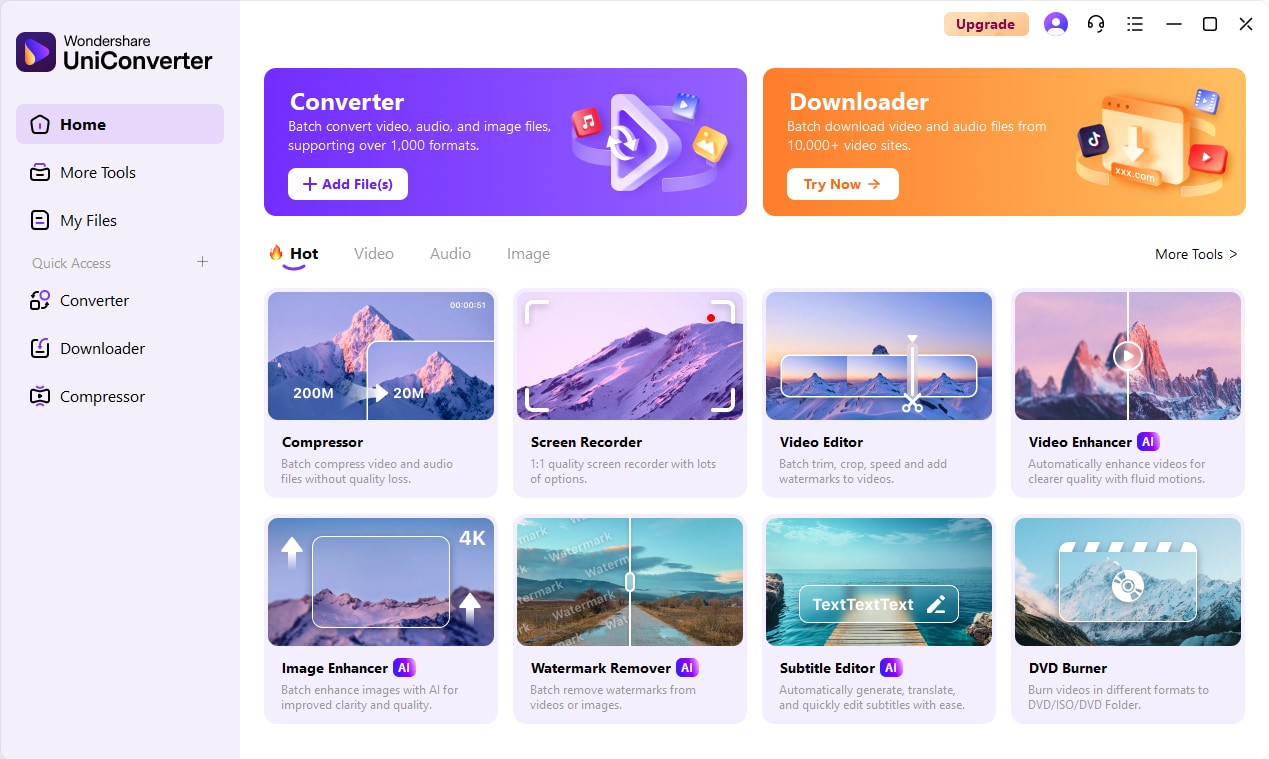
Step 1: Open UniConverter and Choose Compressor
First, I launch UniConverter and navigate to the "Video Compressor" tool from the main interface. It's clearly labeled and easy to find.
Step 2: Upload the Video, Audios or Images
Next, I simply drag and drop my video files into the program, or I can use the "Add Files" button to browse and select them. UniConverter supports a wide range of formats, so I don't usually have to worry about compatibility.

Step 3: Choose Required Parameters
Once my files are loaded, I can select my desired output format, resolution, and quality settings. UniConverter offers various presets, but I can also manually adjust the bitrate and other parameters for more precise control over the file size and quality.

Step 4: Save the Compressed File
After configuring the settings, I click the "Compress" button. UniConverter works quickly, and once it's done, I can find my compressed files in the designated output folder.

Part 7: Conclusion
After thoroughly exploring the Corel VideoStudio Video Compressor review, my takeaway is that it serves a specific segment of the market very well. For those who are already invested in the Corel VideoStudio ecosystem and need a quick, integrated solution for basic video compression, it's a convenient and straightforward tool. Its ease of use and seamless workflow within the editing suite are undeniable advantages for beginners and casual users. However, its limitations in advanced controls, potential for quality loss with aggressive settings, and resource-intensive performance mean it's not a one-size-fits-all solution. Advanced users and professionals who require granular control over compression parameters, superior quality retention, or faster processing will likely find themselves needing more specialized, standalone tools. For a balanced approach that offers both user-friendliness and powerful features, UniConverter emerges as a strong middle ground, providing a robust alternative for efficient and high-quality video compression.
Part 8: FAQs
1. Does Corel VideoStudio Video Compressor support 4K video? Yes, Corel VideoStudio can handle 4K video projects, and its integrated compressor will allow you to compress 4K footage. However, be mindful that compressing 4K can be very resource-intensive and may take a significant amount of time, potentially leading to noticeable quality degradation if not handled carefully.
2. Can I batch compress videos with Corel VideoStudio? While Corel VideoStudio allows you to export multiple projects, its batch compression capabilities are somewhat limited compared to dedicated tools. You can queue up multiple projects for export, but the level of control over individual compression settings for each file in a batch might not be as granular as you'd find in standalone batch compressors.
3. How does Corel VideoStudio's compression compare to online tools? Corel VideoStudio generally offers better control and potentially higher quality output than most free online compression tools. Online tools are convenient for small, quick compressions but often come with file size limits, slower processing, and less control over quality. For anything beyond a very small file, a desktop application like Corel VideoStudio or UniConverter will be more reliable.
4. Is Corel VideoStudio Video Compressor included in all VideoStudio versions? Yes, the video compression functionality is an integral part of the Corel VideoStudio editing suite and is included across its various versions (e.g., Pro, Ultimate). It's not a separate add-on you need to purchase.
5. What are the minimum system requirements for effective compression in Corel VideoStudio? For effective video compression, especially with higher resolutions like 4K, Corel VideoStudio recommends at least an Intel Core i3 or AMD A4 processor (Intel Core i7 or AMD Ryzen 7 for 4K/multi-camera), 8 GB of RAM (16 GB recommended), and a graphics card with at least 256 MB VRAM (1 GB+ recommended). A fast SSD for your project files and scratch disk will also significantly improve performance.
