
- Convertio Overview: Learn what Convertio Video Compressor is and its role in managing large video files.
- Features & Limitations: Discover Convertio's core features, user-friendliness, and its pros and cons, including file size limits.
- Ideal Use Cases: Understand when Convertio shines (quick shares) and when it falls short (professional projects).
- Comparative Analysis: See how Convertio stacks up against HandBrake, VEED.IO, and UniConverter for informed decisions.
- Online Compressor Risks: Be aware of data privacy, quality loss, and internet dependency when using online tools.
- UniConverter Solution: Explore UniConverter for stable, high-quality, and efficient video compression, bypassing online tool drawbacks.
In this article
- Part 1: What is Convertio Video Compressor?
- Part 2: Convertio Video Compressor: Core Features, Pros, and Cons
- Part 3: Who Benefits from Convertio Video Compressor? Use Cases Explored
- Part 4: Convertio Video Compressor vs. Competitors: A Comparative Analysis
- Part 5: Risks and Pitfalls to Consider When Using Online Video Compressors
- Part 6: How to Use UniConverter for Efficient Video Compression
- Part 7: Conclusion
- Part 8: FAQs
Convertio Video Compressor: A Comprehensive Review and Comparison
When it comes to managing digital media, video compression is a task many of us face regularly. Whether you're a content creator, a student, or just someone who loves sharing videos with friends and family, dealing with large video files can be a real headache. They eat up storage, take ages to upload, and can be a pain to share. This is where online video compressors like Convertio Video Compressor come into play, promising to shrink your files without significant quality loss. In this Convertio Video Compressor review, I'll dive deep into its features, compare it with other popular tools, and help you decide if it's the right solution for your video compression needs.
Part 1: What is Convertio Video Compressor?
Convertio Video Compressor is an online tool designed to reduce the file size of your video clips. It's part of the broader Convertio suite, which offers various file conversion services. My main goal with this review is to explore its effectiveness, ease of use, and overall value, especially when stacked against its competitors.
The Landscape of Online Video Compression Tools
* The Need for Speed and Efficiency: In today's fast-paced digital world, I often need to compress videos quickly for social media, email, or cloud storage, without the hassle of downloading and installing software.
* Balancing Quality and Size: My biggest concern is always finding that sweet spot where the video file is significantly smaller, but the quality remains acceptable for its intended purpose.
* Accessibility and Convenience: For many, the appeal of online tools lies in their accessibility from any device with an internet connection, eliminating the need for specific operating systems or powerful hardware.
Part 2: Convertio Video Compressor: Core Features, Pros, and Cons
Convertio Video Compressor offers a straightforward approach to shrinking video files. Its core strength lies in its simplicity and accessibility.
* Extensive Format Support: It handles a wide array of input and output video formats, making it versatile for different needs.
* Customizable Compression Settings: You can adjust parameters like resolution, quality, and bitrate to control the compression level.
* Cloud-Based Processing: All compression happens on their servers, freeing up my local machine's resources.
* Direct Download: Once compressed, I can download my file directly from the browser.
* No Software Installation: I don't need to install anything on my computer, which is a huge plus for convenience.
Pros:
* Wide range of supported formats for input and output: I've rarely encountered a video format it couldn't handle.
* User-friendly interface for quick compression: The process is intuitive; I just upload, choose settings, and download.
* Cloud-based processing, no software installation required: This is incredibly convenient when I'm on the go or using a public computer.
Cons:
* File size limitations for free users: For larger projects, I quickly hit the free tier's limits.
* Reliance on internet connection for operation: If my internet is slow or unstable, the process can be frustratingly long or fail.
Part 3: Who Benefits from Convertio Video Compressor? Use Cases Explored
Convertio Video Compressor shines in specific scenarios, but it also has its limitations for more demanding tasks.
Best Use Case: Quick, On-the-Go Compression for Social Media Sharing
When I need to quickly compress a short video clip from my phone or camera to upload to Instagram, TikTok, or send via WhatsApp, Convertio is incredibly handy. I can access it from any browser, upload my video, and get a shareable file in minutes. For example, if I've just recorded a short event and want to share it with friends without waiting for a huge file to upload, Convertio does the job efficiently. It's perfect for casual users who prioritize speed and convenience over granular control or professional-grade output.
Limited Use Case: Large-Scale, Professional Video Production Workflows
For my professional video editing projects, where I'm dealing with gigabytes of footage, maintaining high fidelity, and needing batch processing capabilities, Convertio falls short. The file size limits for free users and the potential for slower processing with larger files make it impractical. I also need more advanced control over codecs, bitrates, and resolution than Convertio typically offers. For instance, compressing a 4K video project with multiple clips would be a nightmare with an online tool like this due to upload times and potential quality degradation.
Part 4: Convertio Video Compressor vs. Competitors: A Comparative Analysis
To truly understand Convertio's position, I've compared it with some other popular tools in the market.
| Feature/Tool | Convertio Video Compressor | HandBrake | VEED.IO | UniConverter |
| Max File Size (Free) | 100 MB | Unlimited | 250 MB | Unlimited |
| Output Quality Control | Basic | Advanced | Moderate | Advanced |
| Batch Processing | No | Yes | Yes | Yes |
| Offline Capability | No | Yes | No | Yes |
| Pricing Model | Freemium | Free | Freemium | Subscription/One-time |
Key Differentiators and Their Impact
Convertio is great for quick, small tasks, but its free tier limitations are noticeable. HandBrake, being a free desktop app, offers extensive control and no file size limits, but it requires installation and can be intimidating for beginners. VEED.IO is a good online alternative with a slightly higher free file size limit and more editing features, but still cloud-dependent. UniConverter, on the other hand, provides a robust desktop solution with advanced features, batch processing, and offline capability, making it ideal for more serious users who need reliability and control.
Part 5: Risks and Pitfalls to Consider When Using Online Video Compressors
While online video compressors offer convenience, I've learned that they come with their own set of risks, especially when using free versions.
Data Privacy and Security Concerns
When I upload my videos to an online service, I'm essentially entrusting my data to a third party. I always worry about how these services handle my personal or sensitive content. Are they storing my videos? For how long? Who has access to them? It's crucial to read their privacy policies, but often, the details are vague, leaving me feeling uneasy about uploading anything truly private.
Unwanted Advertisements and Pop-ups
Many free online tools rely on advertising to sustain their services. This often translates into a barrage of intrusive ads, pop-ups, and redirects that disrupt my workflow. I've encountered instances where clicking on a download button leads to an ad page instead of the compressed file, making the user experience frustrating and time-consuming.
Potential Loss of Video Quality
While the goal is to reduce file size, aggressive compression, especially with default settings on free online tools, can lead to a noticeable drop in video quality. I've seen videos come out pixelated, blurry, or with artifacts, making them unsuitable for their intended purpose. Without fine-grained control over compression parameters, it's a gamble whether the output will meet my expectations.
Dependence on Internet Speed and Server Load
Since these tools are cloud-based, their performance is directly tied to my internet connection speed and the server load of the service provider. If my internet is slow, or if the server is experiencing high traffic, the compression process can take an unacceptably long time, or even time out. This dependency makes them unreliable for urgent tasks or when I'm in areas with poor connectivity.
Hidden Costs and Subscription Traps
Many "free" online compressors are actually freemium models. While they offer basic functionality for free, they often impose strict limitations on file size, processing speed, or features. To unlock full capabilities, I'm often prompted to upgrade to a paid subscription. Sometimes, these subscription models are not clearly advertised, leading to unexpected costs if I'm not careful.
Part 6: How to Use UniConverter for Efficient Video Compression
When online tools aren’t reliable enough—especially when compression results are inconsistent, quality drops too much, or batch processing isn’t available—I usually turn to UniConverter as a more capable desktop alternative. It works especially well as a dedicated video compressor, offering a smoother, ad-free workflow with broad format support and more stable performance than most browser-based services. I also like that it can help compress videos without quality loss as much as possible, while GPU acceleration makes processing faster and more efficient. For larger tasks, features like 2-pass encoding compression can also help improve output quality, making it a practical all-in-one solution for everyday video compression needs
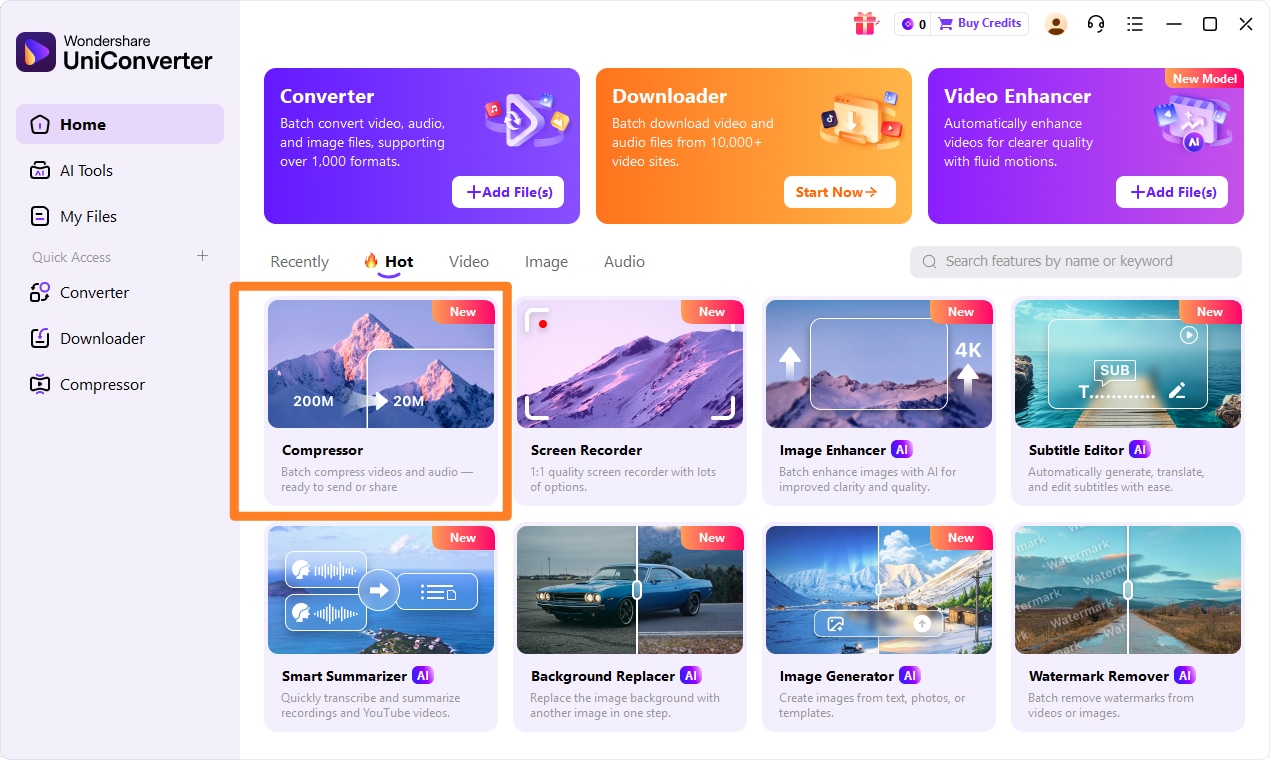
Step 1: Open UniConverter and Choose Compressor
First, I launch UniConverter on my computer. On the main interface, I navigate to the "Video Compressor" tab.
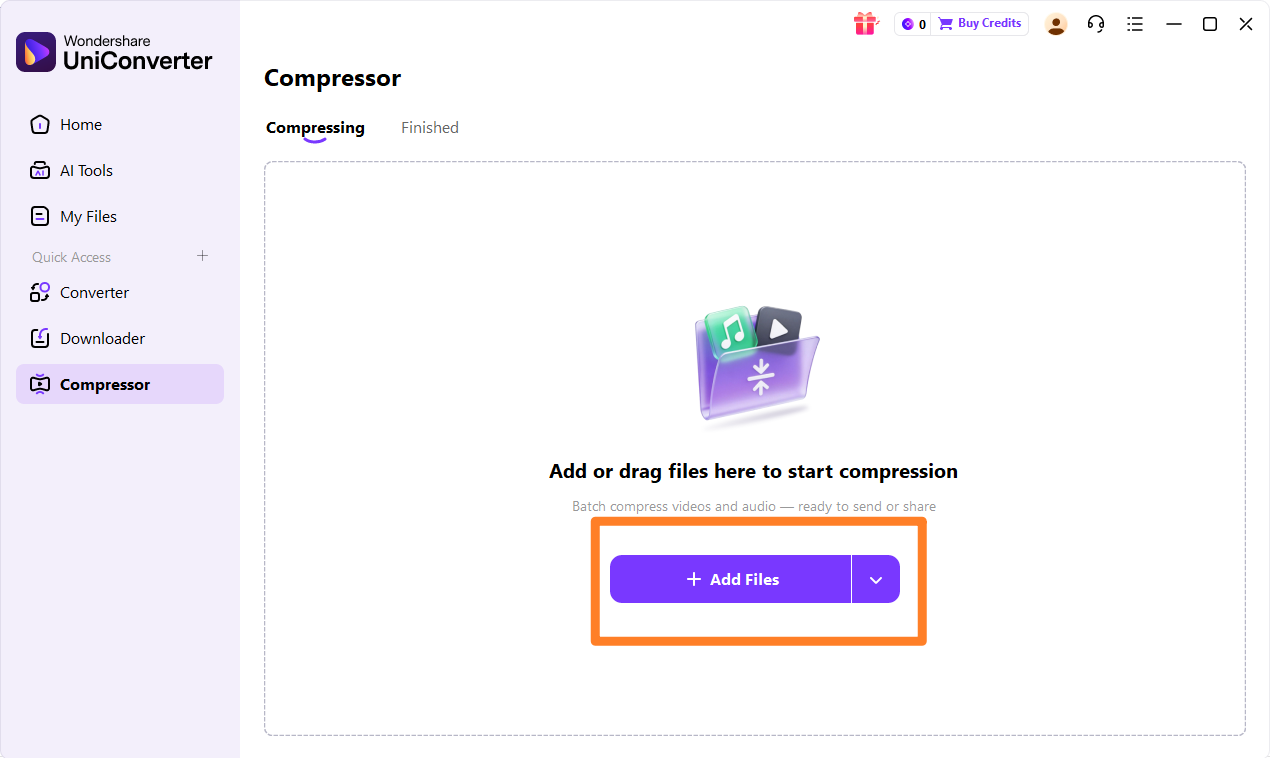
Step 2: Upload the Video, Audios or Images
Next, I click the "Add Files" button or simply drag and drop the video files I want to compress into the program window.
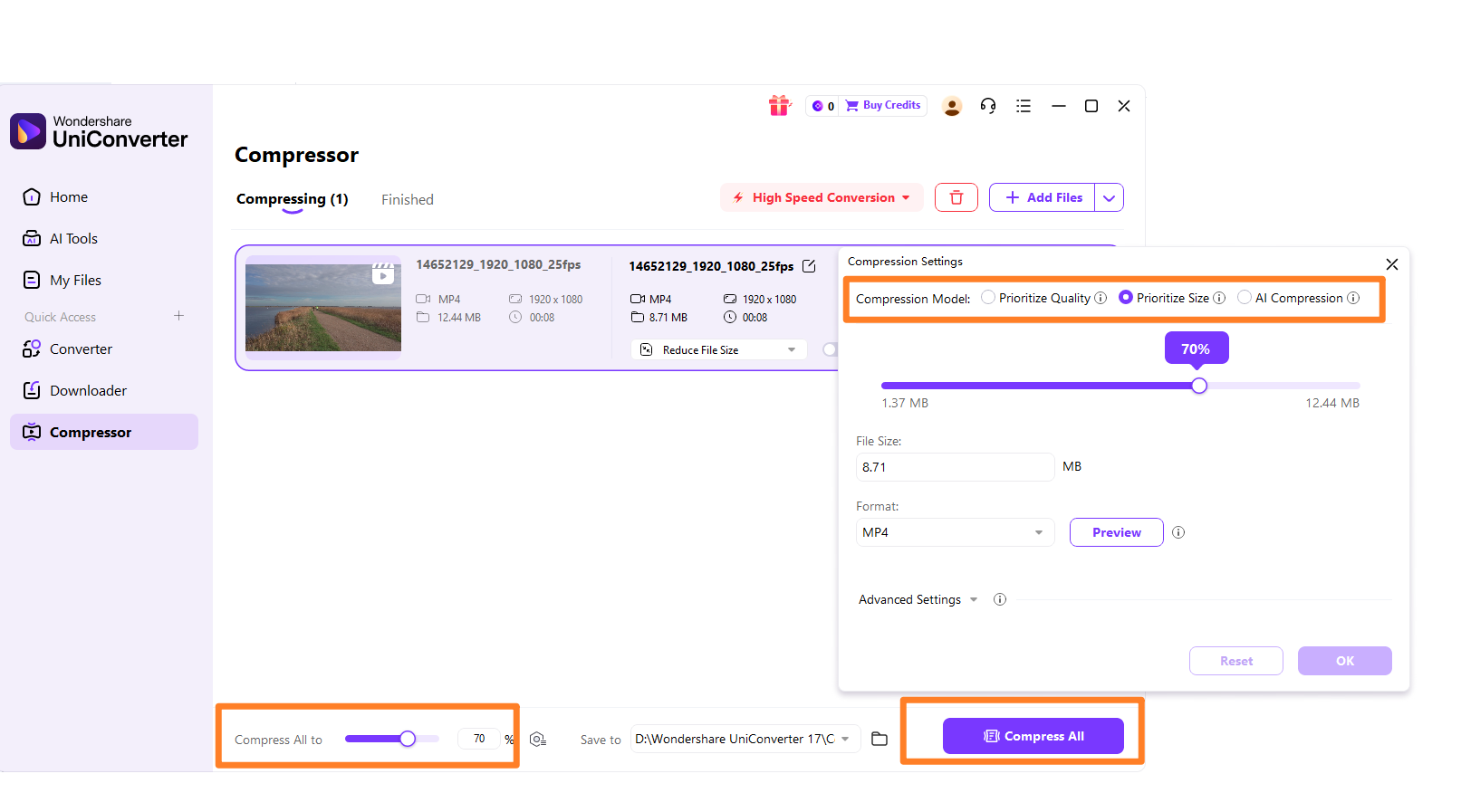
Step 3: Choose Required Parameters
Now, I can adjust the compression settings. I can choose the output format, resolution, bitrate, and quality. UniConverter provides a preview function so I can see the estimated file size and quality before compressing.
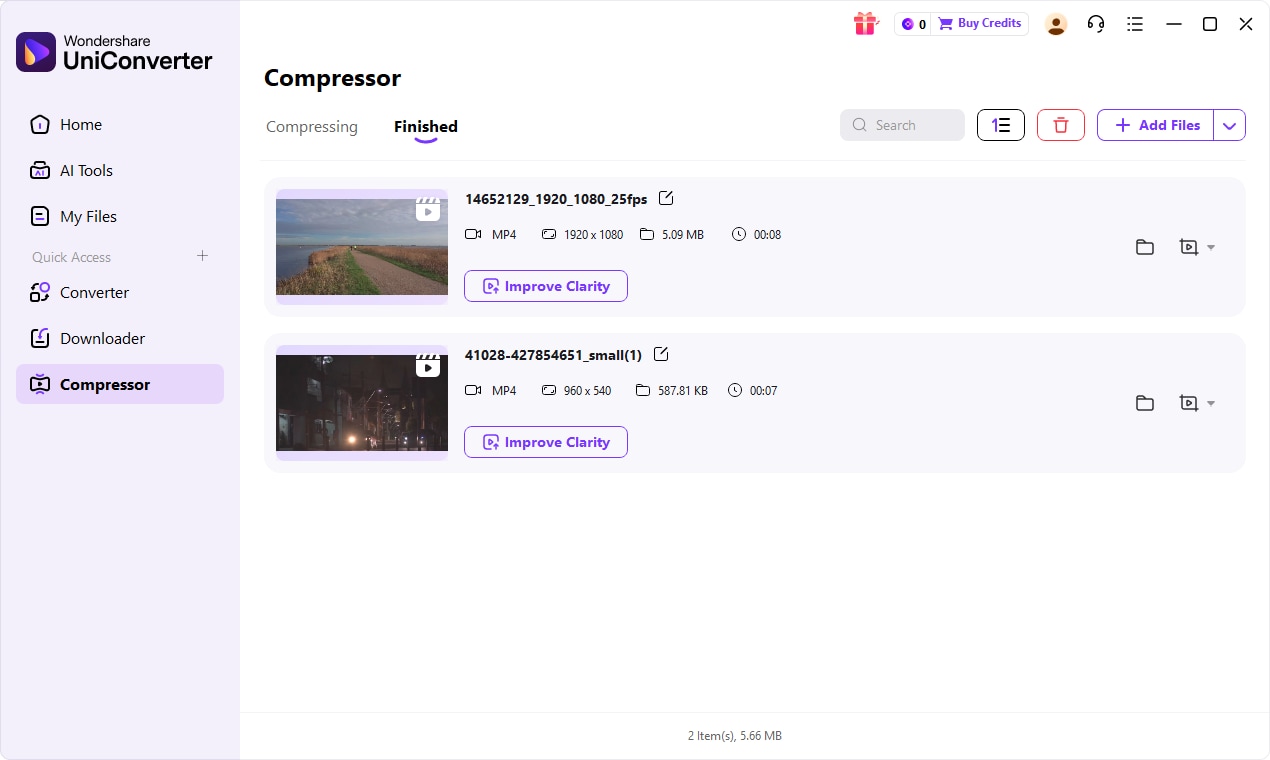
Step 4: Start the Compression Process
Once I'm satisfied with the settings, I click the "Compress" button. UniConverter will then quickly process my videos, often leveraging GPU acceleration for speed. After compression, I can find my reduced files in the designated output folder.

Seeking a Better Convertio Video Compressor Alternative?
Part 7: Conclusion
In conclusion, my Convertio Video Compressor review reveals it to be a highly convenient tool for quick, small-scale video compression tasks. Its ease of use and cloud-based nature make it ideal for casual users who need to shrink files for social media or email on the fly. However, for professionals or anyone dealing with large files, batch processing, or requiring precise control over output quality, Convertio's limitations, particularly its file size caps and reliance on internet speed, become significant drawbacks. For these more demanding scenarios, desktop solutions like UniConverter offer superior performance, control, and reliability, ensuring data privacy and consistent quality without the hassle of ads or hidden costs. Ultimately, the best tool depends on your specific needs: convenience for quick shares versus robust functionality for serious projects.
Part 8: FAQs
-
1. Is Convertio Video Compressor safe to use?
Convertio generally employs standard security measures, but I always advise caution regarding data privacy when uploading sensitive content to any online service. It's wise to avoid uploading highly confidential videos.
-
2. Does Convertio Video Compressor reduce video quality significantly?
The degree of quality reduction depends on the compression settings I choose. More aggressive compression will lead to a more noticeable quality drop. For best results, I try to find a balance between file size and visual fidelity.
-
3. Are there any file size limits for Convertio Video Compressor?
Yes, as a free user, I typically encounter file size limitations. Premium subscriptions remove or significantly increase these limits, which is something to consider if I have larger files.
-
4. Can I compress multiple videos at once with Convertio Video Compressor?
Convertio primarily focuses on single-file compression. For batch processing, I find that dedicated desktop software like UniConverter is much more suitable and efficient.
-
5. What are the main advantages of using a desktop video compressor over an online one?
Desktop compressors like UniConverter offer greater control over settings, often support batch processing, work offline, and typically have higher performance for large files without internet dependency. They also generally provide better data privacy and an ad-free experience.
