
- Clideo's Value: Offers quick, browser-based video compression for casual users and social media sharing.
- Core Features: Simple interface, broad format support, and cloud processing for convenience.
- Limitations: Free version watermarks, lacks advanced settings, and unsuitable for professional quality needs.
- Desktop Advantage: UniConverter provides offline power, granular control, batch processing, and no watermarks for serious users.
- Privacy Risk: Online tools like Clideo involve uploading data to third-party servers, raising privacy concerns.
- Decision Factor: Choose Clideo for quick, non-critical tasks; UniConverter for quality, control, and privacy.
In this article
- Part 1: What is Clideo Video Compressor?
- Part 2: Clideo Video Compressor: Core Features, Pros & Cons
- Part 3: Clideo Video Compressor: Ideal Users & Use Cases
- Part 4: Clideo Video Compressor & Competitors: A Head-to-Head Comparison
- Part 5: Risks & Pitfalls to Consider
- Part 6: How to Use UniConverter to Compress Efficiently
- Part 7: Conclusion
- Part 8: FAQs
Clideo Video Compressor Review: A Scenario-Based Comparison
When you're constantly sharing videos online, whether for social media, work presentations, or just with friends, you quickly realize that file sizes can be a huge headache. Large video files eat up storage, take ages to upload, and can be a pain for recipients to download. This is where online video compressors like Clideo Video Compressor review come in. They promise a quick fix to shrink your videos without needing any software installation. In this comprehensive review, I'll dive deep into Clideo's capabilities, compare it with its competitors, and help you decide if it's the right tool for your specific needs. I'll explore its features, pros, cons, and ideal use cases, ensuring you have all the information to make an informed decision.
Part 1: What is Clideo Video Compressor?
Clideo Video Compressor is an online tool designed to reduce the file size of your video clips directly from your web browser. It's part of a larger suite of online video editing tools offered by Clideo, aiming to provide quick and accessible solutions for common video tasks. The core idea behind Clideo is convenience – you don't need to download any software, making it appealing for users who need a fast, one-off compression without cluttering their device. My goal in this review is to determine if this convenience comes at the cost of quality or control, and whether it truly stands out in a crowded market of online and desktop compression tools.
The Landscape of Online Video Compression
The need for efficient video compression has grown exponentially with the rise of user-generated content and high-definition recording.
* Social media platforms often have strict file size limits, making compression essential for sharing.
* Email attachments and messaging apps also struggle with large video files, hindering quick communication.
* Storage space, both local and cloud-based, can quickly fill up with uncompressed video, leading to additional costs or slower performance.
* Slow internet connections make downloading and uploading large files a frustrating experience, highlighting the importance of smaller file sizes.
Part 2: Clideo Video Compressor: Core Features, Pros & Cons
Clideo Video Compressor offers a straightforward approach to reducing video file size. Its primary capability revolves around taking an uploaded video and processing it to a smaller size, making it more manageable for sharing and storage. It focuses on simplicity rather than offering a myriad of complex settings.
Core Features:
* Direct Browser Upload: You can upload videos directly from your computer, Google Drive, or Dropbox.
* Automatic Compression: The tool automatically applies compression algorithms to reduce file size.
* Preview Functionality: Before downloading, you can preview the compressed video to check the quality.
* Format Support: It claims to support a wide array of video formats, including MP4, MOV, WMV, AVI, and more.
* Cloud-Based Processing: All compression happens on Clideo's servers, freeing up your local machine's resources.
Pros:
* Intuitive Web-Based Interface for Quick Compression: The user interface is incredibly clean and easy to navigate, even for first-time users.
* Supports a Wide Range of Video Formats: I've tested it with various formats, and it generally handles them well without conversion issues.
* No Software Installation Required: This is a huge plus for me, as I often need to compress videos on different computers without admin rights.
Cons:
* Limited Advanced Compression Settings for Granular Control: If you're looking to tweak bitrate, resolution, or codecs, you'll be disappointed.
* Watermark on Free Version Outputs: The most significant drawback for me is the prominent Clideo watermark on all compressed videos in the free tier.
Part 3: Clideo Video Compressor: Ideal Users & Use Cases
Clideo Video Compressor is definitely not a one-size-fits-all solution, but it shines in specific scenarios for particular types of users. Understanding its strengths and limitations helps in determining if it's the right tool for your needs.
Best Use Case: Quick, On-the-Go Compression for Social Media Sharing
If you're like me and often need to quickly shrink a video to upload to Instagram, TikTok, or send via WhatsApp, Clideo is incredibly convenient. Imagine you're at an event, you've just recorded a short clip, and you want to share it instantly without waiting for a large file to upload. You can simply open Clideo in your browser, upload the video, compress it, and download the smaller version in minutes. The ease of access and speed are its biggest assets here. I've used it countless times when I'm away from my main workstation and just need a fast solution.
Limited Use Case: Professional Video Editing Workflows Requiring High Fidelity
On the other hand, if you're a professional video editor, a content creator who prioritizes pristine quality, or someone working on a project with strict visual standards, Clideo will fall short. For instance, if I'm compressing footage for a client's commercial or a high-quality YouTube production, I need granular control over every aspect of the compression process – bitrate, resolution, specific codecs, and multi-pass encoding. Clideo's automatic compression, while convenient, doesn't offer this level of precision, and the potential for quality degradation (especially with the watermark in the free version) makes it unsuitable for professional-grade work. I wouldn't trust it with my final deliverables.
Part 4: Clideo Video Compressor & Competitors: A Head-to-Head Comparison
When evaluating Clideo Video Compressor, it's crucial to see how it stacks up against other popular tools in the market. I've chosen two prominent alternatives: HandBrake, a powerful desktop application, and Online Video Converter, another web-based option, to provide a comprehensive comparison.
| Feature/Tool | Clideo Video Compressor | HandBrake | Online Video Converter | UniConverter |
| Ease of Use | Very High | Moderate | High | Very High |
| Advanced Settings | Low | Very High | Moderate | High |
| Output Quality (Free) | Good (with watermark) | Excellent | Good | Excellent |
| Offline Capability | No | Yes | No | Yes |
| Price | Free (with limitations), Subscription | Free | Free (with limitations), Subscription | Free Trial, Subscription |
| Processing Speed | Moderate | Fast (CPU/GPU dependent) | Moderate | Very Fast (GPU accelerated) |
| Batch Processing | No (paid) | Yes | No | Yes |
| Security/Privacy | Moderate (cloud upload) | High (local processing) | Moderate (cloud upload) | High (local processing) |
Key Differentiators: Online Convenience vs. Desktop Power
Clideo's main advantage is its online convenience. You can access it from any device with an internet connection, making it perfect for quick, spontaneous compression tasks. However, this convenience comes with trade-offs. HandBrake, being a desktop application, offers unparalleled control over compression settings, allowing for highly optimized output quality and file size. It's the go-to for serious users who need to fine-tune every parameter. Online Video Converter is similar to Clideo in its web-based approach but often has fewer features and can be bogged down by ads. UniConverter, on the other hand, bridges the gap, offering desktop power with a user-friendly interface, robust features like GPU acceleration, and batch processing, making it a strong contender for those who need both efficiency and quality without the online limitations or the steep learning curve of HandBrake. For me, the choice often comes down to whether I need a quick fix or a powerful, reliable tool for ongoing projects.
Part 5: Risks & Pitfalls to Consider
While the allure of free and convenient online tools like Clideo Video Compressor is strong, it's important to be aware of the potential risks and pitfalls that come with using them, especially for sensitive or important video content. I've encountered several issues that users should consider before uploading their files.
Data Privacy Concerns with Online Uploads
When you upload a video to an online compressor, you're essentially entrusting your data to a third-party server. For personal or confidential videos, this can be a significant privacy risk. I always question who has access to my uploaded files, how long they are stored, and what security measures are in place. While Clideo states it deletes files after a certain period, the initial upload and processing still involve your data leaving your control.
Potential for Quality Degradation on Aggressive Compression
Online compressors often use automated algorithms that prioritize file size reduction. This can lead to noticeable quality loss, especially if the original video is already compressed or if the tool applies aggressive settings. I've found that details can become blurry, colors can shift, and artifacts can appear, making the compressed video unsuitable for anything beyond casual sharing. Without advanced settings, you have no control over this trade-off.
Annoying Ads and Upsells on Free Tiers
Free online tools often rely on advertising and premium subscriptions to sustain themselves. Clideo is no exception. While using the free version, I frequently encounter pop-up ads, banners, and persistent prompts to upgrade to a paid plan to remove watermarks or unlock more features. This can be disruptive and detract from the user experience, turning a quick task into a frustrating one.
Dependence on Internet Connection for Functionality
Being a purely online tool, Clideo Video Compressor is entirely dependent on your internet connection. If your connection is slow, unstable, or non-existent, you simply cannot use it. This limitation can be a major inconvenience, especially if you're working in an area with poor connectivity or if you have large files that would take a long time to upload and download.
Watermarks and Feature Limitations on Free Versions
As mentioned, the free version of Clideo adds a watermark to your compressed videos. This is a common tactic to encourage users to subscribe. However, it makes the free output unusable for any professional or semi-professional purpose. Additionally, free tiers often impose limitations on file size, processing speed, or the number of compressions you can perform, pushing you towards a paid subscription for full functionality.
Part 6: How to Use UniConverter to Compress Efficiently
Online tools can be limiting, especially when you need batch compression, more consistent results, or better control over quality. In those situations, UniConverter is a strong desktop alternative that offers a more dependable way to manage media files. It works especially well as a dedicated video compressor, helping users avoid many of the usual drawbacks of browser-based services, such as ads, watermarks, or internet-related limitations. I also like that it can help compress videos without quality loss as much as possible, while GPU acceleration improves speed and overall efficiency. Since it also supports audio compression and image compression, it works well as a practical all-in-one solution for different media compression needs.
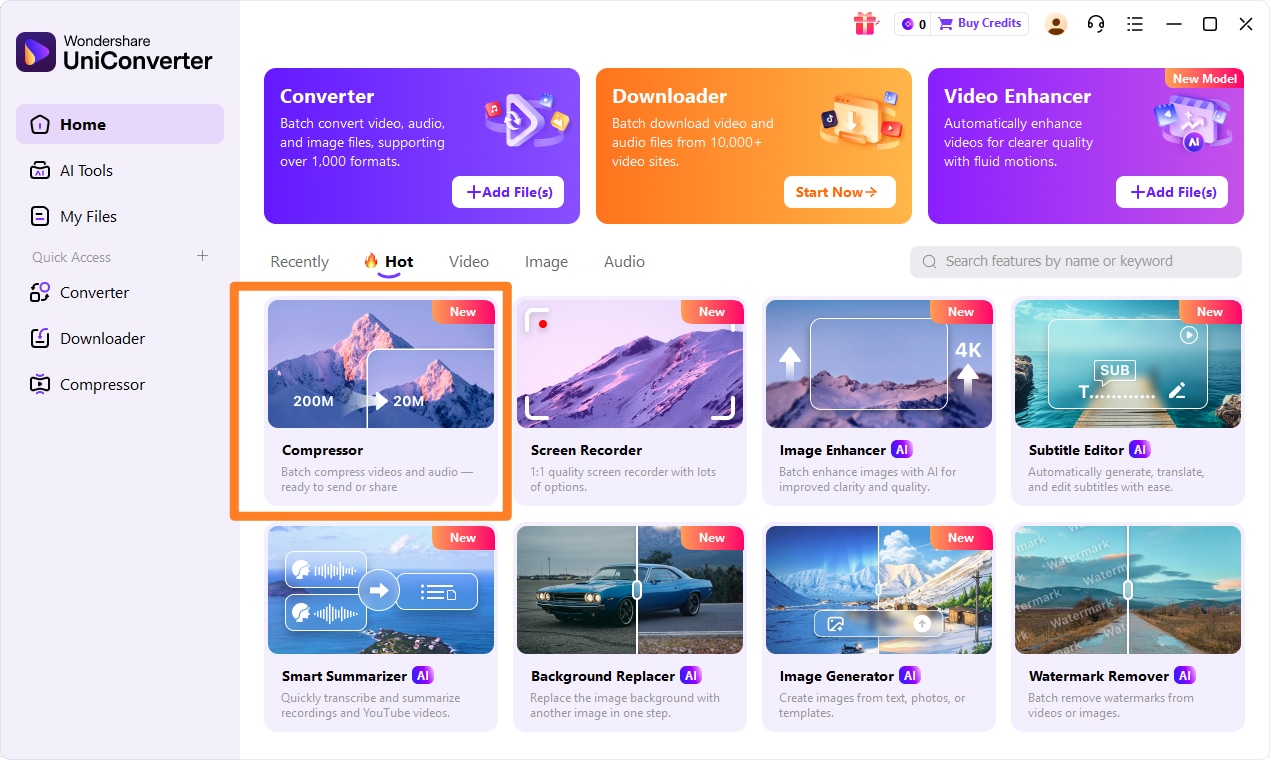
Step 1: Open UniConverter and Choose Compressor
Launch UniConverter on your computer. From the main interface, navigate to the "Compressor" tab. This is where all your compression tasks will be managed.
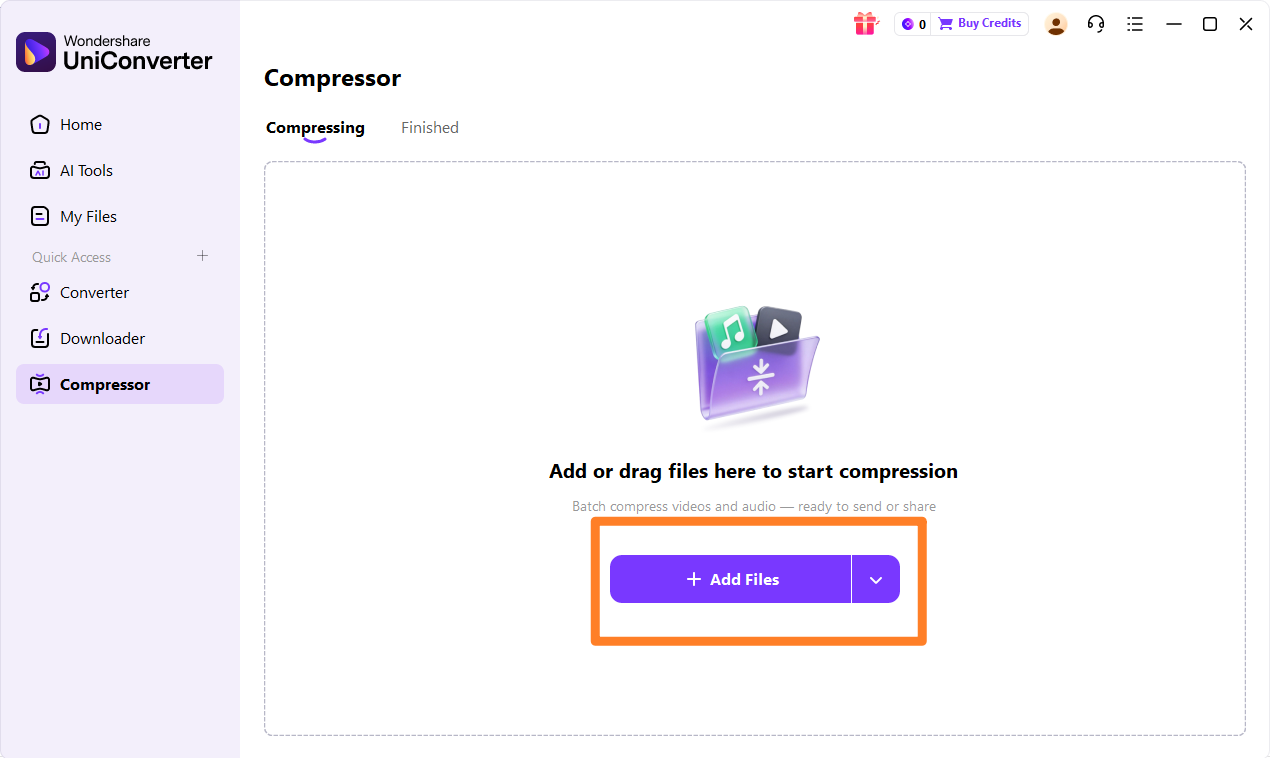
Step 2: Upload the Video, Audios or Images
Click on the "Add Files" button or simply drag and drop your video, audio, or image files into the UniConverter window. You can add multiple files for batch compression.
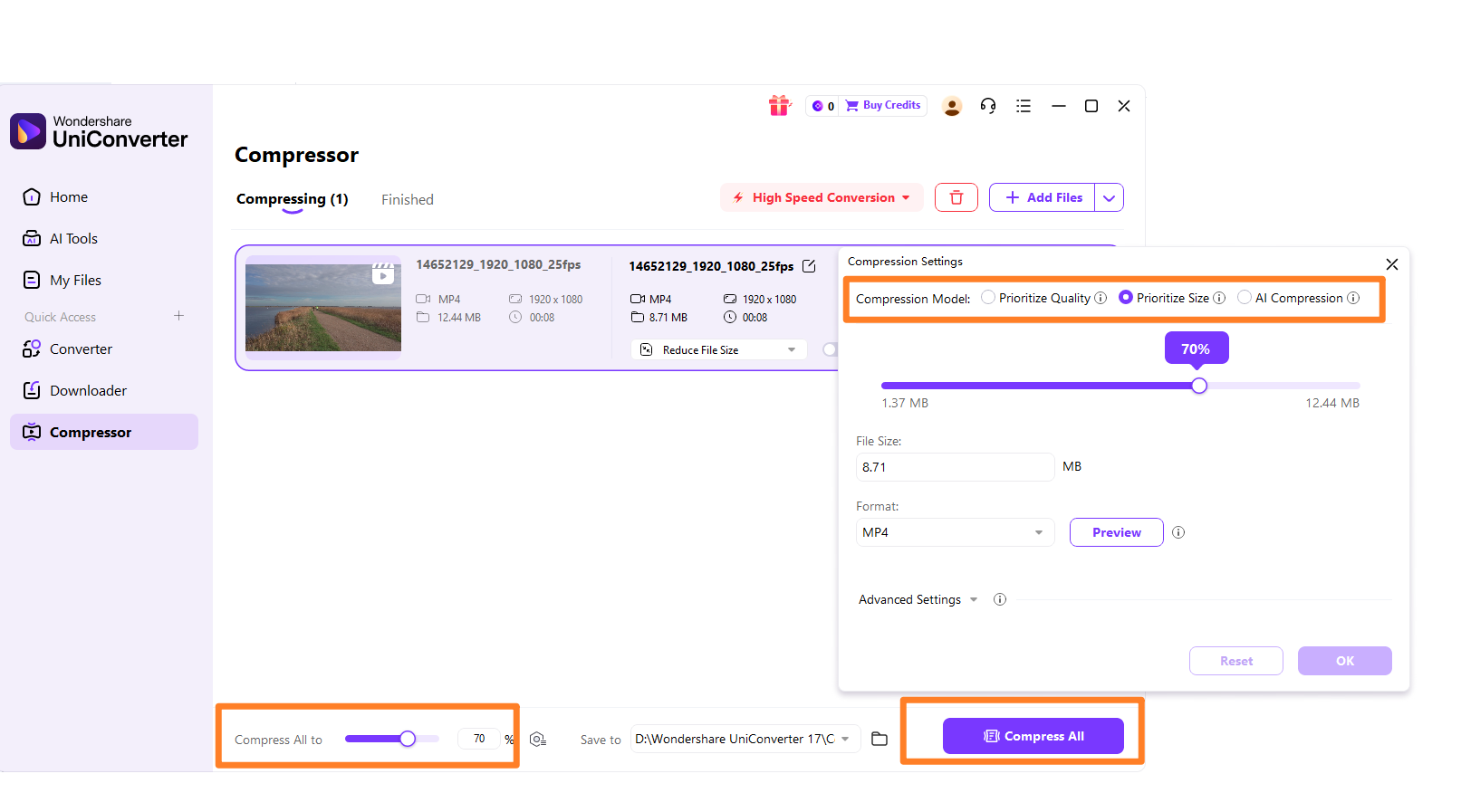
Step 3: Choose Required Parameters
Once your files are loaded, you can adjust the compression settings. UniConverter allows you to choose the output format, resolution, bitrate, and quality level. You can also preview the estimated file size before compression.
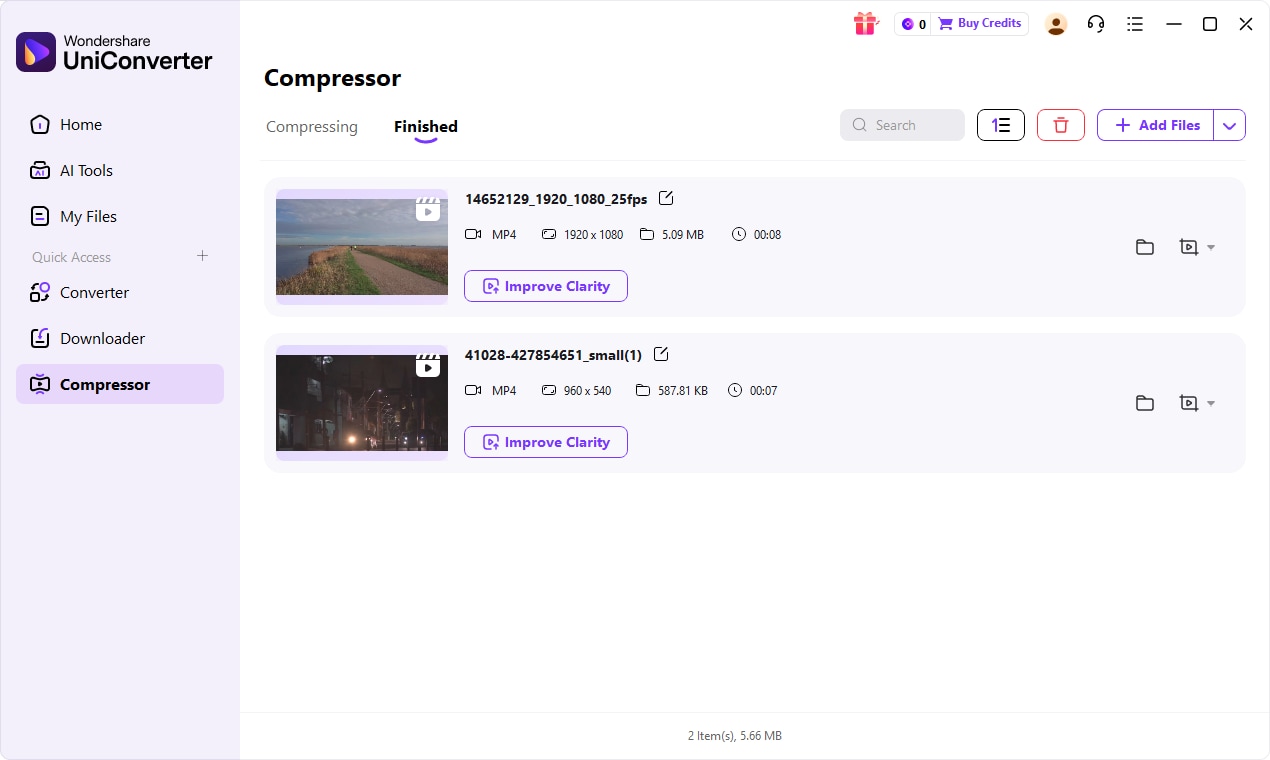
Step 4: Save the Compressed File
After configuring your settings, click the "Compress" button. UniConverter will quickly process your files. Once done, you can find your compressed files in the designated output folder.

Seeking a Better Clideo Video Compressor Alternative?
Part 7: Conclusion
After thoroughly exploring Clideo Video Compressor review and comparing it with various alternatives, my verdict is clear: it serves a specific niche exceptionally well but falls short for more demanding users. For casual users who occasionally need to shrink a video for social media sharing or quick messaging and don't mind a watermark or limited control, Clideo offers unparalleled convenience and ease of use. Its web-based nature means no downloads, quick access, and a straightforward interface. However, for professionals, content creators, or anyone prioritizing high-fidelity output, granular control, and data privacy, Clideo's limitations become evident. The lack of advanced settings, the presence of watermarks in the free version, and the inherent privacy concerns of uploading sensitive data to online servers make it unsuitable for critical projects. In such cases, desktop software like HandBrake or a more comprehensive tool like UniConverter provides the necessary power, control, and security. Ultimately, your choice should align with your specific needs, balancing convenience with quality, control, and privacy considerations.
Part 8: FAQs
-
1. Is Clideo Video Compressor safe to use?
Clideo states it uses secure connections and deletes uploaded files after a certain period. However, as with any online service, there's always an inherent risk when uploading personal or sensitive data to third-party servers. For maximum security, local desktop software is generally preferred.
-
2. Does Clideo Video Compressor reduce video quality significantly?
It depends on the original video and the level of compression applied. While Clideo aims to balance file size and quality, its automated process can sometimes lead to noticeable quality degradation, especially if you're aiming for a very small file size. There's no option to fine-tune quality settings.
-
3. Can I use Clideo Video Compressor offline?
No, Clideo Video Compressor is a purely web-based tool and requires an active internet connection to upload, process, and download your videos. If you need offline compression capabilities, you'll need to use desktop software.
-
4. What are the limitations of the free version of Clideo Video Compressor?
The free version typically includes a watermark on the compressed video, may have file size limits, slower processing speeds, and might display ads. To remove these limitations and unlock full features, you usually need to subscribe to a paid plan.
-
5. How does Clideo Video Compressor compare to desktop compression software?
Clideo offers convenience and ease of use for quick, basic compression tasks online. Desktop software like UniConverter or HandBrake, however, provides much greater control over compression settings (bitrate, resolution, codec), often results in higher quality output, supports batch processing, works offline, and generally offers better privacy and security as files are processed locally on your computer. If you need advanced features, desktop software is the superior choice.
