
In the world of professional video production, the choice of recording format is a foundational decision that impacts everything from image quality to post-production workflow and storage costs. Sony, a leader in camera technology, has introduced numerous formats over the years, with two of the most prominent being XDCAM and XAVC. For videographers, editors, and production managers, understanding the nuances between XDCAM vs XAVC is crucial for making informed decisions that align with project goals and technical requirements. While XDCAM has long been a trusted workhorse for broadcast, the rise of 4K and HDR has positioned XAVC as the modern standard for high-end digital cinematography.
This guide provides a detailed, head-to-head comparison of these two powerful formats. We will break down their technical specifications, explore their strengths and weaknesses, and identify the ideal use cases for each. Whether you're choosing a new camera system, planning a workflow, or managing archival footage, this article will equip you with the knowledge to select the right format for your needs.
In this article, you will learn about:
- The fundamental definitions and characteristics of XDCAM and XAVC.
- A quick comparison table highlighting their key technical differences.
- An in-depth analysis of codec efficiency, image quality, and resolution.
- The ideal production scenarios and use cases for each format.
- A step-by-step guide on how to convert between formats for maximum compatibility.
Part 1. What is XDCAM? What is XAVC?
Before we dive into a direct comparison, it's essential to understand the core identity and purpose of each format. Both were developed by Sony, but they were created for different eras of video production with distinct technological foundations.
What is XDCAM?
XDCAM is a professional recording format first introduced by Sony in 2003. Initially, it was based on optical disc media like the Professional Disc, but it has since evolved to be widely used with solid-state memory cards, such as SxS and XQD cards. Its primary codec is MPEG-2 Long GOP, a highly reliable and efficient compression scheme for its time.
For years, XDCAM has been a dominant standard in broadcast television, electronic news gathering (ENG), and reality TV production. Its reputation is built on reliability, a robust and well-established workflow, and widespread compatibility with broadcast infrastructure. Files are typically wrapped in the MXF (Material Exchange Format) container, which is designed to carry video, audio, and metadata in a single package, making it perfect for professional environments.
What is XAVC?
XAVC is a newer, more advanced recording format introduced by Sony in 2012. It was developed to address the growing industry demand for resolutions beyond HD, higher frame rates, and greater color fidelity. Unlike XDCAM, XAVC is based on the much more modern and efficient H.264/MPEG-4 AVC compression standard. This allows it to capture stunningly detailed images without generating excessively large files.
The format is versatile and comes in several variations to suit different production needs:
- XAVC-I (Intra-frame): Each frame is compressed individually, resulting in the highest quality and easiest editing experience, but with larger file sizes.
- XAVC-L (Long GOP): Uses inter-frame compression to achieve smaller file sizes, making it ideal for longer recording times.
- XAVC-S: A consumer-oriented version often found in mirrorless and prosumer cameras, typically using an MP4 wrapper for broader compatibility.
XAVC was explicitly designed for 4K, high frame rate (HFR), and high dynamic range (HDR) content creation, making it the go-to format for digital cinema, commercial production, and high-end web content in 2026.
Part 2. Quick Comparison Table
For a clear, at-a-glance overview, this table summarizes the key technical differences between the XDCAM and XAVC formats.
| Feature | XDCAM | XAVC |
| Codec | MPEG-2 | H.264/MPEG-4 AVC |
| Common Resolutions | SD, HD (1920x1080) | HD, 4K, 6K, 8K |
| Bit Depth | Typically 8-bit | Up to 10-bit or 12-bit |
| Chroma Subsampling | 4:2:0 or 4:2:2 | 4:2:0, 4:2:2, or 4:4:4 |
| Compression Efficiency | Lower | Higher |
| File Size | Larger for comparable quality | Smaller for comparable quality |
| Primary Use | Broadcast, News | Digital Cinema, High-End Production, Web |
Part 3. XDCAM vs XAVC: Which One Is Better?
While "better" is subjective and depends on the application, XAVC holds a significant technical advantage in almost every category. Let's explore the key areas where these formats differ.
Codec Efficiency and File Size
The most fundamental difference lies in the underlying codec. XAVC uses the H.264 standard, which is roughly twice as efficient as the MPEG-2 codec used in XDCAM. This means XAVC can deliver superior image quality at the same bitrate as XDCAM, or it can provide equivalent quality in a file that is significantly smaller.
This efficiency is a game-changer, especially when working with data-intensive 4K and high-frame-rate footage. For a one-hour 4K recording, the smaller file sizes of XAVC can translate into substantial savings on storage costs and faster file transfer times, streamlining the entire production pipeline.
Image Quality: Color Depth and Chroma Subsampling
Image quality isn't just about resolution; it's also about color information. Here, XAVC has a clear and decisive advantage. It supports 10-bit color depth, which allows it to capture over a billion distinct color shades. This results in smoother gradients, richer colors, and far more flexibility during color grading in post-production. In contrast, XDCAM is typically limited to 8-bit color, which provides only 16.7 million colors. This limitation can sometimes lead to visible "banding" in areas of subtle tonal transition, like a clear blue sky.
Furthermore, XAVC supports higher levels of chroma subsampling, such as 4:2:2. This means it retains more color information compared to many XDCAM variants that use 4:2:0. For any work involving green screens, visual effects, or intensive color correction, the robust color data in XAVC files is invaluable.
Resolution and Frame Rate Capabilities
XAVC was born in the 4K era and was engineered to look toward the future. It natively supports resolutions from HD all the way up to 8K, as well as high frame rates (e.g., 120fps or higher) for creating crisp, detailed slow-motion effects. This makes it the default choice for modern productions aiming for theatrical release, high-end streaming services, or simply future-proofing their content.
XDCAM, on the other hand, is fundamentally an HD format. While some variants can handle higher bitrates, its architecture was not designed for the demands of 4K and beyond. For projects with a final delivery requirement of 1080p, XDCAM is still perfectly capable, but it lacks the forward-looking versatility of XAVC.
Editing and Post-Production Workflow
Both XDCAM and XAVC are professional formats and are natively supported by all major non-linear editing systems (NLEs), including Adobe Premiere Pro, Final Cut Pro, and DaVinci Resolve. In most cases, you can drop footage from either format directly onto your timeline and begin editing.
However, there can be performance differences. The highly compressed nature of Long GOP XAVC variants (XAVC-L and XAVC-S) can be more computationally intensive for a computer's CPU to decode in real-time compared to the less complex XDCAM or the intra-frame XAVC-I. This can sometimes lead to stuttering playback on less powerful systems.
If you encounter performance bottlenecks, compatibility issues, or need to deliver files in a different format, using a dedicated video converter is an excellent solution. For instance, Wondershare UniConverter can effortlessly transcode demanding XAVC files or older XDCAM footage into edit-friendly intermediate formats like Apple ProRes or Avid DNxHD, ensuring a completely smooth and responsive post-production workflow.
Part 4. Use Cases for XDCAM and XAVC
The technical specifications directly inform the best applications for each format. Choosing the right one means aligning its strengths with your project's specific needs.
When to Choose XDCAM
Despite its age, XDCAM remains a relevant and powerful choice in specific professional environments where its proven track record is a key asset.
- Broadcast News and Live Events: In the fast-paced world of news gathering, reliability is paramount. XDCAM's robust media, standardized workflow, and seamless integration with existing broadcast infrastructure make it a trusted and efficient choice.
- Long-Form Reality TV: For productions that generate hundreds or thousands of hours of footage, the established and predictable XDCAM workflow is a major advantage. Here, workflow stability is often prioritized over achieving the most cinematic image quality.
- Projects with Strict HD Delivery: If the final product is exclusively for 1080p HD television broadcast and there are no plans for a 4K master or future remastering, XDCAM is a perfectly viable and cost-effective option that meets all necessary technical standards.
When to Choose XAVC
For nearly all new productions in 2026, XAVC is the superior and more logical choice, offering the quality and flexibility that modern audiences and platforms demand.
- Cinematic and Commercial Productions: The superior color depth (10-bit), higher resolution, and greater flexibility of XAVC are essential for projects that require high production value and will undergo extensive color grading to achieve a specific look.
- 4K and HDR Content Creation: If your project is intended for 4K displays, streaming services like Netflix or Disney+, or requires HDR delivery, XAVC is not just a choice—it's a necessity. Its architecture is built to handle the demands of these modern standards.
- Future-Proofing Your Work: Storage is cheaper than ever. Shooting in XAVC, even if the initial delivery is only HD, ensures your master footage is of the highest possible quality. This makes it ready for future 4K re-masters, new distribution opportunities, and evolving delivery standards without requiring a reshoot.
Part 5. Step-by-Step Guide to Convert XDCAM to XAVC Using UniConverter
In certain workflows, you may need to standardize your footage. For example, you might want to convert older XDCAM archives into a more modern, XAVC-compliant format for a new project. Wondershare UniConverter is a powerful and intuitive tool that simplifies this process into just a few clicks.
How to Convert XDCAM to XAVC in 4 Simple Steps
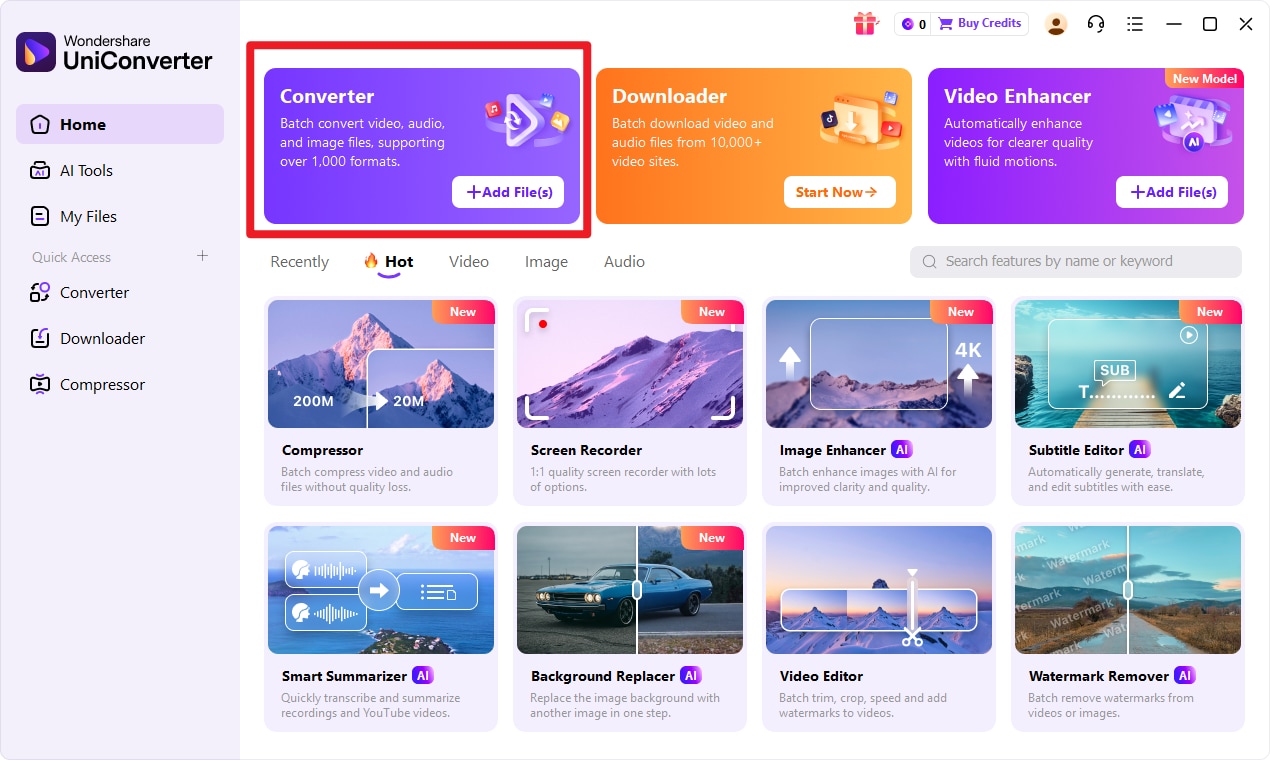
Step 1: Launch Wondershare UniConverter
Launch Wondershare UniConverter on your computer. In the main interface, ensure you are on the Converter tab.
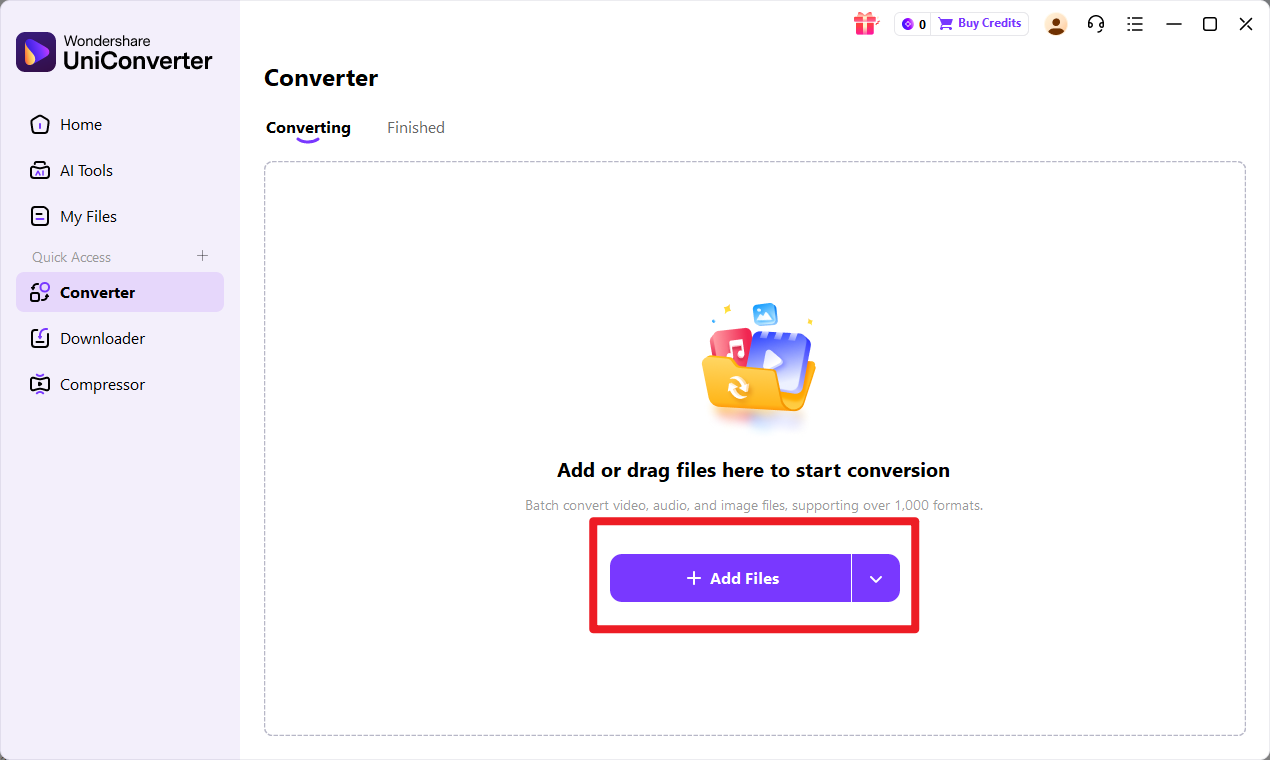
Step 2: Add Files to UniConverter
You can either click the "Add Files" icon to browse for your XDCAM MXF files or simply drag and drop them directly into the program window.
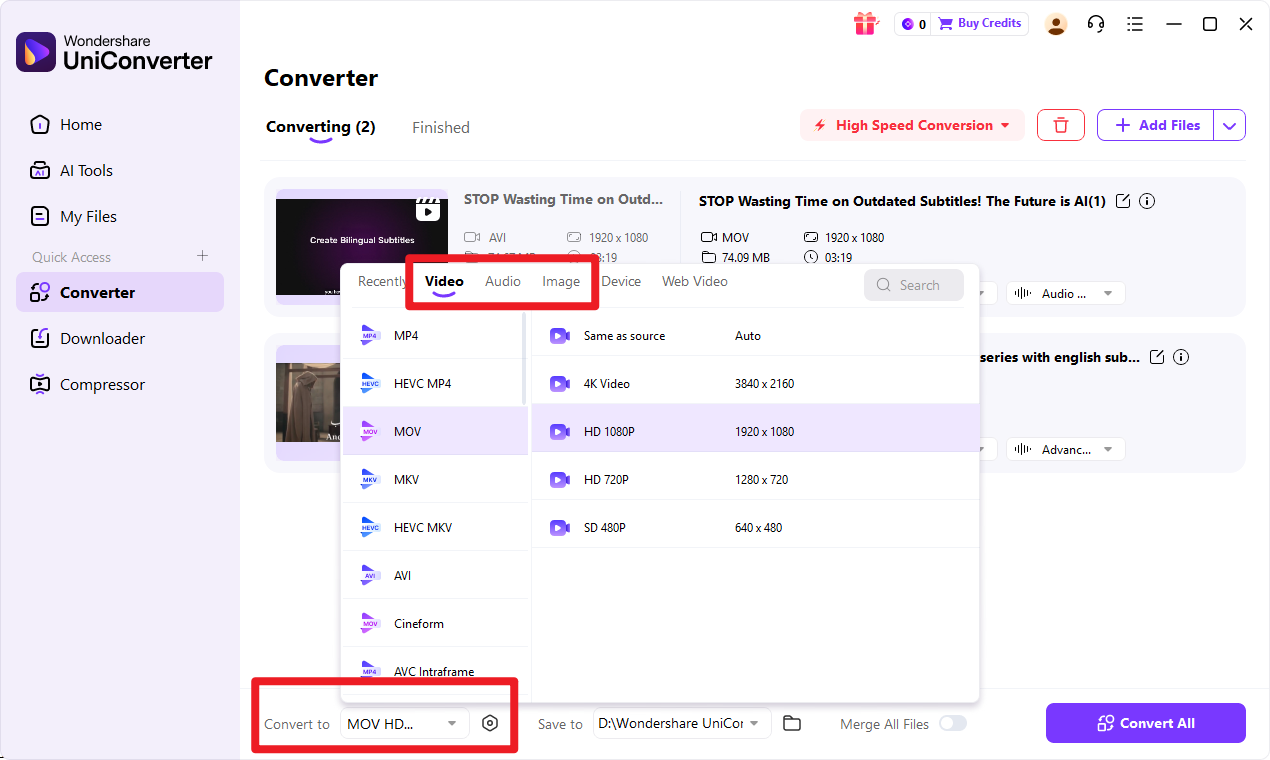
Step 3: Choose Output Format
Click on the Output Format menu located at the bottom of the window. Navigate to the Video tab. To create a file with XAVC-like specifications, select a container like MP4 or MXF. Then, choose a high-resolution preset such as 4K. For more precise control, you can click the settings icon next to the resolution to manually set the encoder to H.264, adjust the bitrate, and ensure the audio settings match your project's requirements.
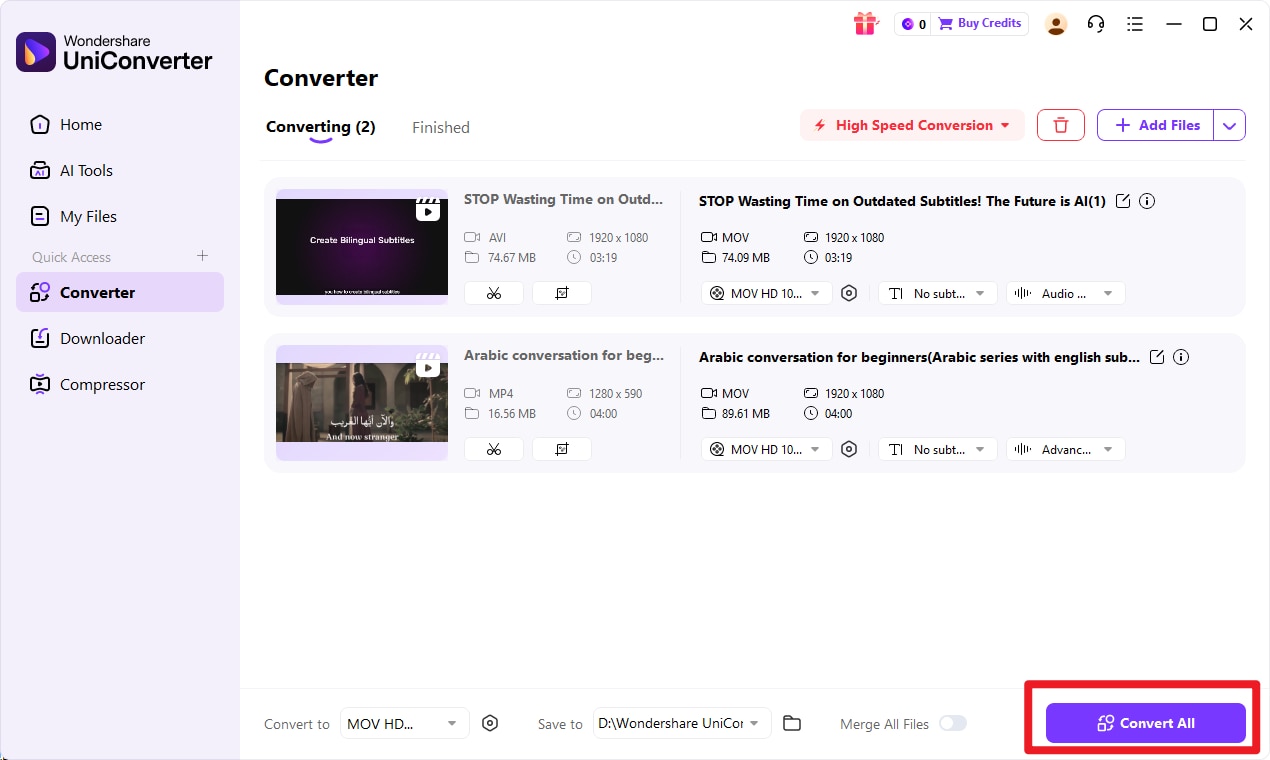
Step 4: Start the Conversion
Before starting, you can specify where you want to save the new file by using the File Location menu at the bottom. Once you are satisfied with your settings, click the Convert button for a single file or Start All if you are converting multiple files in a batch.
UniConverter will process your files quickly using its high-speed conversion technology. Once the conversion is complete, you can find your new files by navigating to the Finished tab at the top of the window or by opening the output folder you selected in the previous step.

Go Beyond Simple Video Conversion
Conclusion
Ultimately, the XDCAM and XAVC formats are both highly capable professional tools, but they were designed for different production landscapes. XDCAM remains a reliable and efficient workhorse for traditional HD broadcast environments, where its proven reliability and deep integration into existing infrastructure are invaluable. It gets the job done for news, live events, and reality television.
However, for almost all new productions in 2026, XAVC is the technically superior and more forward-thinking choice. It offers higher resolution, vastly better color fidelity with 10-bit depth, and greater compression efficiency thanks to its modern H.264 codec. This makes it the ideal format for cinematic work, 4K/HDR delivery, and future-proofing your content. The right choice depends entirely on your specific project requirements, delivery platform, and post-production capabilities, but for quality and flexibility, XAVC leads the way.
FAQs
-
1. Is XAVC technically better than XDCAM?
Yes, from a purely technical standpoint, XAVC is a superior format. It utilizes a more advanced and efficient codec (H.264 vs. MPEG-2), supports much higher resolutions (4K and beyond), and offers greater color depth (up to 10-bit or 12-bit vs. 8-bit). This translates to better overall image quality, smaller file sizes for comparable quality, and significantly more flexibility in post-production, especially during color grading. -
2. Can my computer edit XAVC files without issues?
Most modern editing workstations and NLE software (like Premiere Pro, Final Cut Pro, and DaVinci Resolve) are optimized to handle XAVC files. However, performance can vary. Intra-frame versions like XAVC-I are very easy for your computer to process but result in large files. Conversely, Long GOP versions like XAVC-L and XAVC-S are more compressed to save space but can be more demanding on your computer's CPU during real-time playback. If you experience lag, creating proxy files is a common professional practice. -
3. Why would I need to convert video formats like XDCAM or XAVC?
Video format conversion is a common and often necessary step in many workflows. You might need to convert files to create lightweight proxy versions for smoother editing on a laptop or less powerful machine. You may also need to deliver a final file in a universally compatible format like H.264 MP4 for web upload or client review. Finally, conversion is essential for standardizing footage from different cameras or for archiving projects in a uniform format. A reliable tool like Wondershare UniConverter is essential for handling these tasks quickly and without quality loss.
