
Navigating the world of video formats can feel like learning a new language, with a sea of acronyms and technical specifications. Two of the most common formats you'll encounter, especially if you use Sony cameras, are XAVC and AVCHD. Choosing between them can significantly impact your video quality, storage needs, and editing workflow. Whether you're a professional filmmaker, a budding content creator, or a hobbyist capturing family memories, understanding the core differences in the XAVC vs AVCHD debate is crucial for making the right decision for your project.
This guide is designed to demystify these two formats. We'll break down their technical details, compare their strengths and weaknesses, and provide practical advice on when to use each one. By the end, you'll have the confidence to select the perfect format for your needs and know how to manage your files effectively.
In this article
Part 1. What is XAVC? What is AVCHD?
Before we can compare them, it's essential to understand what each format is and what it was designed for. They were both developed with different users and applications in mind, which explains their fundamental differences.
What is XAVC?
XAVC is a professional-grade recording format developed by Sony in 2012. It was created to accommodate the rise of high-resolution and high-frame-rate video, providing a robust and flexible solution for modern digital cinema and broadcast production. It's not just a single format but a family of standards designed to scale from consumer-level 4K to high-end 8K production.
Key features of XAVC include its support for incredibly high resolutions (up to 8K), high bitrates, and superior color information. It can capture video with 10-bit or even 12-bit color depth and 4:2:2 or 4:4:4 chroma subsampling. This means it records a vast amount of color data, which is invaluable for post-production processes like color grading and visual effects.
There are several variations of XAVC:
- XAVC-I (Intra-frame): This version compresses each frame individually. It results in larger file sizes but is less demanding on your computer's processor during editing, making for a smoother workflow.
- XAVC-L (Long GOP): This version uses inter-frame compression, where only the changes between frames are recorded. This leads to smaller file sizes but requires more processing power to decode during editing.
- XAVC S: This is a consumer-oriented version of the format, often found in Sony's mirrorless cameras and prosumer camcorders. It uses the MP4 container format, making it more widely compatible and easier to manage for content creators and hobbyists, while still offering the benefits of 4K resolution and high bitrates.
Professional versions of XAVC typically use the MXF (Material Exchange Format) wrapper, a standard in the broadcast industry.
What is AVCHD?
AVCHD (Advanced Video Coding High Definition) is a file-based format developed jointly by Sony and Panasonic in 2006. It was designed specifically for consumer and prosumer high-definition camcorders, aiming to provide good quality video in a highly compressed, manageable file size. For many years, it was the go-to format for recording HD video for home movies, events, and early online content.
The primary goal of AVCHD is efficiency. It uses the H.264/MPEG-4 AVC compression standard to pack a lot of video information into a relatively small file. However, this efficiency comes with technical limitations compared to XAVC. AVCHD is generally limited to a maximum resolution of 1080p, uses 8-bit color depth, and employs 4:2:0 chroma subsampling. While this is perfectly adequate for direct-to-web content or projects with minimal color correction, it offers less flexibility in post-production.
AVCHD files are stored in an MTS or M2TS (MPEG Transport Stream) container, which is designed for playback on Blu-ray players and other consumer devices.
Part 2. Quick Comparison Table
For a quick overview, this table highlights the key technical differences between XAVC and AVCHD at a glance.
| Comparison Point | XAVC | AVCHD |
| Developer | Sony | Sony & Panasonic |
| Max Resolution | 8K and higher | Primarily 1080p |
| Bitrate | High (up to 600 Mbps+) | Moderate (up to 28 Mbps) |
| Color Depth | 8, 10, 12-bit | 8-bit |
| Chroma Subsampling | 4:2:0, 4:2:2, 4:4:4 | 4:2:0 |
| File Size | Large | Small to Medium |
| Primary Use | Professional Production | Consumer/Prosumer |
| Container | MXF, MP4 | MTS, M2TS |
Part 3. XAVC vs AVCHD: Which One Is Better?
The question of which format is "better" ultimately depends on your specific needs. Let's dive deeper into the practical implications of their technical differences in three key areas: quality, file size, and editing.
Video Quality and Color Grading Flexibility
This is where XAVC truly shines. Its support for 10-bit color depth means it can represent over a billion colors, compared to the 16.7 million colors of AVCHD's 8-bit depth. This vast color information, combined with 4:2:2 chroma subsampling, provides incredible flexibility in post-production. When you are color grading XAVC footage, you can push and pull the colors, exposure, and contrast aggressively without the image falling apart. The result is smoother gradients, richer colors, and a more cinematic final look. You are far less likely to see "banding"—ugly, distinct steps between color shades—in skies or on flat surfaces.
AVCHD, with its 8-bit, 4:2:0 structure, is sufficient for projects that will undergo minimal color grading. The footage can look great straight out of the camera. However, if you try to perform heavy color adjustments, the limited color information will quickly become apparent. The image can start to show artifacts, noise, and banding, restricting your creative options in post-production.
Winner for Quality: XAVC, by a significant margin.
File Size and Storage Efficiency
The high quality of XAVC comes at a cost: storage space. The high bitrates mean that XAVC files are significantly larger than AVCHD files. A minute of 4K XAVC-I footage can consume several gigabytes of data. This requires you to invest in large-capacity, high-speed memory cards (like CFexpress or fast SD cards) and substantial hard drive space for archiving and editing.
AVCHD, on the other hand, is designed for efficiency. Its higher compression results in much smaller files. You can record for hours on a single, relatively inexpensive SD card, making it an excellent choice for long-form content like event coverage, lectures, or documentaries. If you have limited storage or want to minimize data management overhead, AVCHD is the more practical option.
Winner for Efficiency: AVCHD.
Editing Workflow and System Requirements
The editing experience for these two formats presents an interesting paradox. XAVC, particularly the XAVC-I (Intra-frame) variant, contains more data but is actually easier for your computer's processor (CPU) to decode because each frame is self-contained. The main bottleneck is not the CPU but the speed of your storage drives, which need to be fast enough to read the high-bitrate files in real-time. A powerful computer with fast SSD or RAID storage is recommended for a smooth XAVC editing experience.
AVCHD's Long GOP compression, while creating smaller files, can be more demanding on your CPU. To play back a single frame, the computer has to decode a group of pictures (GOP) to reconstruct it. This can lead to choppy playback, slow rendering, and even crashes on less powerful systems, especially when working with multiple layers of video.
For a smoother workflow regardless of the original format, many editors choose to convert their footage. You can convert large XAVC files to smaller proxy files for editing or convert CPU-intensive AVCHD files to an edit-friendly format like ProRes or a more universal format like MP4. A powerful tool like Wondershare UniConverter is perfect for this task, as it can handle batch conversions of both XAVC and AVCHD files quickly and without quality loss, streamlining your entire post-production process.
Winner for Editing: It's a tie, with different requirements. XAVC needs fast storage, while AVCHD needs a strong CPU.
Part 4. Use Cases for XAVC and AVCHD
Understanding the technical trade-offs helps us define the best real-world scenarios for each format.
When to Choose XAVC
XAVC is the format of choice when image quality is the top priority. Its robustness and flexibility make it ideal for:
- Professional Film and Broadcast Productions: The high bitrates and color depth meet the strict technical standards required for television broadcasting and cinema distribution.
- Projects Requiring Extensive Color Grading: If your project involves creating a specific mood or look through color, such as in music videos, commercials, or narrative films, XAVC's 10-bit color is essential.
- Shooting in 4K or Higher Resolutions: If you want to deliver in 4K or future-proof your content by shooting at a higher resolution than your final delivery, XAVC is the necessary format.
- Visual Effects Work: The clean, detailed image and rich color information provided by XAVC make it much easier to key, track, and composite visual effects.
When to Choose AVCHD
AVCHD remains a highly practical and relevant format, especially when recording time and file management are more important than ultimate post-production flexibility.
- Event Videography: For weddings, conferences, and live performances, where you might be recording for hours continuously, AVCHD's small file sizes are a lifesaver.
- Documentaries and Interviews: When capturing long takes and extensive interviews, AVCHD allows you to focus on the content without constantly worrying about changing memory cards or running out of storage.
- Home Videos and Vlogging: For personal projects and online content where a quick turnaround is needed and heavy color grading is unlikely, AVCHD provides great quality in a convenient package.
- Blu-ray Disc Authoring: The format was designed with Blu-ray in mind, making it a straightforward choice if your final delivery target is a physical disc.
Part 5. Step-by-Step Guide to Convert XAVC to AVCHD Using UniConverter
While XAVC is superior for capture, there are times you might need to convert your footage. For example, you may want to create smaller, more manageable files for archiving, sharing, or for compatibility with older systems. UniConverter simplifies this process, supporting over 1000 formats and ensuring your conversions are fast and lossless.
Why You Might Need to Convert Your Footage
You may need to convert large XAVC files to a more manageable format like AVCHD for long-term storage or to a universally compatible format like MP4 for sharing online. Converting can also help create proxy files for a smoother editing experience on less powerful computers. Wondershare UniConverter is the recommended tool for all your video conversion needs, offering a powerful suite of features in an easy-to-use interface.
Step 1: Launch Wondershare UniConverter
Launch Wondershare UniConverter on your computer. In the main interface, select the Converter tool from the left-hand menu.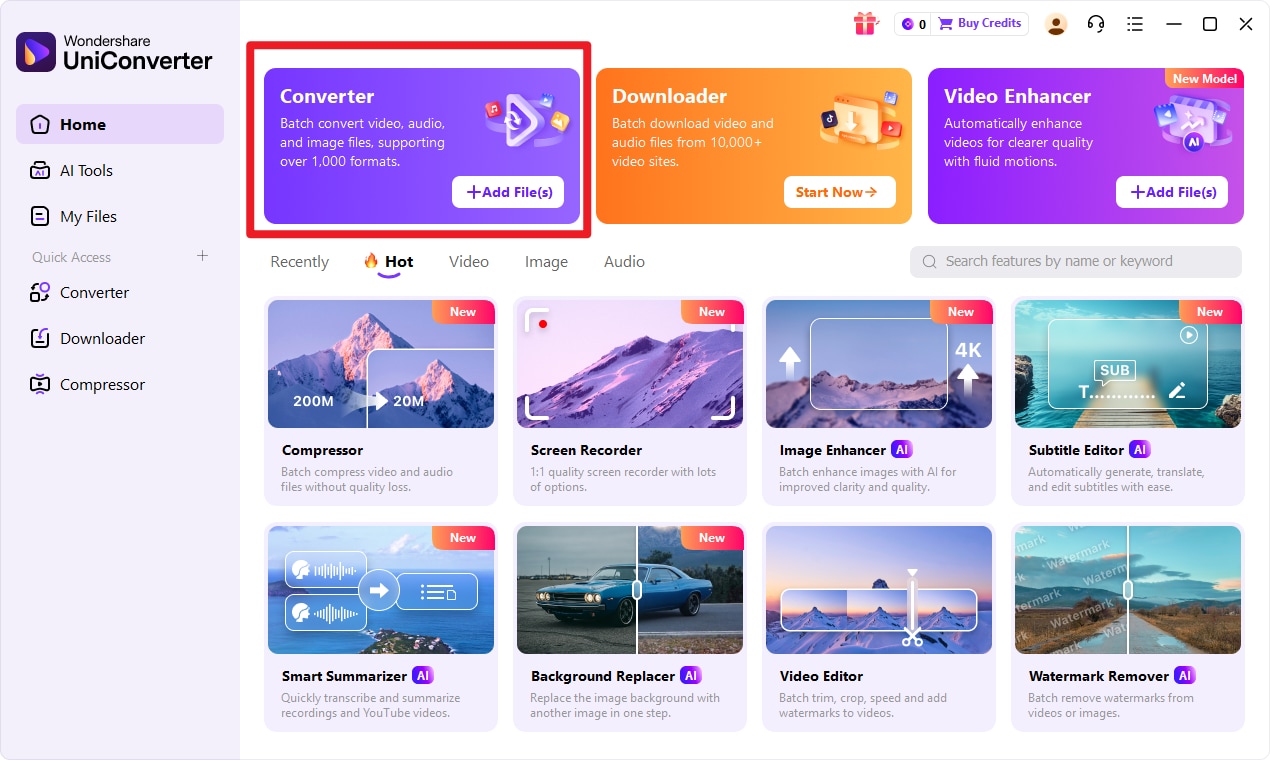
Step 2: Add Your XAVC Files to UniConverter
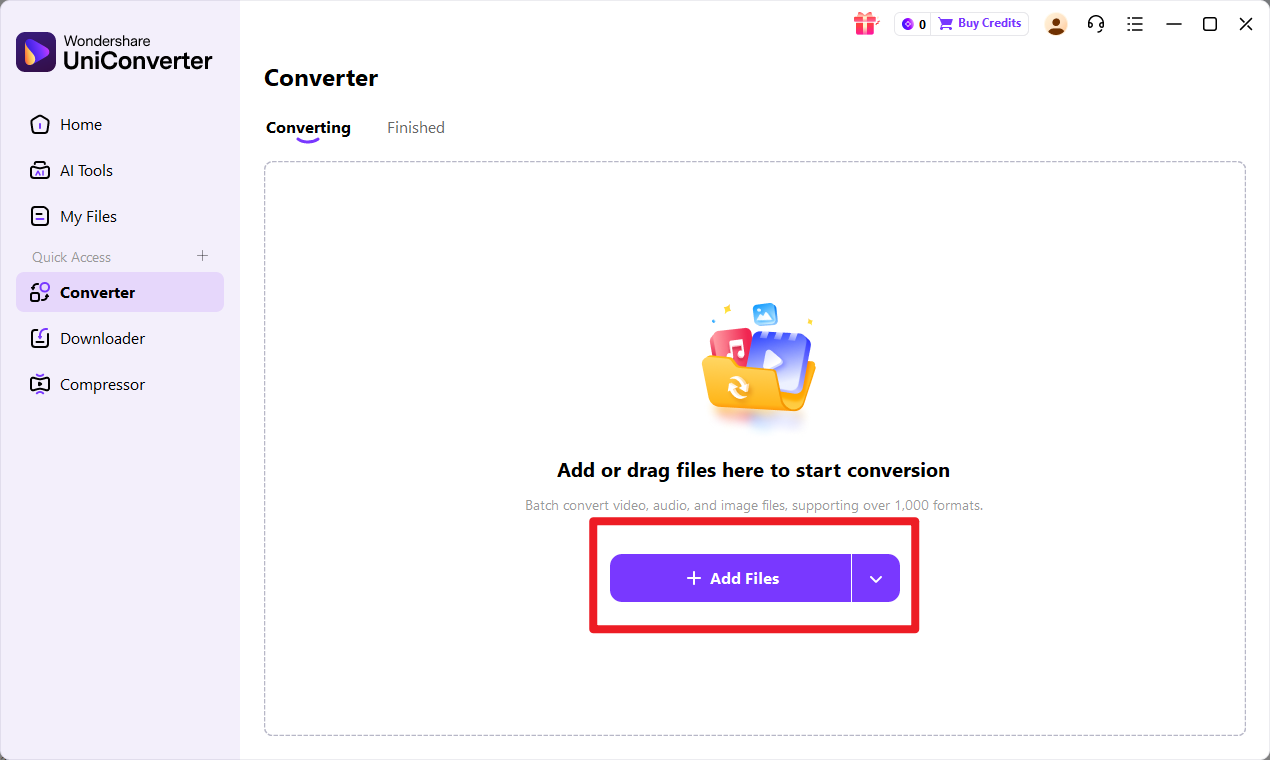
You can then either click the Add Files button or simply drag and drop your XAVC video files directly into the program window.
Step 3: Set the Output Location
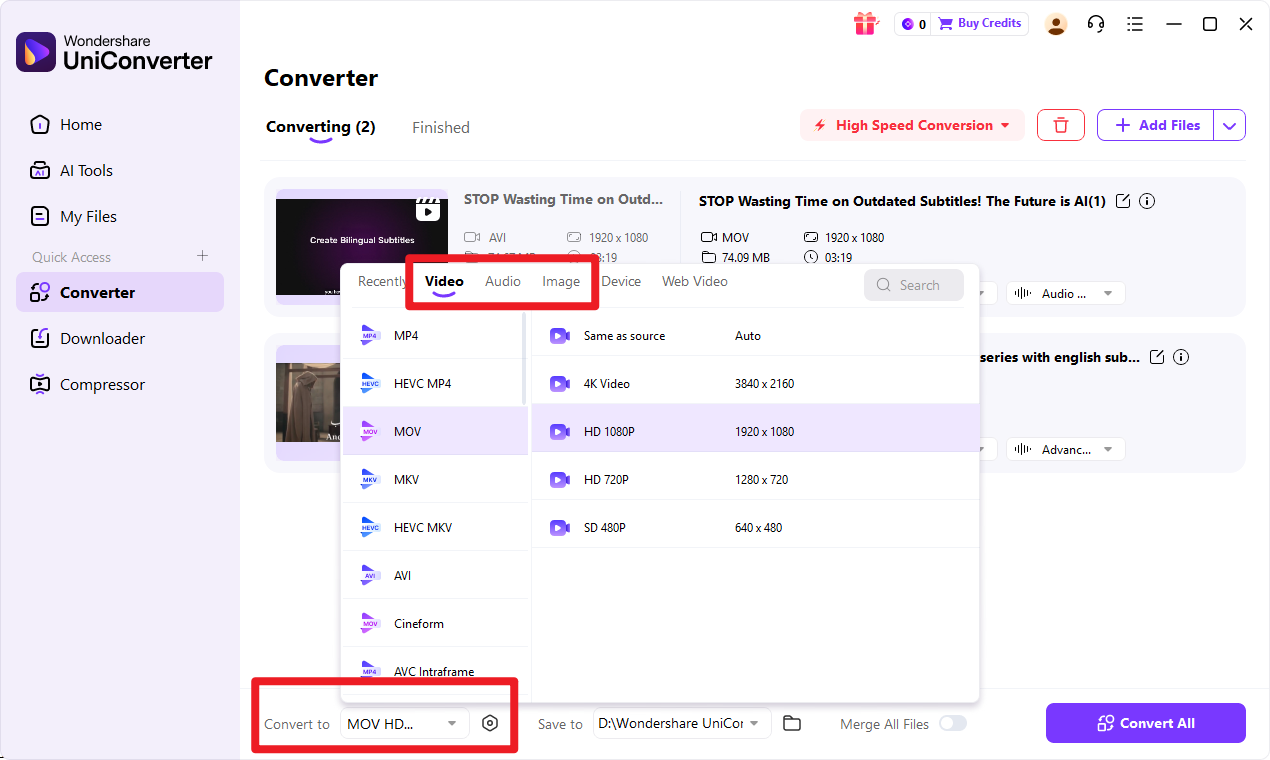
Click on the Output Format menu located at the bottom of the window. This will open a new panel with a list of format options. Navigate to the Video tab, select AVCHD from the list of formats on the left, and then choose your desired resolution (e.g., "Same as source" or "1080p") on the right.
Step 4: Start the High-Speed Conversion
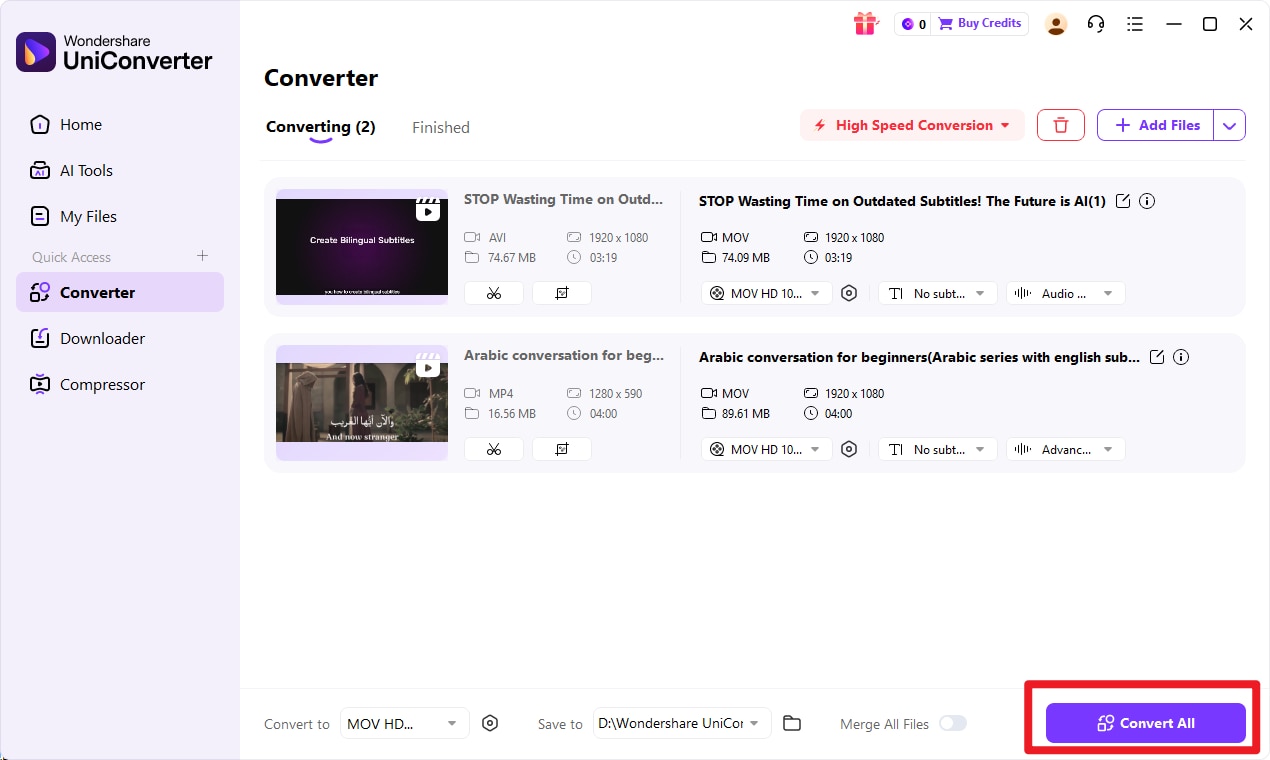
Once you have everything set up, you can convert the files. If you are converting a single file, click the Convert button next to it. If you have added multiple files for a batch conversion, click the Start All button in the bottom-right corner. UniConverter will begin the conversion process, utilizing its high-speed technology to finish the task quickly.

More Than Just a Video Converter
Conclusion
The XAVC vs AVCHD debate doesn't have a single winner because they are tools designed for different jobs. XAVC is the undisputed champion for professional productions that demand the highest possible image quality and extensive flexibility in post-production. Its support for high resolutions, bitrates, and 10-bit color makes it the standard for cinematic and broadcast work in 2026. On the other hand, AVCHD remains a practical and highly efficient choice for long-form recording, event videography, and situations where storage space and ease of management are the primary concerns.
Ultimately, the choice is not about which format is universally "better," but which is the right tool for your specific project, your camera's capabilities, and your post-production workflow. And with a versatile video toolbox like Wondershare UniConverter at your disposal, you are never locked into a single format. You have the freedom to shoot in the highest quality possible and then easily convert your files for any delivery need, giving you the best of both worlds.
FAQs
-
1. Is XAVC S better than AVCHD for YouTube?
Yes, XAVC S is generally better for YouTube. It offers higher bitrates at both 1080p and 4K resolutions. This extra data results in a higher quality source file, which holds up much better after YouTube applies its own heavy compression. Uploading a high-bitrate XAVC S file will result in a cleaner, more detailed final video on the platform compared to an AVCHD file. -
2. Can I edit AVCHD files on my computer?
Yes, most modern non-linear editing (NLE) software, including Adobe Premiere Pro, Final Cut Pro, and DaVinci Resolve, have native support for AVCHD files. However, due to the format's high compression (Long GOP), it can be very demanding on your computer's processor, sometimes leading to slow or choppy playback. For a smoother editing experience, it's often recommended to convert AVCHD files to an intermediate codec like ProRes or a more universally friendly format like MP4 using a tool like UniConverter. -
3. Does XAVC use more storage than AVCHD?
Yes, XAVC uses significantly more storage space than AVCHD. Because of its much higher bitrate and lower compression, XAVC files can be anywhere from 2 to 10 times larger than AVCHD files of the same resolution and length. For example, an hour of 1080p footage in AVCHD might be around 10-12 GB, while the same hour in XAVC S could be 25-50 GB or more. -
4. What is the best software to convert XAVC or AVCHD files?
For reliable, fast, and high-quality video conversions, Wondershare UniConverter stands out as an excellent choice. It is specifically designed to handle a vast range of professional and consumer video formats, including all variations of XAVC (XAVC-I, XAVC-L, XAVC S) and AVCHD. Its key benefits include batch processing to convert multiple files at once, GPU acceleration for incredibly fast conversion speeds, and a suite of other tools like a video editor, compressor, and downloader, making it a comprehensive solution for any videographer's workflow.
