
In the world of digital video, efficiency is everything. Whether you're a content creator trying to upload a 4K video to YouTube, a streamer broadcasting to a live audience, or a media enthusiast archiving your favorite films, you've likely encountered the challenge of balancing video quality with file size. At the heart of this challenge lies the video encoder—the engine that compresses your video. Two of the most prominent names in HEVC/H.265 encoding are x265 and NVENC HEVC. The debate over x265 vs NVENC HEVC is a critical one, as the choice can dramatically impact your workflow, rendering times, and the final quality of your content.
Choosing the wrong encoder can lead to frustratingly slow exports, massive files that eat up storage, or compressed video that looks disappointingly pixelated. This guide is designed to cut through the technical jargon and provide a clear, comprehensive comparison. We'll explore the strengths and weaknesses of each encoder, helping you understand which one is the perfect fit for your specific needs.
In this article, we will cover:
- An introduction to the x265 and NVENC HEVC encoders.
- A quick side-by-side comparison of their key features.
- A deep dive into their differences in speed, quality, and system impact.
- Practical use cases to help you decide when to use each one.
- A simple guide to converting videos using either encoding method.
Part 1. What is x265? What is NVENC HEVC?
Before we can compare these two powerful technologies, it's essential to understand what they are and how they work. While both are used to create HEVC (High-Efficiency Video Coding, or H.265) files, they take fundamentally different approaches to the task.
What is x265?
x265 is a widely respected open-source software library used for encoding video streams into the HEVC/H.265 compression format. The key thing to know about x265 is that it is a software-based encoder, meaning it relies entirely on your computer's Central Processing Unit (CPU) to perform its complex calculations.
It is renowned in the video community for its exceptional compression efficiency. By using sophisticated algorithms, x265 can produce incredibly high-quality video at surprisingly low bitrates, resulting in smaller file sizes without a significant loss in visual fidelity. However, this precision comes at a cost: the encoding process is extremely CPU-intensive and can be very slow, especially on less powerful processors.
What is NVENC HEVC?
NVENC HEVC is NVIDIA's proprietary hardware-based encoder. It is a dedicated physical component built into most modern NVIDIA GeForce graphics cards (GPUs). Unlike x265, which uses the CPU, NVENC offloads the entire encoding process to this specialized chip on the GPU.
The primary advantage of this approach is speed. Because it uses dedicated hardware designed for one specific task, NVENC is extraordinarily fast. This makes it the go-to choice for real-time applications where speed is critical, such as live streaming video games or recording gameplay. By handling the encoding, the GPU frees up the CPU to focus on other tasks, like running the game itself, leading to a smoother overall experience.
Part 2. Quick Comparison Table
For those who need a quick answer, this table provides an at-a-glance summary of the core differences between x265 and NVENC HEVC.
| Feature | x265 | NVENC HEVC |
| Encoding Speed | Slow to very slow, dependent on CPU power and settings. | Extremely fast, thanks to dedicated hardware on the GPU. |
| Output Quality | Generally considered the gold standard for quality at low bitrates. | Very good, but can be slightly lower than x265 at the same bitrate. |
| Compression Efficiency/File Size | Excellent. Can produce very small files for a given quality level. | Good. Files are slightly larger than x265 for comparable quality. |
| Hardware Requirement | A powerful multi-core CPU is recommended for reasonable speeds. | A modern NVIDIA GeForce GPU with NVENC support is required. |
| System Load | High CPU usage, which can slow down the entire system. | Very low CPU usage; load is on the dedicated GPU encoder chip. |
Part 3. x265 vs NVENC HEVC: Which One Is Better?
The "better" encoder truly depends on what you value most: speed, quality, or file size. Let's break down the performance of x265 and NVENC HEVC in more detail to help you make an informed decision.
Deep Dive: Encoding Speed
This is the most significant and clear-cut difference between the two.
NVENC HEVC: The winner for speed, by a massive margin. Because it uses a dedicated hardware chip on the graphics card, NVENC can encode video in real-time or faster. This is a game-changer for anyone who needs to produce content quickly, such as live streamers who are encoding and broadcasting simultaneously, or YouTubers who need to export and upload videos on a tight schedule. The speed of NVENC allows for a fluid, uninterrupted workflow.
x265: This encoder is notoriously slow. It relies on the CPU's general-purpose processing cores to perform highly complex calculations. While these calculations result in excellent compression, they take time. An encode that might take minutes with NVENC could take hours with x265, depending on the source video's length, resolution, and the chosen settings. This slowness makes it impractical for time-sensitive tasks.
Deep Dive: Quality and Compression
This is where the trade-off becomes more nuanced.
x265: For a given file size (or bitrate), x265 is generally recognized as producing slightly better visual quality. Its slower, more methodical software-based approach allows its algorithms to analyze video frames more thoroughly and make more intelligent decisions about how to compress the data. This results in superior compression efficiency, meaning it can pack more quality into fewer bits. This is why it's favored for archival purposes, where the goal is to preserve the best possible quality in the smallest possible file.
NVENC HEVC: While historically lagging behind x265 in quality, modern generations of NVENC have closed the gap considerably. For most viewers, the difference in quality between a high-bitrate NVENC encode and an x265 encode can be nearly indistinguishable. However, at lower bitrates, x265's advantages become more apparent, as it can retain more detail and produce fewer compression artifacts.
Deep Dive: Hardware and System Impact
How each encoder affects your computer's performance during operation is another crucial factor.
x265: Encoding with x265 places a heavy, sustained load on your CPU. If you have a high-end processor with many cores, it can handle the task, but it will likely be running at or near 100% utilization. This can make your computer feel sluggish and unresponsive, making it difficult to perform other tasks while an encode is running.
NVENC HEVC: This is where hardware encoding shines. By offloading the work to the dedicated chip on the GPU, NVENC has a minimal impact on CPU usage. This is incredibly beneficial for multitasking. For example, a gamer can record or stream their gameplay using NVENC without experiencing a significant drop in frame rates, as the CPU remains free to run the game and the operating system.
The Verdict: It's a Trade-off
There is no universal winner. The best choice is a compromise based on your priorities.
Choose NVENC HEVC if your priority is speed and low system impact. It's the ideal solution for live streaming, gameplay recording, and quick video exports where time is of the essence and you need your computer to remain responsive.
Choose x265 if your priority is achieving the absolute best quality and smallest file size. It's the perfect tool for archiving media, creating master copies of your projects, or any scenario where you can let the computer encode for a long time without interruption.
Part 4. Use Cases for x265 and NVENC HEVC
To make the choice even clearer, let's look at some practical scenarios where one encoder is a better fit than the other.
When to Use x265
The strength of x265 lies in its ability to deliver maximum quality and efficiency when time is not a factor.
Archiving Movies or Important Videos: If you are converting your Blu-ray collection or saving precious family videos, you want to preserve as much quality as possible while saving storage space. x265 is perfect for this. You can set up a batch encode and let it run overnight, resulting in files that are both high-quality and compact.
Final Project Rendering: For professional videographers or filmmakers delivering a final product, quality is paramount. Using x265 for the final export ensures the client receives the best possible version of the video. Since this is the last step in the production pipeline, the long encoding time is often an acceptable trade-off.
When to Use NVENC HEVC
NVENC is the champion of real-time performance and speed.
Live Streaming to Platforms like Twitch or YouTube: When streaming, the video must be encoded and sent to the platform in real-time. NVENC's speed and low system impact are essential here, allowing for a smooth stream without crippling your gaming performance.
Recording Gameplay with Minimal Performance Impact: If you use software like OBS Studio or NVIDIA's own ShadowPlay to record your gaming sessions, NVENC allows you to capture high-quality footage without causing your game's frame rate to drop.
Quickly Exporting Videos for Previews: Video editors who need to quickly export a draft for a client to review can use NVENC to create a high-quality preview in a fraction of the time it would take with x265. This speeds up the feedback loop and the entire editing process.
Part 5. Step-by-Step Guide to Convert Videos Using UniConverter
If you need to convert your existing video files to a different format or re-encode them for better efficiency, navigating command-line tools or complex software can be daunting. A dedicated tool is essential for a smooth experience. Wondershare UniConverter is a powerful and user-friendly video converter that supports both CPU-based (like x265) and GPU-accelerated encoding (including NVENC), making the process simple and fast. It intelligently handles the technical details, allowing you to benefit from hardware acceleration without any complex setup.
Here's how you can use it.
Step 1: Choose Converter in UniConverter
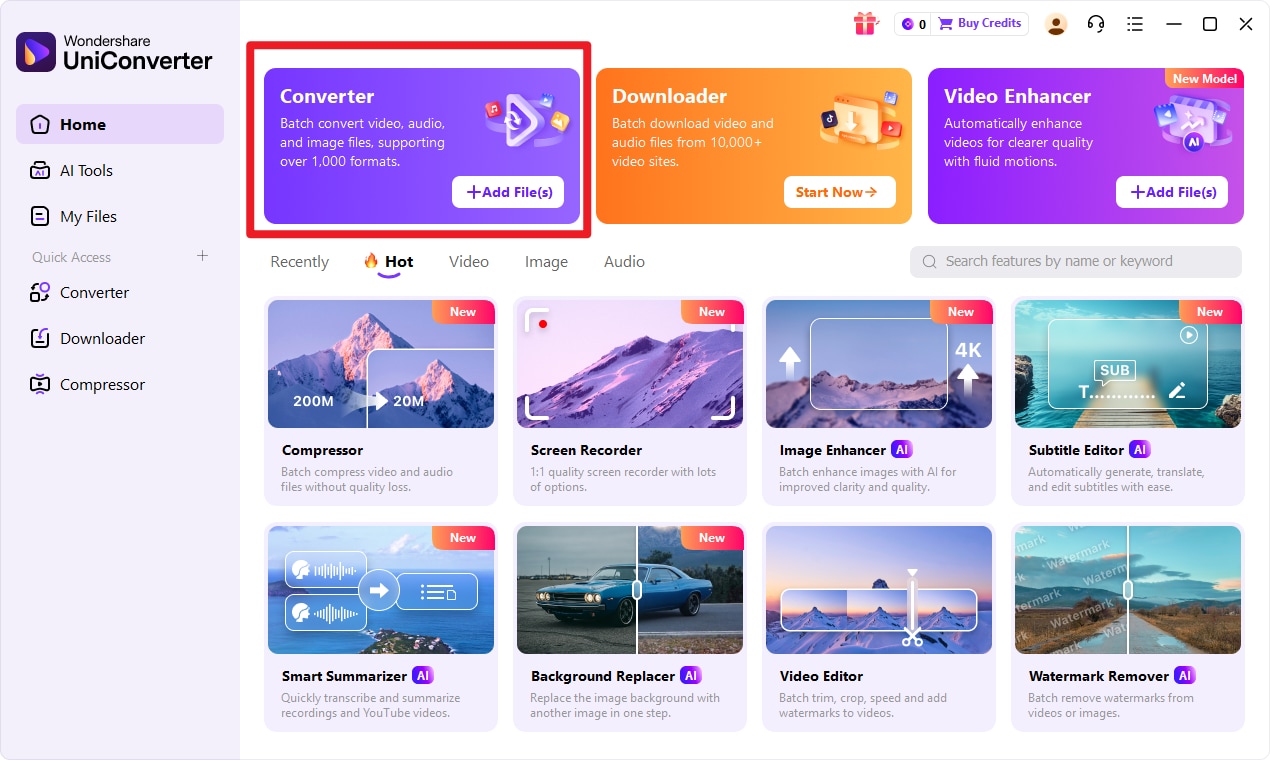
Launch Wondershare UniConverter on your computer. From the main home screen, navigate to the left-side menu and select the Converter tool to open the video conversion interface.
Step 2: Add Files to UniConverter
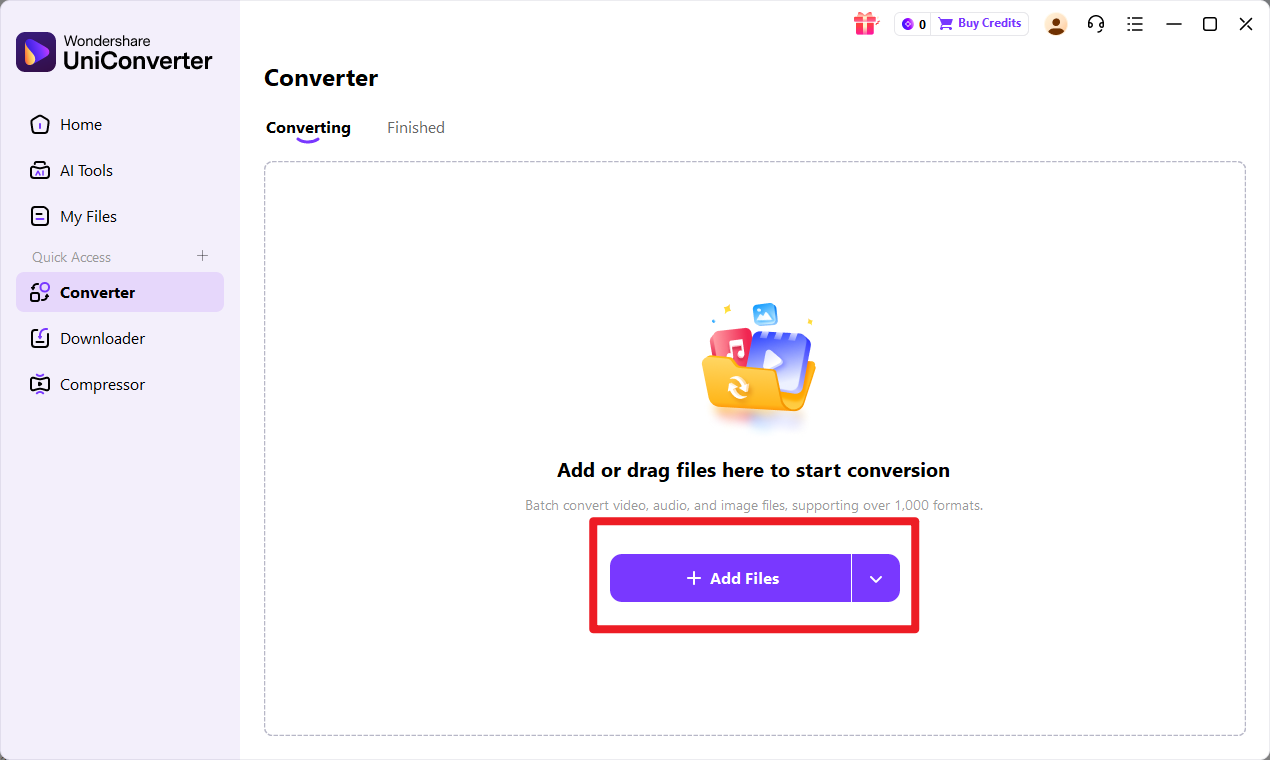
Click on the Add Files icon in the center or top-left corner to browse and import your video files. Alternatively, you can simply drag and drop your video files with the input format directly into the program window. UniConverter supports adding multiple files for batch conversion.
Step 3: Choose Output Format
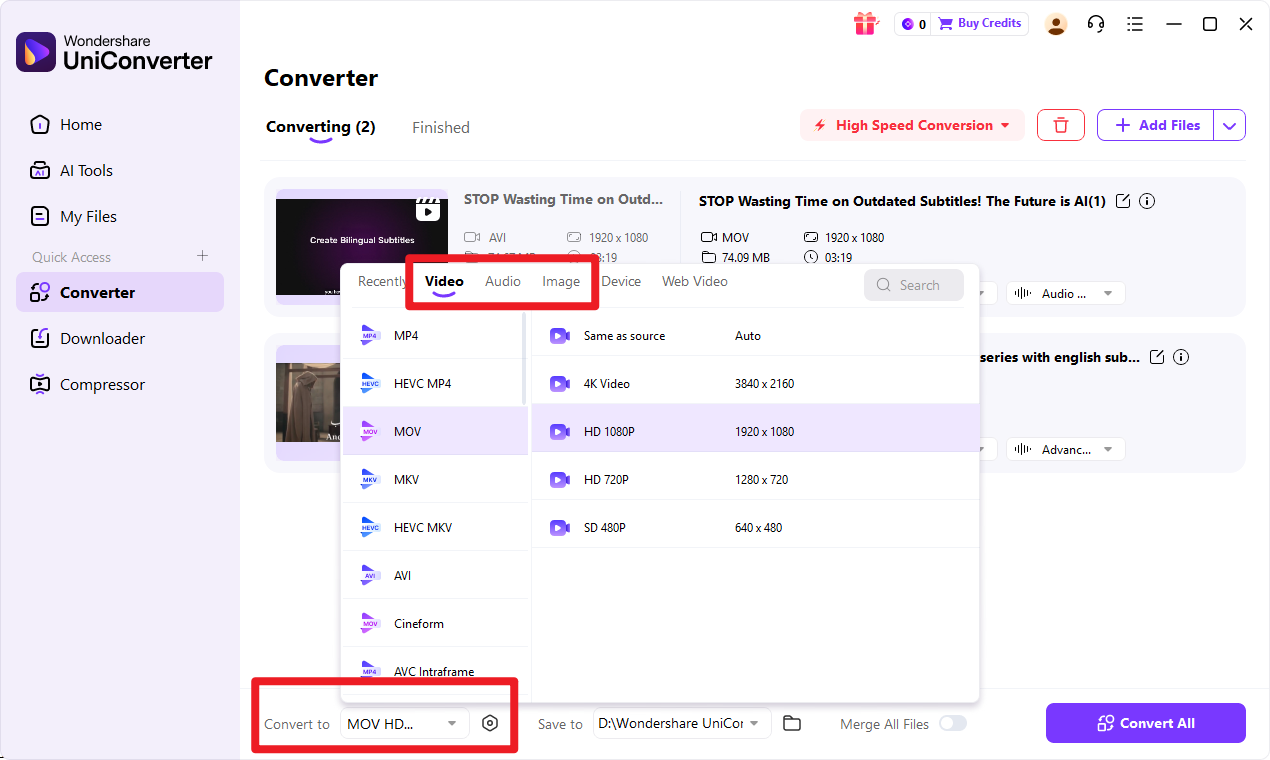
At the bottom of the window, click on the Output Format menu. A new window will appear. Go to the Video tab and choose your desired target format from the list, such as MP4 or MKV. You can also select a specific resolution or click the gear icon to access advanced encoder settings if needed.
Step 4: Start the Conversion
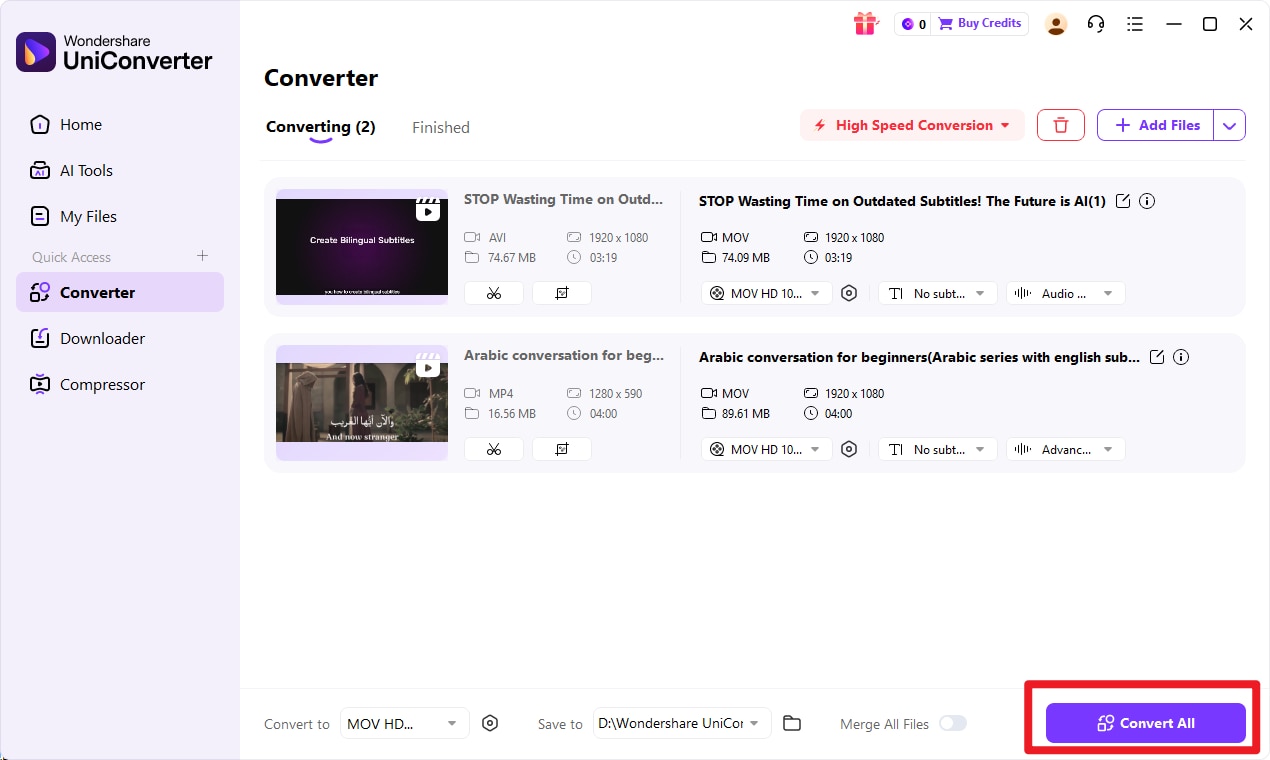
Before starting, ensure the High Speed Conversion toggle in the top-right corner is enabled. This will allow UniConverter to leverage GPU acceleration like NVENC if your hardware supports it. Finally, choose a destination folder under File Location and click the Convert (for a single file) or Start All (for a batch) button to begin the process.

Go Beyond Simple Video Conversion
Conclusion
In the x265 vs NVENC HEVC debate, it's clear there is no single winner for every situation. The best choice depends entirely on your specific goals and hardware. The decision boils down to a fundamental trade-off between speed and quality.
NVENC HEVC is the undisputed champion of speed and efficiency, making it the perfect companion for live streamers, gamers, and content creators who need rapid exports and minimal system impact. It prioritizes a smooth, real-time workflow above all else. On the other hand, x265 remains the master of quality and compression. It is the ideal choice for archivists, data hoarders, and videographers who demand the highest possible visual fidelity in the smallest possible file size and are willing to wait for it.
For users who need the flexibility to handle a variety of tasks, a versatile tool like Wondershare UniConverter is the perfect solution. It simplifies the entire process, automatically detecting and utilizing hardware acceleration like NVENC for fast conversions while still offering high-quality software encoding options. It empowers you to get the best of both worlds without needing to become an encoding expert.
FAQs
-
1. Is x265 always better quality than NVENC HEVC?
At the same low bitrate, x265 often provides slightly better visual quality due to its more advanced and complex software-based algorithms. However, with each new generation of NVIDIA GPUs, NVENC's quality has improved dramatically. At higher bitrates, the difference in quality can be minimal and often imperceptible to the average viewer. -
2. Can I use NVENC HEVC on an AMD graphics card?
No. NVENC is a proprietary technology exclusive to NVIDIA and requires an NVIDIA GeForce GPU that supports it. AMD has its own hardware encoding technology, known as the Video Coding Engine (VCE) or Video Core Next (VCN), which serves a similar purpose. -
3. Which encoder is better for reducing video file size?
For a specific level of visual quality, x265 is generally better at producing a smaller file size. Its intensive compression algorithms are more efficient at reducing data redundancy. The trade-off is that this process takes significantly longer than encoding with NVENC. -
4. What is the easiest way to use these encoders?
The easiest way is to use a comprehensive video software application like Wondershare UniConverter. Such programs provide a simple, graphical user interface that removes the technical complexity. UniConverter can automatically detect and use hardware acceleration like NVENC when available, or fall back to high-quality software encoding, allowing you to convert your videos quickly and easily without needing to manage complicated settings.
