
If you've ever dealt with digital video, especially from the early 2000s, you've likely come across files with extensions like .wmv or videos described as "Xvid." These formats were once giants in the digital landscape, but today they often cause confusion and playback headaches. You might have a WMV file that won't open on your Mac or an Xvid AVI file that your smart TV refuses to recognize. This leads to the central question: what exactly is the difference in the WMV vs Xvid debate, and what should you do with these files in 2026?
This guide will demystify these two legacy formats. We'll break down their technical differences, compare their performance in quality and compatibility, and explain why, for most modern purposes, the best solution is to convert them. By understanding their history and limitations, you can make informed decisions about managing your video library and ensuring your content is playable on any device.
In this article
Part 1. What is WMV? What is Xvid?
Before we can compare WMV and Xvid, it's crucial to understand what each one is, as they are fundamentally different types of technology. One is a container format, and the other is a codec, a distinction that is key to understanding video files.
What is WMV (Windows Media Video)?
WMV, which stands for Windows Media Video, is a video compression format and a corresponding video container format developed by Microsoft. It was introduced as a competitor to RealVideo and was designed to be the standard for video on the Windows platform.
As a container, a .wmv file can hold video, audio, and metadata. The video stream inside is almost always compressed using a Microsoft WMV codec. Its primary advantage was its seamless integration into the Windows ecosystem. If you had a Windows PC, Windows Media Player could play WMV files out of the box without any additional software.
- Pros: Excellent native support on all versions of Windows, decent compression for its time, and strong integration with other Microsoft products.
- Cons: It is a proprietary format, which leads to very limited native support on non-Windows platforms like macOS, Linux, iOS, and Android. Playing WMV files on these systems often requires a third-party media player or file conversion.
What is Xvid?
Xvid is an open-source video codec that adheres to the MPEG-4 Part 2 compression standard. Unlike WMV, Xvid is not a container format. It is purely a piece of software used to compress (encode) and decompress (decode) video data. Think of it as the "language" the video is written in.
Because Xvid is just a codec, the compressed video data needs to be stored inside a container file. The most common container for Xvid-encoded video is AVI (Audio Video Interleave). So, when you see a file labeled "Xvid," it's typically an AVI file containing video compressed with the Xvid codec. During its peak, Xvid was incredibly popular for its ability to produce high-quality video at very low bitrates, making it a favorite for sharing videos online and backing up DVDs.
- Pros: Open-source and free to use, known for excellent compression efficiency that delivered high quality at small file sizes.
- Cons: It has been largely superseded by more modern and efficient codecs like H.264 and H.265 (HEVC). Playback on modern mobile devices and smart TVs can be inconsistent without a versatile media player.
Key Difference: Codec vs. Container Explained
The confusion between WMV and Xvid often stems from not understanding the difference between a codec and a container. Here's a simple analogy:
- A container (like WMV, AVI, or MP4) is like a box. This box can hold different things: a video stream, one or more audio streams, and subtitles. The file extension (e.g.,
.wmv) usually tells you what kind of box it is. - A codec (like the WMV codec, Xvid, or H.264) is the method used to pack the video into the box. It's a set of rules for compressing the video to make it smaller and decompressing it for playback.
So, a WMV file is a Microsoft-designed box that almost always contains video packed with a Microsoft WMV method. An Xvid file, on the other hand, usually refers to a generic box (like AVI) that contains video packed with the Xvid method.
Part 2. Quick Comparison Table
To see the differences at a glance, here is a direct comparison of the key attributes of WMV and Xvid.
| Feature | WMV | Xvid |
| Developer | Microsoft | Xvid Community (Open Source) |
| Type | Video Format & Container | Video Codec |
| Common Container | .wmv, .asf | .avi |
| Compatibility | Excellent on Windows, poor on other platforms without extra software. | Formerly wide on DVD players and PCs, less so on modern mobile devices and smart TVs. |
| Status | Legacy, proprietary. | Legacy, open-source. |
Part 3. WMV vs Xvid: Which One Is Better?
While both formats are now considered legacy, they had distinct advantages during their prime. Understanding these helps explain why you might have files in one format or the other and what to do with them now.
Comparison of Video Quality and Compression
In the mid-2000s, when both formats were popular, Xvid was generally considered superior in terms of compression efficiency. For a given file size, Xvid could often produce a video with noticeably better visual quality and fewer compression artifacts than WMV. This is why it became the de facto standard for the peer-to-peer file-sharing community and for people creating digital backups of their DVD collections. It offered a fantastic balance of quality and size that was hard to beat at the time.
WMV's compression was decent, especially at higher bitrates, but it couldn't quite match the efficiency of Xvid. Its main purpose was streaming and Windows-based media, where guaranteed compatibility within that ecosystem was more important than achieving the absolute smallest file size.
Comparison of Compatibility and Playback
This is where the two diverge significantly.
- WMV: Its strength was its guaranteed playback on any Windows computer. For corporate environments, presentations, or sharing videos between Windows users, WMV was the reliable choice. However, this compatibility was a walled garden. Taking a WMV file to a Mac, an iPhone, or a Linux machine was a recipe for frustration, as these platforms lacked native support.
- Xvid: Because Xvid-encoded video was typically placed in an AVI container, its compatibility was broader in a different sense. Many third-party hardware manufacturers, especially of standalone DVD players, added support for "DivX/Xvid playback." This meant you could burn an Xvid AVI file to a CD or DVD and play it on your TV. However, this compatibility has faded. Most modern smart TVs, smartphones, and tablets do not natively support the Xvid codec or the AVI container, again leading to playback issues.
The Verdict: Which Should You Use Today?
In 2026, the answer is clear: neither. Both WMV and Xvid have been surpassed by far more efficient and universally compatible standards.
For creating or encoding any new video content, you should use the H.264 or H.265 (HEVC) codec within an MP4 container. This combination offers superior compression, higher quality, and is natively supported by virtually every modern device, from smartphones and computers to smart TVs and web browsers.
If you have a library of old WMV or Xvid files, the debate isn't about which is better, but rather about the best way to modernize them. The most practical solution is to convert these files into a modern format like MP4. This ensures you can watch them anywhere, share them easily, and preserve them for the future without worrying about finding a compatible player. This is where a powerful tool like Wondershare UniConverter becomes indispensable, allowing you to batch-convert your entire legacy library with just a few clicks.
Part 4. Use Cases for WMV and B
You are unlikely to create new files in these formats today, but you may still encounter them when dealing with older digital content. Here's where you are most likely to find them.
When You Might Encounter WMV
WMV files typically originate from a Windows-centric environment. You might find them in scenarios such as:
- Legacy Corporate Content: Many companies created training videos, internal communications, and marketing materials in WMV format during the 2000s because it was the corporate standard.
- Old Personal Videos: If you or someone you know used Windows Movie Maker to edit home videos, the default output was often WMV.
- Archived Web Content: Some older websites used WMV for embedded video streams before Flash and later HTML5 video became dominant.
- Digital Camera Files: A few older digital cameras recorded video in the WMV format.
When You Might Encounter Xvid
Xvid files are most often associated with the era of digital media sharing and DVD backups. Common sources include:
- Downloaded Movies and TV Shows: In the age of peer-to-peer file sharing, Xvid was the go-to codec for compressing movie files to a manageable size (e.g., fitting a full movie onto a single CD).
- DVD Backups: Many people used tools like Gordian Knot to create digital copies of their DVD collections, and Xvid was the preferred codec for this purpose due to its quality-to-size ratio.
- Standalone Media Players: Files intended for playback on older DVD/DivX players or early digital media hubs were often encoded with Xvid.
Part 5. Step-by-Step Guide to Convert WMV to Xvid Using UniConverter
Whether you have a WMV file that won't play on your Mac or an old Xvid AVI that your phone rejects, conversion is the answer. Wondershare UniConverter provides a simple, fast, and high-quality solution to make any video file compatible with any device. Here's how you can easily convert your files from one format to another.
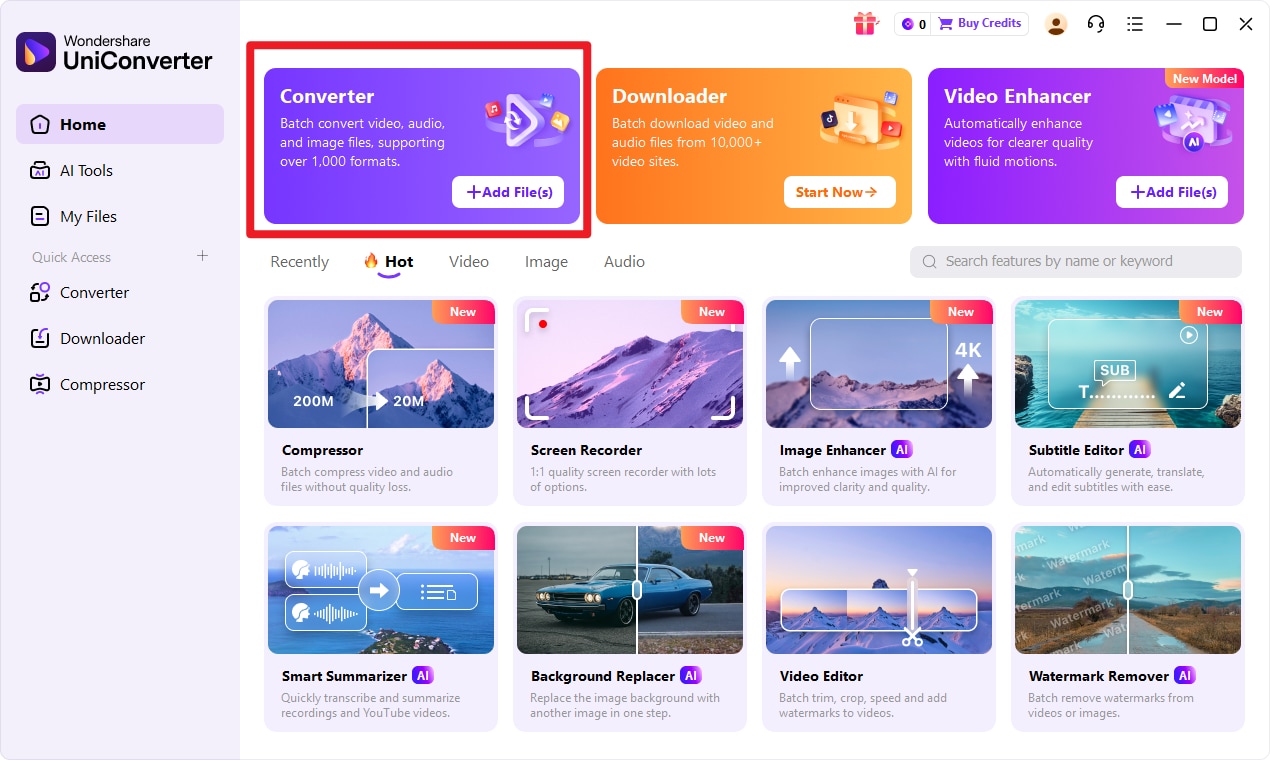
Step 1. Choose Converter in UniConverter
Launch Wondershare UniConverter on your computer. From the main menu on the left, select the Converter tool to open the conversion interface.
Step 2. Add Files to UniConverter
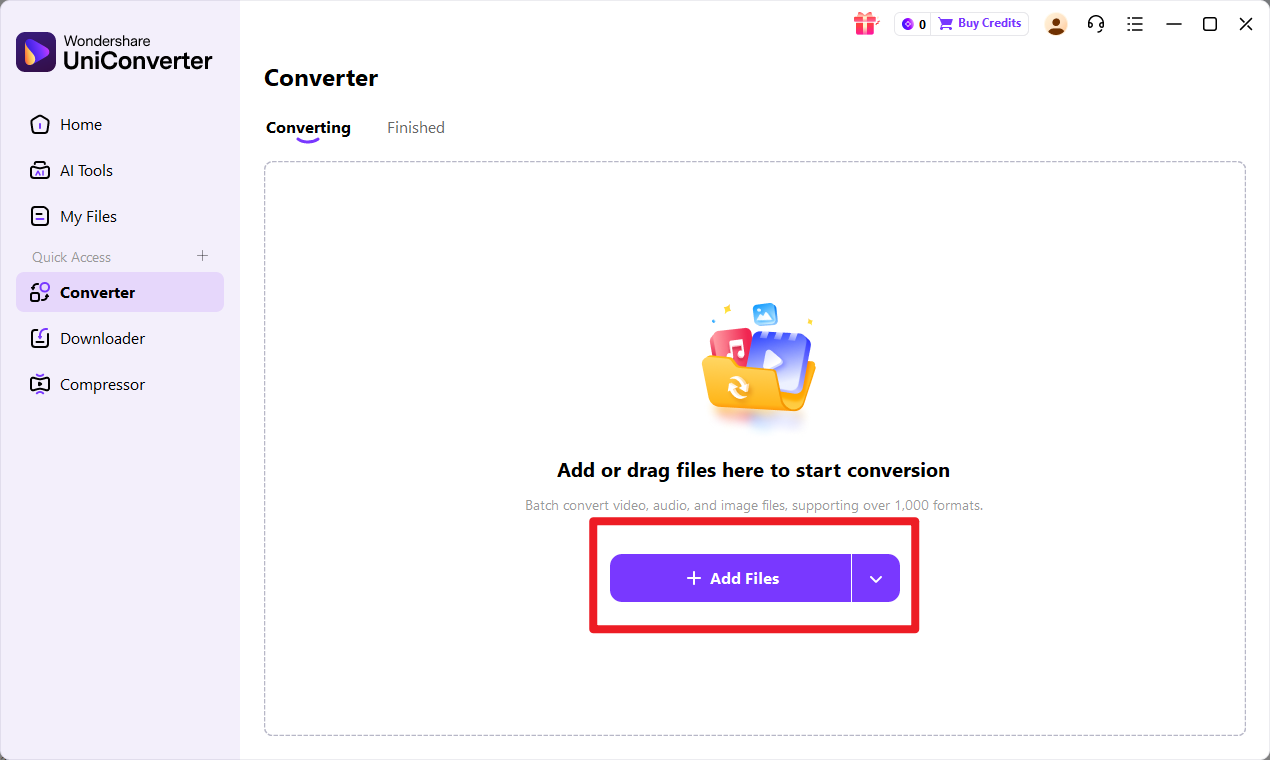
You can drag and drop your input format files directly into the program window. Alternatively, click the Add Files button in the top-left corner to browse your computer's folders and import the video files you want to convert.
Step 3. Choose Output Format
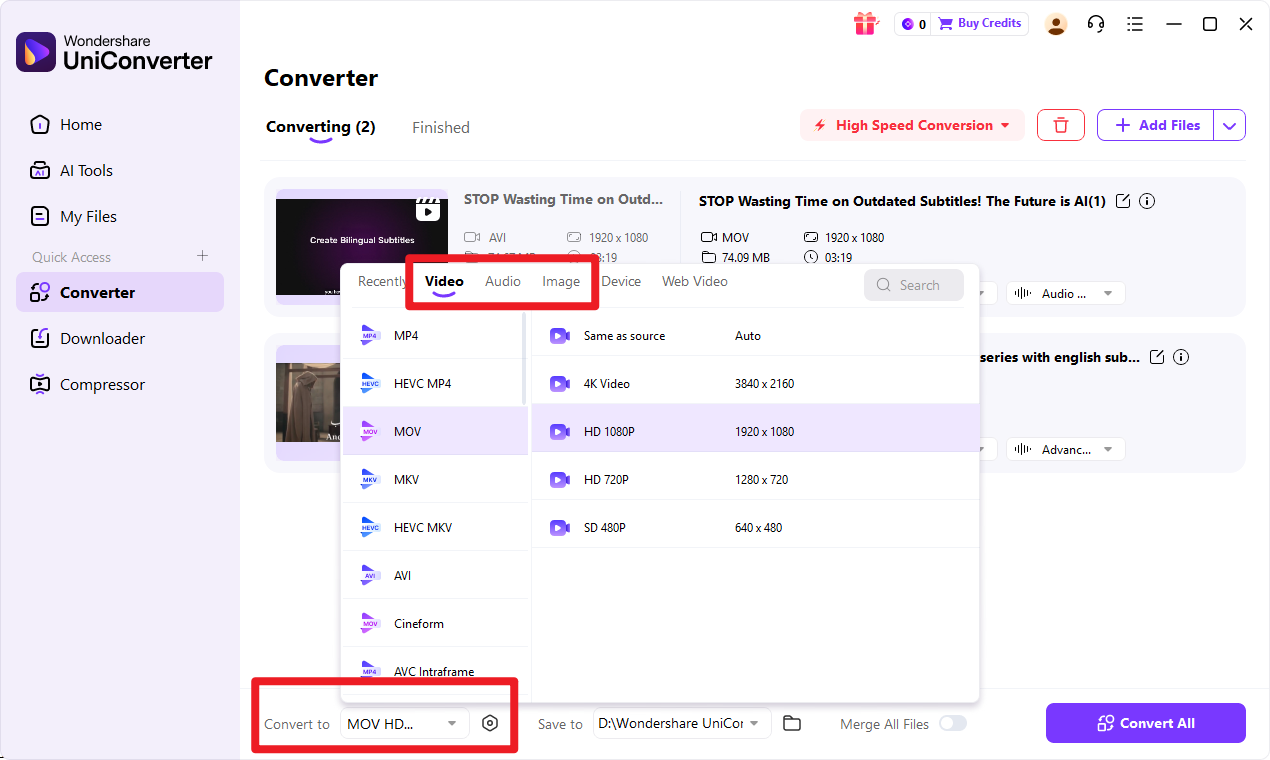
Click on the Output Format menu located at the bottom of the window. This will open a new dialog box. Navigate to the Video tab, select your desired target format (like MP4) from the list on the left, and then choose a resolution on the right (e.g., "Same as source" to maintain quality).
Step 4. Start the Conversion
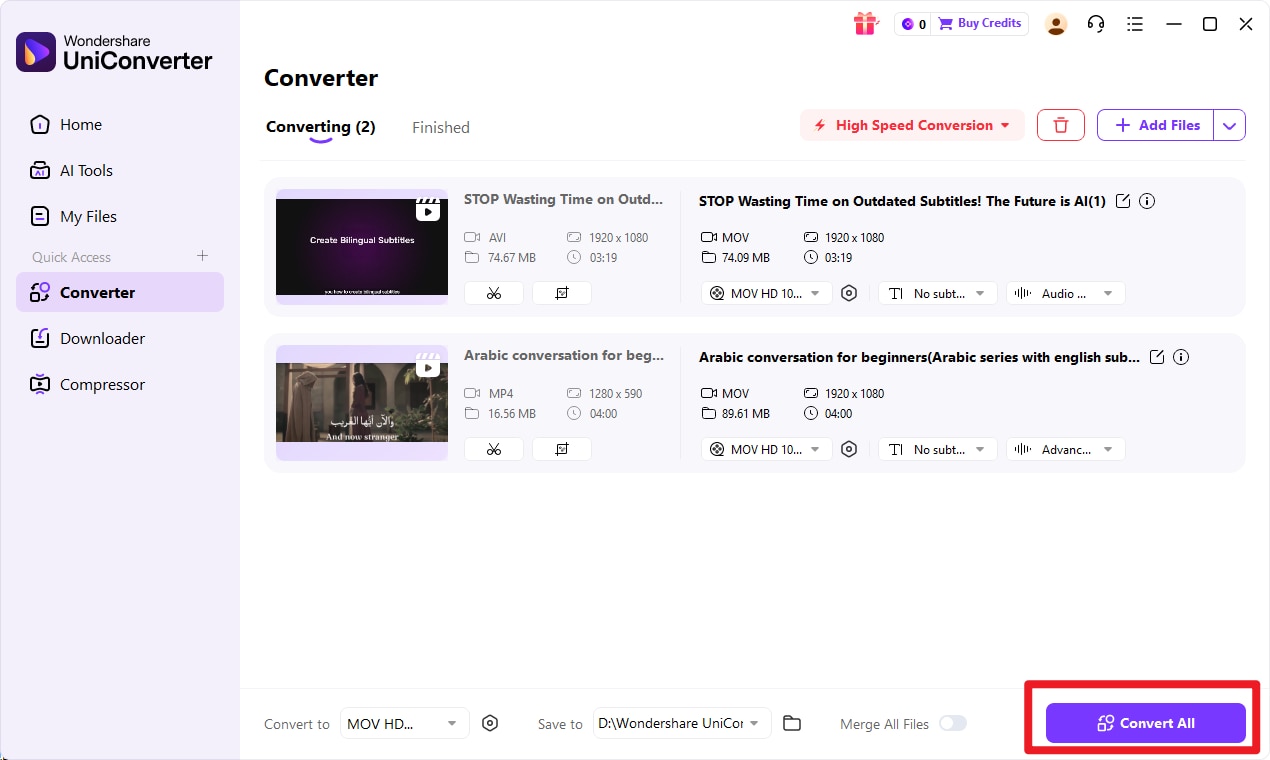
Finally, choose a destination for your converted file by using the File Location menu at the bottom. Once you are ready, click the Start All button to begin the conversion process. UniConverter will quickly process your files and save them in the new format.

Go Beyond Simple Video Conversion
Conclusion
While the WMV vs Xvid discussion was relevant fifteen years ago, today it is largely an academic one. Both formats played a significant role in the evolution of digital video but have since been eclipsed by more efficient, powerful, and universally compatible standards like H.264 and H.265 in an MP4 container. For users in 2026, the challenge is not choosing between them, but rather dealing with the compatibility issues they present on modern devices.
The most practical and forward-thinking solution is to convert these legacy files. By converting your WMV and Xvid videos to a modern format like MP4, you ensure they will be playable for years to come on any device you own, from your smartphone to your smart TV. For this task, Wondershare UniConverter stands out as the ideal tool. It offers a user-friendly interface, lightning-fast conversion speeds, and support for a vast array of formats, making it the perfect solution for modernizing your entire video library.
FAQs
-
1. Is Xvid better than WMV?
In their prime, Xvid was often considered better because it could provide higher video quality at a smaller file size compared to WMV. However, today both are considered outdated. The "better" choice now is to convert files from either format into a modern standard like MP4 (H.264) for universal compatibility and superior performance. -
2. Can I play a WMV file on a Mac?
You cannot play a WMV file on a Mac natively using QuickTime Player. To play it, you need to either install a third-party media player that supports WMV, such as VLC Media Player, or use a conversion tool like Wondershare UniConverter to convert the file into a Mac-friendly format like MP4 or MOV. -
3. Is Xvid a virus?
No, Xvid itself is a legitimate and safe open-source video codec. It is simply a tool for video compression. However, its popularity in the early days of peer-to-peer file sharing means that files encoded with Xvid were sometimes distributed on untrustworthy websites that could bundle them with malware. As long as you obtain your video files from reputable sources, the Xvid codec is perfectly safe. -
4. What is the best format to convert my old WMV or Xvid files to?
For the best balance of high quality, small file size, and maximum compatibility across all modern devices (including smartphones, tablets, computers, and smart TVs), the recommended format is MP4 with the H.264 video codec. This is the current industry standard and will ensure your videos play flawlessly everywhere.
