
Have you ever stumbled upon an old video file with a .wmv or .rmvb extension and found yourself unable to play it on your new smartphone or Mac? You're not alone. These formats, once giants in the world of digital video, have become relics of a different era. Understanding the WMV vs RMVB debate is key to unlocking your old media library. While one was a staple of the Windows ecosystem, the other was the king of file-sharing sites due to its incredible compression. But in 2026, their relevance has shifted dramatically, often leading to frustrating compatibility issues.
This guide will demystify these two formats. We'll dive deep into their origins, compare their strengths and weaknesses, and help you decide what to do with them today. More importantly, we'll show you the definitive solution for modernizing your video collection, ensuring you can enjoy your content on any device, anytime.
In this article, you will learn:
- What WMV and RMVB files are and where they came from.
- A direct comparison of their file size, quality, and compatibility.
- Which format holds up better and in what specific scenarios.
- The best modern alternative for storing and playing your videos.
- A step-by-step guide to converting these files for universal playback.
Part 1. What is WMV? What is RMVB?
To understand the core of the WMV vs RMVB comparison, we first need to look at what each format is and the purpose it was designed to serve.
What is WMV (Windows Media Video)?
WMV, short for Windows Media Video, is a video compression format developed by Microsoft. As the name suggests, it was created to be the standard video format for the Windows ecosystem. It was first introduced in 1999 and was designed primarily for internet streaming and video playback on Windows-based personal computers.
The key advantage of WMV has always been its tight integration with Microsoft products. It plays natively on any Windows PC using Windows Media Player without the need for additional codecs. The format uses Microsoft's own compression technology, which provides a good balance between video quality and file size. Over the years, it has also been used for physical media like HD DVD and Blu-ray Discs, although it was less common than other codecs. While its dominance has waned with the rise of more universal formats, WMV files are still encountered in corporate environments and within older digital media archives.
What is RMVB (RealMedia Variable Bitrate)?
RMVB, which stands for RealMedia Variable Bitrate, is a video format developed by RealNetworks. It is an extension of the earlier RealMedia (RM) format. RMVB's claim to fame was its use of a variable bitrate (VBR) encoding scheme. This was a revolutionary approach at the time, as it allowed the format to allocate more data to complex, high-motion scenes and less data to simpler, static scenes.
The result was a significantly smaller file size compared to other formats of the era offering similar visual quality. This high compression ratio made RMVB incredibly popular in the early 2000s, especially for distributing movies and TV shows over the internet when bandwidth was limited. For many, RMVB was the go-to format for downloading and storing large video libraries on limited hard drive space. However, this efficiency came at a cost: poor compatibility. RMVB files required the specific RealPlayer or special codec packs to be played, and they have virtually no native support on modern devices.
Part 2. Quick Comparison Table
To get a clear, at-a-glance overview of WMV vs RMVB, this table breaks down their key characteristics.
| Feature | WMV | RMVB |
| Developer | Microsoft | RealNetworks |
| File Size | Generally larger | Generally smaller |
| Quality | Consistent quality, can be higher at the same bitrate | Good quality for the size, but can be variable |
| Compatibility | High on Windows, moderate on other platforms | Low on modern devices, often requires special players |
| Primary Use | Streaming and Windows media | Storing large video files in a small space (legacy) |
Part 3. WMV vs RMVB: Which One Is Better?
Choosing a "better" format depends entirely on your priorities. Let's break down the comparison across the three most important factors: file size, quality, and compatibility.
File Size and Compression
When it comes to pure compression efficiency, RMVB is the clear winner. Its variable bitrate technology was specifically engineered to create the smallest possible files. By intelligently adjusting the bitrate throughout the video, it avoids wasting data on simple scenes, allowing it to drastically shrink file sizes. For someone in the early 2000s looking to download a full-length movie over a slow internet connection, RMVB was a game-changer. A 700MB RMVB file could contain a movie that might take up 1.4GB in another format.
WMV, on the other hand, provides good compression but generally results in larger files than an RMVB of comparable length and perceived quality. Its compression algorithm is more focused on maintaining a consistent quality stream, which often requires a higher average bitrate and, consequently, a larger file. For storage purposes where every megabyte counts, RMVB had the historical advantage.
Video and Audio Quality
Here, the trade-offs become more apparent. WMV often delivers more stable and consistent video quality. Because it tends to use a more generous and steady bitrate, it handles high-motion and complex scenes with fewer noticeable compression artifacts. At the same average bitrate, a WMV file will generally look sharper and cleaner than an RMVB file.
RMVB's focus on size can sometimes compromise quality. While it looks surprisingly good for how small the files are, its variable bitrate can sometimes be too aggressive. In scenes with fast action, explosions, or rapid camera pans, you might notice blockiness or a loss of detail. The quality is "variable" in more ways than one—it varies not just with the complexity of the scene, but also in its overall reliability compared to WMV. For users who prioritize visual fidelity over file size, WMV is the more dependable choice.
Compatibility and Playback
This is the category where the battle is decisively won in the modern era. WMV has a massive advantage in compatibility. It is natively supported by all versions of Windows and plays flawlessly in Windows Media Player. Furthermore, many third-party media players on other platforms, like VLC Media Player, can handle WMV files without any issue. While not as universal as MP4, its Microsoft backing gives it a significant edge.
RMVB, in stark contrast, suffers from extremely poor compatibility on modern systems. It will not play on macOS, iOS, or Android devices out of the box. Smart TVs, game consoles, and modern video editing software almost never support it. To play an RMVB file today, you must hunt down and install a specific third-party player like RealPlayer or a comprehensive codec pack, which can be inconvenient and sometimes risky.
This severe lack of support makes RMVB files impractical for modern use. If you have a collection of RMVB videos, the best and often only way to make them usable is to convert them. For seamless playback on any device, converting both legacy WMV and RMVB files is the smartest path forward. An excellent tool like Wondershare UniConverter can handle both formats effortlessly, transforming them into a universally playable format.
Part 4. Use Cases for WMV and RMVB
While both formats are largely outdated for creating new content, they still exist in specific contexts. Understanding their original and current use cases helps clarify what to do with them.
When to Use WMV
Even in 2026, there are a few niche scenarios where using WMV might still make sense:
- Windows-Centric Environments: If you are creating video content exclusively for an audience using Windows PCs, WMV remains a reliable choice that guarantees playback without any extra software.
- Microsoft Office Integration: WMV files can be easily embedded into PowerPoint presentations or other Microsoft Office documents, ensuring smooth integration within that software suite.
- Legacy System Support: In some corporate or educational institutions that still operate on older Windows-based systems, WMV might be the required format for video submissions or internal distribution.
For any other purpose, especially sharing videos online or with users on different platforms, creating new content in WMV is not recommended.
When to Use RMVB
The use case for RMVB in 2026 is extremely limited and almost entirely historical. This format is obsolete for any form of new content creation. Its primary relevance today is related to legacy files:
- Playing or Archiving Old Media: If you have a digital archive of movies or TV shows from the early 2000s, you will likely have a large number of RMVB files.
- Accessing Niche Content: Some older, fan-subtitled anime or foreign films distributed online years ago may only be available in RMVB format.
In nearly every case, if you encounter an RMVB file, your goal should not be to find a player for it, but to convert it. Keeping files in this format is impractical and locks your media to outdated technology.
The Modern Solution: Converting to MP4
For universal compatibility, the best choice is neither WMV nor RMVB. The undisputed modern standard is MP4 (using the H.264 or H.265 codec). MP4 is a container format that is supported by virtually every device, platform, and video editor in existence today.
- Universal Compatibility: MP4 files play on Windows, macOS, iOS, Android, smart TVs, PlayStation, Xbox, and more.
- High-Quality Compression: Modern codecs like H.264 and HEVC (H.265) offer a fantastic balance of high quality and small file size, surpassing what both WMV and RMVB could achieve.
- Web Standard: MP4 is the standard format for web streaming on platforms like YouTube, Vimeo, and Netflix.
Using a powerful video converter is the key to unlocking your old media library. Tools like Wondershare UniConverter allow you to easily transform your aging WMV or RMVB files into future-proof MP4s, preserving their quality while making them accessible everywhere.
Part 5. Step-by-Step Guide to Convert WMV to RMVB Using UniConverter
Whether you need to convert WMV to RMVB for a specific legacy reason or, more practically, convert both formats to the modern MP4 standard, UniConverter makes the process incredibly simple. Here is how you can convert your files in four easy steps.
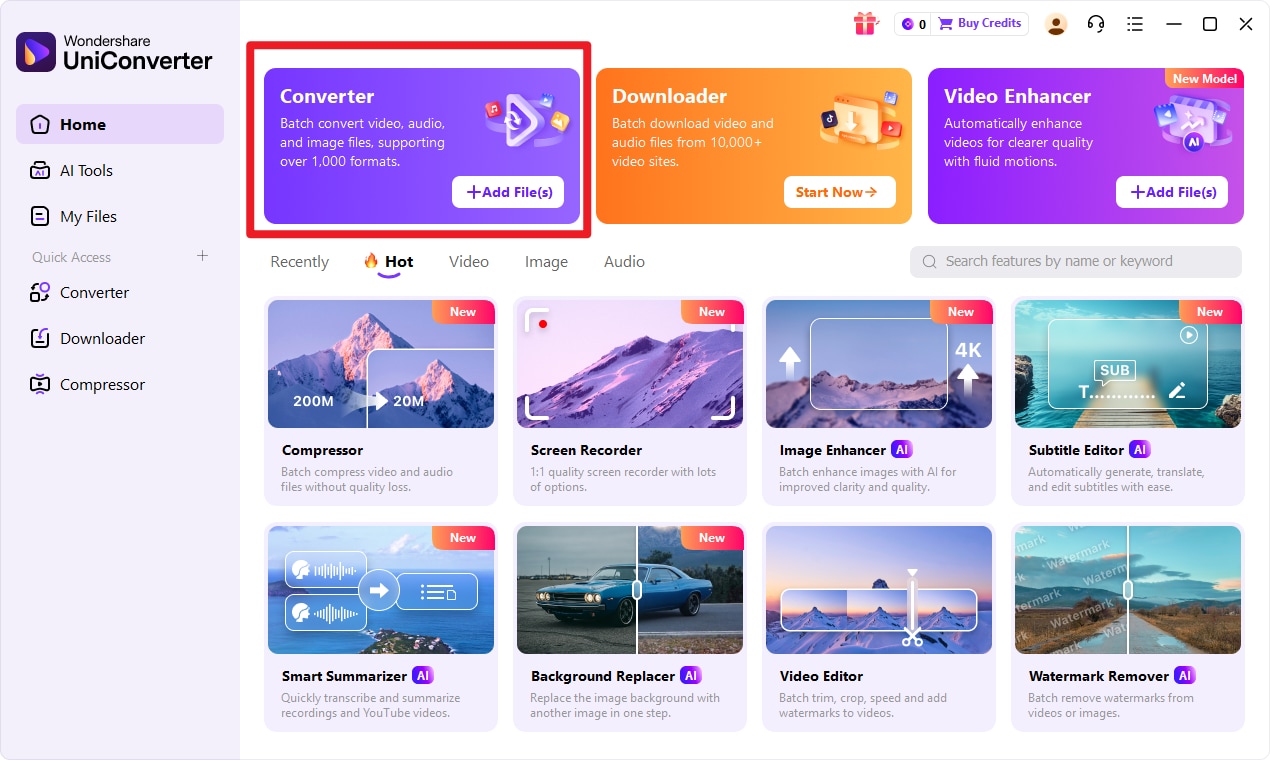
Step 1: Choose Converter in UniConverter
Launch Wondershare UniConverter on your computer. Once the program is open, navigate to the main interface and select the Converter tab from the menu on the left side. This is the main hub for all your video conversion tasks.
Step 2: Add Files to UniConverter
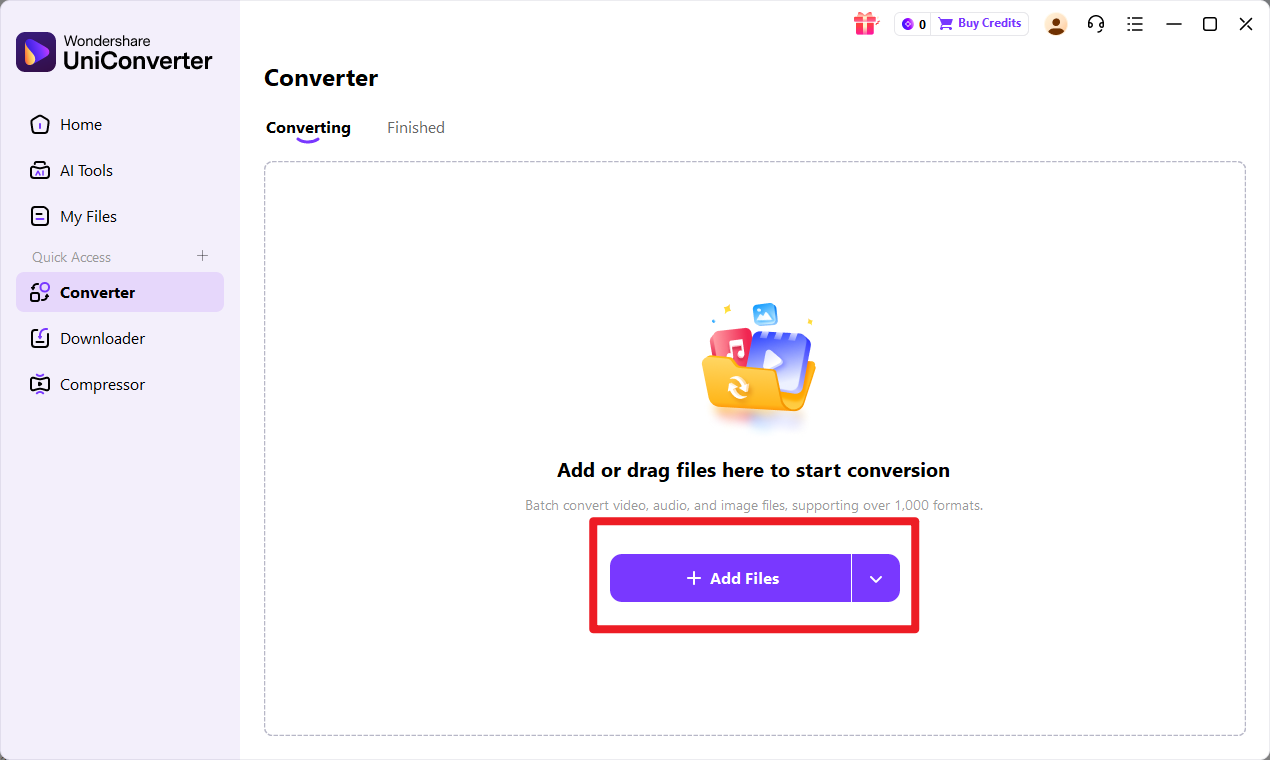
In the Converter window, click on the Add Files icon in the top-left corner to browse and select your input format files from your computer. Alternatively, you can simply drag and drop the files directly into the program window. UniConverter supports batch conversion, so feel free to add multiple files at once.
Step 3: Choose Output Format
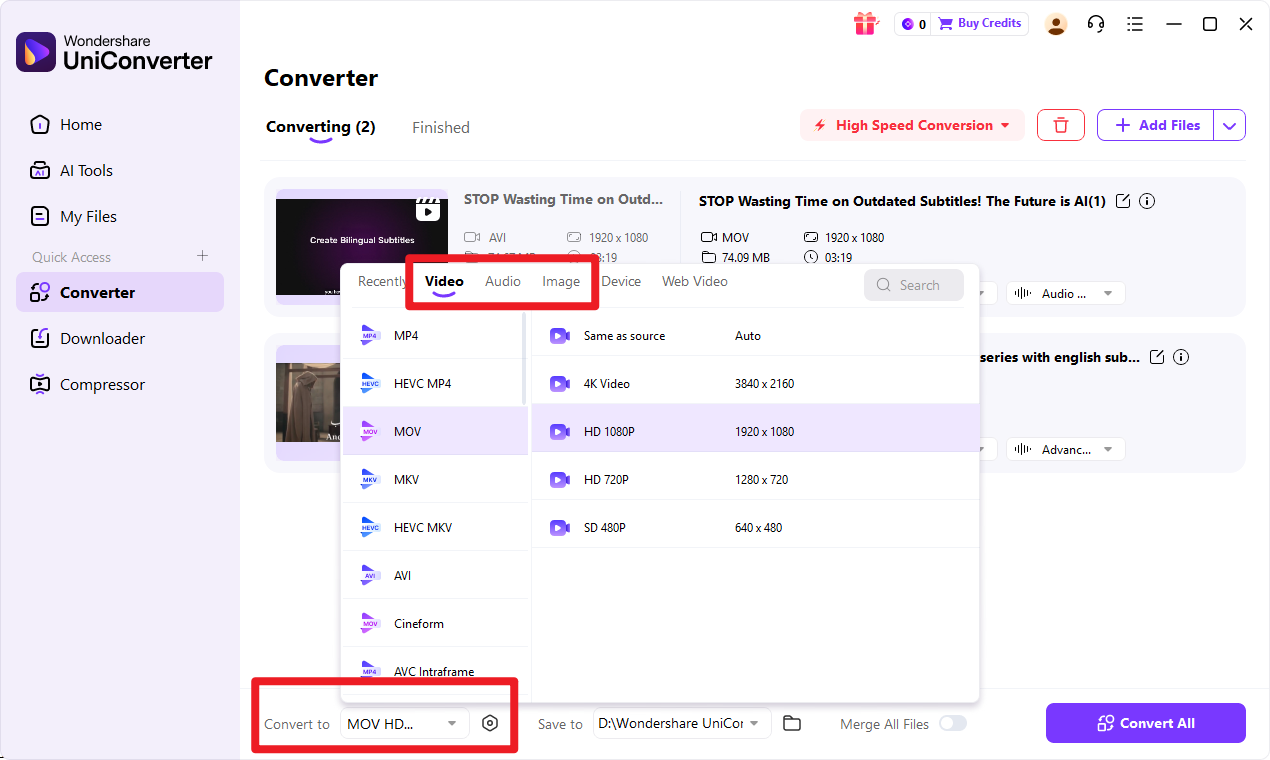
At the bottom of the window, click on the Output Format menu. This will open a new window displaying a wide range of format options. Go to the Video tab and select your desired target format from the list. You can also choose a preset optimized for a specific device.
Step 4: Start the Conversion
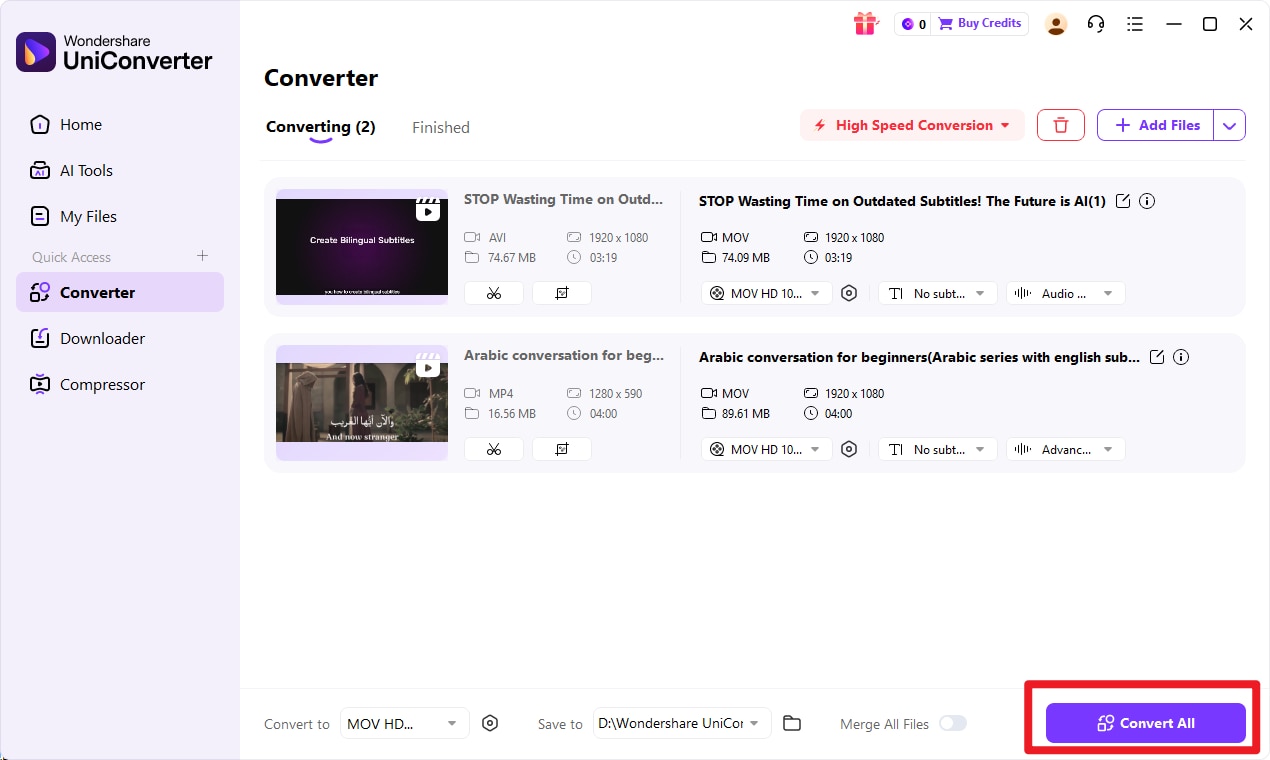
Before starting, you can specify where you want to save the converted files by clicking the File Location field at the bottom. Once you are ready, click the Start All button in the bottom-right corner. UniConverter will begin processing all your files quickly and efficiently.

Go Beyond Simple Video Conversion
Conclusion
Both WMV and RMVB are legacy formats that played important roles in the history of digital video. WMV offered reliable quality and strong integration with the Windows ecosystem, while RMVB revolutionized file sharing with its superior compression and small file sizes. However, in the landscape of 2026, their practical applications are limited. The WMV vs RMVB debate concludes with a clear verdict: for modern video playback, sharing, and editing, neither format is ideal due to significant compatibility limitations, especially in the case of RMVB.
The most effective and forward-thinking solution for anyone dealing with these files is conversion. By transforming your WMV and RMVB videos into the universally accepted MP4 format, you ensure they are accessible on any device, now and in the future. A robust and user-friendly tool like Wondershare UniConverter simplifies this entire process, making it easy to modernize your entire video library without compromising quality.
FAQs
-
1. Is RMVB better than WMV?
It depends entirely on your priority. For achieving the smallest possible file size for a given video, RMVB was historically better due to its variable bitrate encoding. However, for broader compatibility and more consistent video quality without noticeable artifacts, WMV is the superior choice. For any modern application, neither is recommended over MP4. -
2. Can I play RMVB files on my Mac or iPhone?
No, you cannot play RMVB files natively on a Mac, iPhone, or any other Apple device. The operating systems do not include the necessary codecs. To play them, you would need to download a specific third-party media player from the App Store that supports the RMVB format. A much more reliable and permanent solution is to convert the RMVB file to an Apple-friendly format like MP4 or MOV using a converter like UniConverter. -
3. Are WMV and RMVB lossy formats?
Yes, both WMV and RMVB are lossy compression formats. This means that during the compression process, they permanently discard some of the original video data in order to reduce the overall file size. As a result, there is always some degree of quality loss compared to the uncompressed source video. The goal of these formats is to make this quality loss as unnoticeable as possible while achieving significant size reduction.
