
Navigating the world of video formats can be complex, with a sea of acronyms and technical specifications to understand. Two names that frequently appear are WebM and Xvid, yet they serve fundamentally different roles in the digital video landscape. Choosing the right one is crucial for ensuring your videos are high-quality, accessible, and optimized for their intended platform. Whether you're a web developer embedding videos, a content creator archiving your work, or simply trying to play a file that won't open, understanding the WebM vs Xvid debate is essential.
This guide will provide a comprehensive breakdown of both, demystifying their technical differences, comparing their performance in key areas, and outlining their ideal use cases. We'll explore everything from compression efficiency and video quality to device compatibility, helping you make an informed decision for your projects. Furthermore, we'll show you how to easily convert between these formats when you encounter compatibility roadblocks.
In this article
Part 1. What is WebM? What is Xvid?
Before we can compare them, it's important to understand what WebM and Xvid are individually. A common point of confusion is that one is a container format, while the other is a codec. Let's clarify this distinction.
What is WebM?
WebM is an open, royalty-free audiovisual media file format. Think of it as a digital container specifically designed for use with HTML5 video on the web. It was introduced by Google in 2010 as a free and open alternative to proprietary formats, aiming to provide a high-quality video standard for the modern internet.
A WebM file (.webm) bundles together different streams of data into a single package. Its structure is based on the Matroska (.mkv) container profile and typically includes:
- Video Streams: Compressed using the VP8 or VP9 video codecs. VP9, in particular, is highly efficient and offers excellent quality for streaming.
- Audio Streams: Compressed using the free and open-source Vorbis or Opus audio codecs.
The primary purpose of WebM is to streamline the delivery of video content online. Because it's royalty-free and supported natively by most major web browsers (like Chrome, Firefox, and Edge), developers can embed WebM videos directly into web pages without requiring users to install special plugins or codecs. This makes it a cornerstone of modern web video.
What is Xvid?
Unlike WebM, Xvid is not a file format. Instead, Xvid is a video codec library that follows the MPEG-4 Part 2 Advanced Simple Profile (ASP) compression standard. A codec (short for coder-decoder) is a piece of software that compresses and decompresses digital video. Its job is to shrink massive raw video data into a manageable file size for storage or transmission, and then decompress it for playback.
Because Xvid is just the codec, it doesn't exist as a standalone file. The compressed video data it creates must be placed inside a multimedia container format. The most common container for Xvid video is AVI (.avi), though it can also be found in others like MKV.
Xvid emerged as a popular open-source alternative to the proprietary DivX codec, which also follows the MPEG-4 standard. Its main purpose has historically been to compress large video files, such as movies and TV shows, into significantly smaller sizes while maintaining a high level of visual quality. This made it extremely popular for digital video libraries, peer-to-peer file sharing, and playback on a wide range of hardware devices that supported the AVI/MPEG-4 combination.
Part 2. Quick Comparison Table
To get a clear, at-a-glance overview of the key differences, here is a quick comparison table that highlights the essential characteristics of WebM and Xvid.
| Feature | WebM | Xvid |
| Developer | Xvid Community (Open Source) | |
| File Type | Container Format (.webm) | Codec (often in .avi container) |
| Video Codec | VP8, VP9 | MPEG-4 Part 2 ASP |
| Audio Codec | Vorbis, Opus | Commonly MP3, AC3 |
| Primary Use | Web Streaming, HTML5 Video | Local File Storage, Device Playback |
| Compatibility | High on modern web browsers | High on desktop players and older hardware |
| Licensing | Royalty-Free | GNU GPL (Free Software) |
Part 3. WebM vs Xvid: Which One Is Better?
Determining whether WebM or Xvid is "better" depends entirely on the context. Each has distinct advantages in different scenarios. Let's break down their performance in three critical areas: compression, quality, and compatibility.
WebM vs Xvid: Compression and File Size
Compression efficiency is a measure of how well a codec can reduce file size without sacrificing too much visual quality. In this category, WebM has a clear advantage due to its more modern codecs.
WebM, especially when using the VP9 codec, offers significantly superior compression compared to Xvid. VP9 was designed to be a direct competitor to H.265 (HEVC) and is optimized for the demands of internet streaming. It can achieve the same level of video quality as Xvid at a substantially lower bitrate, resulting in a smaller final file size. This is a massive benefit for web developers and content creators, as smaller files mean faster loading times, reduced bandwidth costs, and a smoother viewing experience for users, especially those on slower connections.
Xvid, being based on the older MPEG-4 Part 2 standard, provides excellent compression that was revolutionary for its time. It can still create impressively small files from large sources. However, it has been surpassed by the mathematical efficiency of newer codecs like VP9 and H.265. For a given quality target, an Xvid file will almost always be larger than a VP9-encoded WebM file.
WebM vs Xvid: Quality
The final video quality of any file is not determined by the format or codec alone; it's heavily influenced by the encoding settings used, such as bitrate, resolution, and frame rate. Both WebM and Xvid are capable of producing crisp, high-definition video.
The key difference in quality becomes apparent at lower bitrates. When bandwidth is limited—a common scenario in online streaming—WebM with the VP9 codec tends to perform better. It is more effective at retaining detail and produces fewer noticeable compression artifacts (like blocking or blurring) than Xvid at the same low bitrate. This makes WebM the superior choice for delivering high-quality video over variable network conditions.
At high bitrates, the quality difference between the two becomes less pronounced, and both can look nearly identical to the source. However, for the web, where efficiency is paramount, WebM's ability to maintain quality at smaller sizes gives it the edge.
WebM vs Xvid: Compatibility
Compatibility is where the roles are reversed. The best format is useless if your target audience can't play it.
WebM is the undisputed winner for web compatibility. It is a core part of the HTML5 standard and is supported natively by Google Chrome, Mozilla Firefox, Opera, and Microsoft Edge. This means you can embed a WebM video on a website, and the vast majority of users will be able to play it instantly without needing any plugins or external software. However, its compatibility outside of web browsers is less universal. While many modern media players like VLC can handle WebM, some older hardware devices and software may not recognize it.
Xvid, on the other hand, boasts exceptional compatibility with a vast ecosystem of hardware and software developed over the last two decades. Because Xvid-encoded video is most often found in the ubiquitous AVI container, it plays on nearly every desktop media player, including Windows Media Player, VLC, and MPC-HC. More importantly, it has widespread support on physical devices like DVD/Blu-ray players, older smart TVs, and digital media players that were certified for DivX/Xvid playback. This makes it a reliable choice for local playback on a diverse range of non-browser devices.
Part 4. Use Cases for WebM and B
Based on the comparison above, we can identify clear scenarios where each format excels.
When to Use WebM
WebM is the go-to choice for any video content that will live on the internet. Its combination of high-efficiency compression, good quality, and native browser support makes it ideal for:
- Embedding Videos on Websites: If you're using the HTML5
<video>tag to add video directly to your site, WebM is one of the best formats to use. It ensures a seamless experience for most visitors without relying on third-party platforms like YouTube or Vimeo. - Web-Based Video Streaming: For both on-demand video services and live streaming applications, WebM (with VP9) provides excellent quality at lower bitrates, reducing buffering and saving on bandwidth costs.
- Creating Web Animations and Short Clips: For short, looping videos or animated elements on a webpage, WebM's small file sizes are perfect for ensuring fast page loads and smooth performance.
When to Use Xvid
Xvid remains a highly relevant and practical choice for offline video needs, where web compatibility is not a concern. Its strengths lie in its broad device support and effective compression for storage. Consider using Xvid when:
- Archiving a Large Video Library: If you are digitizing a collection of movies, TV series, or home videos to store on a local hard drive or network-attached storage (NAS), encoding them with Xvid in an AVI container is a great way to save space while maintaining good quality.
- Playback on Older Hardware: If you need to create video files for playback on standalone DivX/Xvid-compatible DVD players, older smart TVs, or other legacy media devices, Xvid is often the most reliable and sometimes the only supported high-compression format.
- Sharing Videos for Desktop Playback: When sharing a video file with someone and you want to ensure they can play it on their computer with minimal fuss, an Xvid-encoded AVI is a very safe bet, as it's supported by default on Windows and easily played on Mac and Linux with free players like VLC.
Part 5. Step-by-Step Guide to Convert WebM to Xvid Using UniConverter
What if you have a WebM file that you need to play on an older DVD player, or an Xvid/AVI file that you want to embed on your website? Bridging this compatibility gap requires a powerful and user-friendly video converter. Wondershare UniConverter is an outstanding all-in-one video toolkit that simplifies this process. It supports over 1,000 formats, including WebM and Xvid, and allows for high-speed, batch conversions without compromising quality.
Here is how you can easily convert your files between any format combination.
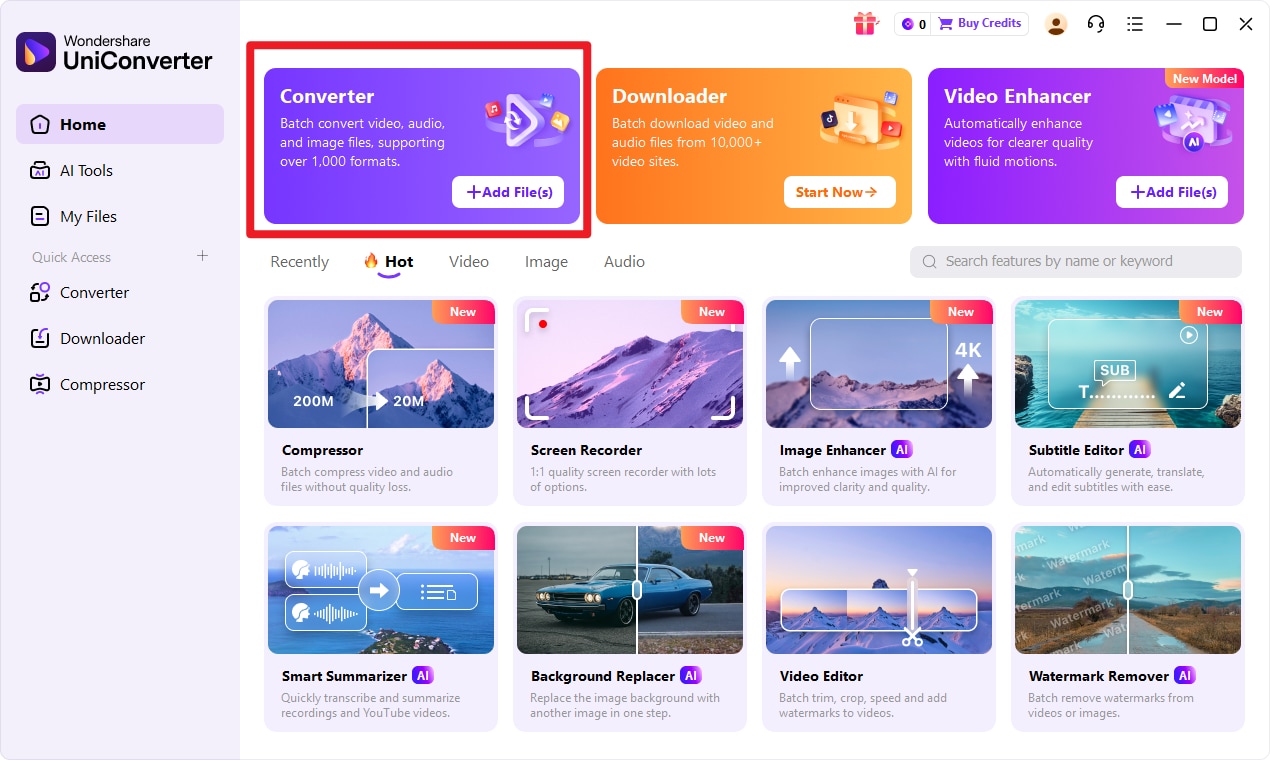
Step 1: Choose Converter in UniConverter
Launch Wondershare UniConverter on your computer after installing it. From the main screen, look at the menu on the left side and select the Converter tool to open the conversion interface.
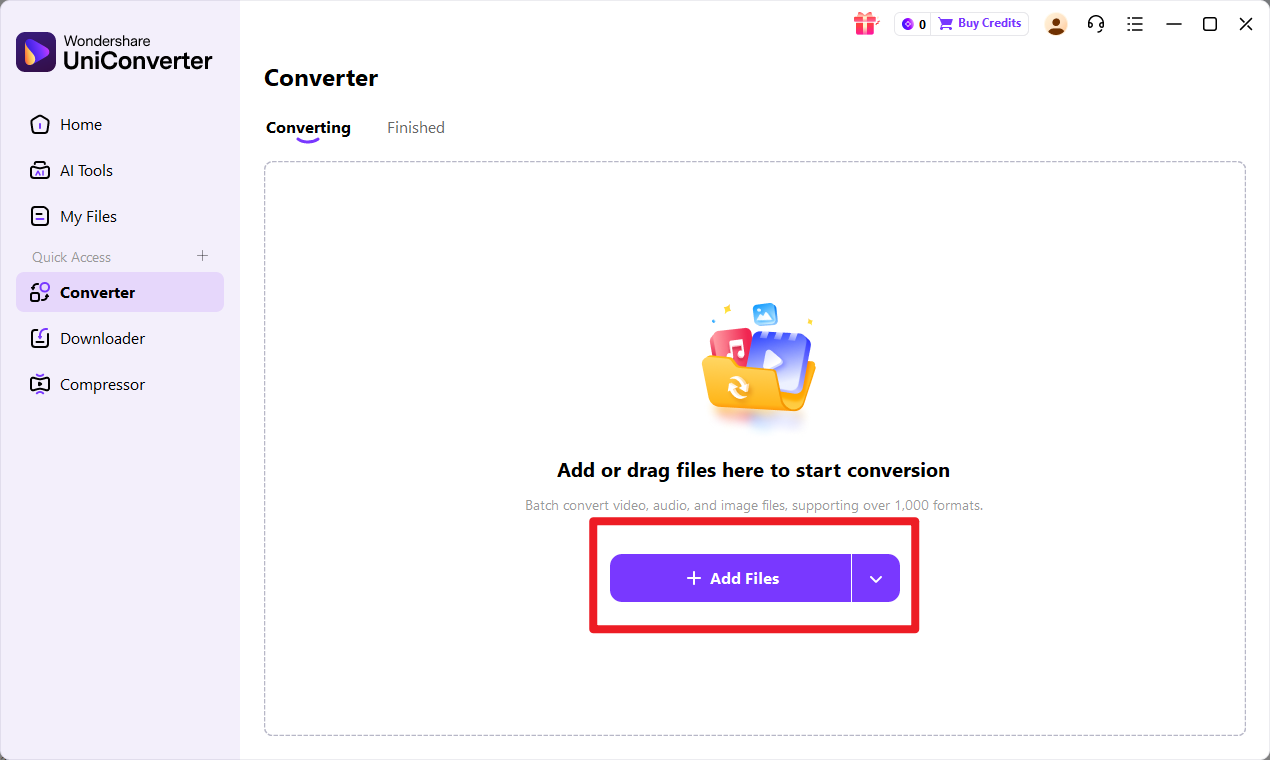
Step 2: Add Files to UniConverter
You can now import your video files. Click the Add Files icon in the top-left corner to browse your computer for the input format files you want to convert. Alternatively, you can simply drag and drop the files directly into the center of the program window. UniConverter supports adding multiple files to perform a batch conversion.
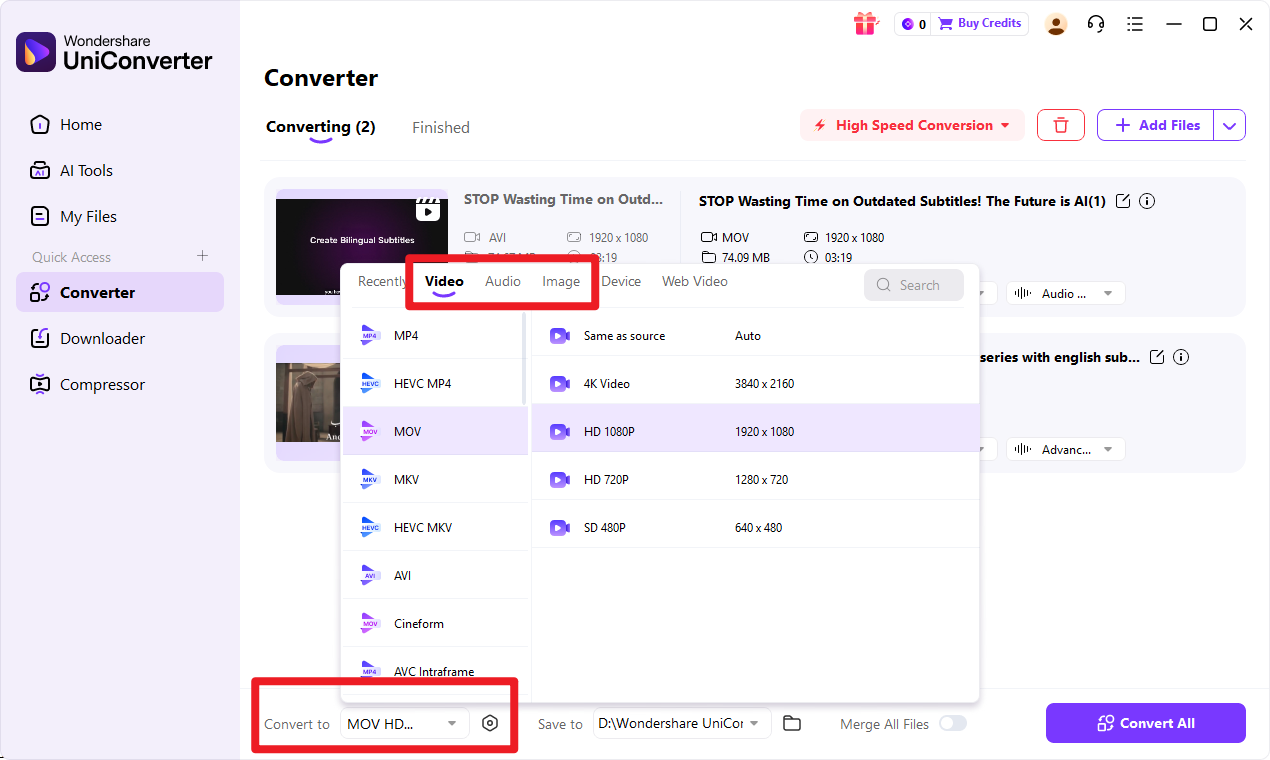
Step 3: Choose Output Format
At the bottom of the window, click on the Output Format menu to open the format selection panel. Navigate to the Video tab. From the list of formats on the left, select your desired target format. On the right, you can choose a specific resolution or select "Same as source" to maintain the original quality.
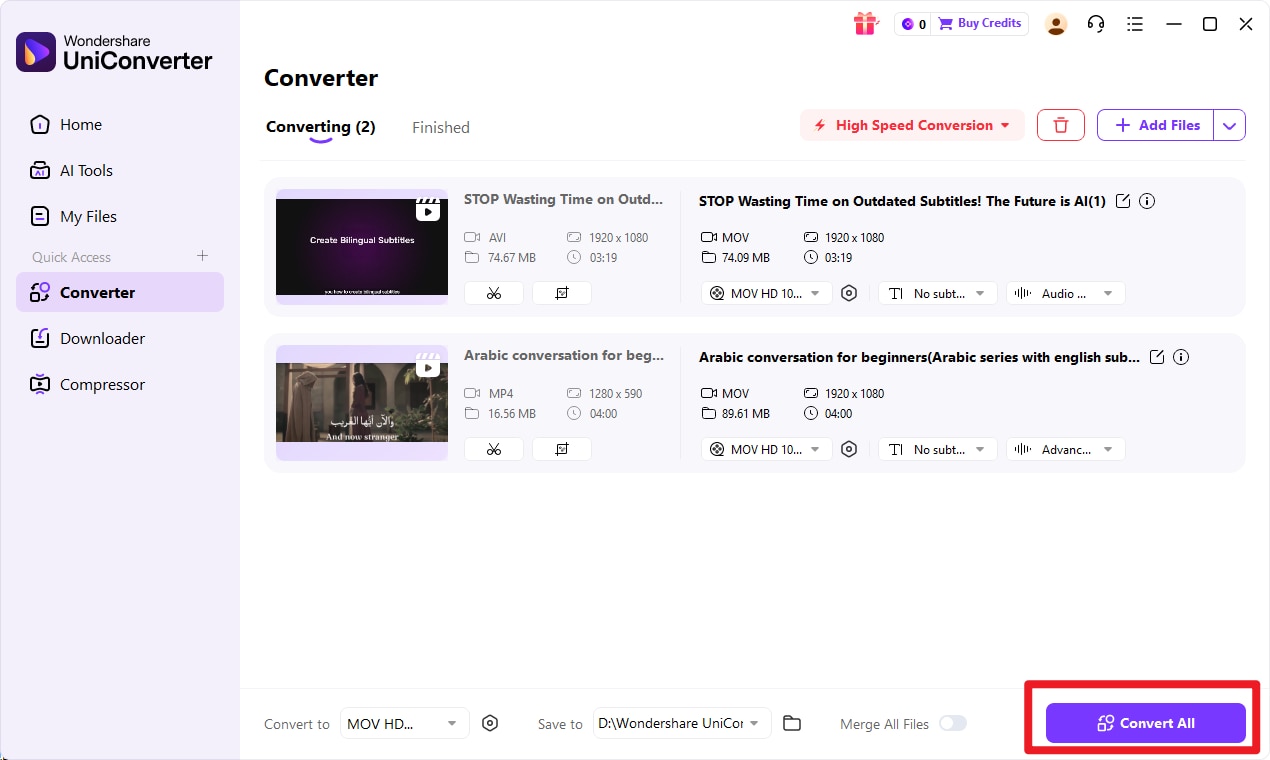
Step 4: Start the Conversion
Before starting, you can specify where to save the converted files by using the File Location field at the bottom. Once you are ready, click the Start All button in the bottom-right corner. UniConverter will begin processing your files, converting them to the target format quickly and efficiently.

More Than Just a Video Converter
Conclusion
Ultimately, the choice in the WebM vs Xvid comparison comes down to your specific objective. There is no single "best" option, only the right tool for the job. WebM is the modern, efficient, and forward-looking choice for any video destined for the web. Its superior compression with the VP9 codec and native browser support make it ideal for streaming, website embeds, and online content delivery. In contrast, Xvid remains a workhorse codec with deep roots in the digital video ecosystem. Its strength lies in its incredible compatibility with a vast range of local playback devices and desktop software, making it a reliable standard for archiving and offline sharing.
Understanding the strengths and weaknesses of each allows you to optimize your video workflow. And for those inevitable moments when you find yourself with the wrong format for the task at hand, having a versatile and powerful tool like Wondershare UniConverter is indispensable. It effortlessly bridges the gap between WebM, Xvid, and countless other formats, ensuring your videos are ready to play, share, and stream, no matter the destination.
FAQs
-
1. Is WebM higher quality than Xvid?
Not necessarily, as the final quality is highly dependent on the encoding settings (like bitrate and resolution) used during compression. However, WebM's more modern VP9 codec is more efficient. This means that at the same file size (or bitrate), WebM can often produce better visual quality with fewer artifacts than Xvid, especially in bandwidth-limited situations like online streaming. -
2. Can I play Xvid files on my phone?
It depends. Most modern Android and iOS devices do not natively support Xvid-encoded files out of the box. However, you can easily play them by installing a versatile third-party media player app from the App Store or Google Play Store. Apps like VLC Media Player are excellent for this, as they contain their own codecs and can play almost any video format, including Xvid-encoded AVIs. -
3. Is Xvid free to use?
Yes, Xvid is free and open-source software distributed under the GNU General Public License (GPL). This means you can download, use, modify, and distribute the Xvid codec library without paying any licensing fees or royalties. This open-source nature was a key factor in its widespread adoption as an alternative to proprietary codecs like DivX.
