
In the vast landscape of digital video, choosing the right format is crucial for ensuring quality, compatibility, and efficiency. Two formats that often come up in discussions, especially concerning web streaming and broadcasting, are WebM and TS. While both are container formats used to package video, audio, and metadata, they are designed for fundamentally different purposes. Understanding the distinction between WebM vs TS is essential for content creators, web developers, and video professionals looking to optimize their workflow and deliver the best possible viewing experience.
This guide will provide a detailed, head-to-head comparison of WebM and TS. We will break down their technical specifications, explore their strengths and weaknesses, and identify the specific scenarios where each format excels. Whether you're embedding a video on your website, setting up a live stream, or managing a digital media library, this article will help you make an informed decision.
In this article:
Part 1. What is WebM? What is TS?
Before we dive into a direct comparison, it's important to understand the basics of each format. What are they, who made them, and what technology do they use?
What is WebM?
WebM is an open, royalty-free media file format designed specifically for the web. Developed and sponsored by Google, it was first introduced in 2010 as a specialized format for providing video on websites using the HTML5 <video> tag. The primary goal of WebM is to offer a high-quality, open-source alternative to proprietary formats, enabling efficient video streaming over the internet.
Its structure is based on a subset of the Matroska (MKV) container format. WebM files typically use the VP8 or VP9 video codecs, which are known for their excellent compression efficiency, allowing for high-quality video at lower bitrates. For audio, WebM files commonly employ the Vorbis or Opus audio codecs, both of which are also open and highly efficient. This combination makes WebM an ideal choice for online video platforms like YouTube, as it helps reduce bandwidth consumption and loading times.
What is TS?
TS stands for Transport Stream. It is a standard digital container format for the transmission and storage of audio, video, and Program and System Information Protocol (PSIP) data. Developed by the Moving Picture Experts Group (MPEG), the TS format is a cornerstone of digital broadcasting. Its design prioritizes error resilience and synchronization, making it incredibly robust for transmitting media over unreliable networks, which is common in broadcasting.
Unlike WebM, which is tailored for the web, TS is the backbone of broadcast systems like DVB (Digital Video Broadcasting) in Europe, ATSC (Advanced Television Systems Committee) in North America, and IPTV (Internet Protocol Television). It is also the format used for Blu-ray discs. TS files can contain video compressed with various codecs, most commonly MPEG-2, H.264/AVC, and the more modern H.265/HEVC. The ability to multiplex multiple video and audio streams into a single file makes it perfect for television broadcasts that may include multiple languages or camera angles.
Part 2. Quick Comparison Table
For a quick overview, here is a table that breaks down the key differences between the WebM and TS formats.
| Aspect | WebM | TS (Transport Stream) |
| Developer | MPEG (Moving Picture Experts Group) | |
| File Extension | .webm | .ts, .tsv, .tsa |
| Primary Use Case | Web video streaming, online content, HTML5 video | Digital broadcasting, live streaming (HLS), Blu-ray discs |
| Video Codecs | VP8, VP9 | MPEG-2, H.264/AVC, H.265/HEVC |
| Audio Codecs | Vorbis, Opus | MP2, MP3, AC-3, AAC |
| Compatibility | Excellent support in modern web browsers (Chrome, Firefox, Edge) | Wide support in hardware players, set-top boxes, and professional video software |
| Error Resilience | Moderate; designed for packet-based web delivery | High; designed for robust transmission over lossy networks |
| Royalty Status | Royalty-free | May involve licensing fees depending on the codecs used (e.g., H.264/H.265) |
Part 3. WebM vs TS: Which One Is Better?
The question of which format is "better" ultimately depends on your specific needs. Let's break down their performance across several key criteria to help you decide.
Quality and Compression
When it comes to quality, both formats are capable of delivering stunning, high-definition video. The final quality is more dependent on the codec, bitrate, and encoding settings than the container itself.
WebM: Leveraging modern codecs like VP9, WebM can achieve video quality comparable to H.264/H.265 but often at a lower bitrate. This superior compression efficiency is a major advantage for web streaming, as it means faster loading times and less data usage for the end-user without a noticeable drop in visual fidelity. The newer AV1 codec, also supported by the WebM container, pushes this efficiency even further.
TS: The quality of a TS file is determined by the widely used codecs it supports, such as H.264 (AVC) and H.265 (HEVC). These codecs are industry standards and are known for their excellent quality. The primary strength of the TS container isn't compression but its robustness. It includes features for error correction and stream synchronization, which are critical for maintaining a stable, high-quality broadcast signal even with minor data loss during transmission.
File Size
File size is a direct consequence of compression efficiency. For web-based applications, smaller is almost always better.
WebM: Thanks to its highly efficient VP9 and Opus codecs, WebM files are generally smaller than TS files of comparable quality. This is its main selling point for web developers and content creators. A smaller file size translates directly to lower bandwidth costs for the host and a smoother, buffer-free playback experience for the viewer, especially on mobile devices or slower internet connections.
TS: TS files can be significantly larger. This is partly because the codecs it often uses (like MPEG-2) are less efficient than VP9. More importantly, the TS format includes additional data overhead for timing information, synchronization, and error resilience. While this overhead is essential for broadcasting, it contributes to a larger overall file size, making it less ideal for on-demand web delivery where every kilobyte counts.
Compatibility and Support
A video format is only useful if it can be played on the target device or platform. Here, WebM and TS occupy very different ecosystems.
WebM: As a Google-backed format designed for the web, WebM boasts excellent native support in most modern web browsers, including Chrome, Firefox, Edge, and Opera. This means you can embed a WebM video on a webpage, and it will play directly without requiring any plugins or special software. However, its support outside of the web browser environment can be less consistent. While many modern media players support it, some older hardware devices and professional video editing software may have limited or no native support.
TS: Transport Stream is the undisputed king of broadcast and hardware devices. It is the standard format for over-the-air digital television, cable TV, satellite broadcasts, and Blu-ray discs. Consequently, it is universally supported by televisions, set-top boxes, Blu-ray players, and professional broadcast equipment. While not natively supported by web browsers for direct playback like WebM, it is the required format for popular live streaming protocols like HLS (HTTP Live Streaming), which is supported on virtually all modern devices, including browsers via JavaScript players.
Editing and Workflow
The ease of integrating a format into your video production workflow is another critical factor.
WebM: Support for WebM in video editing software has grown significantly. Major non-linear editors (NLEs) like Adobe Premiere Pro and DaVinci Resolve now support WebM files, though sometimes with a plugin or after a quick import process. For web-focused content creators, the workflow can be very streamlined.
TS: TS is a standard in professional broadcast and post-production environments. Professional-grade editing software and media asset management systems are built to handle TS files natively. Capturing video from a broadcast feed or a professional camera often results in a TS file, making it a natural part of the workflow for television and film professionals.
For workflows that require moving between these two ecosystems—for instance, taking a broadcast clip (TS) and putting it on a website (WebM)—conversion is necessary. A versatile tool like Wondershare UniConverter is invaluable in these situations. It can bridge any compatibility gaps, allowing you to convert files between WebM, TS, and hundreds of other formats without compromising quality, ensuring your media is always ready for its intended platform.
Part 4. Use Cases for WebM and B
To put it all together, here are the most common and appropriate scenarios for using each format.
When to Use WebM
Choose WebM when your primary delivery target is the web and efficiency is key.
- Website Video Embedding: If you want to embed a video directly into your website using the HTML5
<video>tag for fast, plugin-free playback, WebM is an excellent choice. - Online Video Platforms: For creating content for platforms like YouTube or other streaming services, encoding in WebM (or providing it as an option) can improve loading speeds and reduce bandwidth.
- Royalty-Free Projects: When you are developing an open-source application or need to avoid potential licensing fees associated with codecs like H.264/H.265, WebM's royalty-free nature is a significant advantage.
- Short-form Content and Ads: For short video clips, animations, and online advertisements, WebM's small file size ensures they load quickly and play instantly, capturing the user's attention without delay.
When to Use TS
Choose TS when robustness, broadcast compatibility, and live streaming are your priorities.
- Live Streaming: If you are setting up a live stream using the HLS or MPEG-DASH protocol, the video segments must be in the TS format. This is the standard for delivering live events, webinars, and 24/7 channels over the internet.
- Digital Television Broadcasting: For any content intended for over-the-air, cable, or satellite television, TS is the mandatory format. Its error-correction capabilities ensure a stable picture for viewers.
- Authoring Blu-ray Discs: When creating a Blu-ray disc, the video, audio, and subtitle streams are multiplexed into the BDAV MPEG-2 Transport Stream format.
- Archiving Broadcasts: Recording content from a TV tuner or other broadcast source will typically result in a TS file. The format is ideal for capturing the stream exactly as it was transmitted, including all associated data.
Part 5. Step-by-Step Guide to Convert WebM to TS Using UniConverter
If your project requires you to switch between formats—for example, converting a web video for a broadcast or vice versa—a reliable video converter is essential. Wondershare UniConverter provides a simple and powerful solution, supporting over 1,000 formats, including WebM and TS. Follow these four simple steps to convert your files.
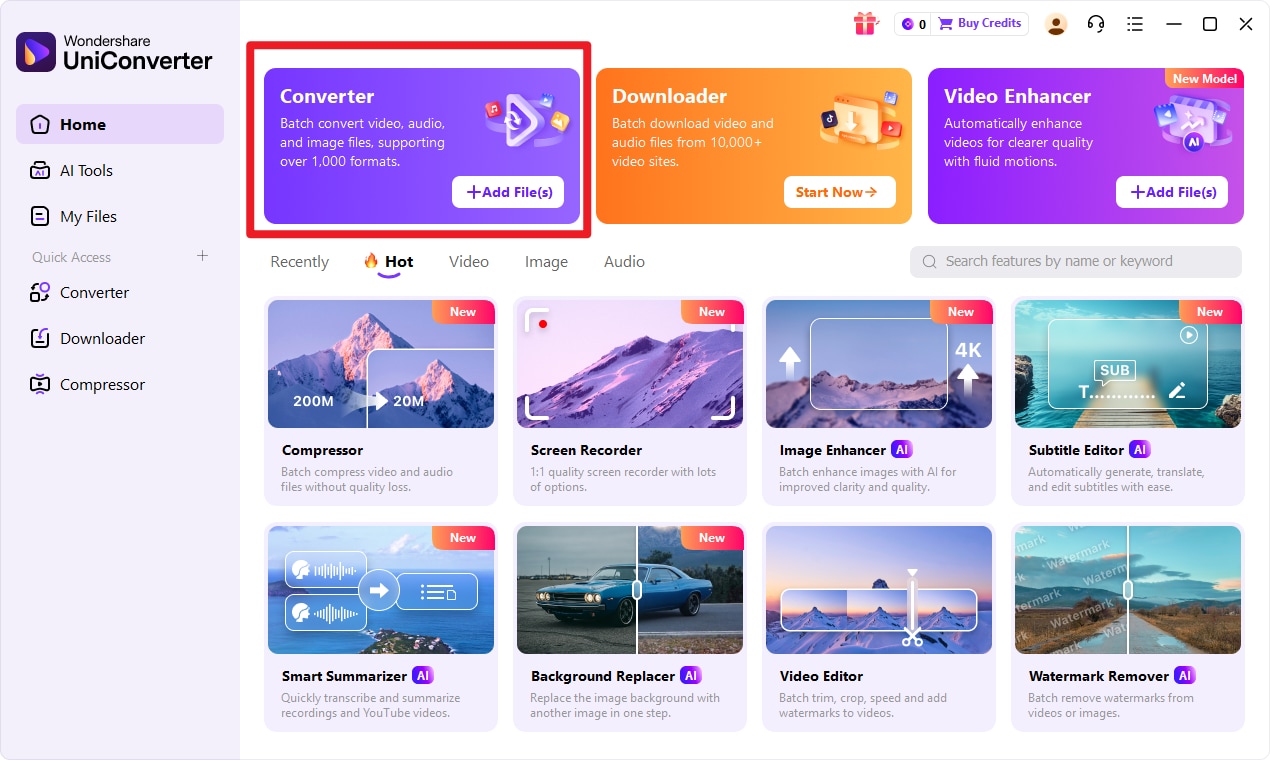
Step 1. Choose Converter in UniConverter
Launch Wondershare UniConverter on your computer. From the main screen, navigate to the left-side menu and select the Converter tool.
Step 2. Add Files to UniConverter
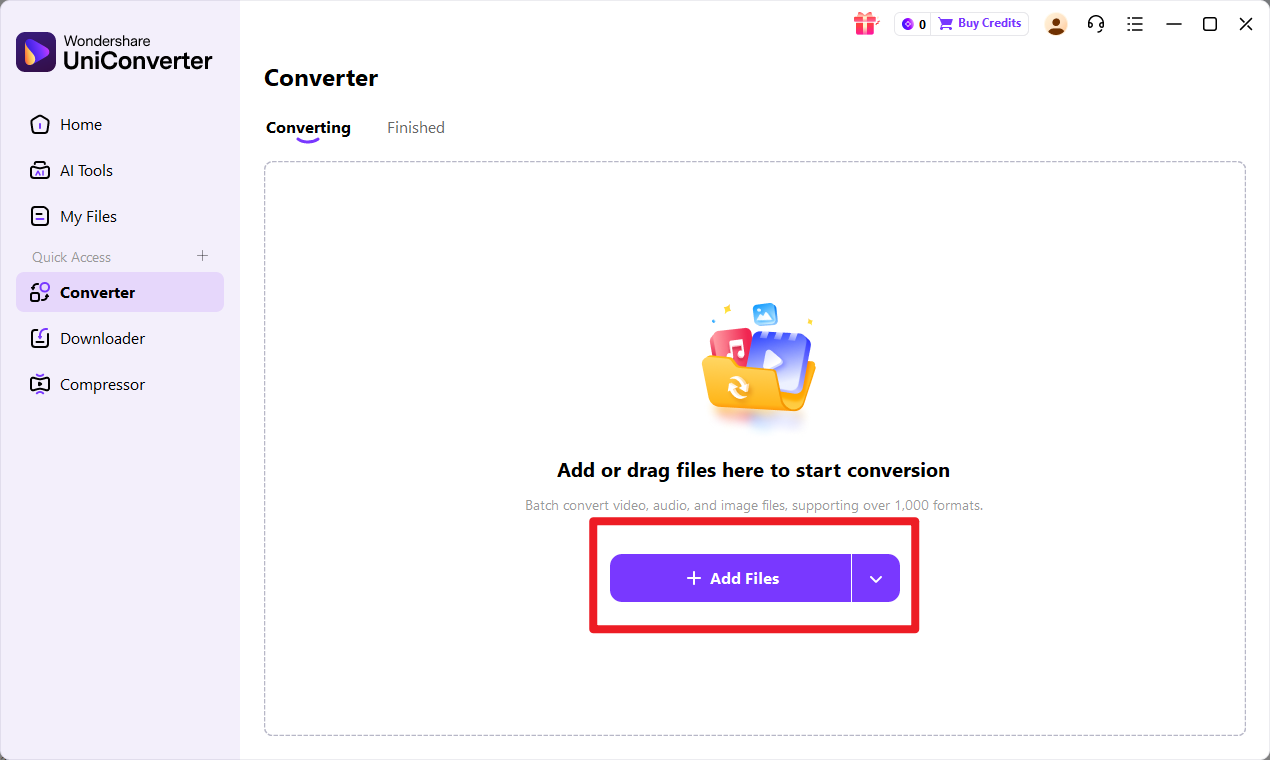
Click the Add Files button in the center of the panel or drag and drop your input format files directly into the converter window. UniConverter supports batch conversion, so you can add multiple files to convert them all at once.
Step 3. Choose Output Format
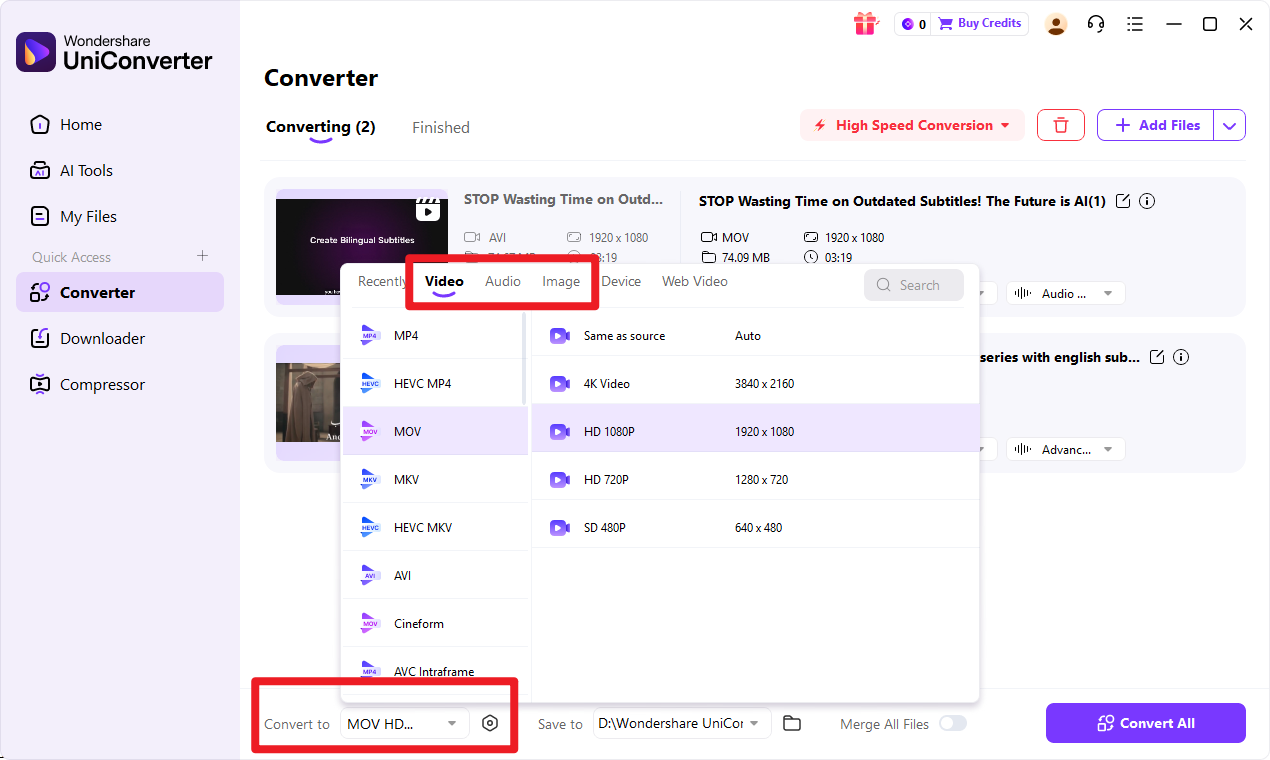
At the bottom of the window, click on the Output Format menu. This will open a new window with a list of supported formats. Go to the Video tab, select your desired target format from the list on the left, and then choose a resolution or quality preset on the right.
Step 4. Start the Conversion
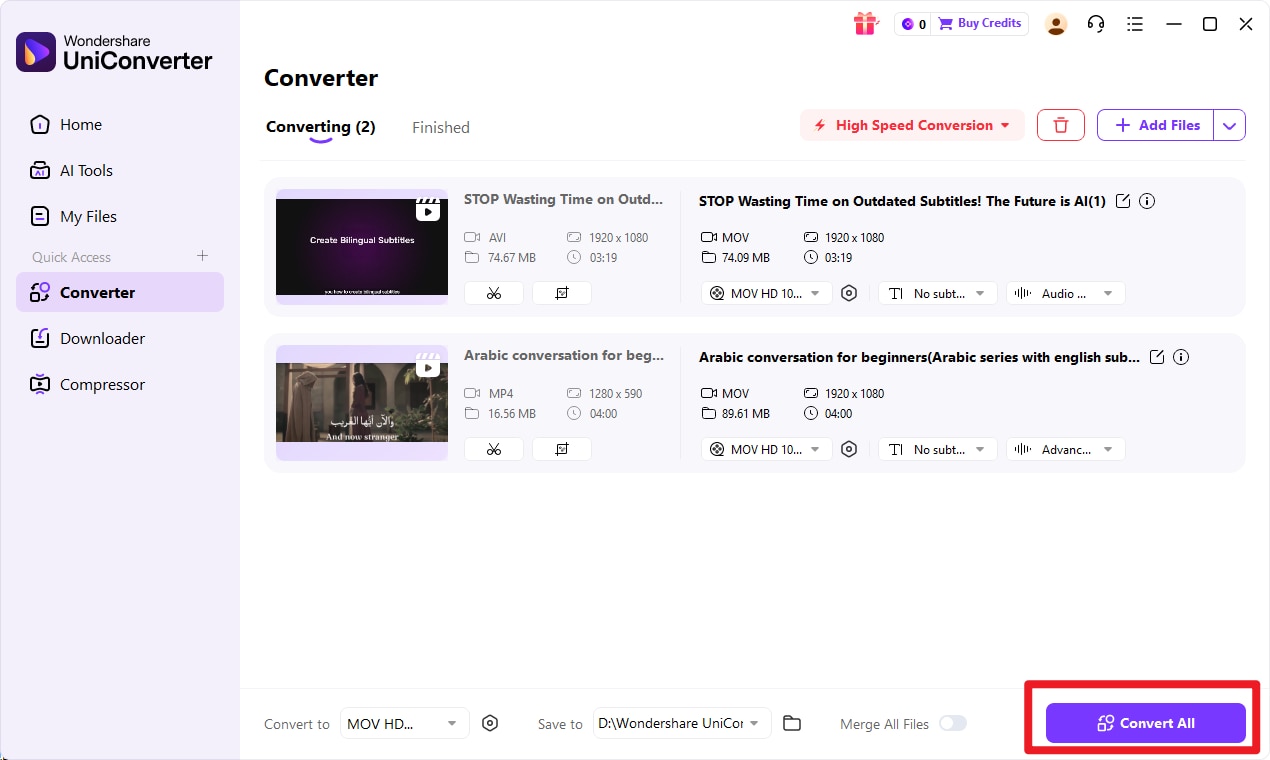
Before starting, you can specify where to save the converted files by clicking the File Location field at the bottom. Once you are ready, click the Start All button in the bottom-right corner to begin the conversion process. Your files will be converted to the target format quickly and saved to your chosen folder.

Go Beyond Simple Video Conversion
Conclusion
Choosing between WebM vs TS is not about finding a single "best" format, but about selecting the right tool for the job. The decision hinges entirely on your specific objective. WebM is the modern, efficient, and clear winner for web-based video delivery. Its high compression, excellent quality at low bitrates, and native browser support make it the go-to choice for embedding videos on websites and optimizing for online streaming. On the other hand, TS remains the unshakeable industry standard for broadcasting and robust live streaming. Its design prioritizes error resilience and synchronization, ensuring a stable and reliable signal for television and live events. Neither format is universally superior; they are simply specialized for different ecosystems. For those moments when you need to bridge the gap between the web and broadcast worlds, a powerful and flexible tool like Wondershare UniConverter is indispensable, ensuring your video files are always in the perfect format for any project or platform.
FAQs
-
1. Is WebM better than TS for streaming?
It depends on the type of streaming. For on-demand video streaming on a website (like a blog or portfolio), WebM is generally better due to its smaller file size and efficient compression, leading to faster load times. For live streaming using protocols like HLS (HTTP Live Streaming), TS is the required standard format for the video segments. -
2. Can VLC play both WebM and TS files?
Yes, VLC Media Player is a highly versatile, open-source player that provides excellent out-of-the-box support for both WebM and TS files. You can play either format on Windows, macOS, or Linux using VLC without needing to install any additional codecs. -
3. Is WebM smaller than TS?
Generally, yes. For a video of the same length and visual quality, a file encoded in WebM (using the VP9 codec) will typically have a smaller file size than a video in a TS container (especially if it's using an older codec like MPEG-2). This is due to WebM's more modern and efficient compression algorithms. -
4. How can I convert TS to WebM easily?
The easiest and most reliable method is to use a dedicated video converter application. Tools like Wondershare UniConverter are designed for this purpose. You can simply add your TS file, select WebM as the output format, and click a button to convert it. This process preserves quality and handles all the technical details for you.
