
Navigating the world of video formats can often feel like a complex puzzle. You create or download a video, only to find it won't play on your intended device. Two formats that frequently cause this confusion are WebM and M4V. While both are used to store video content, they were designed for very different purposes, leading to a classic showdown of web-friendliness versus device compatibility. Understanding the core differences between WebM vs M4V is crucial for web developers, content creators, and anyone who wants their videos to play seamlessly, wherever they are viewed.
This guide will demystify these two formats. We'll break down their technical specifications, compare their strengths and weaknesses, and help you decide which one is the right choice for your specific project. More importantly, we'll show you a simple solution for when you have the "wrong" format for the job.
In this article
Part 1. What is WebM? What is M4V?
Before we can compare them, it's essential to understand what each format is and where it came from. Both are "container formats," meaning they are like digital boxes that hold video data, audio data, and metadata together. However, their internal structure and intended use are worlds apart.
What is WebM?
WebM is a video file format developed and sponsored by Google. It was introduced in 2010 as an open-source, royalty-free alternative specifically designed for the web. The primary goal of WebM is to provide a high-quality, efficient video format that works natively with HTML5 video. This means you can embed WebM videos directly into a webpage without relying on third-party plugins like the old Adobe Flash Player.
Under the hood, WebM files typically use video codecs like VP8 or its more advanced successor, VP9. For audio, they use the Vorbis or Opus codecs. This combination is engineered to deliver excellent compression, resulting in smaller file sizes that are perfect for streaming over the internet without sacrificing too much visual quality. Because it's an open standard, it has gained widespread support in major web browsers like Google Chrome, Mozilla Firefox, and Opera.
What is M4V?
M4V is a video container format developed by Apple. It is very closely related to the ubiquitous MP4 format; in fact, a standard M4V file can often be renamed to .mp4 and still play without issues. The key distinction lies in its association with the Apple ecosystem and its optional support for Apple's FairPlay Digital Rights Management (DRM).
This DRM is used to protect copyrighted content sold through the Apple iTunes Store. As a result, M4V is the default format for movies, TV shows, and music videos purchased or rented from iTunes. It is optimized for flawless playback on all Apple hardware, including iPhones, iPads, Macs, and Apple TV. M4V files typically use the H.264 or H.265 (HEVC) video codecs and AAC or AC-3 audio codecs, which are industry standards known for their excellent balance of quality and compatibility.
Part 2. Quick Comparison Table
To get a clear, at-a-glance overview of the key differences between WebM and M4V, here is a side-by-side comparison table.
| Feature | WebM | M4V |
| Developer | Apple | |
| Video Codecs | VP8, VP9, AV1 | H.264, H.265 (HEVC) |
| Audio Codecs | Vorbis, Opus | AAC, AC-3 |
| Browser Compatibility | Excellent (Chrome, Firefox, Opera, Edge) | Good (Plays in browsers that support H.264) |
| Device Compatibility | Limited (Mainly Android and web browsers) | Excellent (Optimized for iPhone, iPad, Mac, Apple TV) |
| DRM Support | No | Yes (Apple FairPlay DRM) |
| Primary Use Case | HTML5 web video and streaming | Apple ecosystem, iTunes content |
| File Extension | .webm | .m4v |
| Nature | Open-source, royalty-free | Proprietary (based on open MP4 standard) |
Part 3. WebM vs M4V: Which One Is Better?
The question of which format is "better" doesn't have a single answer. The best choice depends entirely on your priorities: are you focused on web performance, device compatibility, or content protection? Let's break it down by category.
Compatibility: The Deciding Factor
Compatibility is arguably the most significant difference between the two formats and the primary reason users need to choose one over the other.
WebM: As a format built for the web, WebM shines in browser environments. It is natively supported by Google Chrome, Mozilla Firefox, Opera, and Microsoft Edge. This means you can embed a WebM video in your website, and a majority of desktop users will be able to play it instantly. However, its native support on physical devices is limited. While Android devices handle WebM well, Apple's ecosystem—iPhones, iPads, and macOS's default QuickTime Player—does not support WebM out of the box.
M4V: This is where M4V has a clear advantage. It is the native format for the entire Apple ecosystem. If your video needs to be played on an iPhone, synced via iTunes, or viewed on an Apple TV, M4V is the undisputed winner. Because it's so similar to MP4, it also enjoys broad compatibility on Windows PCs, Android devices, and various media players that support the H.264 codec.
Winner for Web: WebM
Winner for Devices (especially Apple): M4V
File Size and Compression Efficiency
For web developers and anyone conscious of bandwidth, file size is a critical metric. Smaller files load faster and consume less data, improving the user experience.
WebM: Thanks to its modern VP9 and AV1 codecs, WebM often achieves superior compression. This means it can produce a smaller file size than an M4V file (using the older H.264 codec) while maintaining a similar level of visual quality. This efficiency is a major reason why platforms like YouTube heavily utilize WebM for streaming high-resolution video.
M4V: While H.264 is an incredibly efficient codec, it can be outmatched by VP9 in terms of compression ratio. However, when M4V uses the newer H.265 (HEVC) codec, the gap in efficiency narrows considerably. Still, for general web use where broad compatibility with older systems is a factor, H.264 remains common, giving WebM/VP9 a slight edge in the size-to-quality ratio.
Winner for Smallest File Size: WebM (especially with VP9/AV1)
Video and Audio Quality
It's a common misconception that one container format is inherently higher quality than another. The truth is more nuanced.
Both WebM and M4V are just containers. The final perceived quality of the video and audio depends almost entirely on:
1. The source material: A low-quality source will produce a low-quality output, regardless of the format.
2. The codec used: Advanced codecs like VP9 and H.265 can preserve more detail at lower bitrates.
3. The encoding settings: Bitrate, resolution, and frame rate are the true determinants of quality. A high-bitrate M4V file will look better than a low-bitrate WebM file, and vice versa.
Both formats are capable of holding stunning 4K HDR video with multi-channel surround sound. Therefore, in terms of potential quality, it's a tie. The choice of format does not limit you from achieving excellent results.
Winner: Tie
DRM and Content Protection
If you are a content creator or distributor who needs to protect your work from unauthorized copying and distribution, this category is a deal-breaker.
M4V: This is the only choice of the two if you need DRM. Its ability to incorporate Apple's FairPlay DRM is the reason it's used for all protected content sold or rented on the iTunes Store. This makes it the industry standard for commercial video distribution within the Apple ecosystem.
WebM: As an open-source and royalty-free format, WebM was designed with accessibility in mind. It does not include any native support for DRM. Its philosophy is rooted in the open web, where content is meant to be freely accessible.
Winner for Content Protection: M4V
Part 4. Use Cases for WebM and B
Now that we've covered the technical differences, let's look at practical scenarios where you would choose one format over the other.
When You Should Use WebM
WebM is the ideal choice in several specific situations, primarily centered around the open web.
For embedding videos directly into websites and blogs: If your main goal is to have a video play automatically on your webpage using the HTML5 <video> tag, WebM is a fantastic choice. Its excellent browser support and efficient compression ensure a fast, smooth experience for most visitors.
For web applications that prioritize open-source technologies: If your project is built on an open-source stack and you want to avoid proprietary formats, WebM aligns perfectly with that philosophy. It's free to use without any licensing fees.
When your target audience primarily uses desktop browsers: Since Chrome, Firefox, and Edge command a massive share of the desktop browser market, using WebM ensures that the vast majority of your users will have a seamless playback experience.
When You Should Use M4V
M4V is the go-to format for anyone deeply invested in the Apple ecosystem or who needs maximum device compatibility.
For playing videos on any Apple device: If you want to watch a movie on your iPhone during your commute, show a presentation from your iPad, or stream a home video to your Apple TV, M4V is the most reliable and hassle-free format.
For creating a video library within iTunes or the Apple TV app: M4V is the native format for these applications. Using it ensures that all your metadata (like cover art, descriptions, and titles) is displayed correctly and that the files sync perfectly across your devices.
When you need to ensure maximum compatibility: While WebM is great for browsers, an M4V file (encoded with H.264) is one of the most universally playable video files in existence, working on Apple devices, Windows PCs, Android phones, game consoles, and smart TVs.
For any situation where your WebM file is not playing: This is the most common pain point. If you've downloaded a WebM video and can't open it on your Mac or iPhone, the best solution is to convert it. Wondershare UniConverter is an excellent tool for this task, ensuring a smooth and high-quality conversion from WebM to M4V.
Part 5. Step-by-Step Guide to Convert WebM to M4V Using UniConverter
If you have a WebM file that you need to play on your iPhone or Mac, the easiest solution is to convert it to M4V. Wondershare UniConverter is a powerful and user-friendly tool that can handle this conversion in just a few clicks while preserving quality.
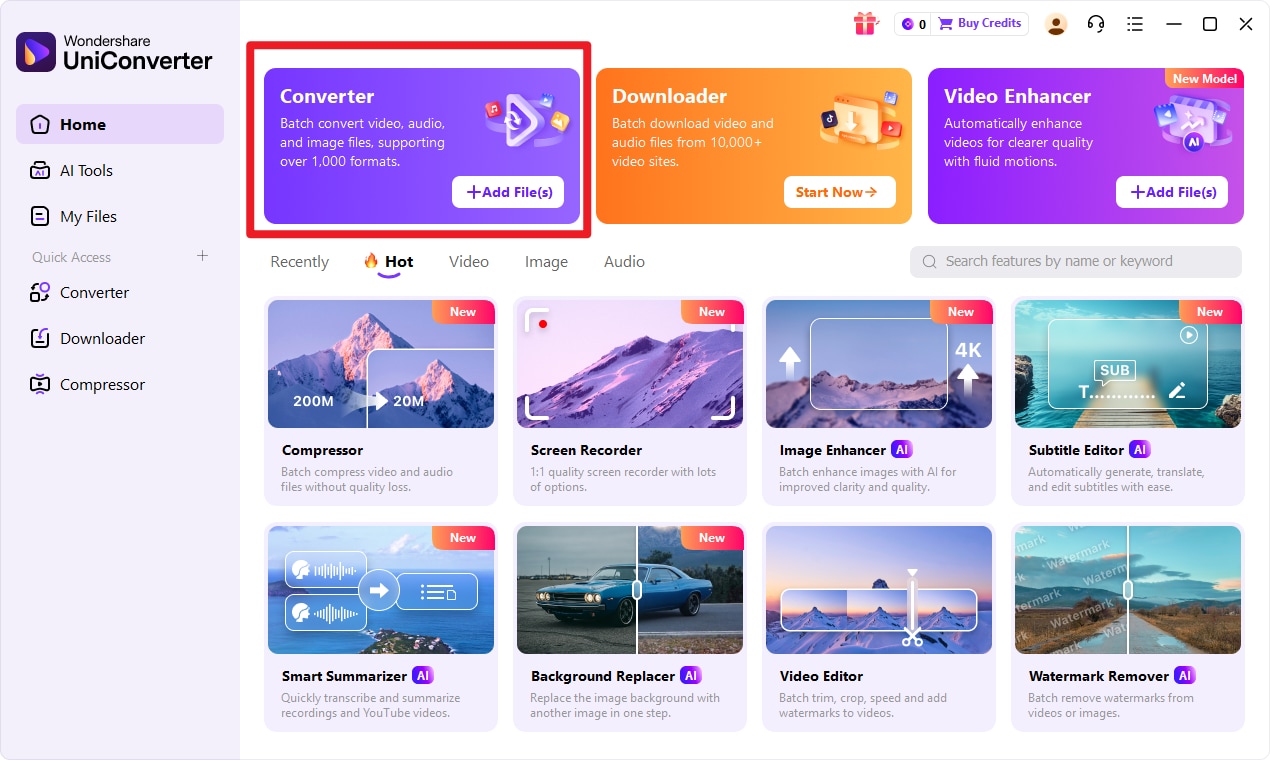
Step 1: Choose Converter in UniConverter
Launch Wondershare UniConverter on your computer. On the main screen, select the Converter tab from the left-side menu.
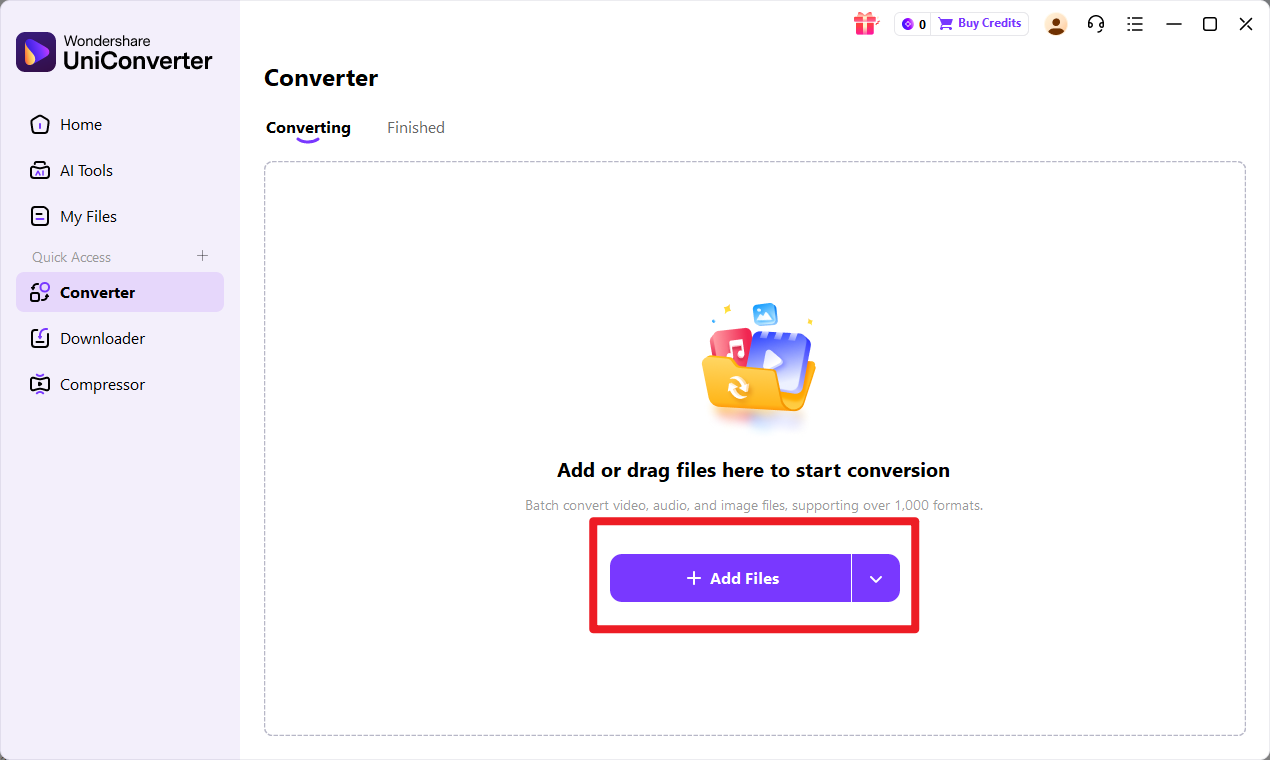
Step 2: Add Files to UniConverter
Click the Add Files icon or simply drag and drop your input format video files directly into the center of the program window. You can add multiple files to convert them in a batch.
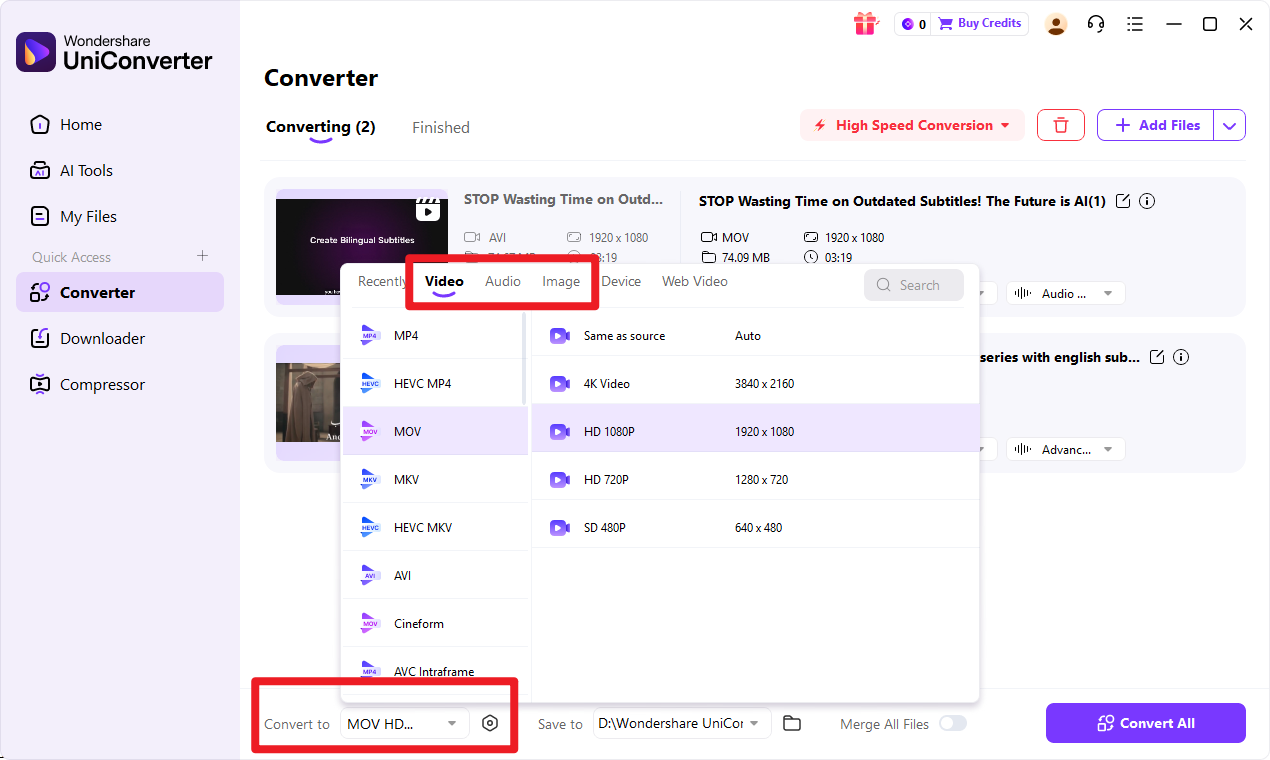
Step 3: Choose Output Format
Click on the Output Format menu at the bottom of the window. In the new window, select the Video tab, choose the target format from the list on the left, and then select your desired resolution on the right. For the best quality, you can choose "Same as source."
Step 4: Start the Conversion
Select a destination folder by clicking the File Location field at the bottom. Finally, click the Start All button in the bottom-right corner to begin converting your files to the target format. The high-speed conversion will complete the process quickly.
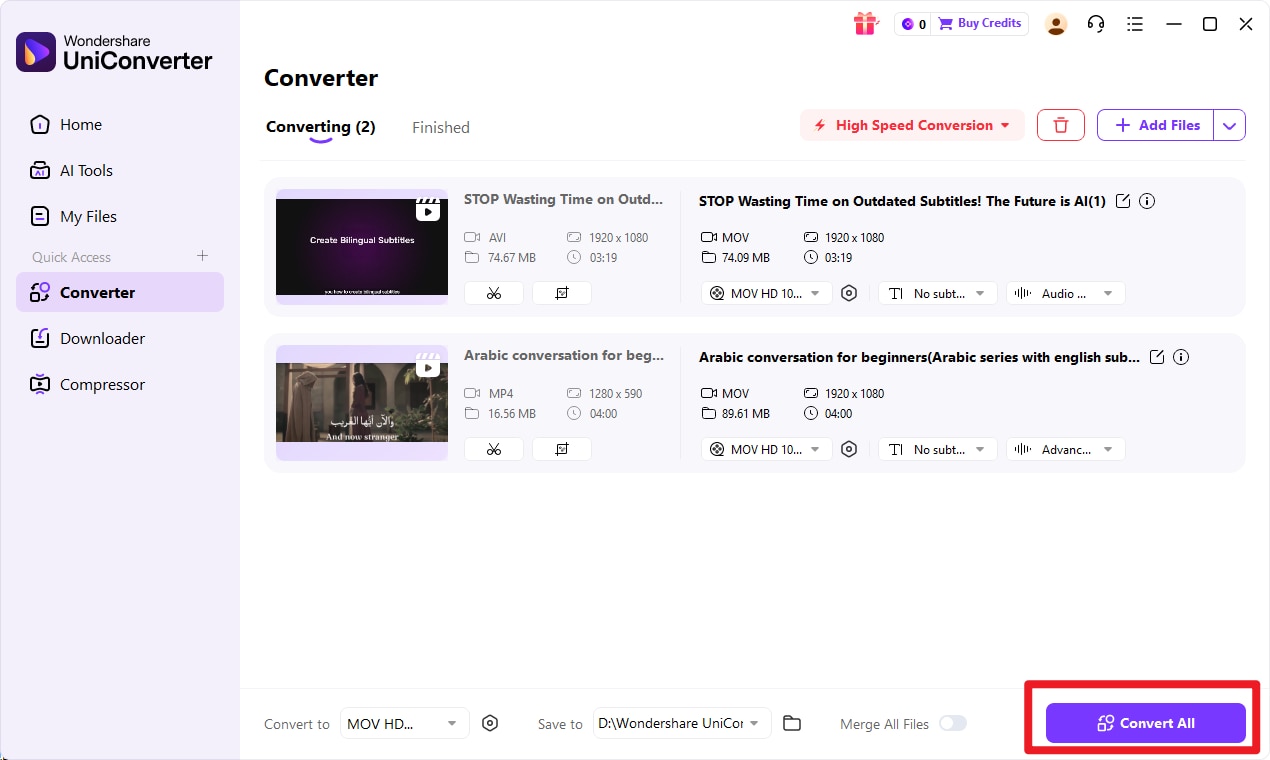
Once the conversion is finished, you can find your new M4V files in the specified folder, ready to be played on any Apple device.

Your Complete Video Processing Toolkit
FAQs
-
1. Is WebM higher quality than M4V?
Not inherently. Both are container formats, and the final quality depends on the source video, the codec used (e.g., VP9 vs. H.264), and the encoding settings like bitrate and resolution. Both formats can store extremely high-quality video. A high-bitrate M4V can look better than a low-bitrate WebM, and vice versa. -
2. Can I play a WebM file on my iPhone?
Not natively. The default iOS video player and the Photos app do not support the WebM format. To play a WebM file on an iPhone, you have two options: download a third-party media player app from the App Store (like VLC Media Player) that supports WebM, or convert the file to an iPhone-compatible format like M4V or MP4. -
3. How can I convert WebM to M4V without losing quality?
To convert WebM to M4V with minimal or no perceptible quality loss, using a professional video converter is key. A tool like Wondershare UniConverter is designed for this purpose. It allows you to select high-quality presets or even match the source video's settings exactly. This process, known as transcoding, re-encodes the video data into the new format while preserving as much detail as possible, ensuring your converted M4V file looks just as good as the original WebM.
Conclusion
Choosing between WebM vs M4V is a matter of context. There is no single "best" format, only the right format for the job. If your primary goal is efficient, high-quality video delivery on the open web, WebM is an outstanding, modern choice. If your world revolves around the Apple ecosystem or you need the broadest possible device compatibility, M4V is the safer and more reliable option.
For those moments when you're caught between these two worlds—with a WebM file that won't play on your iPad or an M4V you want to embed on your blog—the most practical solution is conversion. A robust and intuitive tool can bridge the gap effortlessly. Wondershare UniConverter stands out as a top choice for converting WebM to M4V, M4V to WebM, or any other format combination you might need, ensuring your videos work everywhere, every time.
