
In the world of digital video, codecs are the unsung heroes that make everything possible, from streaming your favorite shows to sharing videos with friends. They compress massive video files into manageable sizes without sacrificing too much quality. Two of the most prominent and powerful codecs today are VP9 and H.265 (also known as HEVC). Choosing between them can be a complex decision, impacting everything from file size and visual quality to device compatibility and cost. Whether you're a content creator, a developer, or just a tech enthusiast, understanding the VP9 vs H.265 debate is crucial for making informed choices in 2026.
This guide will provide a comprehensive, head-to-head comparison of these two leading codecs. We'll break down their technical specifications, real-world performance, and ideal use cases to help you decide which one is right for your needs. We'll also show you how to easily solve any compatibility issues that may arise between them.
In this article
Part 1. What is VP9? What is H.265?
Before we dive into a detailed comparison, it's important to understand what each codec is and where it came from. Both were designed to be successors to older, less efficient standards, but they took very different paths to adoption.
What is VP9 (VP-Next)?
VP9 is an open and royalty-free video coding format developed by Google. It was officially released in 2013 as the successor to VP8. Google's primary motivation for creating VP9 was to establish a high-quality, efficient video standard for the open web that was not encumbered by patent licensing fees.
Key characteristics of VP9 include:
- Royalty-Free: Its biggest advantage is that anyone can use it in their software or hardware without paying licensing fees. This has been a major driver of its adoption.
- Web-Optimized: VP9 was designed with internet streaming in mind. It powers a significant portion of the web's video content, most notably as the primary codec for YouTube.
- Strong Ecosystem: It is natively supported by most modern web browsers, including Chrome, Firefox, and Edge, as well as the entire Android operating system.
What is H.265 (HEVC)?
H.265, also known as High Efficiency Video Coding (HEVC), is a video compression standard developed as a successor to the widely used H.264/AVC. It was developed by the ISO/IEC Moving Picture Experts Group (MPEG) and the ITU-T Video Coding Experts Group (VCEG). The goal of H.265 was to provide substantially improved compression efficiency over H.264—delivering the same video quality at about half the bitrate.
Key characteristics of H.265 include:
- High Efficiency: HEVC is renowned for its exceptional compression capabilities, making it an industry standard for 4K and 8K UHD content, where file sizes can become enormous.
- Royalty-Bearing: Unlike VP9, H.265 is covered by numerous patents. Manufacturers and software developers who implement H.265 in their products must pay licensing fees to various patent pools.
- Wide Hardware Support: Despite the licensing costs, H.265 has achieved widespread hardware support. It's built into the chips of most modern smart TVs, high-end smartphones (especially Apple devices), and digital cameras.
Part 2. Quick Comparison Table
For a quick overview, here is a side-by-side comparison of the key features of VP9 and H.265.
| Feature | VP9 | H.265 (HEVC) |
| Developer | ISO/IEC MPEG & ITU-T VCEG | |
| Licensing | Royalty-free | Royalty-bearing |
| Compression Efficiency | High, comparable to H.265 | Very High, often slightly better than VP9 at lower bitrates |
| Adoption & Compatibility | Strong in web browsers and Android; used by YouTube | Wide hardware support in modern TVs, smartphones (especially Apple), and cameras |
| Quality | Excellent, especially at high resolutions | Excellent, considered an industry standard for 4K/UHD content |
Part 3. VP9 vs H.265: Which One Is Better?
The question of which codec is "better" doesn't have a simple answer. It depends entirely on your priorities and specific application. Let's break down the comparison across four critical areas.
Compression and File Size: The Efficiency Battle
Both VP9 and H.265 represent a massive leap forward in compression technology compared to their predecessors like H.264. They can reduce file sizes by up to 50% while maintaining the same level of visual quality. This efficiency is what makes streaming 4K video over a standard internet connection possible.
When compared directly, H.265 often has a slight edge. In many technical tests, H.265 can achieve the same quality as VP9 at a slightly lower bitrate (meaning a smaller file size). This difference is most noticeable at lower bitrates, where every bit counts. For high-quality archiving or broadcasting where minimizing bandwidth is the absolute top priority, H.265 is often the preferred choice. However, for most practical purposes, especially at the higher bitrates used for high-quality streaming, the compression performance of VP9 is very close to that of H.265.
Quality Comparison: What the Eye Can See
In terms of pure visual quality, both codecs are exceptional. When encoded at a sufficient bitrate, video in either format will look sharp, clear, and vibrant. For the average viewer watching a movie or a YouTube video, it is practically impossible to distinguish between a high-quality VP9 encode and a high-quality H.265 encode.
Differences only tend to emerge under intense scrutiny, such as in side-by-side technical analyses or at very low bitrates where compression artifacts become more visible. Some analyses suggest H.265 does a better job of preserving fine details in complex scenes, while others find VP9 to be more consistent across different types of content. Ultimately, the quality of the final video depends as much on the encoder software and settings used as it does on the codec itself. For all intents and purposes, both codecs can deliver a stunning visual experience.
Licensing: The Open Source vs. Patent Pool Debate
This is the most significant and clear-cut difference between the two codecs.
VP9 is completely royalty-free. Google developed it as an open standard to avoid the complex and costly patent licensing associated with codecs like H.265. This means any developer or hardware manufacturer can implement VP9 support in their products without paying fees. This philosophy has been instrumental in making VP9 the de facto standard for web video, championed by the world's largest video platform, YouTube.
H.265 is a royalty-bearing standard. It is covered by thousands of patents held by dozens of different companies. These companies have formed patent pools (like HEVC Advance and Velos Media) to manage and collect licensing fees. This adds a layer of cost and legal complexity for companies that want to create or play H.265 content. This cost is often passed on to the consumer, either directly or indirectly, and it has been a significant barrier to the universal adoption of H.265, especially in open-source software and web browsers.
Compatibility and Ecosystem Support
The licensing models have directly influenced the ecosystems where each codec has thrived.
VP9's domain is the web. Thanks to Google's push, it is natively supported in Google Chrome, Mozilla Firefox, Opera, and Microsoft Edge. It is also a mandatory codec for all Android devices. Since YouTube transcodes all uploaded videos into VP9 (among other formats), a huge portion of internet video traffic is delivered using this codec.
H.265's strength lies in hardware and closed ecosystems. Apple made a significant commitment to H.265, making it the default codec for capturing video on iPhones and iPads and ensuring robust support across macOS and iOS. It is also the standard for 4K UHD Blu-ray discs and is widely used in digital television broadcasting and professional video cameras. Most modern smart TVs and streaming devices have dedicated hardware decoders for H.265, ensuring smooth playback of high-resolution content.
Part 4. Use Cases for VP9 and H.265
So, based on these differences, when should you use one over the other? Here are some practical guidelines.
When You Should Choose VP9
- Content for YouTube: If your primary distribution platform is YouTube, encoding in VP9 can be beneficial. While YouTube will re-encode whatever you upload, providing a high-quality VP9 file can streamline the process and ensure your video is available in the best possible format on the platform.
- Web-Based Video Projects: If you are developing a website or web application that features video and want to avoid licensing fees, VP9 is the clear choice. Its excellent browser support ensures a seamless experience for the majority of web users.
- Targeting Android and Chrome Users: If your target audience primarily uses Android devices or the Chrome browser, VP9 offers guaranteed native support and optimized performance.
When You Should Choose H.265 (HEVC)
- Professional Video Production and Archiving: For professionals who need the absolute best compression for 4K, 6K, or 8K footage, H.265 is the industry standard. Its efficiency is crucial for managing the massive file sizes associated with high-resolution video workflows and for long-term archiving.
- Creating Content for Apple Devices: If your videos are intended for playback on iPhones, iPads, or Macs, H.265 is the best choice. It ensures native compatibility and takes advantage of Apple's hardware acceleration for smooth, power-efficient playback.
- Physical Media and Broadcasting: For creating 4K UHD Blu-ray discs or preparing content for digital television broadcast, H.265 is the mandated standard and the only viable option.
Part 5. Step-by-Step Guide to Convert VP9 to H.265 Using UniConverter
Sometimes you have a file in the wrong format for your device. For example, a VP9 video downloaded from the web might not play on your iPhone. In these cases, a reliable video converter is essential. Wondershare UniConverter is a powerful and user-friendly tool for solving these compatibility issues, allowing you to convert between VP9, H.265, and over 1,000 other formats with ease.
Step 1: Launch Wondershare UniConverter
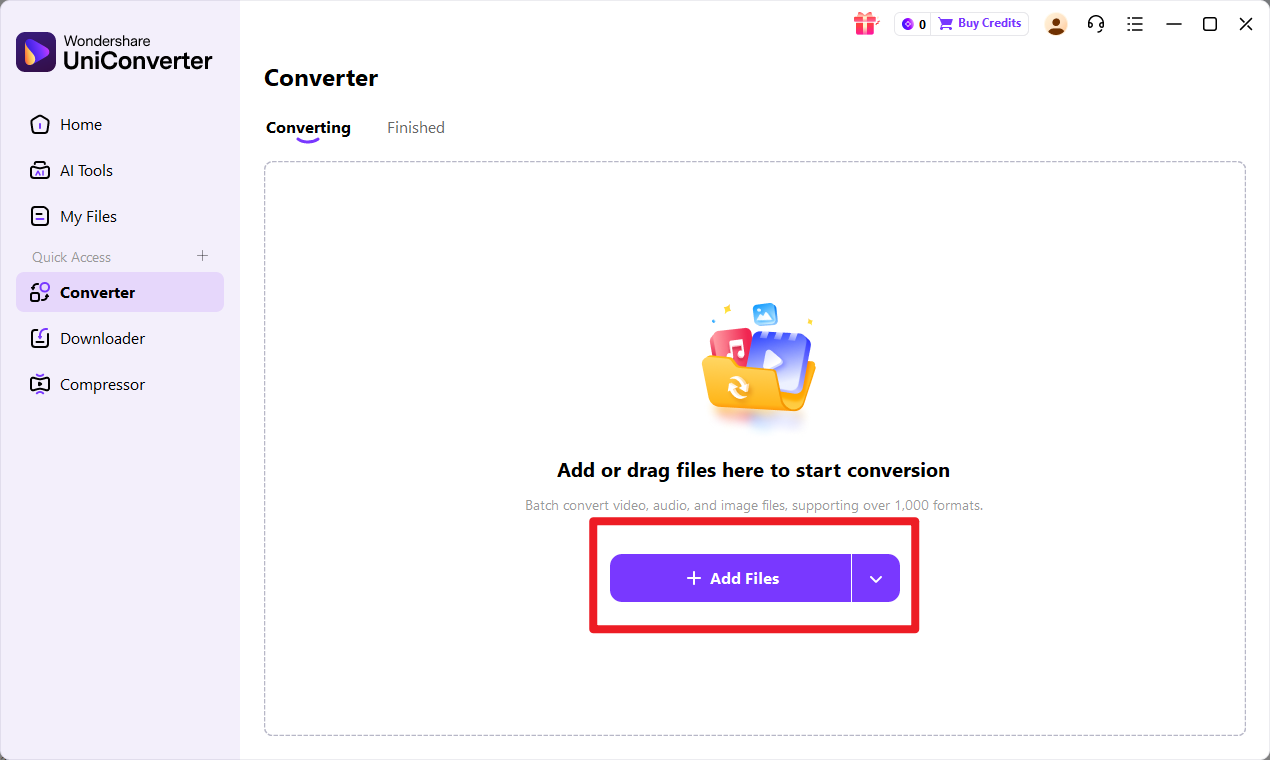
Launch Wondershare UniConverter on your computer. In the main interface, ensure you are on the "Converter" tab. You can either drag and drop your VP9 video file directly into the program window or click the "Add Files" button to browse your computer and import the video.
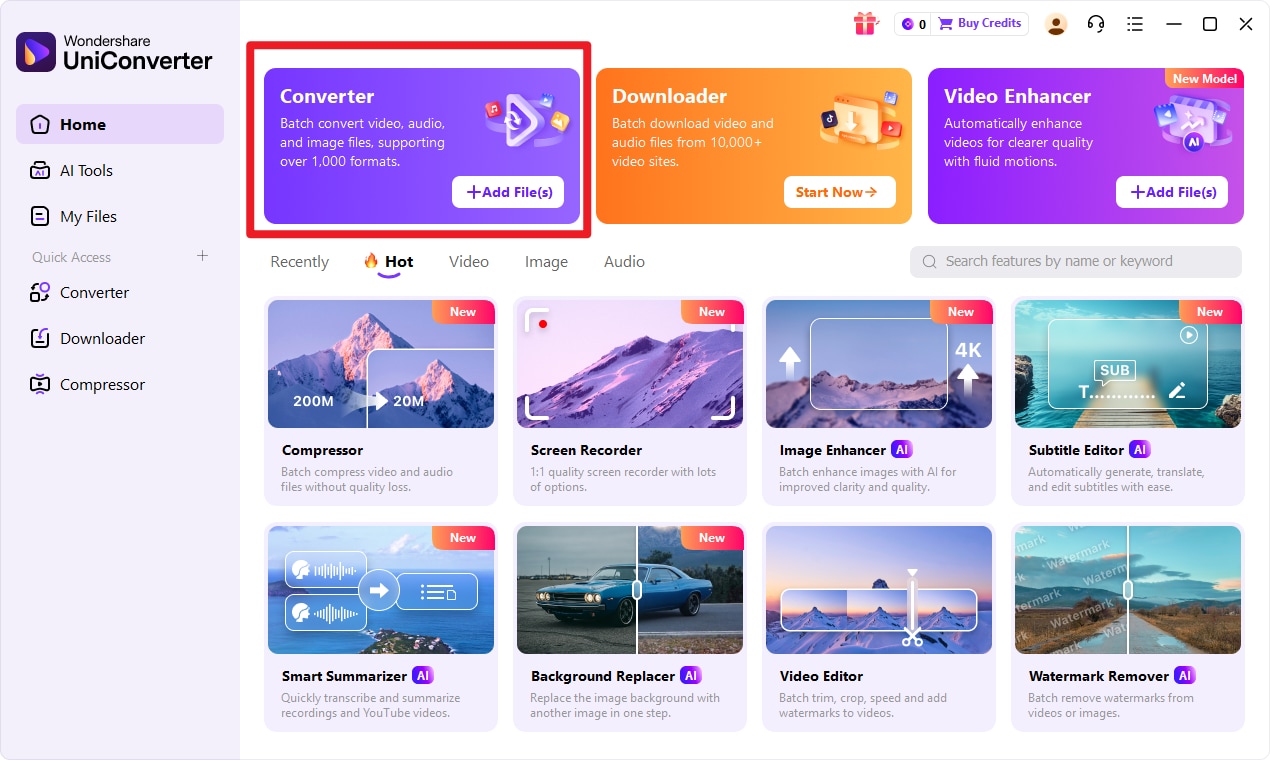
Step 2: Add Your VP9 Video to UniConverter
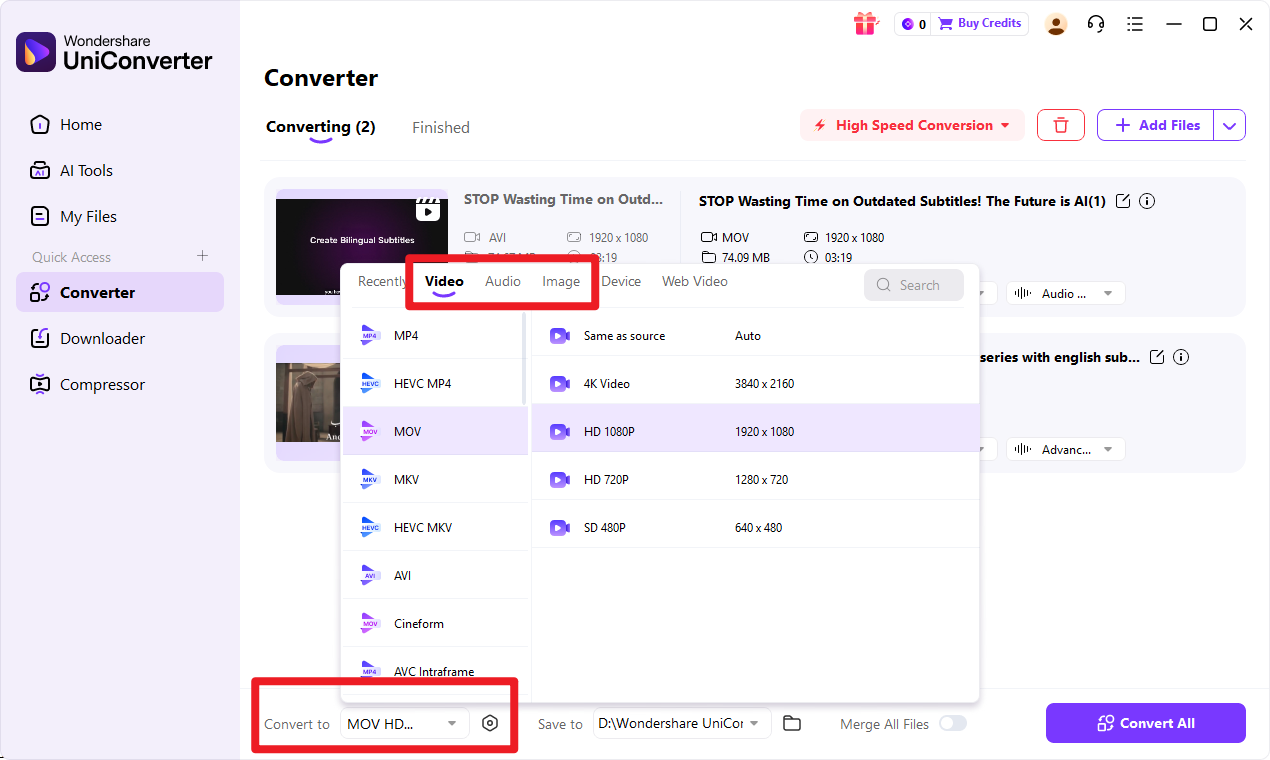
Once your video is loaded, click on the "Output Format" menu at the bottom of the window. A new window will appear. Go to the "Video" tab. From the list on the left, choose a container format like MP4 or MKV. Then, select a resolution on the right. To specify the codec, click the small "Edit" (pencil) icon next to the resolution to open the settings, and from the "Encoder" dropdown menu, select H.265.
Step 3: Select H.265 as the Output Format
UniConverter's presets are optimized for a great balance of quality and file size. However, if you are an advanced user, you can further customize the output. In the same settings window from Step 2, you can manually adjust parameters like bitrate, frame rate, and audio settings to meet your exact specifications. For most users, the default presets are perfect.
Step 4: Convert Your Video
After configuring the output format, you can choose a destination folder for your converted file using the "File Location" menu at the bottom. Once you are ready, click the "Start All" button in the bottom-right corner. UniConverter will use GPU acceleration to convert your VP9 video to H.265 quickly and efficiently.
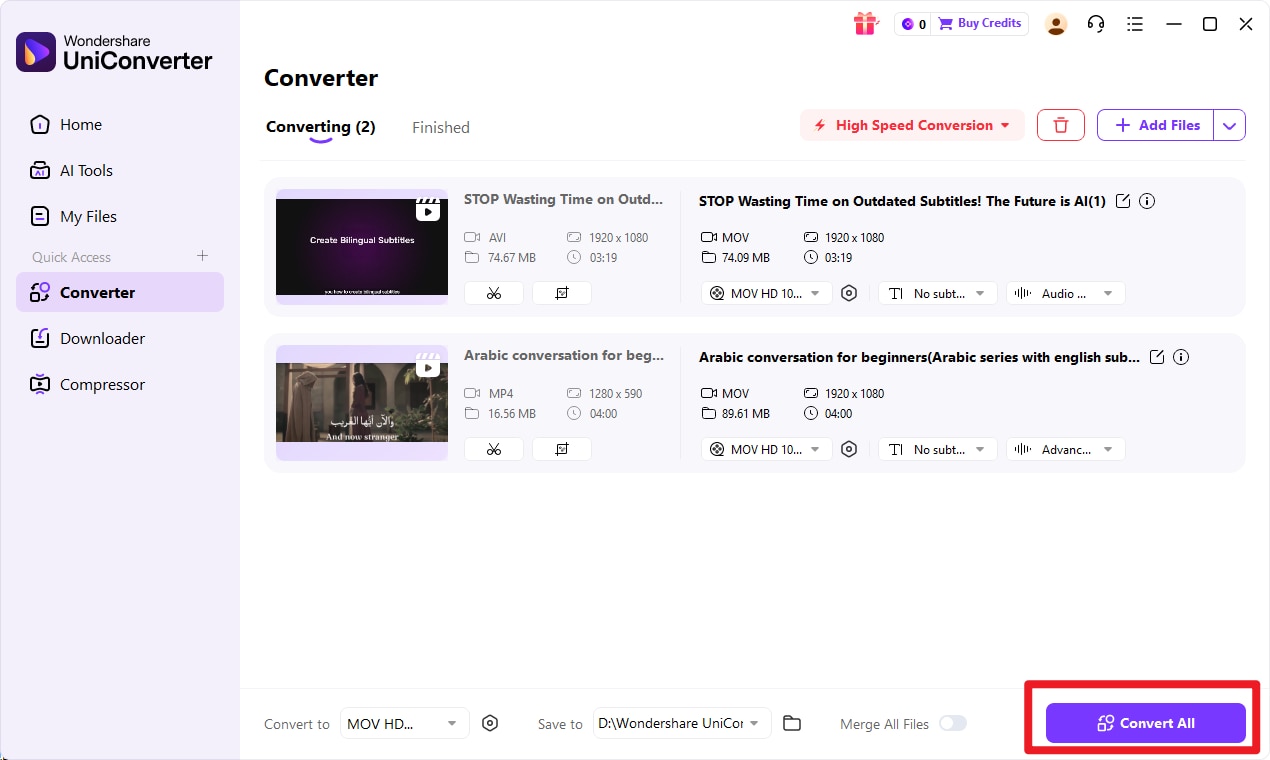

Go Beyond Simple Video Conversion
Conclusion
The debate between VP9 and H.265 is not about which codec is definitively superior, but which is better suited for a specific task. VP9 stands as the royalty-free champion of the open web, driven by Google and powering platforms like YouTube. It offers excellent quality and accessibility. H.265, on the other hand, is the highly efficient industry standard for premium 4K/8K content, professional production, and hardware-based ecosystems like Apple's, though it comes with licensing costs.
Your choice will depend on your platform, audience, budget, and technical requirements. And for those inevitable moments when you have a file in one format but need it in another, a versatile tool like Wondershare UniConverter provides the perfect bridge, offering a simple, fast, and effective solution to all your video conversion needs.
FAQs
-
1. Is VP9 better than H.265 for streaming?
It depends on the platform. For streaming to YouTube, VP9 is often better as it's the platform's preferred native codec. For creating your own streaming service or for private streaming where you control the client, H.265 might be a better choice due to its widespread hardware decoding support on devices like smart TVs and set-top boxes, which can lead to more efficient playback. -
2. Can my iPhone play VP9 videos?
Natively, iOS and iPadOS do not support VP9 video within a standard container like MP4 or MKV. While the YouTube app can play VP9 streams, you cannot save a VP9 file to your camera roll and play it with the default player. To play it, you would need to use a third-party media player app from the App Store or, more reliably, convert the video to a compatible H.264 or H.265 format using a tool like UniConverter. -
3. Is H.265 smaller than VP9?
Generally, H.265 can produce slightly smaller files than VP9 at the same level of perceived visual quality. This compression advantage is often cited as being around 5-10%, particularly at lower bitrates. However, the difference is often negligible in real-world scenarios, and the final file size is heavily influenced by the specific encoder software and settings used for compression. -
4. Why is VP9 free?
Google made VP9 royalty-free to promote an open and accessible standard for high-quality video on the internet. By offering a powerful codec without patent licensing fees, Google aimed to accelerate its adoption by browser developers, content creators, and hardware manufacturers, creating a viable alternative to the patent-encumbered H.265 and ensuring the web's video infrastructure remained open.
