
In the ever-evolving landscape of digital video, choosing the right format can feel like navigating a complex maze. Two formats that often come up in discussions, representing different ends of the video workflow spectrum, are Apple ProRes and Windows Media Video (WMV). Understanding the fundamental differences in the ProRes vs WMV debate is crucial for anyone from a seasoned video editor to a student creating their first project. One is a heavyweight champion of post-production, while the other is a nimble contender for web delivery. This guide will break down everything you need to know to make an informed decision for your specific needs in 2026.
In this article
Quick Note
- ProRes is an Apple-developed codec family designed for high-quality, high-performance video editing. It produces very large files but maintains exceptional visual fidelity and is easy for editing software to process.
- WMV (Windows Media Video) is a Microsoft-developed format designed for streaming and distribution. It uses high compression to create very small files, making it ideal for the web but less suitable for editing.
- The primary choice depends on your goal: use ProRes for professional post-production and WMV for final delivery on Windows-based platforms or when file size is the main concern.
- Compatibility issues are common. A tool like Wondershare UniConverter is often necessary to convert files between these two formats to bridge the gap between Mac and Windows workflows.
Part 1. What is ProRes? What is WMV?
Before we can compare these two formats, it's essential to understand what they are, who made them, and what purpose they were designed to serve.
What is ProRes?
ProRes is not just a single format but a family of intermediate video codecs developed by Apple Inc. It was introduced in 2007 with Final Cut Pro 6, and its primary purpose is to be used during the video editing and post-production process.
Think of ProRes as a "work-in-progress" format. It uses a technology called visually lossless compression. This means it compresses the video data to make the file more manageable than a completely uncompressed video, but it does so in a way that the human eye cannot perceive any loss of quality. The result is a file that retains incredible detail, color information, and dynamic range, which is vital for tasks like color grading, applying visual effects, and other intensive editing work.
Because it's an intra-frame codec (compressing each frame individually), it's very easy for a computer's processor to decode. This translates to exceptionally smooth playback, scrubbing, and real-time performance within editing software like Final Cut Pro, Adobe Premiere Pro, and DaVinci Resolve. The main trade-off is its file size—ProRes files are notoriously large. Common variations include ProRes 422, ProRes 422 HQ (High Quality), and ProRes 4444 (which includes an alpha channel for transparency).
What is WMV?
WMV stands for Windows Media Video. As the name suggests, it's a video compression format developed by Microsoft. Unlike ProRes, which is designed for editing, WMV was created primarily as a delivery and distribution format. Its main goal is to achieve very small file sizes, making it suitable for streaming over the internet, sharing via email, or storing on devices with limited space.
To achieve these small file sizes, WMV uses a lossy compression method. This means it permanently discards some of the video data that it deems less important. While this is incredibly efficient for reducing file size, it comes at the cost of video quality. If the compression is too high, you may notice visible artifacts, such as blockiness or color banding.
WMV is part of the larger Windows Media framework, which also includes Windows Media Audio (WMA). It's natively supported on all Windows operating systems and plays back easily in Windows Media Player. However, its support on other platforms, like macOS, is limited and often requires third-party software or plugins. Because it typically uses inter-frame compression (compressing groups of frames), it is much more difficult for editing software to process, leading to poor performance during editing tasks.
Part 2. Quick Comparison Table
For a quick overview, here is a table summarizing the key differences between Apple ProRes and Windows Media Video.
| Feature | ProRes | WMV |
| Developer | Apple | Microsoft |
| Compression | Visually Lossless (Intra-frame) | Lossy (Inter-frame) |
| File Size | Very Large | Small to Very Small |
| Quality | Excellent / Master Quality | Good to Fair / Delivery Quality |
| Editing Performance | Excellent | Poor |
| Primary Use | Professional Editing & Post-Production | Web Streaming, Distribution, & Local Playback |
| Platform | macOS (natively), supported on Windows/Linux | Windows (natively), limited support on macOS/Linux |
Part 3. ProRes vs WMV: Which One Is Better?
The question of which format is "better" is misleading. The correct question is, "Which format is better for my specific task?" Let's break down their performance in key areas.
Quality and Compression
This is the most significant difference between the two. ProRes is built from the ground up to preserve quality. As an intermediate codec, its visually lossless compression ensures that the video data remains nearly identical to the original source footage. This is non-negotiable for professional workflows where video will undergo multiple stages of processing, such as color correction, visual effects, and compositing. Each time you re-export a lossy file, you lose more quality, a problem that ProRes is designed to avoid. ProRes 4444 XQ, for example, supports up to 12-bit color depth and full alpha channels, making it suitable for the most demanding cinematic and VFX work.
WMV, on the other hand, prioritizes high compression rates above all else. Its lossy compression algorithm is designed to discard as much data as possible to shrink the file size. While modern WMV codecs are quite efficient, this process is inherently destructive. The quality loss might not be obvious at high bitrates, but for web streaming or emailing, where files need to be tiny, the compression artifacts can become noticeable. This makes WMV an end-point format—it's for viewing, not for further editing.
Winner for Quality: ProRes, by a very wide margin.
File Size and Storage
The trade-off for ProRes's incredible quality is its massive file size. A single minute of 1080p video at 30fps in ProRes 422 HQ format can take up over 1.3 GB of storage. A 4K version would be many times larger. This has significant implications for storage and data transfer. You'll need large, fast hard drives (preferably SSDs) to store and work with ProRes files, and transferring them over the internet can be time-consuming and impractical.
This is where WMV shines. Its primary advantage is its small file size. That same one-minute 1080p clip could be compressed to a WMV file of just 15-30 MB, depending on the settings. This makes it incredibly efficient for web hosting, where bandwidth and storage costs are a concern, and for sharing with clients who may not have a high-speed internet connection. For a 10-minute corporate presentation, a WMV file might be 150 MB, whereas a ProRes version could be over 13 GB. The difference is staggering.
Winner for Small File Size: WMV, without a doubt.
Editing Performance
Editing performance is determined by how easily a computer can read and display the video frames. ProRes uses intra-frame compression, where every single frame is a complete picture. When you want to jump to a specific frame in your timeline, the software simply has to read and display that one frame. This requires very little processing power, resulting in buttery-smooth playback, instant scrubbing, and a responsive editing experience, even with multiple layers and effects.
WMV typically uses inter-frame compression (also known as a Group of Pictures or GOP structure). In this method, only certain frames (I-frames) are complete images. The frames in between (P-frames and B-frames) only store the changes from the previous frame. To display a single P-frame, the computer must first decode the preceding I-frame and then calculate the changes. This is computationally intensive and can cause lag, stuttering, and dropped frames during editing, especially on less powerful machines. It's why editors often convert delivery formats like WMV or MP4 into ProRes before starting a project.
Winner for Editing: ProRes is the industry standard for a reason.
Platform Compatibility
ProRes is an Apple creation and is deeply integrated into the macOS ecosystem. It works flawlessly in Final Cut Pro and is well-supported in other major editing applications on both Mac and Windows, such as Adobe Premiere Pro and DaVinci Resolve. However, playing a ProRes file on a Windows PC without specialized software is not possible with default tools like Windows Media Player.
WMV is Microsoft's baby. It is the native video format for the Windows platform and will play on any Windows PC out of the box. It's a safe bet for content intended for a corporate environment that primarily uses Windows machines. Conversely, WMV has very poor native support on macOS. QuickTime Player cannot open WMV files without third-party components, and general support across Mac applications is weak.
This stark compatibility divide is a major pain point for creators working in cross-platform environments. A Mac-based editor needing to send a preview to a Windows-based client often has to convert their ProRes master file to WMV. This is where a reliable and powerful video converter like Wondershare UniConverter becomes an indispensable part of the workflow, seamlessly bridging the gap between these two ecosystems.
Winner for Compatibility: It's a tie, but in a bad way. Each format is a winner on its home turf and a loser on the other's.
Part 4. Use Cases for ProRes and WMV
Understanding the technical differences is one thing; knowing when to apply them is another. Here are the practical scenarios for using each format.
When to Use ProRes
ProRes is the format of choice for the creation and post-production phases of a video project. Its use cases are centered around maintaining maximum quality and performance when the video is being actively worked on.
- As a Capture Format: Many professional cameras from brands like Blackmagic Design, ARRI, and Panasonic can record directly to ProRes. This saves editors the step of having to transcode footage from a more compressed camera format before they can start editing efficiently.
- For Editing, Color Grading, and VFX: This is the primary use case. When you are cutting scenes, adjusting colors, adding titles, and applying complex visual effects, you need a format that doesn't bog down your system and provides all the image data needed for precise adjustments. ProRes is the industry standard for this "mezzanine" or "intermediate" stage of the workflow.
- For Creating High-Quality Master Files: Once your edit is complete, you'll want to export a final master file. This master file is the highest possible quality version of your project. Exporting to ProRes ensures you have a pristine, visually lossless archive copy from which you can then create all other compressed delivery versions (like WMV, MP4, etc.).
When to Use WMV
WMV is a final delivery format. You should only use it when your project is finished and you need to distribute it for viewing, especially when file size and Windows compatibility are priorities.
- For Streaming Videos on a Website: If you are self-hosting videos on a website and need to keep bandwidth usage low, WMV is a viable option. Its excellent compression can deliver decent-quality video at very low bitrates, which is beneficial for users with slower internet connections.
- For Sending Video Previews to Clients: When you need to email a draft of a video for a client's approval, you can't send a 10 GB ProRes file. Compressing it to a 100 MB WMV file makes it easy to send and ensures your client on a Windows PC can open it without any issues or special software.
- For Corporate Presentations and Training: In many corporate environments where Windows is the standard operating system, using WMV for videos embedded in PowerPoint presentations or for internal training modules guarantees playback without compatibility headaches.
Part 5. Step-by-Step Guide to Convert ProRes to WMV Using UniConverter
When you find yourself needing to bridge the compatibility gap between a ProRes master file and the need for a small, Windows-friendly WMV file, a professional conversion tool is essential. Wondershare UniConverter is a powerful and intuitive application that handles conversions between over 1,000 formats, including ProRes and WMV. It's designed to be fast, efficient, and maintain the best possible quality during the conversion process.
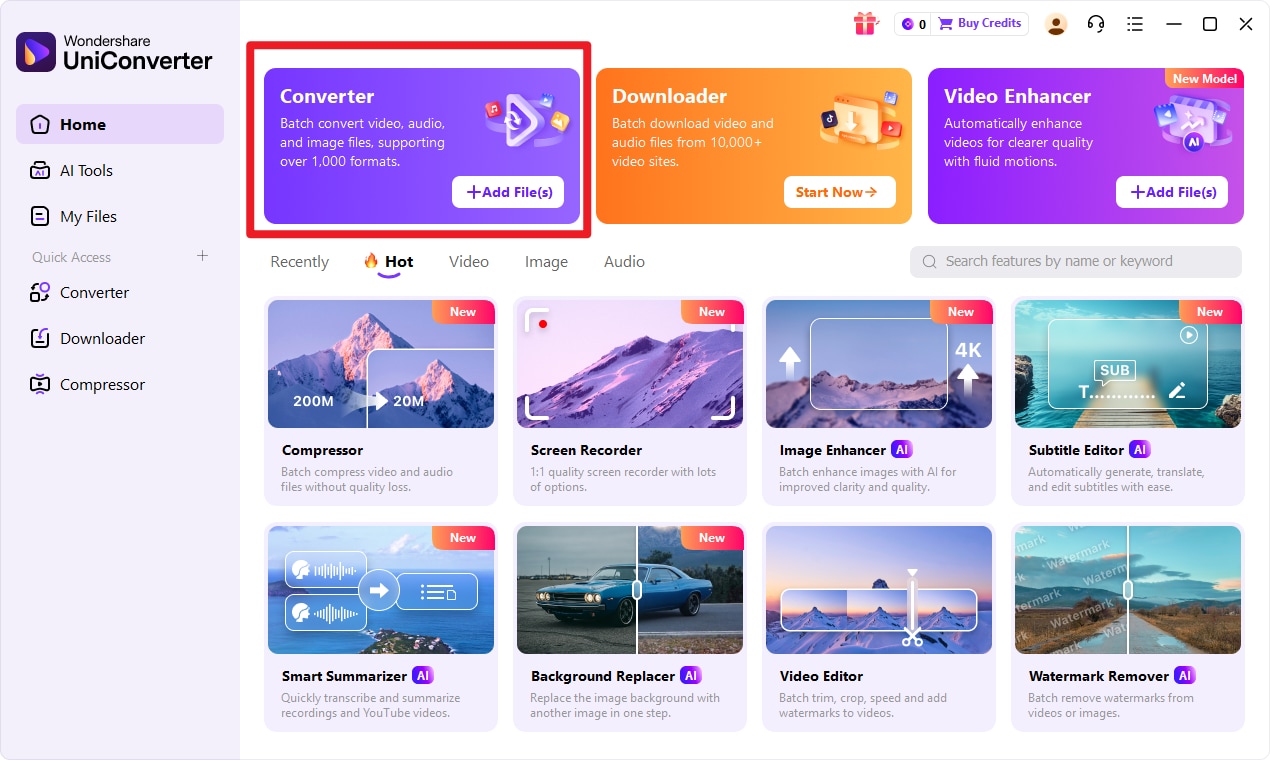
Step 1: Choose Converter in UniConverter
Launch Wondershare UniConverter on your computer. From the main interface, navigate to the left-side menu and click on the Converter tab to open the video conversion module.
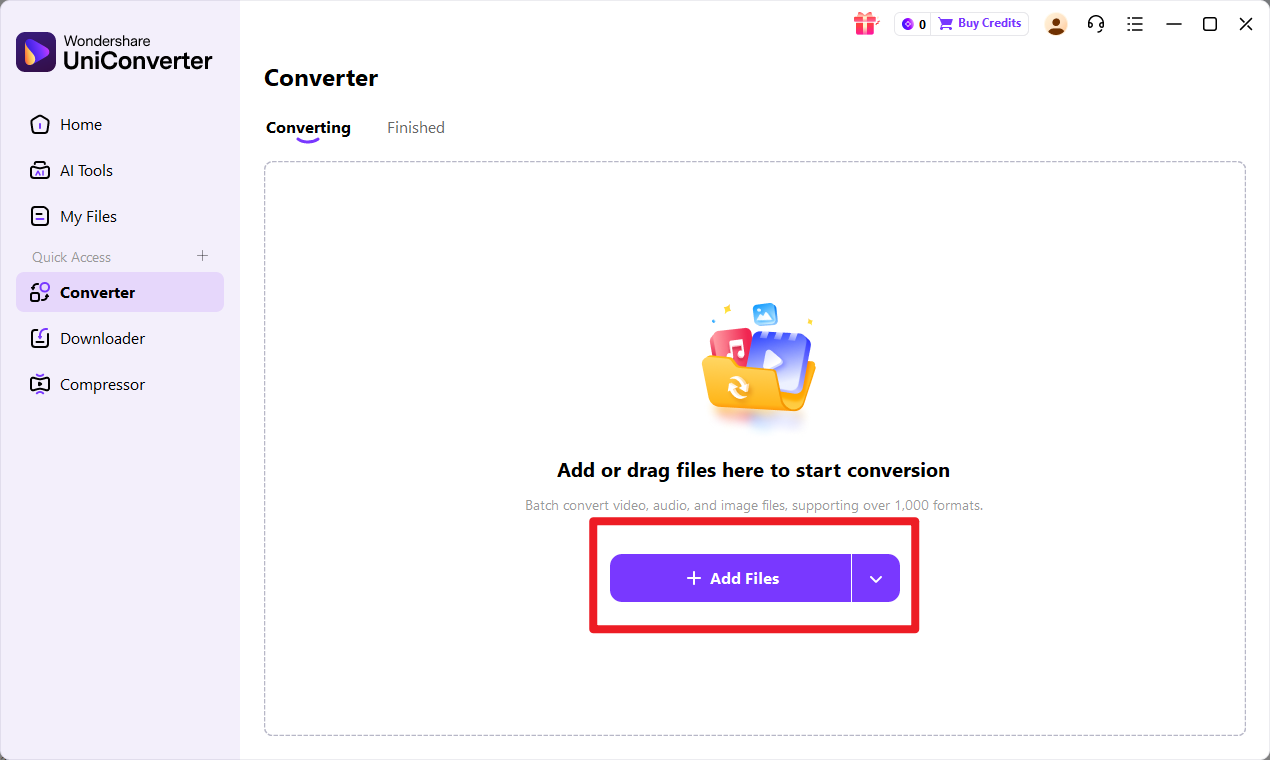
Step 2: Add Files to UniConverter
You can now import your input format files. Either drag and drop the files directly from your folder into the UniConverter window or click the Add Files icon in the top-left corner to browse your computer's storage and select the videos you wish to convert.
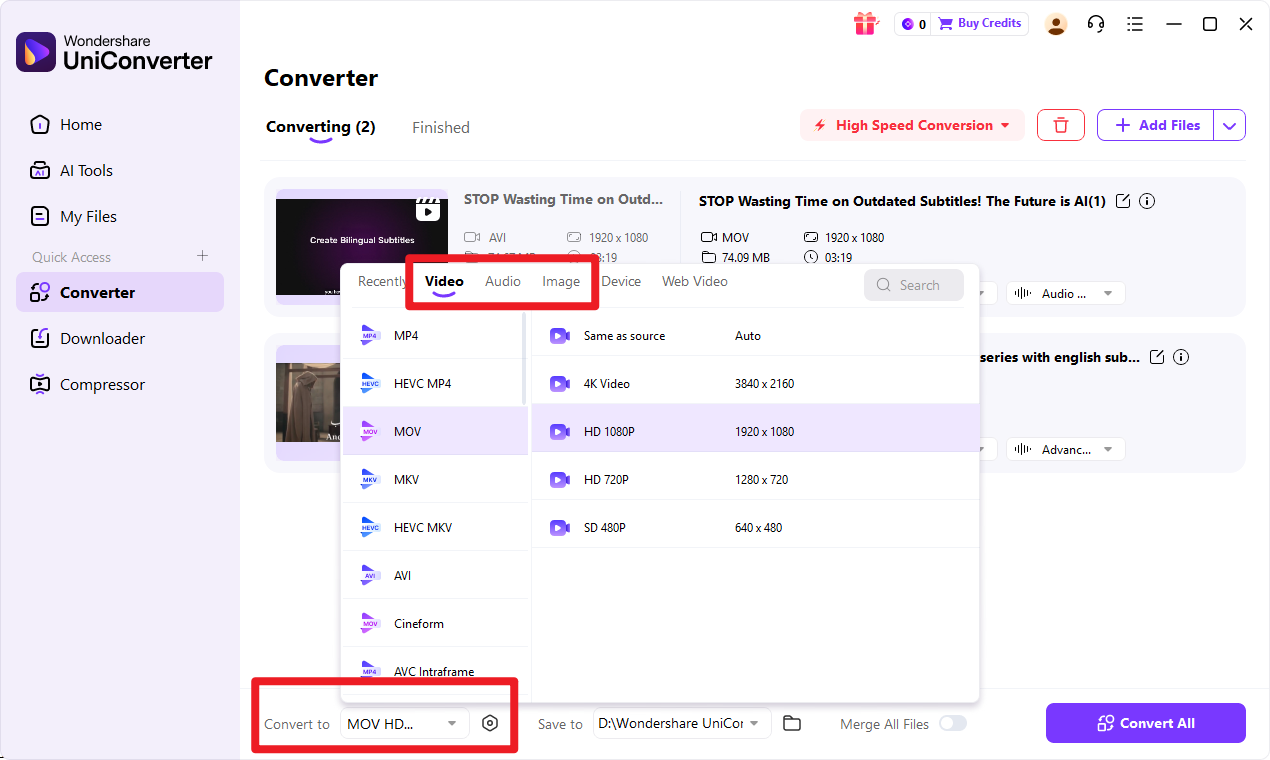
Step 3: Choose Output Format
At the bottom of the window, click on the Output Format menu. This will open a new dialog box. Select the Video tab, choose your desired target format from the list on the left, and then select a specific resolution and quality preset on the right.
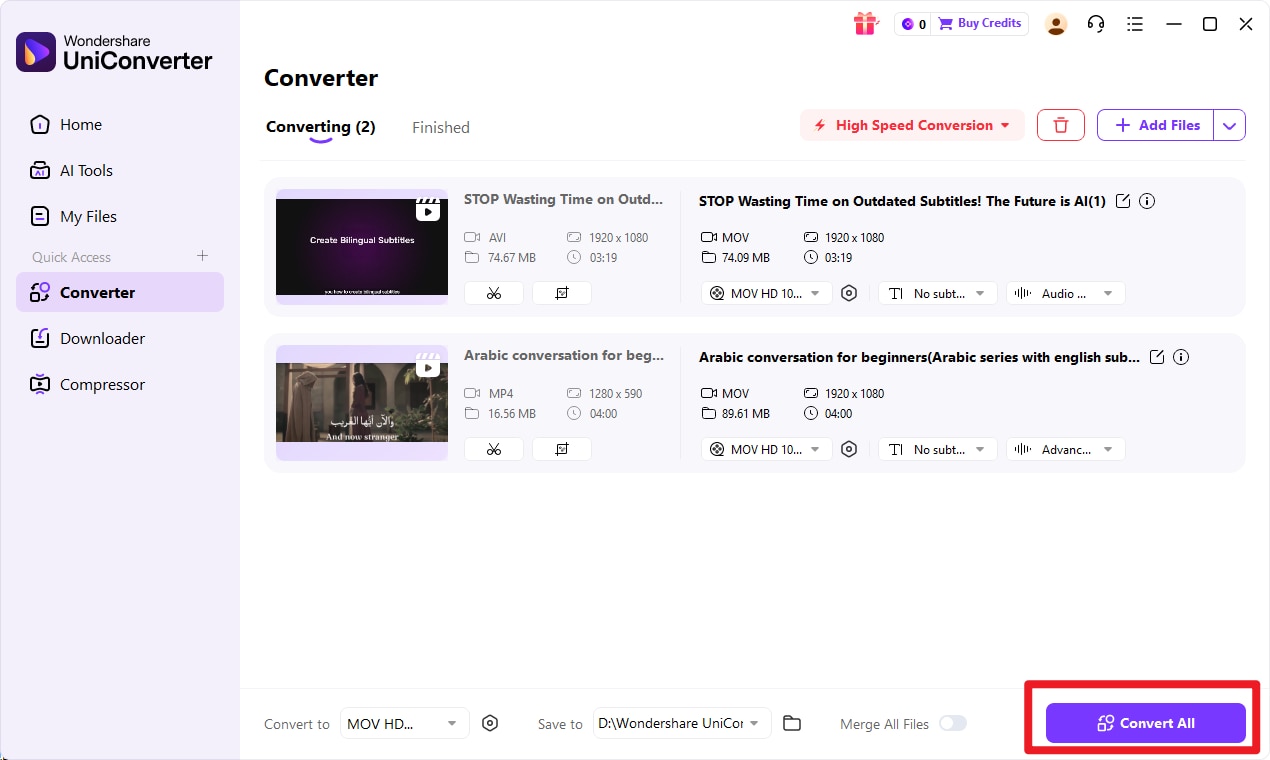
Step 4: Start the Conversion
Before starting, you can specify where you want to save the converted files by clicking the File Location field at the bottom. Once you are ready, click the Start All button in the bottom-right corner to begin the batch conversion. UniConverter will process your files quickly and save them to your chosen destination folder.

Go Beyond Simple Video Conversion
FAQs
-
1. Can I play a ProRes file on a Windows PC?
Not natively with default applications like Windows Media Player. To play a ProRes file on Windows, you would need to install a specialized media player like VLC Media Player, which has its own built-in codecs. Alternatively, professional editing software like Adobe Premiere Pro or DaVinci Resolve can import and play ProRes files. However, for simple playback and sharing with non-technical users, the easiest and most reliable method is to convert the ProRes file to a universally compatible format like MP4 or a Windows-friendly format like WMV using a tool like UniConverter. -
2. Is WMV a good format for YouTube?
While YouTube does accept WMV files for upload, it is not the recommended format. YouTube's official recommendation is to upload videos in the MP4 container format, using the H.264 video codec and AAC audio codec. This combination provides the best balance of high quality and manageable file size. When you upload a WMV file, YouTube has to re-encode it into its preferred format anyway, which can sometimes lead to a greater loss of quality than if you had uploaded in the recommended format to begin with. -
3. Does converting from ProRes to WMV reduce video quality?
Yes, absolutely. This is a fundamental aspect of video compression. You are moving from a visually lossless, high-bitrate format (ProRes) to a highly compressed, lossy format (WMV). The conversion process will permanently discard video information to achieve the smaller file size of WMV. The key is to manage this quality loss so that the final file is still visually acceptable for its intended purpose (e.g., web viewing). A good conversion tool like UniConverter gives you control over settings like bitrate and resolution, allowing you to find the right balance between file size and visual fidelity for your delivery needs.
Conclusion
Choosing between ProRes and WMV is not about picking a winner, but about selecting the right tool for the job at hand. They were designed with opposite goals in mind and excel in different areas. ProRes is the undisputed champion of the post-production world, offering the pristine quality and smooth editing performance required for professional work. WMV is a practical and efficient solution for final delivery, especially in Windows-centric environments where small file sizes are paramount. The key takeaway is to use ProRes while you create and WMV when you need to share. For those critical moments when you need to move between these two worlds, a robust and reliable tool like Wondershare UniConverter is an indispensable asset, ensuring your video workflow is seamless, efficient, and free from format-related frustrations.
