
Navigating the world of video formats can be complex, with a dizzying array of acronyms and technical specifications. Two formats that frequently come up in discussions among video professionals and media enthusiasts are ProRes and MKV. At first glance, they might seem like just two different file types, but they serve fundamentally different purposes in the video production and consumption lifecycle. Understanding the core differences in the ProRes vs MKV debate is crucial for optimizing your workflow, whether you're a professional editor, a content creator, or a media archivist.
Choosing the wrong format can lead to massive file sizes that cripple your storage, compatibility issues that halt your playback, or quality loss that degrades your final product. This guide is designed to demystify these two powerful formats. We will break down their individual strengths and weaknesses, compare them head-to-head, and show you exactly when and how to use each one for the best results.
In this article
Quick Note
- ProRes is a Codec: It's a family of high-quality, intermediate codecs from Apple designed for smooth video editing in post-production. It prioritizes performance and quality over file size.
- MKV is a Container: It's an open-standard container format that can hold multiple video, audio, and subtitle tracks in a single file. It's designed for flexibility and delivery, not editing.
- Primary Difference: Use ProRes for editing and professional workflows. Use MKV for archiving, streaming, and final delivery.
- Conversion is Key: A common workflow involves editing in ProRes and then converting to MKV for distribution. A reliable tool is needed for this conversion to balance quality and file size.
Part 1. What is Apple ProRes? What is MKV?
Before we can compare these two formats, it's essential to understand what they are individually. They are not interchangeable; one is a method of compressing video (a codec), while the other is a digital wrapper for that video (a container).
What is Apple ProRes?
Apple ProRes is a family of high-quality, lossy video compression formats (or codecs) developed by Apple Inc. It was introduced in 2007 with Final Cut Pro 6 and has since become an industry standard for video post-production.
The primary purpose of ProRes is to serve as an "intermediate" or "mezzanine" codec. This means it's not typically used for final delivery to consumers but rather for the stages in between camera acquisition and final export. Its key characteristic is its ability to maintain visually lossless quality while being less demanding on computer hardware during editing than uncompressed video. It achieves this through I-frame-only (or intra-frame) compression, where each frame is compressed individually. This makes scrubbing through a timeline in editing software like Final Cut Pro, Adobe Premiere Pro, or DaVinci Resolve incredibly smooth and responsive, as the computer doesn't need to decode a group of pictures to display a single frame. The trade-off for this performance and quality is significantly large file sizes.
What is MKV (Matroska)?
MKV, which stands for Matroska Video, is not a codec but a free, open-standard multimedia container format. Think of a container as a box. The box itself doesn't determine what's inside; it can hold various items. Similarly, an MKV file can "contain" a vast number of video, audio, picture, or subtitle tracks all within a single file.
The video and audio inside an MKV file are compressed using separate codecs (like H.264, H.265/HEVC, or AV1 for video, and AAC, AC3, or DTS for audio). MKV's greatest strength is its unparalleled flexibility. It can store multiple language tracks, various subtitle formats (including styled subtitles like ASS), chapter points, menus, and more. This makes it a favorite for media archivists and enthusiasts who want to preserve a movie with all its supplemental materials—like director's commentary and foreign language dubs—in one convenient file. It's widely supported by media players like VLC and Plex but is not natively supported for editing in most professional video editing software.
Part 2. Quick Comparison Table
To get a clear, at-a-glance overview of ProRes vs. MKV, here is a side-by-side comparison of their key attributes.
| Feature | Apple ProRes | MKV (Matroska) |
| Developer | Apple Inc. | CoreCodec, Inc. (Open Standard) |
| Type | Codec (Compression Format) | Container (File Format) |
| Primary Use | Professional video editing, post-production, mastering | Media archiving, streaming, final delivery |
| File Size | Very Large | Small to Medium (depends on internal codec) |
| Editing Performance | Excellent, designed for real-time editing | Poor, not designed for direct editing |
| Quality | Visually Lossless to High-Quality Lossy | Variable (depends on internal codec and settings) |
| Compatibility | Limited to professional editing software and players | Excellent, supported by most media players |
| Audio & Subtitle Support | Limited to multiple mono audio channels | Excellent, supports numerous audio and subtitle tracks |
Part 3. ProRes vs MKV: Which One Is Better?
The question of which format is "better" depends entirely on the context of its use. One excels in the editing suite, while the other shines in your media library. Let's break down their differences across key categories.
File Size and Storage Efficiency
This is one of the most significant differentiators. ProRes files are notoriously large. A single minute of 4K ProRes 422 HQ footage can easily consume several gigabytes of storage. This is by design; the codec uses minimal compression to preserve as much image data as possible, which is crucial for intensive tasks like color grading.
MKV, on the other hand, is a container. The file size of an MKV file is determined by the codecs used inside it. Typically, MKV files use highly efficient codecs like H.264 (AVC) or H.265 (HEVC). These codecs use advanced compression techniques to achieve drastically smaller file sizes compared to ProRes, often at a fraction of the size for a visually similar result. For storage and sharing, MKV is the clear winner in efficiency.
Editing Performance and Workflow
Here, the roles are completely reversed. ProRes is the undisputed king of editing performance. Its intra-frame compression means that every frame is self-contained, allowing editing software to access and display any frame instantly. This results in a smooth, lag-free experience when scrubbing, cutting, and applying real-time effects. This is why professional workflows are built around intermediate codecs like ProRes.
MKV is not designed for editing. The efficient codecs it usually contains (like H.265) use inter-frame compression, where frames are grouped together and depend on each other. To display a single frame, the software may need to decode multiple surrounding frames, which is computationally intensive and leads to a choppy, unresponsive editing experience. While some editors are beginning to support MKV, the performance is generally poor, and it's almost always recommended to convert MKV files to an editing-friendly format like ProRes before starting post-production.
Video Quality and Fidelity
ProRes is designed to be "visually lossless," especially in its higher-end variations like ProRes 422 HQ and ProRes 4444. This means that while it is a compressed format, the resulting video is virtually indistinguishable from the uncompressed source to the human eye. This high fidelity is essential for professional color grading and visual effects work, where every bit of image data counts.
The quality of an MKV file is entirely dependent on the codec and the bitrate settings used during encoding. You can create a very high-quality MKV file that looks fantastic, but it will almost always be a "delivery" file. The compression used (e.g., H.264) is lossy and discards more data than ProRes to achieve its small file size. While perfect for viewing, this loss of data means it's a less suitable format for re-editing or heavy color manipulation, as artifacts can become more apparent.
Compatibility and Playback
ProRes compatibility is largely confined to the professional video ecosystem. It's natively supported in macOS and by all major professional non-linear editing systems (NLEs) like Final Cut Pro, Adobe Premiere Pro, and DaVinci Resolve. However, playback on consumer devices, web browsers, or standard media players on Windows can be problematic without installing specific codecs.
MKV enjoys near-universal compatibility for playback. It is the format of choice for media enthusiasts for a reason. Software media players like VLC, MPV, and PotPlayer handle MKV files flawlessly on all operating systems. Furthermore, media server platforms like Plex and Kodi are built around the flexibility of the MKV container, allowing users to stream their libraries to TVs, tablets, and phones with ease.
Container Flexibility
This is MKV's signature advantage. As a container, it is incredibly versatile. A single MKV file can bundle a 4K video stream, a 7.1 surround sound audio track, a stereo audio track, a director's commentary track, and subtitles in ten different languages. It also supports chapters for easy navigation. This "all-in-one" capability makes it the perfect format for creating a definitive, archival copy of a film or show.
ProRes, being a codec, is typically stored in a QuickTime (.MOV) container. The MOV container can hold multiple audio channels, but it lacks the extensive, open-standard support for the sheer variety of subtitle formats and metadata that MKV offers. For pure container functionality, MKV is in a class of its own.
Part 4. Use Cases for ProRes and MKV
Understanding the technical differences is one thing; knowing when to apply them in a practical workflow is another. Here are the ideal scenarios for using each format.
When to Use ProRes
- During Video Editing and Color Grading: This is its primary purpose. If you are editing footage from a professional camera, transcoding it to ProRes will provide the smoothest performance in your NLE. Its high color fidelity (10-bit or 12-bit) is essential for professional color grading.
- For Creating High-Quality Master Files: After you finish your edit, exporting a "master file" in a high-bitrate ProRes format (like ProRes 422 HQ or 4444 XQ) creates a top-quality archive of your finished project before it's compressed for delivery.
- For Inter-departmental Transfers: When passing a project from the editing department to the visual effects or sound mixing department, using a ProRes file ensures that quality is maintained and everyone is working with a consistent, high-performance format.
When to Use MKV
- For Final Delivery and Distribution: When your project is complete and you need to send it to a client, upload it to a video-sharing platform, or simply save it for viewing, encoding it into an MKV file (with an H.264 or H.265 codec) provides an excellent balance of quality and small file size.
- For Archiving Media Collections: If you are digitizing your collection of Blu-rays or DVDs, ripping them to MKV allows you to preserve all the original audio and subtitle tracks in a single, organized file.
- For Home Media Streaming: MKV is the preferred format for home media servers like Plex or Jellyfin. Its ability to hold multiple audio and subtitle tracks allows you to select your preferred language on the fly while streaming to any device on your network.
Bridging the Gap: The ProRes to MKV Workflow
In the professional world, you don't choose one format over the other; you use them both at different stages. A very common and efficient workflow looks like this:
- Acquisition: Shoot video on a camera.
- Post-Production: Transcode the camera footage to ProRes for editing, color grading, and effects.
- Mastering: Export the final, edited timeline as a high-quality ProRes master file.
- Delivery: Convert that ProRes master file into a compressed MKV (or MP4) file for easy sharing, web upload, or long-term storage.
This workflow leverages the strengths of both formats. You get the performance and quality of ProRes when it matters most (during editing) and the efficiency and flexibility of MKV when the project is finished. To bridge this gap effectively, you need a reliable and powerful conversion tool. This is where software like Wondershare UniConverter becomes an indispensable part of the process, allowing you to seamlessly transform your large ProRes master into a compact and versatile MKV file.
Part 5. Step-by-Step Guide to Convert ProRes to MKV Using UniConverter
When you have finished editing your master file in ProRes and need to create a compact, flexible MKV file for delivery or archiving, a powerful video converter is essential. Wondershare UniConverter simplifies this process, ensuring a high-quality output with its efficient conversion engine. It is the recommended tool for this task.
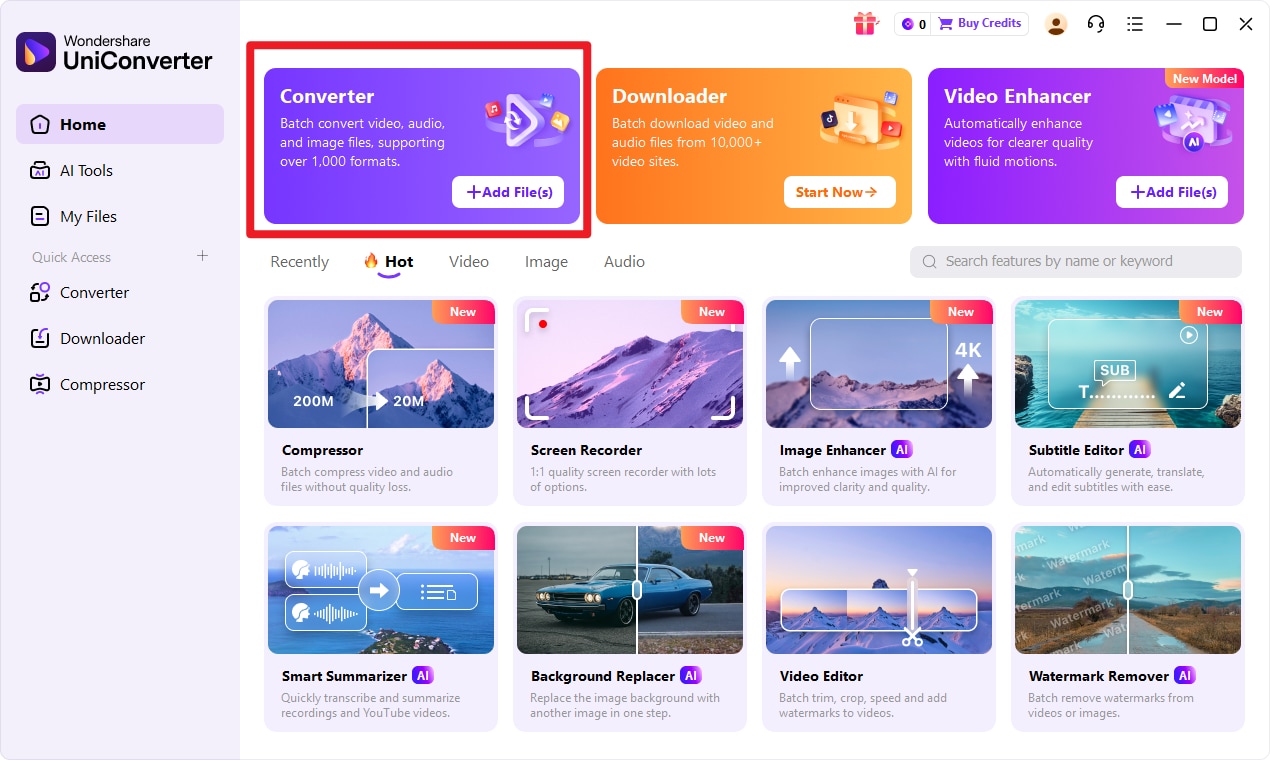
Step 1: Choose Converter in UniConverter
Launch Wondershare UniConverter on your computer. From the main interface, navigate to the left-hand menu and select the Converter tool to begin.
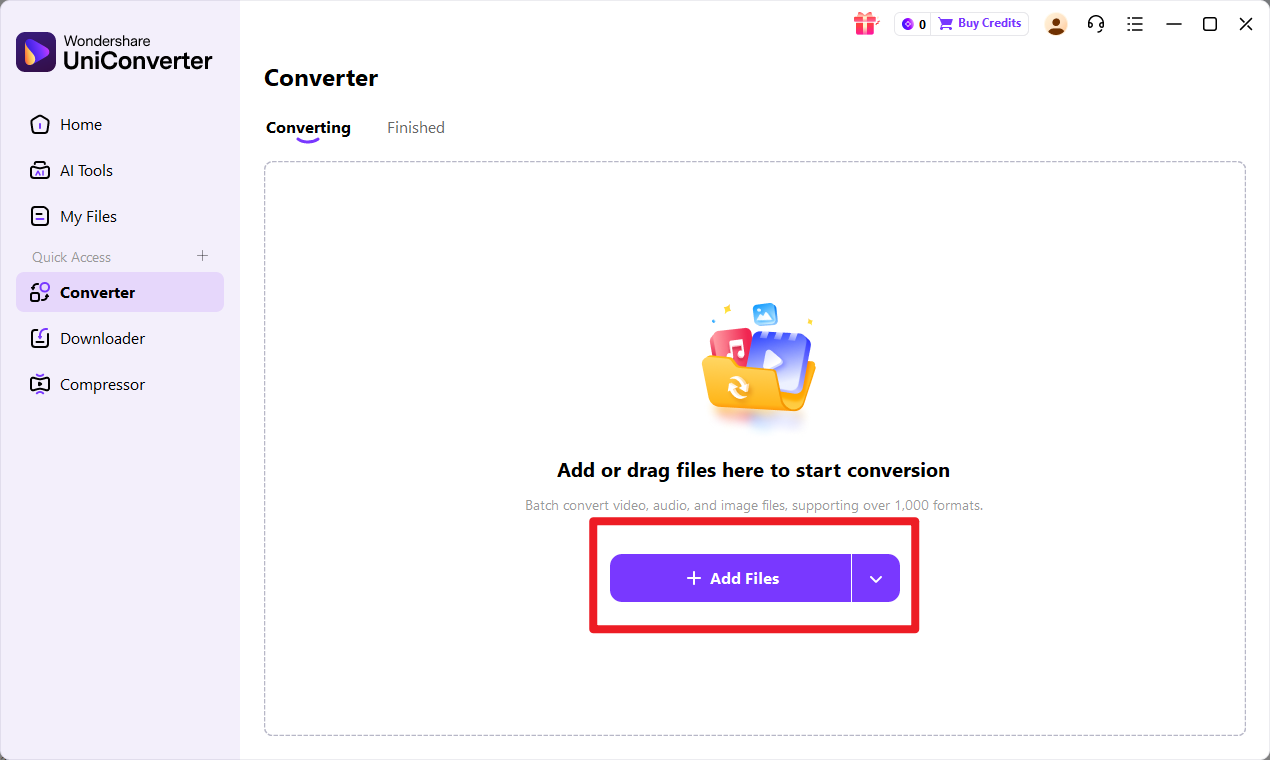
Step 2: Add Files to UniConverter
In the Converter window, you can either click the Add Files icon to browse and select your input format files from your computer or simply drag and drop them directly onto the program's interface.
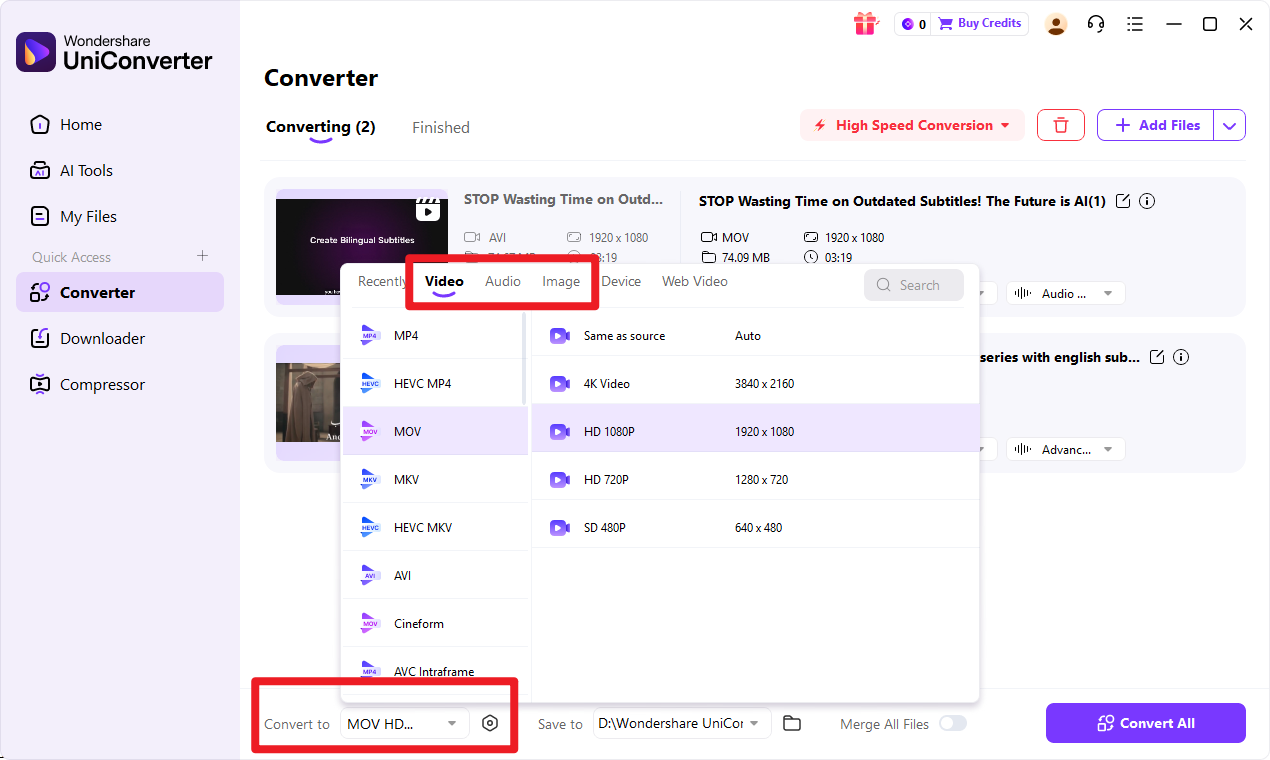
Step 3: Choose Output Format
Once your file is loaded, click on the Output Format menu located at the bottom of the window. A new dialog box will appear. Go to the Video tab and select your target format from the list of available formats on the left. You can also choose a specific resolution on the right.
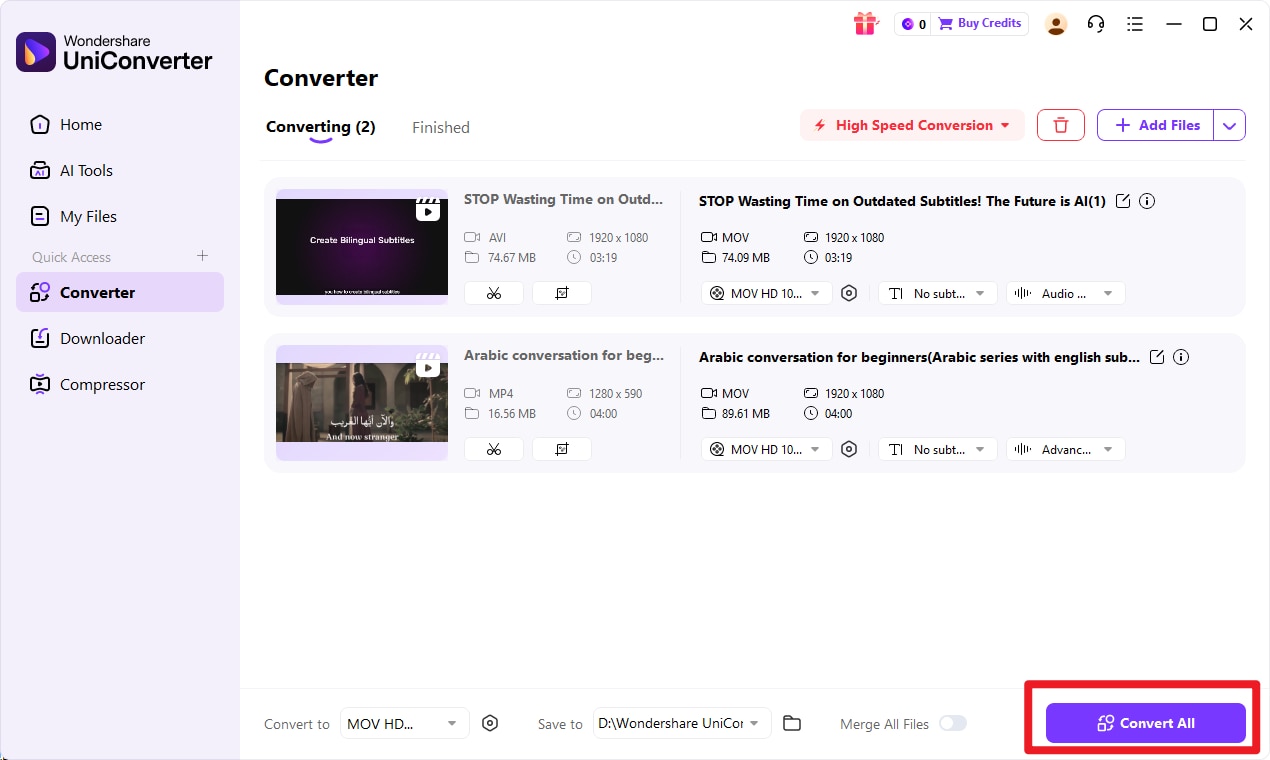
Step 4: Start the Conversion
Finally, specify where you want to save the converted file by using the File Location field at the bottom. When you are ready, click the Convert button (or Start All for multiple files) to initiate the conversion process. UniConverter will quickly process your file.

Go Beyond Simple Video Conversion
Conclusion
The ProRes vs MKV discussion isn't about finding a single winner, but about understanding the right tool for the right job. ProRes is a professional, high-performance editing codec designed to make the post-production process smooth and maintain maximum image fidelity. Its large file sizes are a necessary trade-off for its performance. MKV, in contrast, is a highly flexible and efficient delivery container, perfect for archiving and playback, thanks to its ability to hold numerous data streams in a single, compact file.
For any serious video creator or media manager, the best approach is not to choose one over the other but to use them in tandem. A typical professional workflow relies on ProRes for its editing prowess and then transitions to MKV for final distribution and storage. To make this transition seamless, a robust conversion tool is essential. Wondershare UniConverter stands out as an indispensable utility, providing a fast, reliable, and user-friendly way to bridge the gap between these formats, ensuring your video workflow is both efficient and effective from start to finish.
FAQs
-
1. Does converting ProRes to MKV lose quality?
Yes, converting from ProRes to a typical MKV file (using a codec like H.264 or H.265) is a lossy process and will result in some quality loss. ProRes is designed to hold a massive amount of image data for editing. When you convert to a delivery format like MKV, the goal is to reduce the file size significantly, which is achieved by discarding some of that data. However, with a good converter and appropriate settings (e.g., a high bitrate), you can create an MKV file where the quality loss is visually negligible for viewing purposes. -
2. Can I edit an MKV file directly in Premiere Pro or Final Cut Pro?
While some newer versions of professional editing software have added limited support for importing MKV files, it is generally not recommended. The compression codecs typically used in MKV files (like H.265) are not optimized for editing and can cause severe performance issues, such as lag, stuttering, and crashes. The best practice is to convert the MKV file to an editing-friendly codec like ProRes before importing it into your project. -
3. Is MKV better than MP4 for delivery?
This depends on your needs. MKV is technically more flexible, as it can hold more types of tracks (e.g., multiple subtitle formats like ASS/SSA). This makes it superior for personal archives where you want to keep everything in one file. However, MP4 has slightly broader hardware compatibility, especially with older devices, smart TVs, and gaming consoles. For web uploads (like YouTube), both are generally acceptable, but MP4 is often considered the "safer" and more universally compatible choice. -
4. Why are my ProRes files so large?
ProRes files are large by design. The codec prioritizes editing performance and image quality over file size. It uses a compression method called intra-frame, where each video frame is compressed individually. This requires less processing power to decode during editing, allowing for smooth playback and scrubbing. To achieve this while preserving near-lossless quality and high color depth (10-bit or more), the file must retain a vast amount of data, resulting in very large file sizes compared to delivery formats that use more aggressive compression.
