
Navigating the world of video formats can feel like learning a new language, with a confusing array of acronyms and technical specifications. Two terms that frequently come up, especially for those involved in video production and editing, are ProRes and AVI. While both are used to store video data, they are fundamentally different technologies designed for distinct purposes. Understanding the core differences in the ProRes vs AVI debate is crucial for optimizing your workflow, ensuring high-quality results, and avoiding compatibility headaches. Whether you're a professional editor working on a high-end production or a content creator trying to manage your files, choosing the right format can significantly impact your project's efficiency and final output.
In this article:
Quick Note:
- ProRes is a Codec: Developed by Apple, it's a family of high-quality, visually lossless video codecs designed for smooth performance in post-production.
- AVI is a Container: Developed by Microsoft, it's a multimedia container format that can hold video and audio compressed with various codecs. Its quality and performance are not fixed but depend on the codec used inside.
- Key Difference: ProRes prioritizes editing performance and quality preservation, resulting in large files. AVI is a versatile but older container whose characteristics are highly variable.
- Best Use Cases: ProRes excels as an intermediate format for professional video editing. AVI is primarily used for legacy workflows and general playback on Windows systems.
- Solution for Incompatibility: When you need to switch between these formats for different platforms or purposes, a reliable video converter is the most effective solution.
Part 1. What is ProRes? What is AVI?
Before we can compare these two formats, it's essential to understand what they are individually. A common point of confusion is the difference between a codec and a container, and ProRes and AVI are perfect examples of this distinction.
What is ProRes?
ProRes is a family of intermediate video codecs developed by Apple Inc. An "intermediate" codec is designed not for final delivery to viewers but for use during the video editing and post-production process. Its primary goal is to maintain the highest possible image quality while being less demanding on your computer's processor than camera-native formats.
ProRes achieves this through visually lossless compression. This means that while the file is compressed to a smaller size than uncompressed video, the reduction in quality is mathematically present but practically invisible to the human eye. This high fidelity makes it a standard in professional workflows, especially within the Apple ecosystem (e.g., Final Cut Pro), as it provides a perfect balance of quality and real-time editing performance.
What is AVI?
AVI, which stands for Audio Video Interleave, is a multimedia container format developed by Microsoft in the early 1990s. Unlike ProRes, which is a codec (the method of compressing and decompressing data), AVI is a container (the "box" that holds the data). This container can hold both audio and video streams, which can be compressed using a wide variety of different codecs.
Because AVI is just a wrapper, its quality and file size are not inherent to the format itself. An AVI file can contain uncompressed video (resulting in enormous files of perfect quality) or video compressed with codecs like DivX or Xvid (resulting in much smaller files with lower quality). As one of the earliest video formats for Windows, it has deep roots in that ecosystem but is considered a legacy format compared to more modern and efficient containers like MP4 or MKV.
Part 2. Quick Comparison Table
To get a clear, at-a-glance overview of the key differences between ProRes and AVI, here is a quick comparison table.
| Feature | ProRes | AVI (Audio Video Interleave) |
| Developer | Apple | Microsoft |
| Type | Codec Family | Container Format |
| Compression | Visually Lossless | Variable, Codec-Dependent |
| Quality | High to Excellent | Variable, from Low to Lossless |
| File Size | Large | Highly Variable |
| Compatibility | Best on macOS, supported in professional software on Windows | Native to Windows, may require extra components on macOS |
| Primary Use | Professional video editing and post-production | General video storage and playback on Windows |
Part 3. ProRes vs AVI: Which One Is Better?
The question of which format is "better" depends entirely on the context of your work. Let's break down their performance across several critical categories.
Quality and Compression
ProRes was engineered to be a mastering-quality codec. It uses a sophisticated form of intra-frame compression, where each frame of video is compressed individually. This method preserves an extremely high level of detail, making it the ideal choice for intensive tasks like color grading, visual effects, and compositing, where you need to manipulate the image without introducing compression artifacts. The different "flavors" of ProRes (like ProRes 422, ProRes 422 HQ, and ProRes 4444) offer varying data rates, allowing you to choose the right balance of quality and file size for your project.
AVI's quality, on the other hand, is a complete variable. It is entirely dependent on the codec used to compress the video stream inside the container. If an AVI file uses an uncompressed codec, its quality will be mathematically perfect, but the file size will be astronomical. If it uses a highly lossy codec like DivX, the quality will be significantly lower, suitable for standard-definition web video but not for professional editing. This unpredictability is one of AVI's main drawbacks in a professional environment.
File Size and Storage
There's no getting around it: ProRes files are large. The focus on high quality and editing-friendly compression means that ProRes files occupy a significant amount of storage space. For example, one hour of 1080p footage at 24fps in ProRes 422 HQ will take up roughly 100 GB of space. This necessitates large, fast hard drives or RAID arrays for any serious project, which is a standard investment in professional post-production.
AVI file sizes can swing from one extreme to the other. An AVI file containing uncompressed video could be even larger than a comparable ProRes file. Conversely, an AVI file using an efficient distribution codec could be a fraction of the size. This variability makes it difficult to plan for storage unless you know exactly which codec is being used within the AVI container. In general, for a given level of visual quality, modern codecs within an MP4 container often provide better compression and smaller file sizes than the codecs typically found in AVI files.
Compatibility and Platform Support
ProRes is a native citizen of the Apple ecosystem. It works flawlessly within macOS and is the default intermediate codec for Final Cut Pro. However, its reach extends beyond Apple. Major professional non-linear editing systems (NLEs) like Adobe Premiere Pro and DaVinci Resolve offer robust support for ProRes on both macOS and Windows. The main compatibility issue arises with general playback. A standard Windows PC cannot play a ProRes file using Windows Media Player out of the box. You would need to install a specialized player like VLC Media Player or have professional video software installed.
AVI is the polar opposite. As a Microsoft creation, it is native to the Windows operating system. Any Windows machine can play an AVI file without needing to install additional software, assuming it uses a common codec. On macOS, however, the situation is reversed. QuickTime Player often struggles with AVI files, especially if they contain older or Windows-specific codecs. Similar to the ProRes-on-Windows issue, Mac users typically need to install a third-party player like VLC or a codec pack to ensure reliable playback of AVI files.
Editing Performance
This is the category where ProRes truly shines and demonstrates its core purpose. The intra-frame compression of ProRes is highly efficient for your computer's CPU to decode. This means you can get smooth, real-time playback, scrubbing, and editing, even with multiple 4K streams, layers of effects, and color grades. It was built from the ground up for post-production, and its performance reflects that.
Editing performance with AVI files is completely unpredictable and often poor. The performance depends on the codec inside the container. Many codecs commonly found in AVI files, such as DivX, use inter-frame (or Long-GOP) compression. This method is great for reducing file size for delivery but is very processor-intensive to decode during editing, as the computer has to reconstruct frames based on information from surrounding frames. This can lead to significant lag, dropped frames, and a frustrating editing experience.
Part 4. Use Cases for ProRes and AVI
Understanding the strengths and weaknesses of each format helps clarify when you should use them.
When to Use ProRes
- Intermediate Editing Codec: This is its primary function. You convert your camera-native footage (like H.264 or HEVC) to ProRes to create a high-quality, edit-friendly version for your post-production workflow.
- Mastering and Archiving: When you've finished your project, exporting a master file in ProRes (like ProRes 422 HQ or 4444) ensures you have a top-quality version for archival purposes or for creating other deliverables.
- Transferring Between Applications: If you are moving a project from one piece of software to another (e.g., from Premiere Pro to DaVinci Resolve for color grading), a ProRes file is a reliable and high-quality way to transfer the video.
- Mac-Centric Workflows: If your entire production pipeline is based on macOS and especially if you use Final Cut Pro, ProRes is the natural and most efficient choice.
When to Use AVI
- Legacy Projects: If you are working with older footage or projects created on Windows systems years ago, you will likely encounter AVI files.
- Specific Hardware/Software Requirements: Some older cameras, industrial equipment, or specialized software may only output or accept video in the AVI format. In these niche cases, you have to work with the format required.
- General Windows Playback: For simple video files intended for playback on a wide range of Windows computers without concern for editing, an AVI with a common codec can be a straightforward choice, though modern formats like MP4 are now generally preferred for this purpose due to better compression and wider device support.
Part 5. Step-by-Step Guide to Convert ProRes to AVI Using UniConverter
When you're caught between the Mac and Windows worlds or need to convert a high-quality master file into a more compatible format, a video converter is an essential tool. Wondershare UniConverter is a powerful and intuitive application that makes this process simple, handling both ProRes and AVI files with ease. It is the ideal choice for converting your video files quickly without compromising quality, ensuring your workflow remains seamless regardless of format requirements.
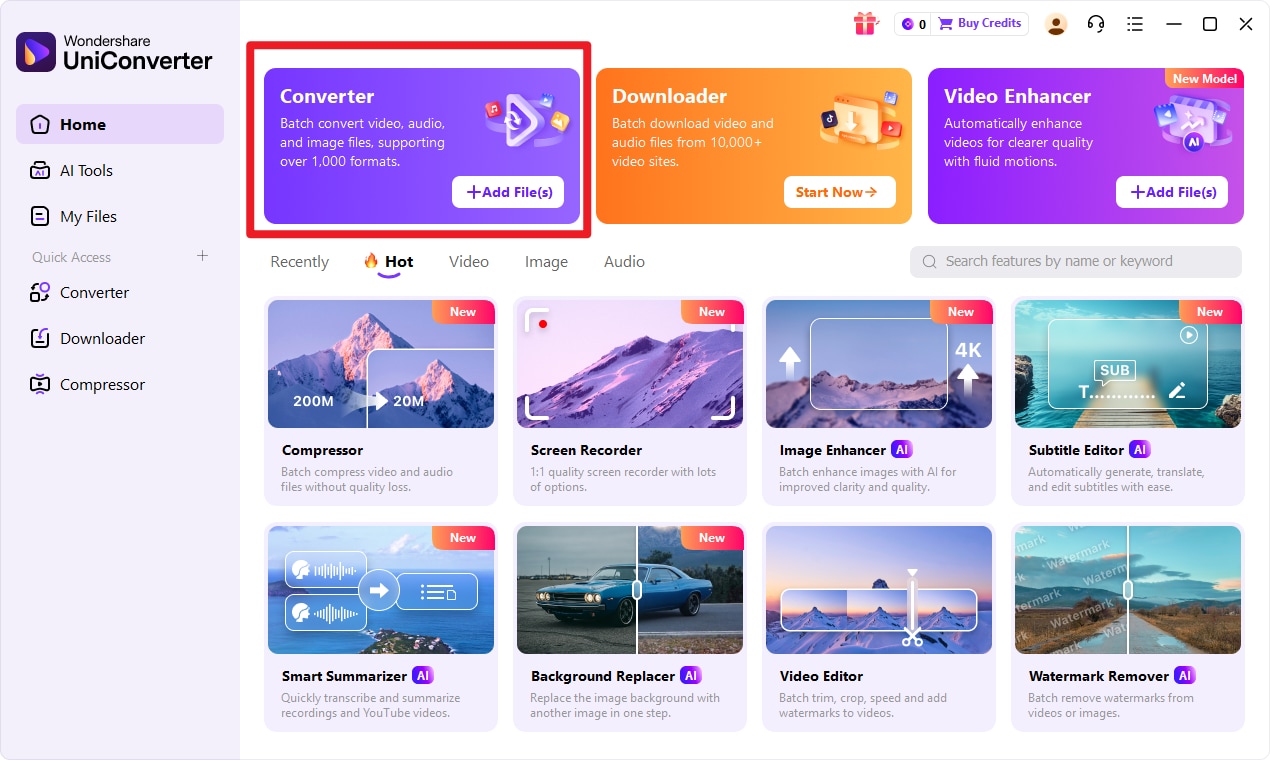
Step 1: Choose Converter in UniConverter
Launch Wondershare UniConverter on your computer. From the main dashboard, navigate to the left-side menu and select the Converter tool to open the conversion interface.
Step 2: Add Files to UniConverter
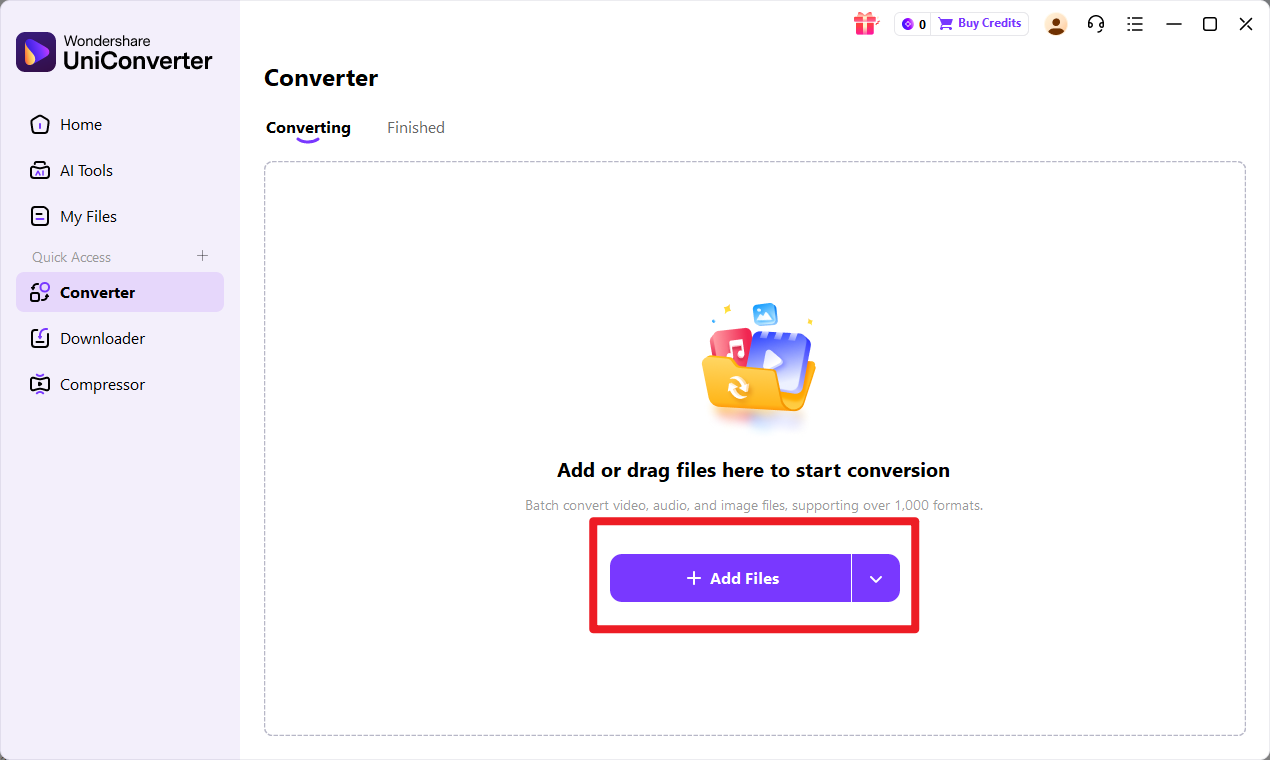
You can now import your video file. Click the Add Files icon in the center or top-left corner to browse your computer for the input format file. Alternatively, you can simply drag and drop the video directly into the program window. UniConverter also supports batch conversion, so feel free to add multiple files at once.
Step 3: Choose Output Format
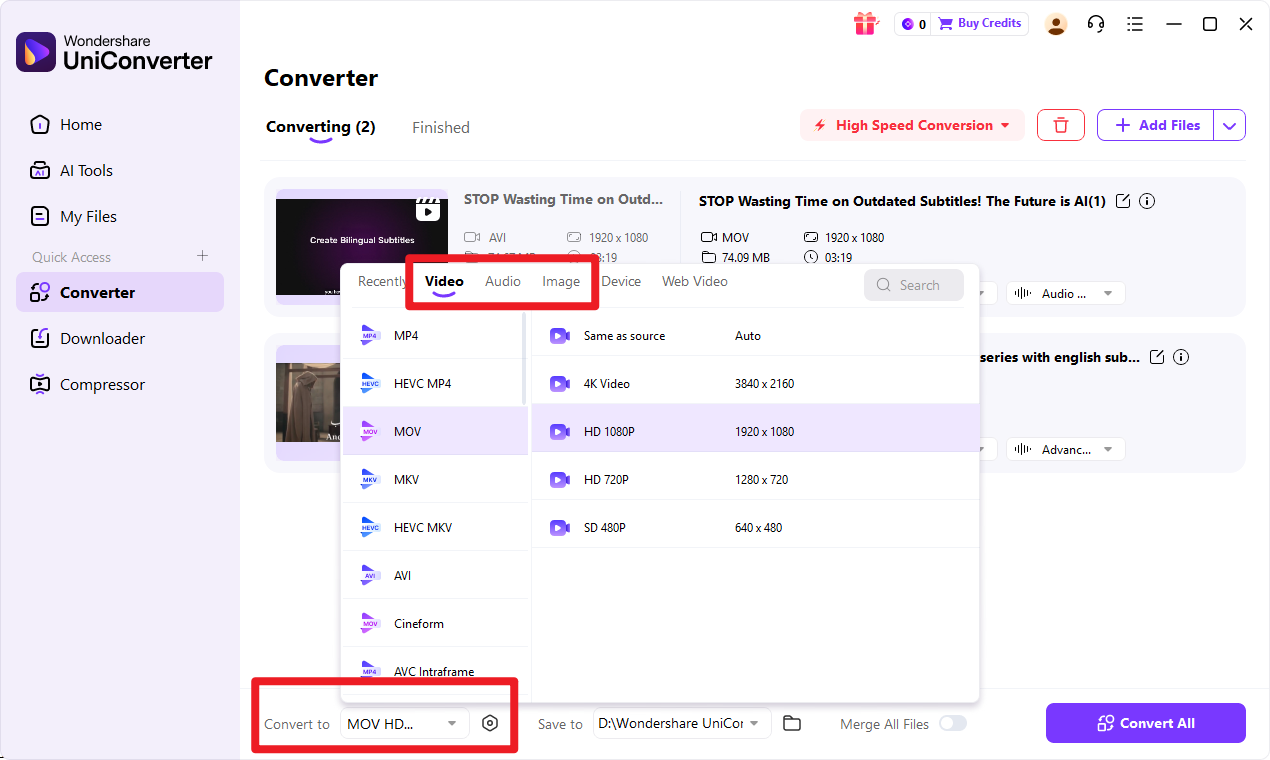
At the bottom of the window, click on the Output Format menu to open the format selection panel. Click on the Video tab. From the list of formats on the left, select your desired target format. On the right, you can then choose a specific resolution or quality preset for your output file.
Step 4: Start the Conversion
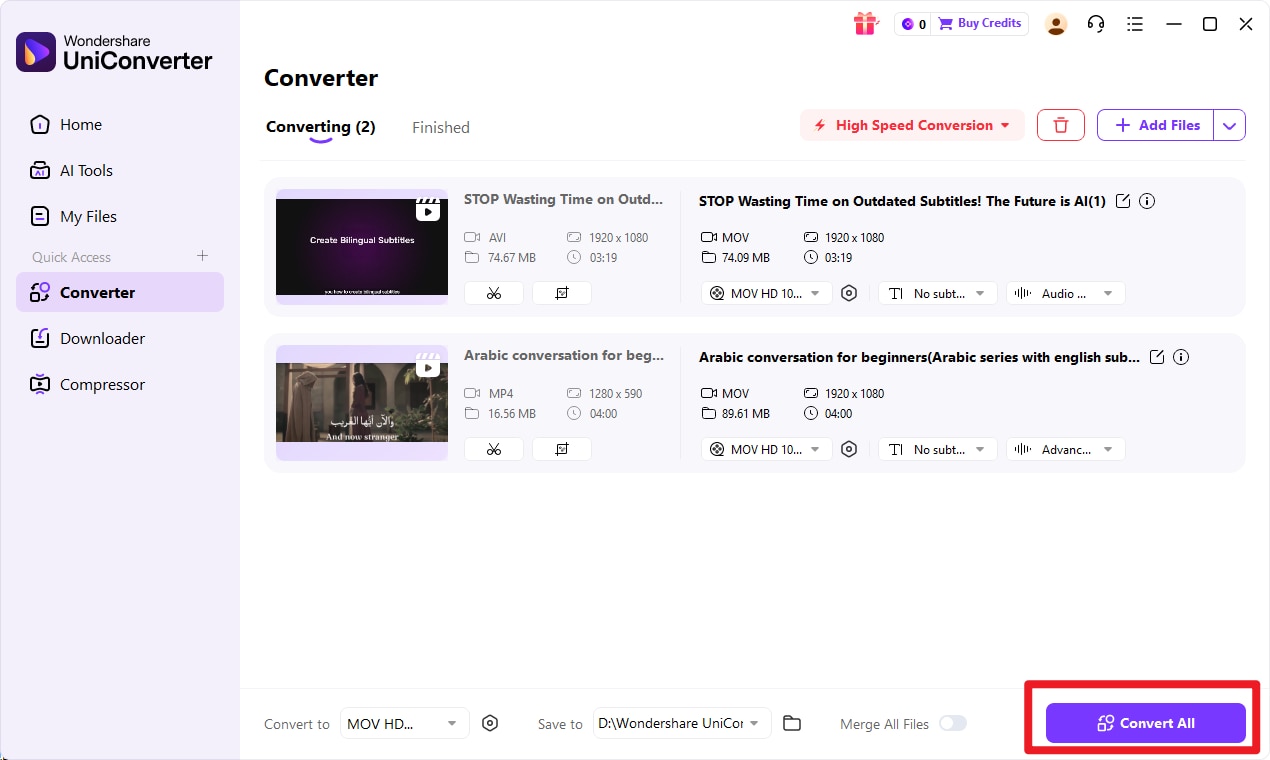
Before starting, you can specify where to save the converted file by using the File Location option at the bottom. Once you are ready, click the Start All button (or the Convert button next to an individual file) to begin the conversion process. UniConverter will process your files quickly and efficiently.

More Than Just a Video Converter
Conclusion
Choosing between ProRes and AVI is not about picking a winner, but about selecting the right tool for the job. For any serious video editing, post-production, or mastering workflow, especially on a Mac, ProRes is the undisputed champion. Its combination of visually lossless quality and exceptional editing performance makes it the industry standard for intermediate codecs. AVI, in contrast, is a legacy container format from the Windows ecosystem. Its utility in 2026 is limited, primarily serving niche or older workflows. Its variable nature, dependent on the codec held within, makes it an unpredictable choice for professional editing environments. For most modern delivery and sharing purposes, formats like MP4 have largely superseded it.
Ultimately, your project's specific needs—quality requirements, editing platform, and final destination—will dictate the correct format. And for those inevitable moments when you face a format barrier, having a reliable and versatile tool like Wondershare UniConverter is essential to convert your files and keep your creative projects moving forward without a hitch.
FAQs
-
1. Is ProRes better than AVI for editing?
Yes, ProRes is significantly better for editing. It is a codec specifically designed for the demands of post-production, offering smooth, real-time playback and preserving high visual quality through multiple generations of effects and rendering. AVI is a container, and its editing performance varies wildly from excellent to terrible based on the codec used inside. Most codecs commonly found in AVI files are not optimized for editing and can cause severe performance issues. -
2. Can I play ProRes files on Windows?
Yes, but not natively with the default Windows Media Player. To play ProRes files on a Windows PC, you will need to install a media player that includes the necessary codecs, such as the popular and free VLC Media Player. Alternatively, professional video editing software like Adobe Premiere Pro or DaVinci Resolve can import and play ProRes files on Windows without any issue. -
3. Why is my AVI file not playing on my Mac?
If an AVI file isn't playing on your Mac, it's almost certainly a codec issue. The AVI container itself is just a wrapper; the problem is that your Mac's default player, QuickTime, does not have the specific codec required to decode the video or audio stream inside that particular AVI file. The easiest solution is to use a more versatile media player like VLC, which has a vast library of built-in codecs. Another reliable solution is to convert the file to a Mac-friendly format like MOV or MP4 using a tool like UniConverter.
