
In the world of professional video post-production, the choice of an intermediate codec is a critical decision that impacts everything from image quality and file size to editing performance and workflow compatibility. Two of the most dominant players in this space are Apple's ProRes 4444 and Avid's DNxHR. Choosing between ProRes 4444 vs DNxHR can be a daunting task, as both are high-quality, robust codecs designed to withstand the rigors of editing, color grading, and visual effects. However, they possess distinct characteristics and are optimized for different ecosystems and use cases.
Whether you're a video editor, colorist, VFX artist, or filmmaker, understanding the nuances of these codecs is essential for building an efficient and high-fidelity post-production pipeline. This guide will provide a direct, in-depth comparison to help you determine which codec is the right fit for your specific project needs, software environment, and collaborative demands.
In this article:
- An introduction to Apple ProRes 4444 and Avid DNxHR.
- A quick side-by-side comparison table of their key features.
- A detailed analysis of image quality, performance, and workflow compatibility.
- Specific use cases to help you decide when to use each codec.
- A step-by-step guide on how to convert between ProRes 4444 and DNxHR.
Part 1. What is Apple ProRes 4444? What is Avid DNxHR?
Before we dive into a direct comparison, it's important to understand the fundamentals of each codec. Both are "intermediate" or "mezzanine" codecs, meaning they are designed not for final delivery to consumers, but for use during the editing and post-production process. They compress video in a way that preserves high image quality while being less computationally demanding to decode than camera-native formats like H.264 or HEVC.
What is Apple ProRes 4444?
Apple ProRes is a family of lossy video compression formats developed by Apple Inc. for use in post-production. Since its introduction, it has become a staple in the industry, particularly within the macOS ecosystem. The ProRes family includes several versions, such as ProRes Proxy, LT, 422, 422 HQ, and the highest-quality versions, ProRes 4444 and ProRes 4444 XQ.
ProRes 4444 stands out for three key characteristics:
- 12-bit Color Depth: It can maintain up to 12 bits of color information per channel, allowing for incredible precision during color grading and the representation of a vast range of tones and hues.
- 4:4:4 Chroma Subsampling: This means it stores full color information for every single pixel. Unlike 4:2:2 or 4:2:0 codecs, which discard some color data to save space, 4:4:4 is crucial for high-end compositing and green screen work where precise color edges are paramount.
- Alpha Channel Support: Its most unique feature is the optional, mathematically lossless alpha channel for representing transparency. This makes ProRes 4444 the go-to codec for exporting motion graphics, animations, and visual effects elements that need to be seamlessly layered over other video footage.
While widely supported across major non-linear editing (NLE) software, ProRes has its roots in Apple's ecosystem and is the native intermediate codec for Final Cut Pro.
What is Avid DNxHR?
DNxHR (Digital Nonlinear Extensible High Resolution) is the successor to Avid's popular DNxHD codec. Developed by Avid Technology, it was designed to be resolution-independent, supporting everything from standard HD to 2K, 4K, 8K, and beyond. This makes it a future-proof choice for modern high-resolution workflows.
The DNxHR family is broken down into several quality levels, each serving a different purpose:
- DNxHR 444: The highest quality level, comparable to ProRes 4444, offering 12-bit 4:4:4 color.
- DNxHR HQX: A high-quality 10-bit 4:2:2 or 12-bit 4:2:2 option suitable for mastering.
- DNxHR HQ: A high-quality 8-bit or 10-bit 4:2:2 option.
- DNxHR SQ: A "standard quality" 8-bit 4:2:2 option, good for a balance of quality and file size.
- DNxHR LB: A "low bandwidth" 8-bit 4:2:2 option, ideal for offline editing and creating proxies due to its very small file sizes.
A core design philosophy behind DNxHR is cross-platform compatibility. It is engineered to perform exceptionally well on macOS, Windows, and Linux systems. It is wrapped in a generic MXF container (Material Exchange Format), which is an open standard, further enhancing its interoperability, especially in broadcast environments and within Avid Media Composer.
Part 2. Quick Comparison Table
For a quick overview, this table summarizes the key differences and similarities between Apple ProRes 4444 and Avid DNxHR 444.
| Feature | Apple ProRes 4444 | Avid DNxHR 444 |
| Developer | Apple Inc. | Avid Technology |
| Bit Depth | Up to 12-bit | Up to 12-bit |
| Chroma Subsampling | 4:4:4 | 4:4:4 |
| Alpha Channel Support | Yes (up to 16-bit, mathematically lossless) | Yes (but less common and not as integrated) |
| File Size & Data Rate | High (e.g., ~1320 Mbps for 4K 24p) | High and variable (e.g., ~1498 Mbps for 4K 24p) |
| Platform Compatibility | Excellent on macOS, good on Windows (encoding limited) | Excellent on macOS, Windows, and Linux |
| Primary Software Ecosystem | Apple Final Cut Pro, macOS-centric workflows | Avid Media Composer, cross-platform workflows |
Part 3. ProRes 4444 vs DNxHR: Which One Is Better?
The question of which codec is "better" is not about a definitive winner but about which is better suited for a specific task, system, and workflow. Let's break down the comparison into three critical areas.
Image Quality and Color Fidelity
At the highest end of the spectrum, both ProRes 4444 and DNxHR 444 are designed for mastering-quality results.
- Color Depth and Subsampling: Both codecs support up to 12-bit color depth and full 4:4:4 chroma subsampling. This means that for most practical purposes, the visual difference in color fidelity between them is negligible. Both provide the rich color information needed for aggressive color grading, allowing you to push and pull colors, exposure, and contrast without introducing banding or other artifacts. They are both considered "visually lossless," meaning that while they are technically compressing the data, the resulting image is indistinguishable from the uncompressed source to the human eye.
- Alpha Channel Advantage: This is where ProRes 4444 has a distinct advantage. Its implementation of a mathematically lossless 16-bit alpha channel is an industry standard for delivering graphics with transparency. If your workflow involves creating motion graphics in Adobe After Effects or Apple Motion and then compositing them in an NLE, ProRes 4444 is the superior and more streamlined choice. While DNxHR can technically support an alpha channel, it's not as widely or seamlessly integrated into most software.
Performance and File Size
Performance and storage are practical considerations that can heavily influence your codec choice.
- Data Rates and Storage: Both ProRes 4444 and DNxHR 444 are data-intensive. At comparable settings (e.g., 4K at 24fps), their data rates and resulting file sizes are quite similar, with DNxHR sometimes being slightly higher. This means both require fast storage solutions (like SSDs or RAID arrays) for smooth multi-stream playback. A project edited with these codecs will consume a significant amount of disk space, which is a crucial factor to plan for in your production budget.
- Editing Performance and Flexibility: Real-world editing performance can depend on your operating system and NLE. ProRes is heavily optimized for macOS and Final Cut Pro, often delivering exceptionally smooth playback on Apple hardware. DNxHR, designed for cross-platform use, generally offers excellent performance across Windows and macOS, especially within Avid Media Composer and DaVinci Resolve.
The biggest advantage for DNxHR in this category is its range of quality levels. The ability to easily create lightweight proxies using DNxHR LB (Low Bandwidth) is a massive workflow benefit. Editors can work with these small, nimble files on less powerful laptops or systems for a fluid editing experience, and then relink to the full-quality source files for final color grading and export. ProRes also has a proxy version, but the comprehensive and tiered DNxHR family offers more granular control.
Workflow and Ecosystem Compatibility
This is often the most decisive factor for studios and collaborative teams.
- ProRes 4444 in the Apple Ecosystem: If your entire post-production pipeline is based on macOS and your team primarily uses Final Cut Pro or Adobe Premiere Pro on Macs, ProRes 4444 is the path of least resistance. It is the native, default choice, ensuring maximum stability and performance.
- DNxHR for Cross-Platform Collaboration: DNxHR shines in mixed-OS environments. If you have editors on Windows machines and colorists on Macs, or if you're delivering files to a facility that uses Avid Media Composer, DNxHR is the more robust and reliable choice. Its use of the open MXF wrapper makes it a standard in many broadcast and enterprise-level workflows, avoiding potential compatibility headaches.
The challenge arises when you need to move assets between these two worlds. For instance, a graphics artist on a Mac might create a ProRes 4444 file that needs to be used by an editor on a Windows-based Avid system. While Windows NLEs can read ProRes files, creating them is often restricted. In these scenarios, converting between the codecs becomes necessary. For seamless transitions, a professional converter like Wondershare UniConverter is essential to convert files without compromising quality, ensuring that your project moves smoothly from one stage to the next regardless of the underlying codec.
Part 4. Use Cases for ProRes 4444 and DNxHR
To make the choice even clearer, here are some practical scenarios where one codec is generally preferred over the other.
When to Use ProRes 4444
- Final Mastering and Archiving: When you need to create the highest quality master file of your project for archival purposes, especially if the project originated in a ProRes workflow.
- Visual Effects and Motion Graphics: It is the undisputed choice for any workflow that relies heavily on alpha channels. If you are exporting animations, lower thirds, or complex composites from software like After Effects to be used in an NLE, ProRes 4444 is the standard.
- Mac-Centric Post-Production: If your entire team, from editor to colorist to sound designer, is working on Apple computers, using ProRes throughout the pipeline ensures maximum compatibility and performance.
When to Use DNxHR
- Cross-Platform Collaborative Projects: This is the primary strength of DNxHR. If your team includes a mix of Windows and Mac users, standardizing on DNxHR will prevent compatibility issues and ensure everyone can work with the same files seamlessly.
- Avid Media Composer Workflows: If you are editing in Avid Media Composer, using its native codec, DNxHR, is a no-brainer. It guarantees the best possible performance and stability within that NLE.
- Proxy Workflows: When you need to edit high-resolution footage (4K, 6K, 8K) on a system that isn't powerful enough to handle the native files smoothly. Creating lightweight DNxHR LB proxies allows for a fluid editing experience before relinking to the high-quality source files for finishing.
Part 5. Step-by-Step Guide to Convert ProRes 4444 to DNxHR Using UniConverter
When you need to bridge the gap between a ProRes and DNxHR workflow, a powerful video converter is indispensable. UniConverter supports a wide range of professional codecs, ensuring a fast and high-quality conversion process. Here's how to convert your files in four simple steps.
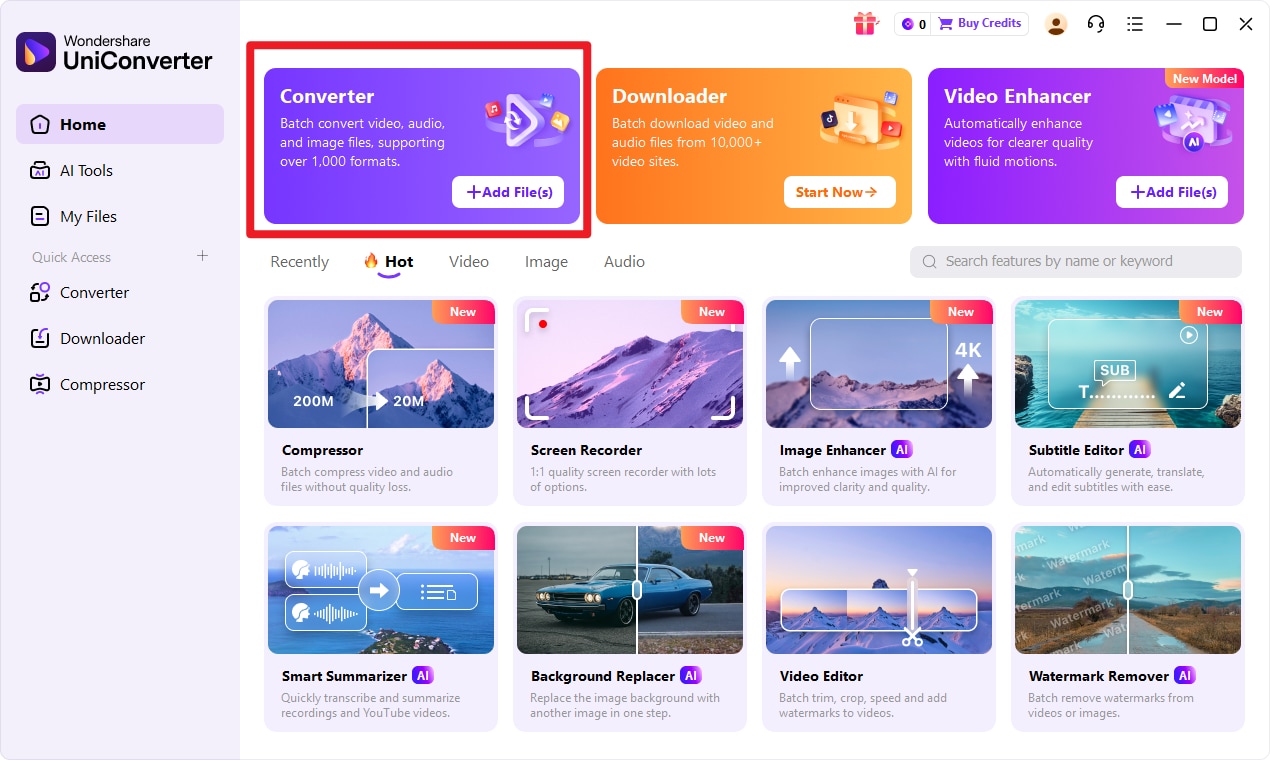
Step 1: Choose Converter in UniConverter
Launch the UniConverter software on your computer. From the main interface on the left-hand side, select the Converter tool.
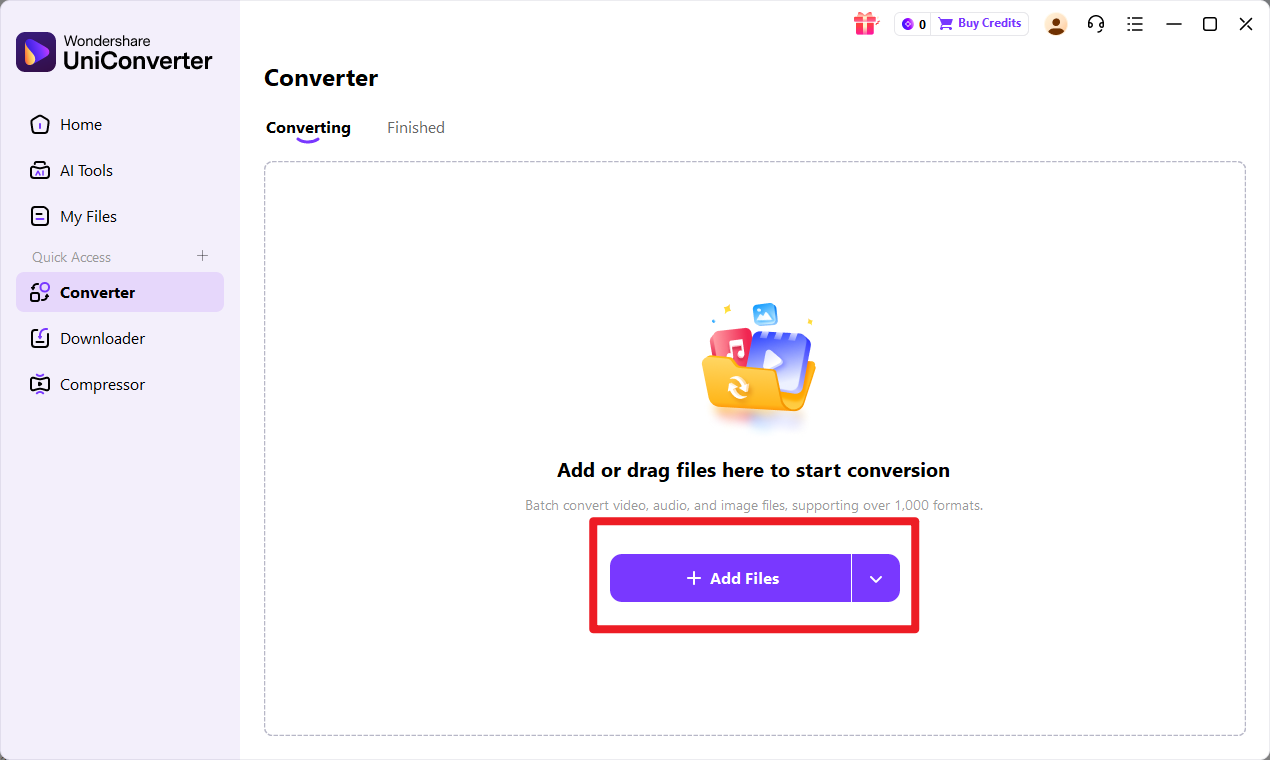
Step 2: Add Files to UniConverter
You can either drag and drop your input format video files directly into the main window or click the Add Files button to browse and import them from your computer.
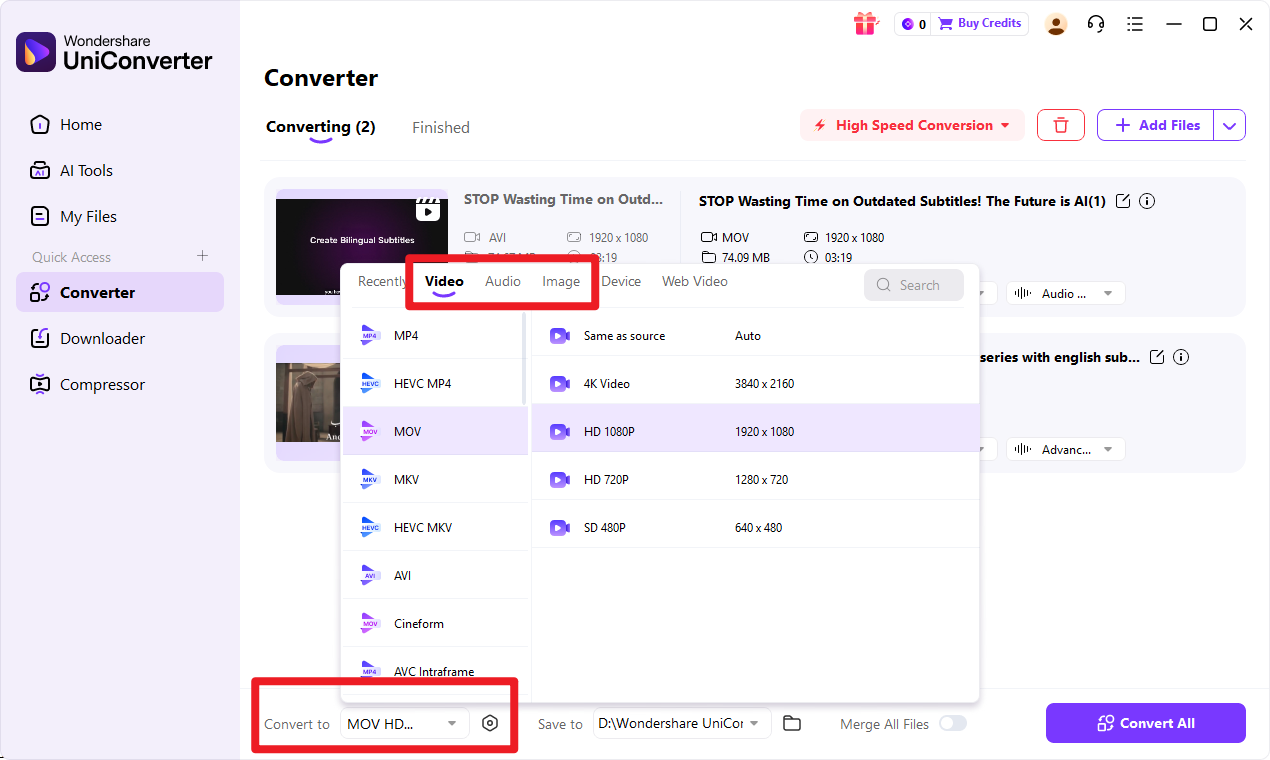
Step 3: Choose Output Format
Click on the Output Format option at the bottom of the window. In the new pop-up, navigate to the Video tab, select the target format from the list, and choose the desired resolution and quality setting.
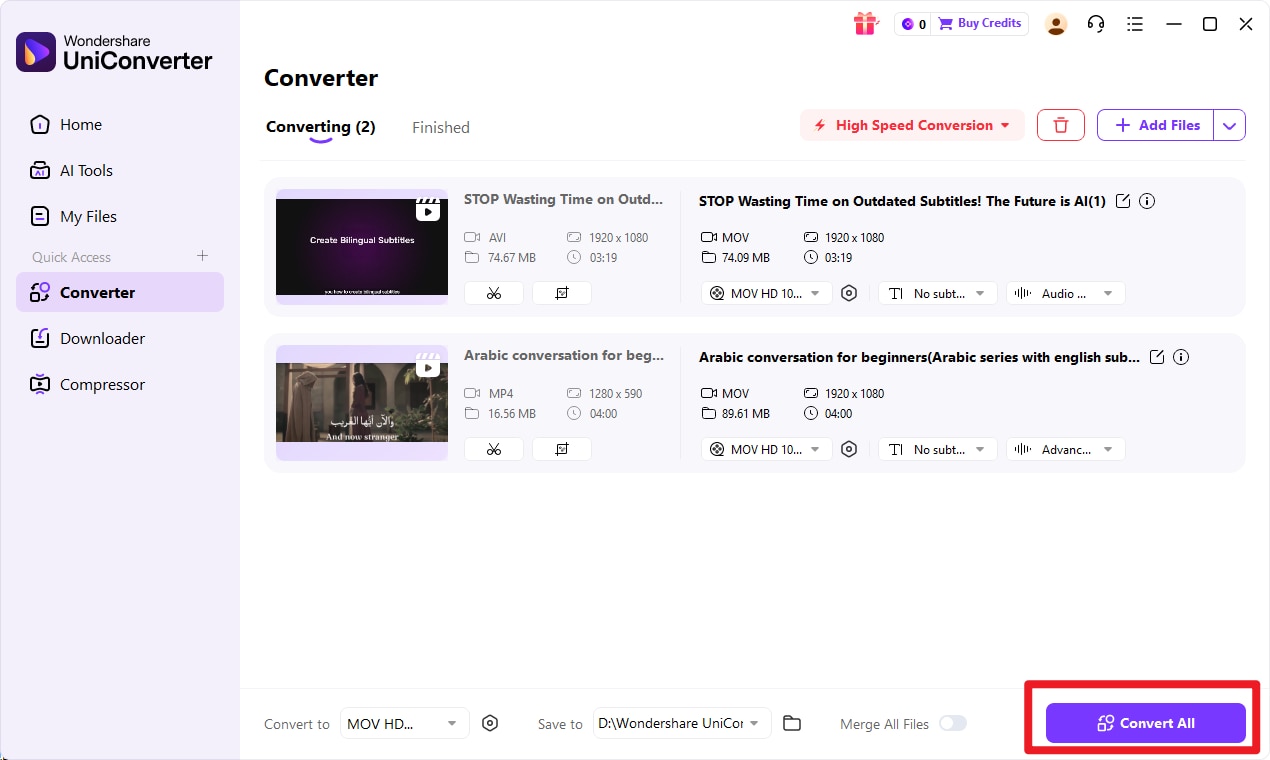
Step 4: Start the Conversion
Select a destination folder for your converted file using the File Location option. Finally, click the Convert button (or Start All for multiple files) to begin the conversion process.

Go Beyond Simple Video Conversion
Conclusion
Ultimately, the debate over ProRes 4444 vs DNxHR doesn't have a single winner. The "best" codec is the one that best serves your project's specific needs. ProRes 4444 is the champion of Mac-centric workflows, especially those heavy on motion graphics and VFX requiring pristine alpha channel support. In contrast, DNxHR is the hero of cross-platform collaboration, offering unparalleled flexibility for teams working across Windows and macOS, and providing an excellent proxy workflow solution.
Your decision should be guided by your primary editing software, your team's operating systems, your storage capacity, and whether your project demands transparency information. Fortunately, the choice is not a permanent one. With powerful and reliable tools like Wondershare UniConverter, you can easily and efficiently transcode between these professional formats, giving you the flexibility to adapt your workflow as needed and ensuring seamless interoperability between different ecosystems.
FAQs
-
1. Is ProRes 4444 truly lossless?
ProRes 4444 is considered "visually lossless," not "mathematically lossless." This means it uses a form of compression that discards data, but the discarded information is perceptually insignificant to the human eye. For virtually all professional applications, the quality is more than sufficient for mastering and intense grading. Apple also offers ProRes 4444 XQ, which is a higher-bitrate version for even more demanding scenarios. -
2. Can I use DNxHR files on a Mac?
Yes, absolutely. DNxHR is fully supported on macOS. You can install the Avid Codecs LE package for free to ensure system-wide support, and all major NLEs, including Final Cut Pro, Adobe Premiere Pro, and DaVinci Resolve, can read and write DNxHR files without any issues. -
3. Which codec has a larger file size, ProRes 4444 or DNxHR?
At comparable high-quality settings, such as ProRes 4444 versus DNxHR 444, their file sizes are very similar, with minor variations depending on the image content and resolution. However, the DNxHR family includes lower bitrate options like DNxHR SQ and DNxHR LB, which produce significantly smaller files than any version of ProRes 4444, making them ideal for proxy workflows. -
4. What is the best way to convert ProRes to DNxHR?
The best way is to use a dedicated, professional-grade video converter that understands the intricacies of these codecs. A tool like Wondershare UniConverter is highly recommended because it is specifically designed to handle conversions between professional formats like ProRes and DNxHR. It ensures that the process is fast, efficient, and, most importantly, preserves the maximum possible image quality without introducing artifacts.
