
Navigating the world of video codecs can be a complex task, even for seasoned professionals. Among the most respected and widely used formats is Apple's ProRes family, known for its exceptional balance of image quality and editing performance. However, within this family, choosing the right variant for your specific needs can be challenging. The decision often comes down to a crucial matchup: ProRes 422 LT vs ProRes 422. One promises efficiency and smaller file sizes, while the other is an industry benchmark for quality.
This decision has significant implications for your entire production workflow, from storage costs and data transfer speeds to editing performance and final image fidelity. If you're a filmmaker, video editor, or content creator weighing the pros and cons of these two powerful codecs, you've come to the right place. This comprehensive guide will break down their technical differences, practical applications, and performance characteristics to help you make an informed choice for your next project.
In this article
Part 1. What is ProRes 422 LT? What is ProRes 422?
Before diving into a direct comparison, it's essential to understand the foundation upon which both codecs are built. Let's start with a quick look at the Apple ProRes family and then explore the individual characteristics of ProRes 422 and its "Light" counterpart.
What is Apple ProRes? A Quick Overview
Apple ProRes is a family of high-quality, lossy video compression formats developed by Apple Inc. It was introduced in 2007 with Final Cut Pro 6 and quickly became an industry standard for post-production. The primary goal of ProRes is to provide a codec that maintains excellent image fidelity while offering manageable file sizes and smooth, real-time editing performance in non-linear editing (NLE) software.
Unlike heavily compressed delivery formats like H.264 or H.265 (HEVC), which are designed for final viewing and distribution, ProRes is an intermediate codec. This means it's optimized for the demanding tasks of editing, color grading, and applying visual effects, where preserving as much image data as possible is crucial. All members of the ProRes 422 family support up to 10-bit color depth, which allows for greater flexibility in post-production compared to standard 8-bit formats.
What is ProRes 422?
Apple ProRes 422 is often considered the workhorse and gold standard of the ProRes family. It strikes a perfect balance between compression and quality, making it the go-to choice for a vast range of professional video productions. It's designed to deliver pristine image quality that holds up under heavy color correction and compositing.
Key features of ProRes 422 include:
- 10-bit Color Depth: It can represent over a billion colors, providing smooth gradients and preventing the "banding" artifacts common in 8-bit video. This is essential for professional color grading.
- 4:2:2 Chroma Subsampling: This specification means it records more color information than formats like 4:2:0. The result is more accurate color representation, which is particularly important for tasks like green screen keying and detailed color work.
- High Data Rate: ProRes 422 has a target data rate of approximately 147 Mbps for 1080p footage at 29.97 fps. This higher data rate ensures that more of the original image detail is preserved during compression.
Because of these characteristics, ProRes 422 is a popular acquisition format for many professional cameras and the preferred intermediate codec for high-end post-production workflows.
What is ProRes 422 LT?
As its name suggests, Apple ProRes 422 LT (for "Light") is a more compressed version of ProRes 422. It was created to offer the same professional features—10-bit color and 4:2:2 chroma subsampling—but with a lower data rate and consequently smaller file sizes. The goal of ProRes 422 LT is to provide a high-quality option for workflows where storage capacity or data bandwidth are significant concerns.
Key features of ProRes 422 LT include:
- Lower Data Rate: With a target data rate of approximately 102 Mbps for 1080p footage at 29.97 fps, it's about 30% smaller than standard ProRes 422.
- Storage Efficiency: The smaller file sizes make it an excellent choice for projects with long recording times, such as documentaries, corporate events, or reality television.
- Visually Lossless Quality: For most viewing scenarios, the image quality of ProRes 422 LT is visually indistinguishable from ProRes 422. The difference in quality only becomes apparent under intense scrutiny or extreme color manipulation.
ProRes 422 LT is ideal for projects destined for online platforms, for creating editing proxies, or for any situation where you need a good balance between quality and file size.
Part 2. Quick Comparison Table
For a clear, at-a-glance overview, this table summarizes the key differences between Apple ProRes 422 LT and Apple ProRes 422.
| Feature | ProRes 422 LT | ProRes 422 |
| Bitrate (1080p @ 29.97 fps) | Approx. 102 Mbps | Approx. 147 Mbps |
| File Size | Smaller | Larger |
| Image Quality | Visually lossless for most scenarios | High-quality, industry standard |
| Compression Ratio | Higher compression | Lower compression |
| Primary Use Case | Editing, proxies, online content, documentaries | Professional acquisition, heavy color grading, broadcast |
Part 3. ProRes 422 LT vs ProRes 422: Which One Is Better?
The question of which codec is "better" ultimately depends on the specific requirements of your project. There is no single right answer; instead, it's a trade-off between quality, storage, and performance. Let's break down the comparison across three critical areas.
Image Quality and Visual Fidelity
On paper, both ProRes 422 LT and ProRes 422 share the same excellent foundation: 10-bit color depth and 4:2:2 chroma subsampling. This means both are vastly superior to 8-bit, 4:2:0 formats commonly found in consumer cameras and delivery codecs. Both will give you clean, rich colors and smooth tonal transitions.
The primary difference lies in the data rate. ProRes 422, with its higher bitrate (147 Mbps vs. 102 Mbps), retains more of the original sensor data. This extra information acts as a "safety net" during intensive post-production. If your workflow involves extreme color grading—such as making dramatic changes to exposure, contrast, or saturation, or recovering poorly exposed shots—ProRes 422 will provide more robust footage that is less likely to break down or show artifacts like banding or blockiness. The same applies to heavy visual effects (VFX) work, where every bit of data counts.
However, for a majority of projects, ProRes 422 LT is more than sufficient. In standard viewing conditions, and even with moderate color correction, it is often impossible to tell the difference between the two codecs. The compression algorithm is so efficient that the quality loss is visually negligible for most applications.
File Size and Storage Considerations
This is where ProRes 422 LT truly shines. With a data rate that is roughly 30% lower than standard ProRes 422, the savings in storage space are substantial.
Consider a one-hour clip of 1080p footage at 29.97 fps:
- ProRes 422 LT: Approximately 45 GB
- ProRes 422: Approximately 65 GB
While 20 GB might not seem like a huge difference for a single clip, this scales up dramatically on larger projects. For a documentary with 50 hours of footage, choosing ProRes 422 LT would save you around 1 Terabyte of storage space. This has a direct impact on your budget, reducing the need for additional hard drives. Furthermore, smaller file sizes mean faster data transfer times when moving footage from camera cards to drives, faster backup processes, and easier collaboration when sending files over the internet.
Performance in Post-Production
Both ProRes 422 LT and ProRes 422 are designed for exceptional performance in NLEs like Final Cut Pro, Adobe Premiere Pro, and DaVinci Resolve. Unlike heavily compressed formats like H.264, which require significant CPU power to decode on the fly, ProRes is an I-frame-based codec. This means every frame is encoded independently, allowing your computer to scrub through the timeline smoothly without lag or dropped frames.
The lower data rate of ProRes 422 LT can provide a slight performance edge, especially on less powerful systems. Laptops, older workstations, or systems with slower storage drives (like USB 3.0 external HDDs instead of SSDs) will handle ProRes 422 LT footage more easily. This is particularly noticeable in multicam editing, where the system has to decode multiple streams of video simultaneously.
In a professional workflow, it's common to use different formats for different stages. You might shoot in a high-quality format like ProRes 422 or even RAW, but then transcode to ProRes 422 LT to create "proxy" files for a smoother editing experience. Once the edit is complete, you can relink to the original high-quality files for final color grading and export. For these essential transcoding tasks, a reliable and efficient tool is crucial. Wondershare UniConverter is an excellent solution for converting between ProRes variants or from other camera formats, ensuring your workflow remains seamless and efficient.
The Verdict: Which Should You Choose?
- Choose ProRes 422 for projects where maximum image quality is non-negotiable. This includes high-end commercial work, broadcast television delivery, feature films, and any project that will undergo extensive color correction, green screen keying, or VFX. It is the safest choice when you need to preserve as much data as possible for maximum flexibility in post.
- Choose ProRes 422 LT for projects where efficiency and storage management are key priorities. This is perfect for corporate videos, online content for YouTube or Vimeo, documentaries with long runtimes, and news gathering. It's also the ideal format for creating offline editing proxies to speed up your post-production workflow without a noticeable sacrifice in visual quality during the edit.
Part 4. Use Cases for ProRes 422 LT and ProRes 422
To make the decision even clearer, here are some practical scenarios where you would choose one codec over the other.
When to Use ProRes 422 LT
- Creating Offline Editing Proxies: If you're shooting in 4K, 6K, or RAW, editing the native files can be incredibly demanding on your system. Transcoding this footage to 1080p ProRes 422 LT creates lightweight proxy files that allow for a fluid editing experience on almost any modern computer.
- Shooting for Web Content: For videos destined for YouTube, Vimeo, or social media, the subtle quality difference between LT and standard ProRes 422 will be completely lost after the platform's own compression is applied. Using LT saves you storage space from the start.
- Projects with Limited Storage Budgets: When you're working with a fixed number of hard drives or a tight budget, the 30% space saving offered by ProRes 422 LT can be a project-saver, allowing you to record more footage without constantly worrying about running out of space.
- Multicam Editing: When editing a concert, interview, or event shot with multiple cameras, the combined data rate can overwhelm your system. Using ProRes 422 LT for all camera angles reduces the load on your CPU and storage, leading to smoother playback.
When to Use ProRes 422
- Primary Acquisition Format: Many professional cinema cameras (like those from ARRI, Blackmagic Design, and Canon) can record directly to ProRes 422. It's a robust and reliable format that captures beautiful, detailed images ready for professional post-production.
- Heavy Color Grading or Green Screen Work: If you know your project will require significant color manipulation or precise chroma keying, the extra data in ProRes 422 is invaluable. It provides the clean color separation and bit depth needed for pulling a perfect key or pushing colors to their limits.
- Creating Master Files: After your project is complete, exporting a final master file in ProRes 422 is a common practice. This high-quality file serves as a digital archive of your work, which can be used to create other delivery formats in the future without significant quality loss.
- Broadcast and Cinema Delivery: When your final delivery target is traditional broadcast television or a digital cinema package (DCP), there are often strict technical specifications that must be met. ProRes 422 is widely accepted and often required for these high-end delivery pipelines.
Part 5. Step-by-Step Guide to Convert Between ProRes Formats Using UniConverter
A flexible workflow often requires converting between different codecs. Whether you need to down-convert ProRes 422 files to ProRes 422 LT to save space or up-convert for a high-quality master, UniConverter provides a simple and efficient solution. Follow these four steps to convert your files.
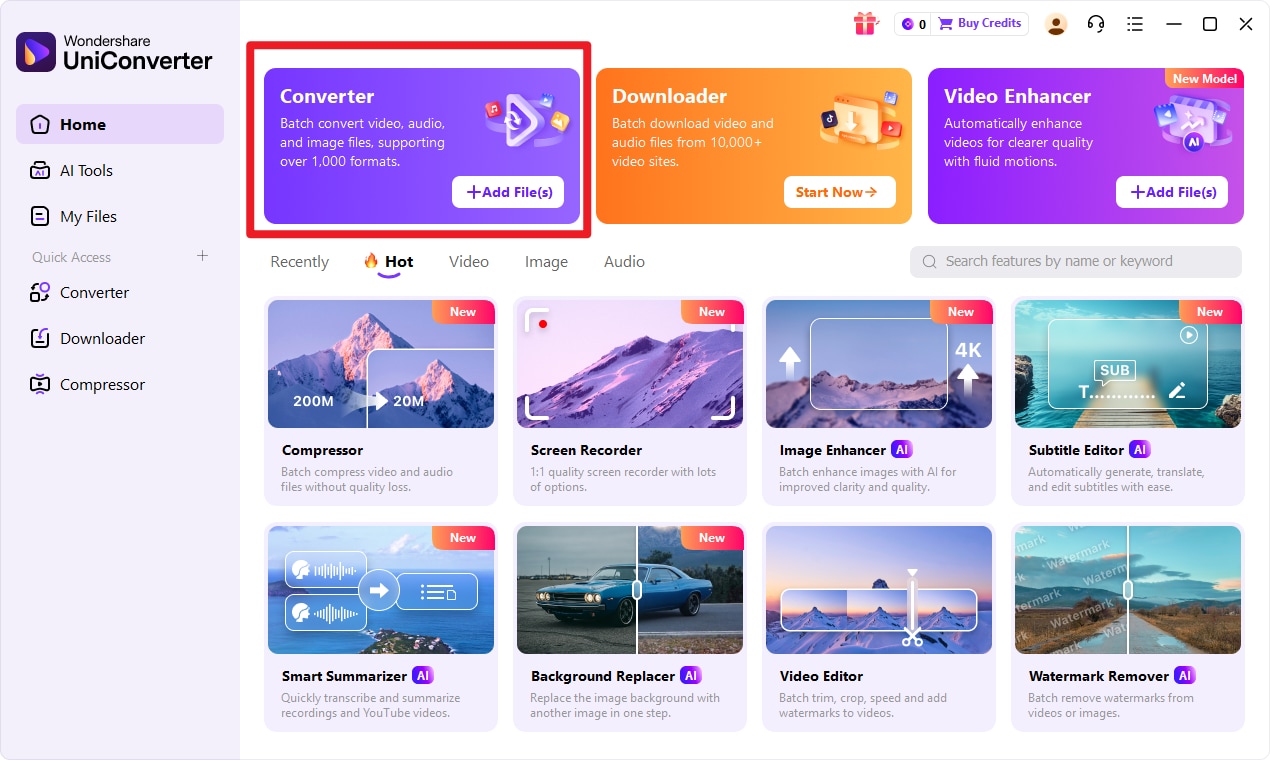
Step 1: Choose Converter in UniConverter
Launch the Wondershare UniConverter software on your computer. On the main interface, select the Converter tab from the left-side menu to begin the process.
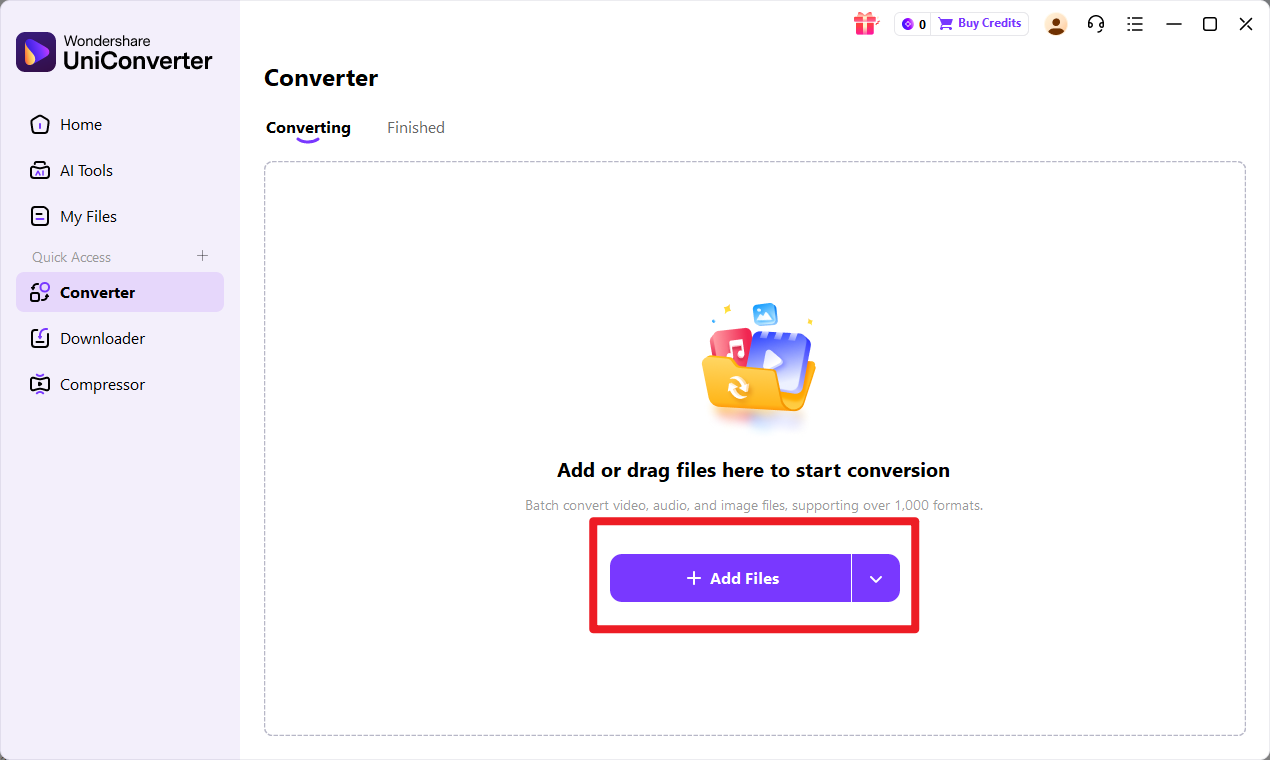
Step 2: Add Files to UniConverter
Click on the Add Files icon or simply drag and drop your video files with the input format directly into the center of the Converter window. You can add multiple files to the queue to perform a batch conversion, saving you valuable time.
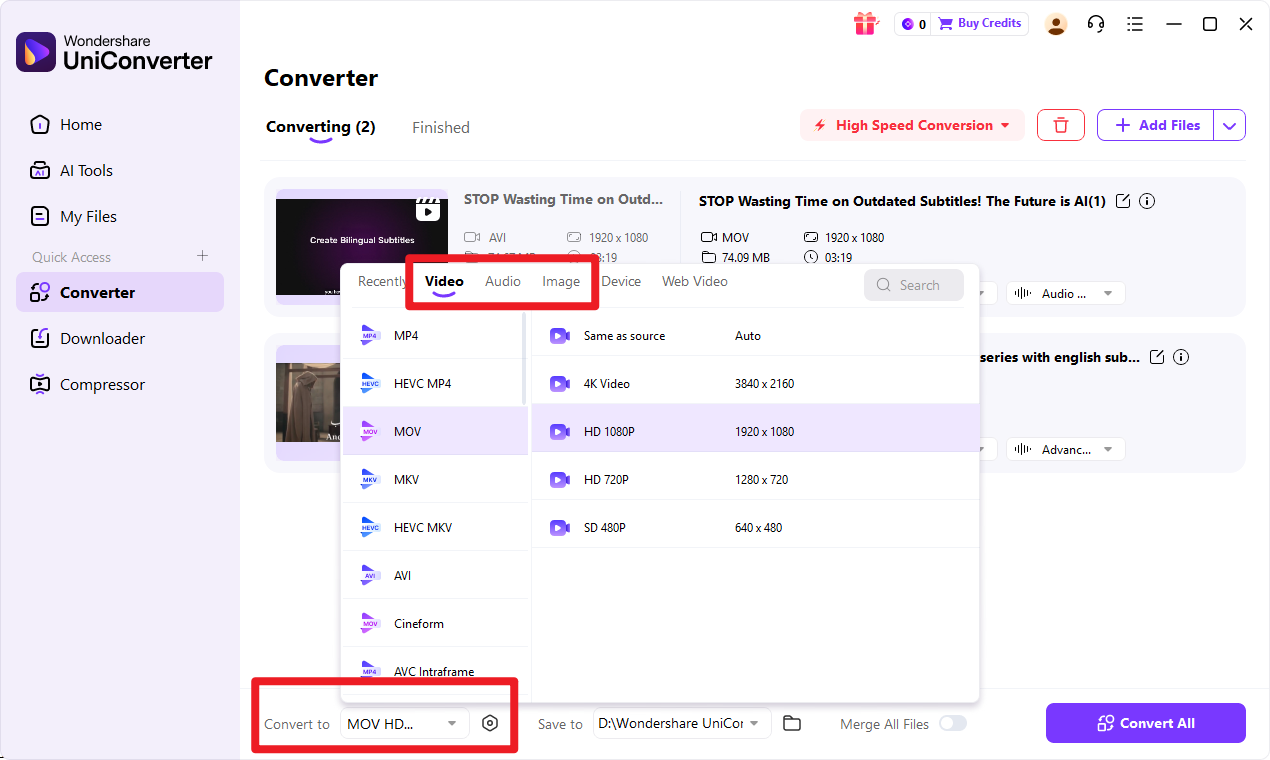
Step 3: Choose Output Format
Click on the Output Format option located at the bottom of the window. This will open a new dialog box. Navigate to the Video tab, select your target format (e.g., ProRes) from the list of codecs on the left, and then choose the desired resolution and specific variant (like ProRes 422 or ProRes 422 LT) on the right.
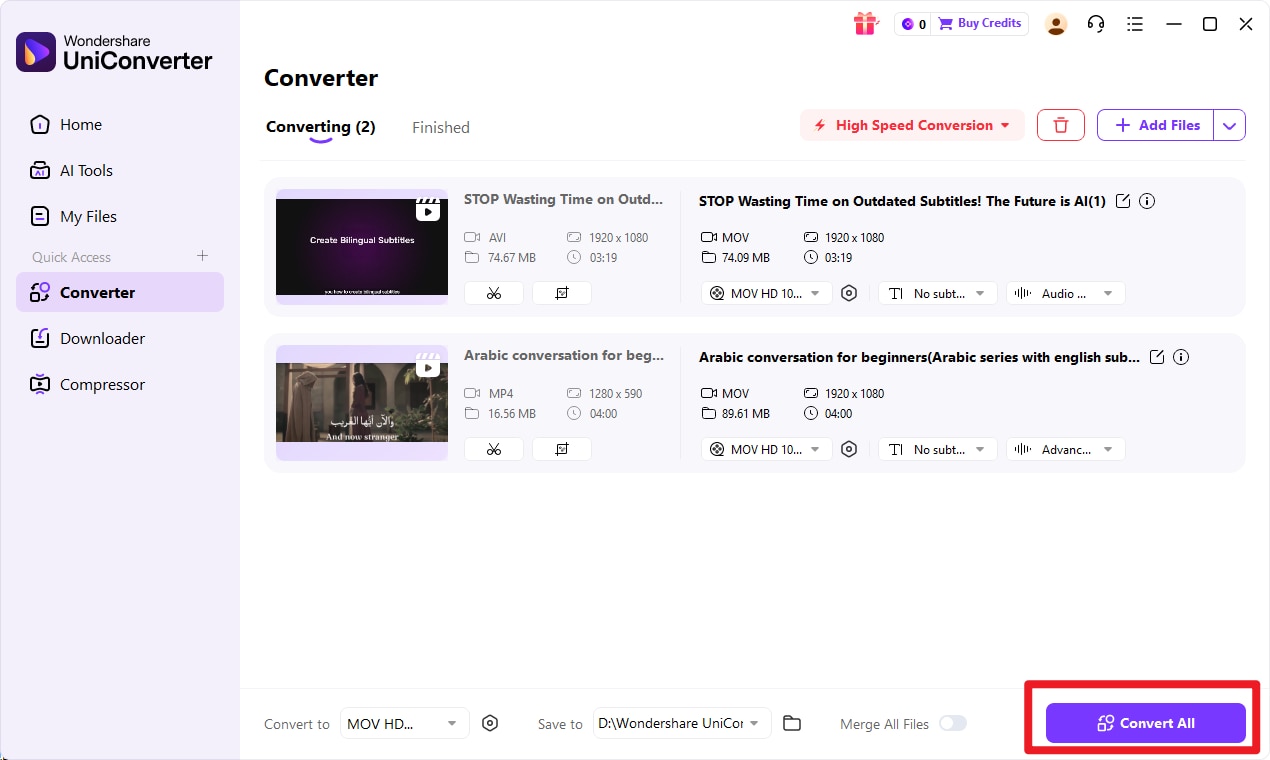
Step 4: Start the Conversion
Before starting, you can select a destination folder for your converted files by clicking the File Location option at the bottom. Once you are ready, click the Start All button in the bottom-right corner to begin converting all your files to the target format.

Beyond ProRes: A Universal Video Toolkit
Conclusion
The debate over ProRes 422 LT vs ProRes 422 is not about which codec is definitively superior, but which is the right tool for the job at hand. ProRes 422 remains the benchmark for uncompromising quality, providing the robust data needed for high-end post-production and broadcast delivery. In contrast, ProRes 422 LT stands out as the efficient workhorse, offering visually lossless quality in a smaller, more manageable package, making it perfect for online content, long-form projects, and proxy workflows.
Ultimately, the best choice depends entirely on your project's specific needs, from acquisition to final delivery. A modern, flexible video editor will often find themselves using both codecs at different stages of the same project. This is why having a powerful and reliable conversion tool is no longer a luxury but a necessity. By integrating a solution like Wondershare UniConverter into your toolkit, you empower yourself to seamlessly transcode between formats, optimize your workflow for both quality and efficiency, and focus on what truly matters: creating compelling visual stories.
FAQs
-
1. Is ProRes 422 LT good enough for professional work?
Yes, absolutely. For a wide range of professional applications, especially content destined for online platforms, corporate clients, or documentaries, ProRes 422 LT provides excellent quality that is more than sufficient. Its main benefit is achieving this quality with significantly smaller file sizes. -
2. Can you see the difference between ProRes 422 LT and ProRes 422?
For the vast majority of viewers and in most standard viewing conditions, the visual difference is negligible. A difference might only become apparent to a trained eye under direct, side-by-side comparison (pixel-peeping) or after applying very extreme color grades where the extra data in ProRes 422 provides more stability. -
3. Can I edit ProRes 422 LT on any computer?
ProRes 422 LT is less demanding on system resources than standard ProRes 422 due to its lower data rate. This makes it an excellent choice for editing on laptops, older workstations, or systems with slower hard drives. It generally provides a smoother editing experience, especially with 4K footage or multicam sequences. -
4. Why would I need to convert from ProRes 422 to ProRes 422 LT?
The primary reason is to optimize your workflow. Converting high-resolution ProRes 422 or RAW files to ProRes 422 LT creates smaller "proxy" files. This allows for a much smoother and faster editing experience, especially on long-form projects or less powerful hardware. Once the edit is locked, you can relink back to the original high-quality files for the final color grade and export, getting the best of both worlds.
