
Navigating the world of digital audio formats can feel like learning a new language, with a confusing alphabet soup of acronyms like WAV, FLAC, MP3, and more. Among the most fundamental and frequently encountered are PCM and AAC. Whether you're an audiophile archiving your CD collection, a content creator distributing a podcast, or simply trying to optimize the music library on your phone, understanding the PCM vs AAC debate is crucial. One represents the purest, unadulterated form of digital audio, while the other offers a brilliant balance of quality and convenience.
Choosing the right format can significantly impact your storage space, streaming performance, and listening experience. But which one is truly better? The answer isn't a simple one-size-fits-all. It depends entirely on your specific needs—what you're doing with the audio and where you plan to listen to it. This guide will demystify these two formats, breaking down their technical differences, practical applications, and ultimate trade-offs.
In this article, we will cover:
- A clear definition of both PCM and AAC formats.
- A quick comparison table for an at-a-glance overview.
- A deep dive into how they stack up in terms of audio quality, file size, and compatibility.
- Specific use cases to help you decide when to use each format.
- A simple guide on how to convert files between formats when needed.
Part 1. What is PCM? What is AAC?
Before we can compare them, it's essential to understand what each format is at its core. They represent two fundamentally different philosophies in digital audio storage.
What is PCM (Pulse-Code Modulation)?
Pulse-Code Modulation, or PCM, is the most direct and pure digital representation of an analog audio signal. Think of it as a perfect, uncompressed digital photograph of a sound wave. When analog audio is converted to digital, its waveform is sampled thousands of times per second. PCM records the value (amplitude) of each of these samples as raw numerical data without any compression or data removal.
This makes PCM a lossless format. The "lossless" part is key—it means that the digital audio is a bit-for-bit perfect copy of the original analog-to-digital conversion. There is absolutely no data lost in the process. Because of this uncompromised fidelity, PCM is the foundational standard for audio CDs (at a sample rate of 44.1 kHz and 16-bit depth) and is the backbone of professional audio recording and production workflows. The primary trade-off for this perfect quality is its massive file size.
What is AAC (Advanced Audio Coding)?
Advanced Audio Coding, or AAC, is a compressed and lossy audio format. It was developed by a consortium of companies including Dolby, Sony, and Nokia as a more efficient and advanced successor to the popular MP3 format. Unlike PCM, which keeps all the original data, AAC is designed to be clever about what it throws away.
AAC uses a sophisticated psychoacoustic model to analyze the audio signal and remove data that the human ear is least likely to notice. This includes sounds that are too high or too low in frequency for us to hear, or sounds that are masked by louder sounds occurring at the same time. By intelligently discarding this "perceptually irrelevant" information, AAC can drastically reduce file size while maintaining a listening experience that is often indistinguishable from the original source, especially at higher bitrates. This efficiency has made it the format of choice for major streaming platforms like Apple Music and YouTube, as well as for digital broadcasting.
Part 2. Quick Comparison Table
For a quick overview, here is a side-by-side comparison of the key attributes of PCM and AAC.
| Feature | PCM (Pulse-Code Modulation) | AAC (Advanced Audio Coding) |
| Compression Type | Uncompressed, Lossless | Compressed, Lossy |
| Audio Quality | Theoretically perfect; a 1:1 digital copy of the source. | Perceptually excellent; often indistinguishable from lossless at high bitrates. |
| File Size | Very large (e.g., approx. 10 MB per minute for CD quality). | Small and efficient (e.g., approx. 1-2 MB per minute at 256 kbps). |
| Primary Use Case | Professional audio production, mastering, archiving master copies, CDs. | Music streaming, portable devices, podcasts, online video audio. |
| Compatibility | Universal in professional audio software and hardware (often in a .WAV or .AIFF container). | Extremely wide support on consumer devices (Apple, Android), web browsers, and streaming services. |
Part 3. PCM vs AAC: Which One Is Better?
The question of which format is "better" depends entirely on the criteria you prioritize: pure fidelity, storage space, or device compatibility. Let's break down their performance in several key areas.
Audio Quality: The Uncompressed Original vs. The Efficient Copy
In a purely technical sense, PCM is the undisputed winner in audio quality. Because it is uncompressed and lossless, a PCM file contains every single bit of data from the original digital recording. It is the ground truth, the master copy against which all other formats are measured. For critical listening on high-end audio systems, professional mixing, or mastering, the mathematical perfection of PCM is non-negotiable.
However, the real-world listening experience is more nuanced. AAC was engineered to be "perceptually lossless," especially at high bitrates (256 kbps or 320 kbps). Its advanced compression algorithms are so effective that for the vast majority of listeners, on the vast majority of playback systems (like headphones, car stereos, or Bluetooth speakers), an AAC file can be indistinguishable from its PCM source. While a trained ear in a controlled environment might detect subtle differences, for everyday listening, AAC delivers exceptional quality.
File Size and Storage Efficiency
This is where AAC has a massive and undeniable advantage. A standard CD-quality PCM audio track requires about 10 MB of storage for every minute of audio. A 3-minute song would be roughly 30 MB. An entire album could easily exceed 500 MB. This makes storing a large library of PCM files impractical on devices with limited space, like smartphones or tablets, and makes streaming it over a mobile network very data-intensive.
In contrast, an AAC file of the same song at a high-quality 256 kbps bitrate would be only about 2-3 MB. That's a reduction of over 90% in file size with minimal perceptible loss in quality. This incredible efficiency is why AAC is the dominant format for digital distribution. It allows you to store thousands of songs on your phone and enables services like Apple Music to stream high-quality audio smoothly even over slower internet connections.
Compatibility and Ecosystem
Both formats enjoy wide support, but in different domains. PCM, typically found within WAV or AIFF file containers, is the universal language of professional audio. Every digital audio workstation (DAW), professional audio editor, and piece of studio hardware is built to work with PCM natively. It is the standard for production.
AAC, on the other hand, rules the consumer ecosystem. It is the default audio format for the entire Apple ecosystem, including iPhones, iPads, and Apple Music. It's also used by YouTube, Nintendo, and the digital video broadcasting (DVB) standard. This means virtually every modern smartphone, tablet, computer, and streaming device can play AAC files without any issue, making it the most convenient format for distribution and personal listening.
Editing and Post-Production
For anyone involved in creating or editing audio, PCM is the only viable choice for the core workflow. Because it's lossless, you can edit, process, and re-save a PCM file countless times without ever degrading its quality. Each save is a perfect copy of the last.
Editing a lossy format like AAC is highly discouraged. Every time you decompress an AAC file to edit it and then re-compress it upon saving, you go through another cycle of data loss. This is known as "generational loss," and the audio quality will degrade with each save. The best practice is to perform all edits on a PCM master file. Once the project is finalized, you can then export a high-quality AAC version for distribution.
When you need to convert your master PCM files for streaming, a reliable tool is key. Wondershare UniConverter handles this conversion flawlessly, preserving the highest possible quality by giving you precise control over the output bitrate and format settings.
Part 4. Use Cases for PCM and AAC
Understanding the strengths and weaknesses of each format leads to clear recommendations for their use.
When to Use PCM
Choose PCM when audio fidelity is the absolute top priority and file size is not a concern.
- Professional Audio Production: Use PCM (in WAV or AIFF format) for all stages of recording, mixing, and mastering music or sound for video.
- Archiving Master Copies: If you are digitizing a vinyl collection or ripping CDs for archival purposes, saving them as PCM (or a lossless compressed format like FLAC) ensures you have a perfect master copy for the future.
- High-Fidelity Home Audio: For audiophiles with dedicated, high-end playback systems, PCM files will deliver the most accurate and detailed sound reproduction.
When to Use AAC
Choose AAC when you need a great balance of high-quality sound and manageable file size.
- Streaming Music: Virtually all major streaming services use AAC or a similar lossy format to deliver audio to you efficiently.
- Portable Music Libraries: For storing a large collection of music on your smartphone, tablet, or portable media player, AAC is the ideal choice to maximize space without a noticeable drop in quality.
- Distributing Audio Content: If you are a podcaster or video creator, exporting your final audio in AAC format ensures it will be a reasonable file size for your audience to download or stream, and it will be compatible with nearly any device they use.
Part 5. Step-by-Step Guide to Convert PCM to AAC Using UniConverter
When you have a high-quality PCM file (like a WAV) that you need to share or put on a portable device, converting it to AAC is the perfect solution. Wondershare UniConverter makes this process simple, fast, and reliable. Here's how to do it in four easy steps.
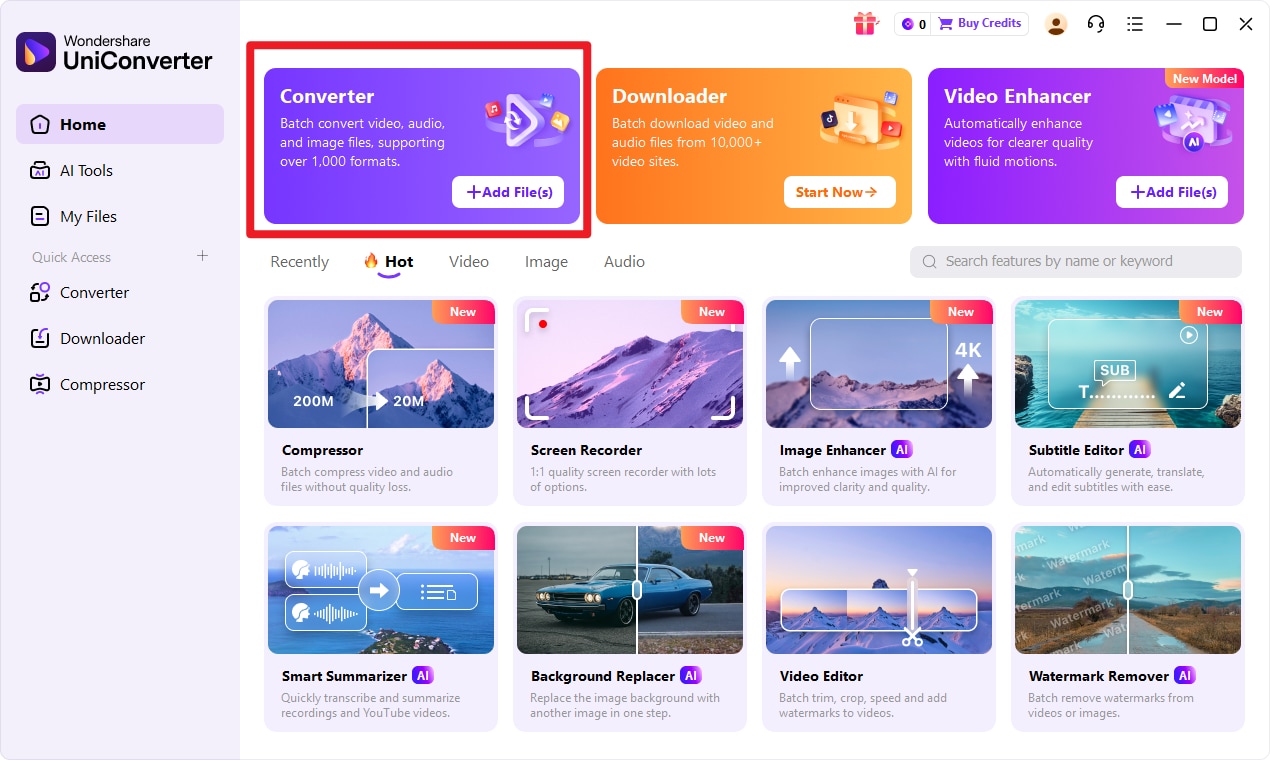
Step 1: Add Your PCM Files to UniConverter
Launch Wondershare UniConverter on your computer. In the main interface, make sure you are on the Converter screen. You can either drag and drop your PCM files directly onto the window or click the + Add Files icon in the top-left corner to browse and import them from your computer.
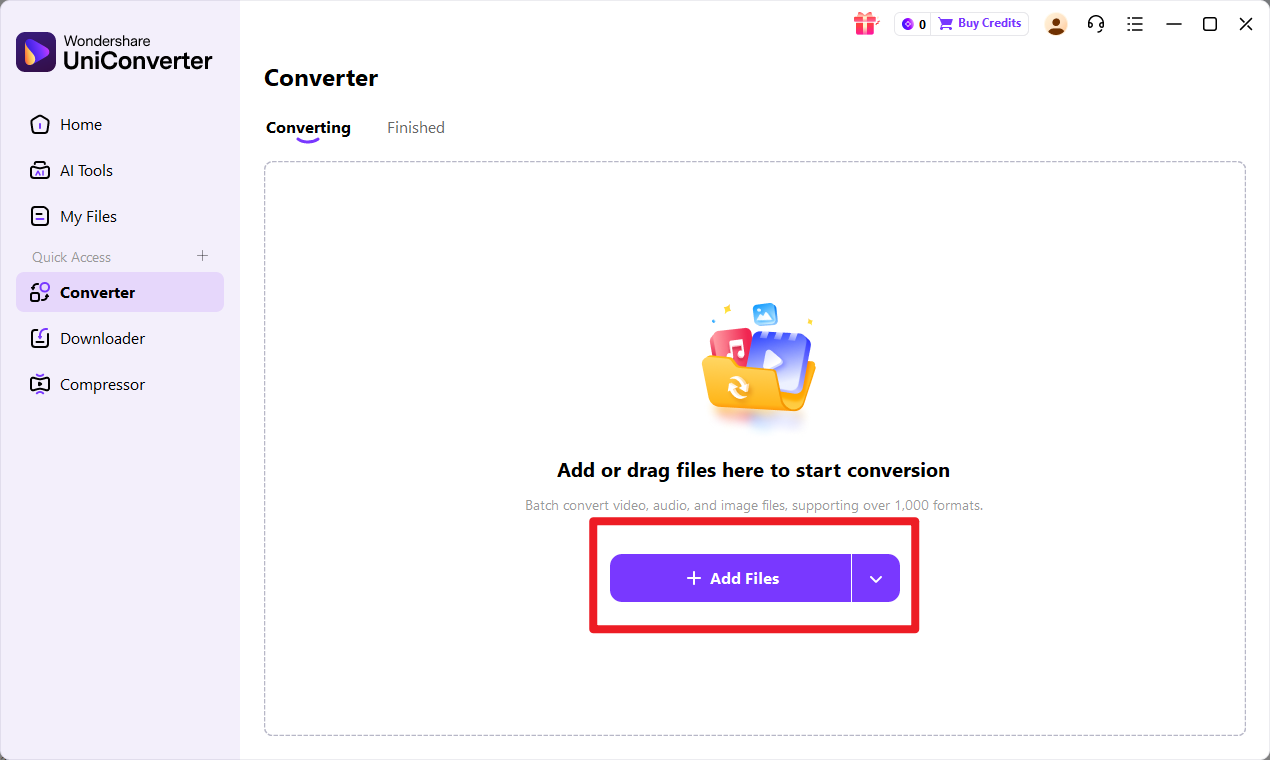
Step 2: Choose AAC as the Output Format
Once your files are loaded, click on the Output Format menu at the bottom of the window. This will open a new panel. Go to the Audio tab, select AAC from the list of formats on the left, and then choose your desired quality preset on the right. For most purposes, "High Quality" or a specific bitrate like 256 kbps is an excellent choice.
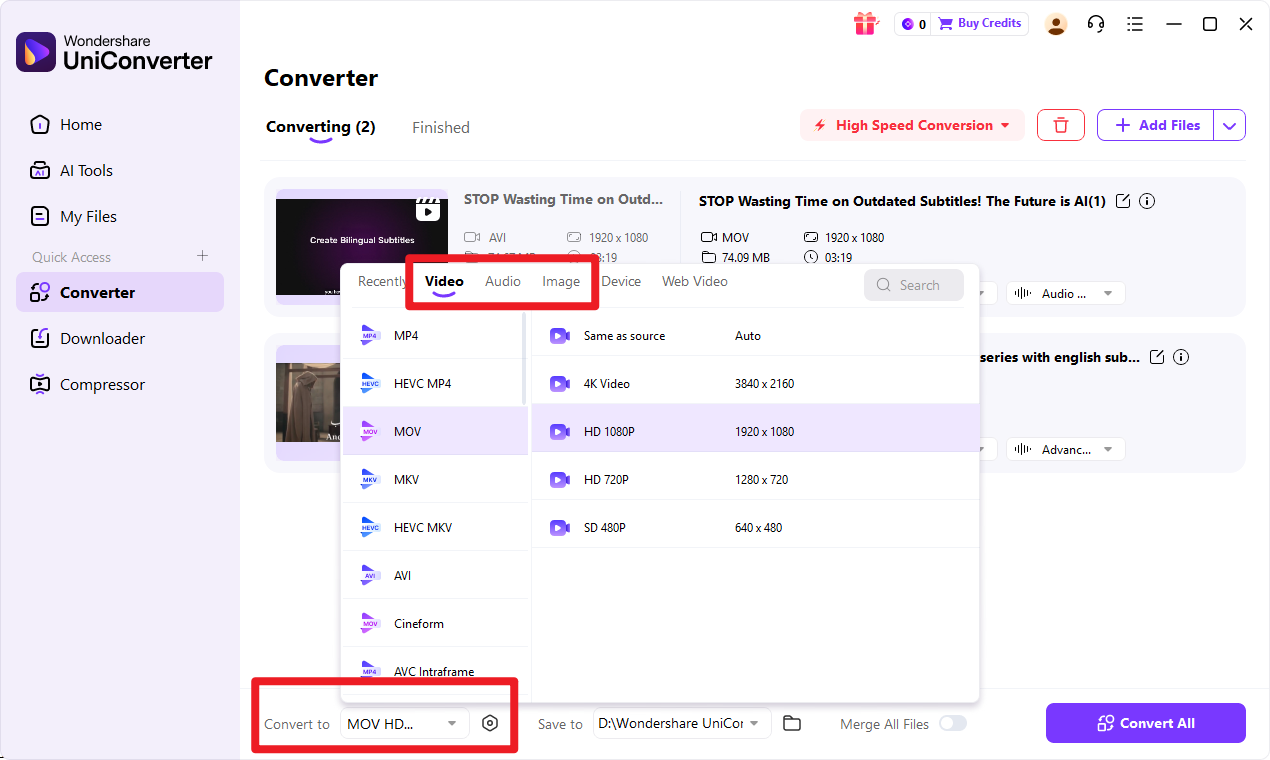
Step 3: Start the Conversion
Before converting, you can specify where you want the new files to be saved using the File Location field at the bottom. Once you're ready, you can convert files individually by clicking the Convert button next to each one, or you can process them all at once by clicking the Start All button in the bottom-right corner.
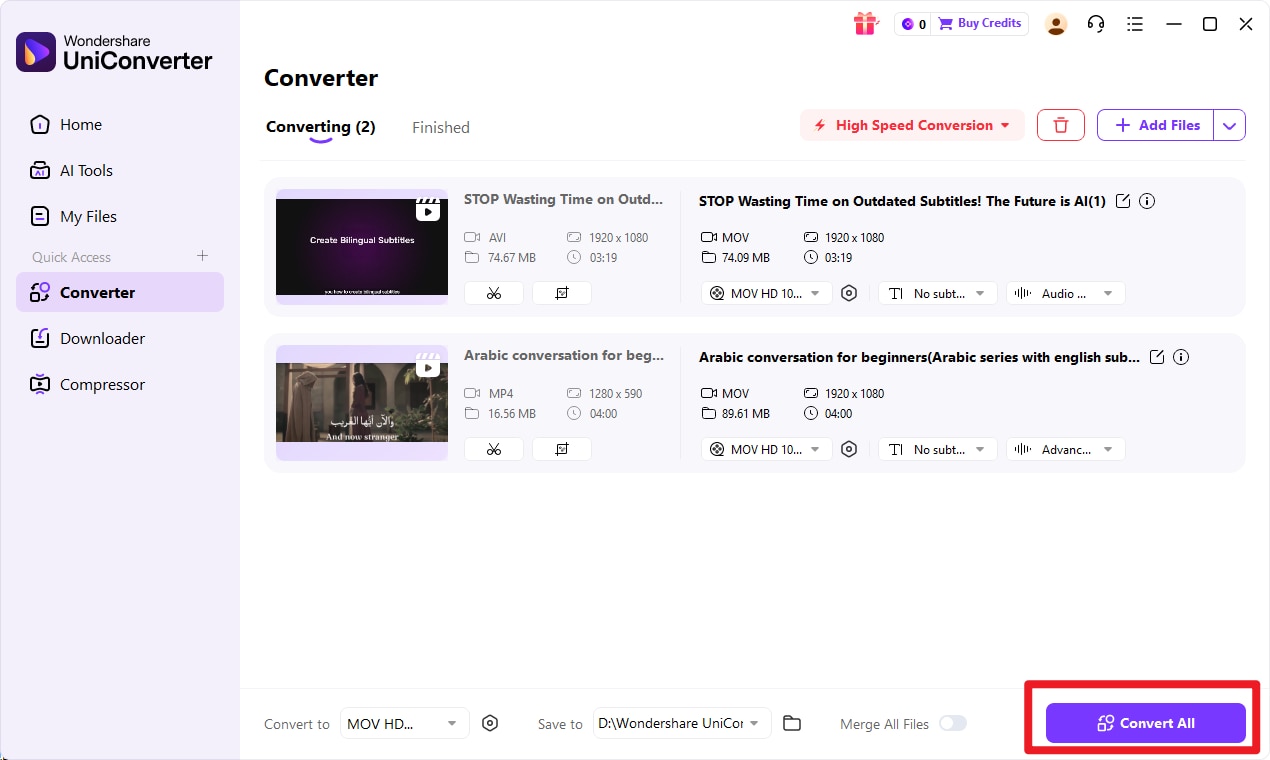
Step 4: Check Converted Files
UniConverter will process your files quickly. Once the conversion is complete, you can find your new, high-quality AAC files by clicking on the Finished tab at the top of the screen or by navigating directly to the output folder you selected in the previous step.

Your All-in-One Media Conversion Toolkit
Conclusion
The PCM vs AAC debate doesn't have a single winner because they are designed for different purposes. PCM is the undisputed champion of quality, serving as the uncompressed, bit-perfect foundation for professional audio creation and archival. Its only drawback is its massive file size. AAC, on the other hand, is the master of efficiency, offering a listening experience that is nearly indistinguishable from the original but at a fraction of the storage cost, making it perfect for streaming and portable devices.
Ultimately, the "better" format is the one that best fits your context. Are you mastering an album? Use PCM. Are you loading up your phone for a run? Use AAC. For those moments when you need to bridge the gap between these two worlds—transforming a professional master into a distributable file—a powerful and intuitive tool is essential. Wondershare UniConverter stands out as a user-friendly and robust solution for all your audio conversion needs, ensuring your files are ready for any application without compromising quality.
FAQs
-
1. Does converting PCM to AAC reduce audio quality?
Yes, technically it does, because you are moving from a lossless (PCM) to a lossy (AAC) format. The conversion process permanently discards some audio data. However, when using a high-quality converter like UniConverter and selecting a high bitrate (e.g., 256 kbps or 320 kbps), the discarded data is psychoacoustically modeled to be the least perceptible to the human ear. For most listeners, the difference is negligible. -
2. Is PCM better than FLAC?
PCM and FLAC are both lossless formats, meaning they contain identical audio information. The difference is that PCM is uncompressed, while FLAC (Free Lossless Audio Codec) uses compression to reduce file size by 40-60% without discarding any data. So, FLAC provides the exact same quality as PCM but in a smaller package, making it a better choice for archiving. -
3. What is a good bitrate for AAC?
For most general listening purposes, 256 kbps is considered the sweet spot for AAC. It provides an excellent balance of high-fidelity audio and small file size, and it's the standard used by Apple Music. For users who want the highest possible quality from a lossy format, 320 kbps is also a popular option. -
4. Can UniConverter convert other audio formats besides PCM and AAC?
Absolutely. Wondershare UniConverter is a comprehensive media toolkit that supports over 1,000 formats. You can convert between virtually any audio format you can think of, including MP3, FLAC, WAV, AIFF, OGG, M4A, and many more. It also handles video conversion, compression, editing, and downloading, making it an all-in-one solution for your media files.
