
In the ever-evolving landscape of digital video, the codecs used to compress and decompress files are the unsung heroes that determine everything from file size to streaming quality. Two prominent names that often come up in discussions are MPEG-2 and H.265. While one is a foundational standard from the era of DVDs and digital broadcasts, the other is a modern powerhouse driving 4K and 8K streaming. Understanding the MPEG-2 vs H.265 comparison is crucial for anyone working with video, whether you're a professional editor, a content creator, or simply someone looking to manage your personal media library.
This guide will provide a comprehensive breakdown of these two video codecs. We will explore their technical specifications, compare their performance head-to-head, and identify the best use cases for each. Furthermore, we will show you how to easily modernize your older video files by converting them from MPEG-2 to the more efficient H.265 format.
In this article:
Part 1. What is MPEG-2? What is H.265?
Before we dive into a direct comparison, it's essential to understand what each codec is and the technology behind it. They represent two different generations of video compression, each designed for the technological demands of its time.
What is MPEG-2?
MPEG-2 (formally known as ITU-T H.262) is a video compression standard that became a cornerstone of digital video in the mid-1990s. It was the technology that made digital television broadcasts and DVDs possible. Its primary goal was to provide good quality video at bitrates that were manageable for the broadcast and physical media technologies of the day.
For its time, MPEG-2 was revolutionary, offering a significant improvement over analog video and earlier digital standards. Its widespread adoption means it enjoys excellent compatibility with a vast range of older hardware.
- Pros:
- Extremely high compatibility with legacy hardware, including standard-definition TVs, DVD players, and older broadcast equipment.
- Less computationally demanding to encode and decode compared to modern codecs.
- A well-established and reliable standard for specific legacy applications.
- Cons:
- Highly inefficient compression by today's standards, resulting in very large file sizes.
- Not optimized for high-resolution content like 4K or 8K.
- Requires significantly more bandwidth for streaming compared to modern alternatives.
What is H.265 (HEVC)?
H.265, also known as High Efficiency Video Coding (HEVC) or MPEG-H Part 2, is a modern video compression standard finalized in 2013. It was developed as a successor to the widely used H.264 (AVC) and was designed specifically to address the demands of high-resolution video.
The main advantage of H.265 is its remarkable compression efficiency. It can deliver the same level of video quality as its predecessors at roughly half the bitrate. This breakthrough has been instrumental in making 4K and 8K streaming a reality for consumers, as it allows high-quality video to be transmitted over standard internet connections.
- Pros:
- Superior compression efficiency, reducing file sizes by up to 50% compared to H.264 and even more compared to MPEG-2.
- The industry standard for 4K and 8K UHD video content.
- Ideal for streaming, reducing bandwidth requirements and buffering.
- Excellent for archiving large video libraries, saving significant storage space.
- Cons:
- Requires more processing power to encode and decode, which can be a challenge for older or low-powered devices.
- May have compatibility issues with hardware manufactured before its widespread adoption (roughly pre-2014).
- Some software and browsers had slower adoption of H.265 due to licensing considerations, though this is less of an issue today.
Part 2. Quick Comparison Table
To get a clear overview of the key differences, let's look at a side-by-side comparison of the two codecs. This table highlights how H.265 represents a major technological leap forward from MPEG-2.
MPEG-2 vs H.265 at a Glance
| Feature | MPEG-2 | H.265 (HEVC) |
| Full Name | MPEG-2 Part 2 Video (formally ITU-T H.262) | High Efficiency Video Coding (HEVC) (MPEG-H Part 2) |
| Release Year | 1995 | 2013 |
| Compression Efficiency | Low | Very High |
| File Size (at same quality) | Large | Small (approx. 50-75% smaller than MPEG-2) |
| Quality (at same bitrate) | Lower | Higher |
| Supported Resolutions | Primarily SD (480p/576p), up to HD (1080i) | Up to 8K (8192x4320) and beyond |
| Primary Use Cases | DVD authoring, standard-definition digital broadcast (DVB-T) | 4K/8K streaming, Blu-ray UHD, modern video recording, archiving |
Part 3. MPEG-2 vs H.265: Which One Is Better?
While the table above gives a quick summary, a deeper dive into specific performance aspects reveals why H.265 is the superior choice for almost all modern applications.
Compression Efficiency and File Size
This is the most significant difference between the two codecs. H.265's advanced compression algorithms allow it to achieve roughly double the data compression ratio of MPEG-2. In practical terms, this means a video file encoded with H.265 can be about half the size of an MPEG-2 file while maintaining the same level of visual quality. For some content, the size reduction can be even more dramatic, reaching up to 75%.
This advantage is critical in two key areas: storage and transmission. For anyone archiving a video collection—whether it's digitizing old DVDs or storing new recordings—H.265 can save an immense amount of disk space. For content distributors, the smaller file size translates directly to lower storage and bandwidth costs.
Video Quality for Streaming
When it comes to streaming, bitrate is king. A lower bitrate means less data needs to be sent over the internet, resulting in smoother playback with less buffering. The efficiency of H.265 allows it to deliver excellent video quality at much lower bitrates than MPEG-2.
For example, streaming a 1080p video using MPEG-2 would require a high bitrate that many internet connections would struggle with, leading to a poor user experience. H.265, on the other hand, can stream crisp 1080p and even 4K UHD content smoothly over average broadband connections. This is why major streaming platforms like Netflix, YouTube, and Amazon Prime Video have adopted H.265 as their standard for delivering high-resolution content. MPEG-2 is simply not a viable option for modern online streaming.
Hardware Compatibility and Support
Here, the context matters. MPEG-2 has a clear advantage in the realm of legacy hardware. It is the native format for all DVD players and was the standard for over-the-air digital TV for many years. Any device designed to play a DVD will support MPEG-2 without issue.
However, in the context of 2026, H.265 has become the dominant standard. Virtually all modern devices—including smartphones, smart TVs, computers, streaming sticks, and game consoles—are equipped with hardware decoders capable of playing H.265 files smoothly. The compatibility issue now lies with older hardware trying to play modern files. If you try to play an H.265 video on a TV or computer from 10 years ago, it will likely fail or stutter badly because the device lacks the necessary processing power.
If you encounter these compatibility roadblocks, the most effective solution is to convert your video files. For instance, if you have an H.265 file that won't play on an older device, you can convert it to a more compatible format. Conversely, and more commonly, you'll want to convert old MPEG-2 files to H.265 to save space. A powerful tool like Wondershare UniConverter makes it easy to bridge this compatibility gap, allowing you to convert videos between virtually any format to ensure they play on any device.
Part 4. Use Cases for MPEG-2 and H.265
Choosing the right codec depends entirely on your specific goal. While H.265 is technically superior, MPEG-2 still has a few niche applications where it remains relevant.
When to Use MPEG-2
Despite its age, there are a few scenarios where using MPEG-2 is still necessary or practical:
- Authoring Standard-Definition DVDs: If your goal is to create a video DVD that will play in any standard DVD player, you must use MPEG-2. It is part of the official DVD-Video specification.
- Working with Legacy Broadcast Systems: Some older television stations or cable providers may still use broadcast equipment that relies on MPEG-2 streams. In these professional environments, you must work within the established infrastructure.
- Targeting Very Old Playback Devices: If you know your video will be played exclusively on a device that was manufactured before 2010 and does not have modern software, MPEG-2 offers the highest chance of successful playback.
When to Use H.265
For virtually every other scenario in 2026, H.265 is the recommended choice. Its efficiency and quality make it the default for modern video workflows.
- Streaming High-Resolution Video: Whether you're streaming 1080p, 4K, or even 8K content online, H.265 is the standard. It provides the best quality-to-bitrate ratio, ensuring a smooth experience for viewers.
- Archiving a Large Video Library: If you are digitizing your DVD collection or have a large library of video files, encoding them in H.265 will drastically reduce the storage space required without a noticeable loss in quality.
- Recording on Modern Devices: Most modern cameras, drones, and smartphones (especially for 4K recording) use H.265 by default to keep file sizes manageable.
- Future-Proofing Your Media: Converting old media, such as MPEG-2 files from DVDs or old camcorders, to H.265 is a smart way to modernize your library, making it more efficient and compatible with future devices.
Part 5. Step-by-Step Guide to Convert MPEG-2 to H.265 Using UniConverter
Given the clear benefits of H.265, one of the most practical actions you can take is to convert your older, bulkier MPEG-2 files into the modern, efficient H.265 format.
Why You Should Convert MPEG-2 to H.265
Converting your video library from MPEG-2 to H.265 is a strategic move to modernize your media. The primary benefits are immediate and significant: you can drastically reduce the total size of your video files, freeing up valuable storage space on your hard drives or cloud storage. This also makes your files much easier to share or upload. Furthermore, it prepares your media for smooth playback on modern devices and streaming platforms, ensuring your library is future-proof.
While the conversion process might sound technical, a user-friendly tool like Wondershare UniConverter simplifies it entirely. Its intuitive interface, powerful batch-processing capabilities, and high-speed conversion engine make it the perfect solution for both beginners and professionals.
How to Convert MPEG-2 to H.265 in 4 Easy Steps with UniConverter
Follow this simple guide to quickly convert your files.
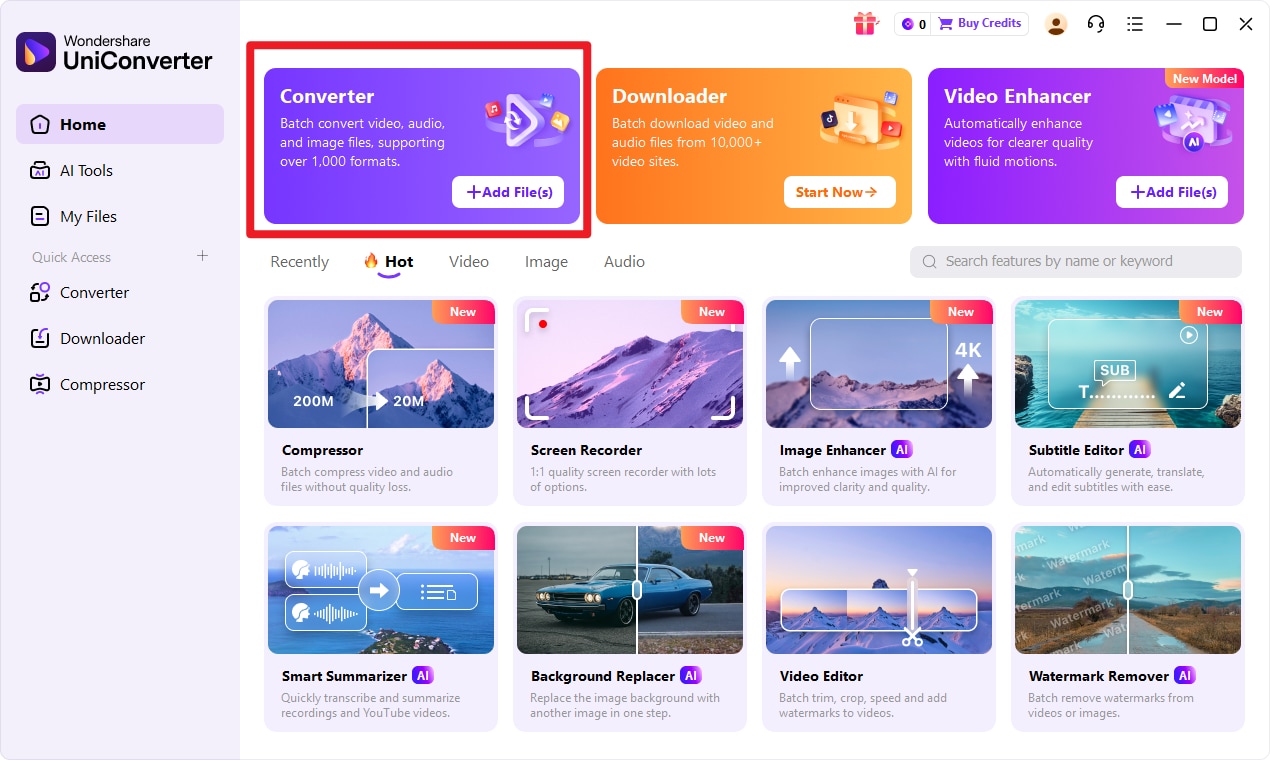
Step 1: Choose Converter in UniConverter
Launch Wondershare UniConverter on your computer. On the main interface, look at the menu on the left side and click on the Converter tool to open the video conversion window.
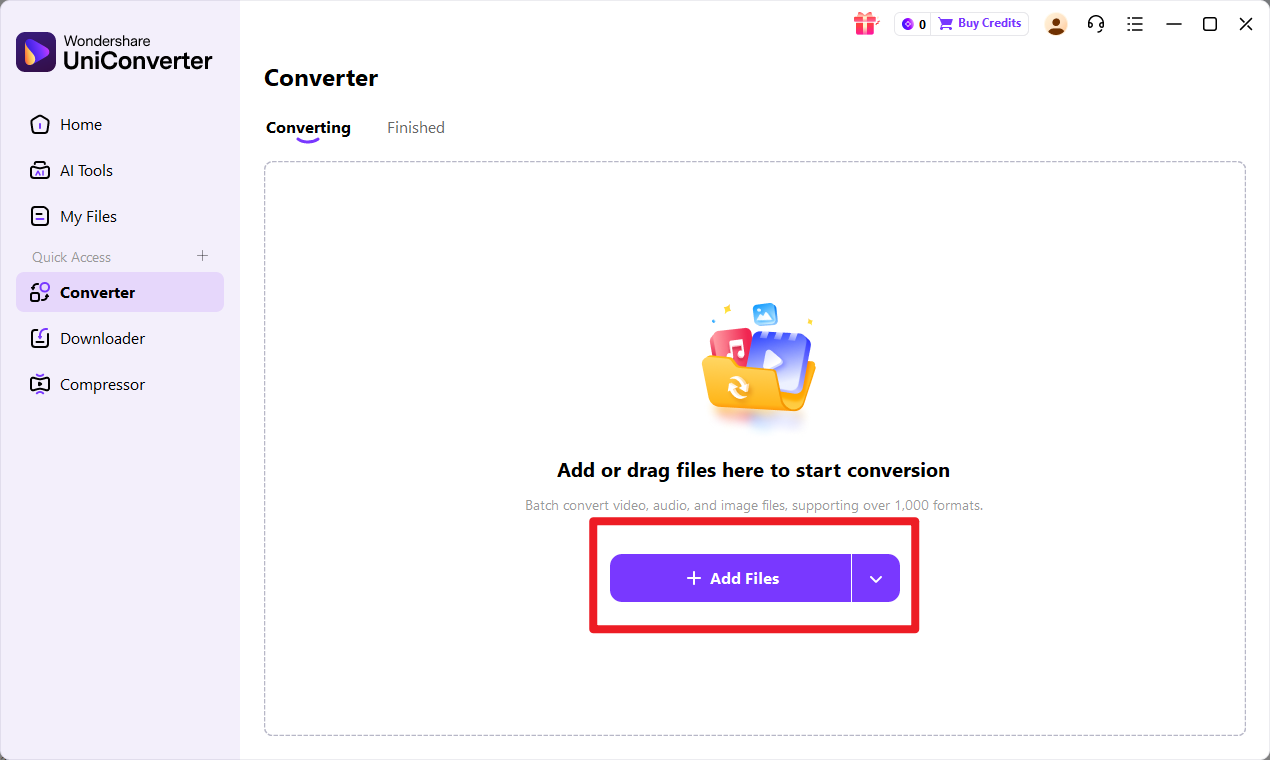
Step 2: Add Files to UniConverter
You can now import your input format files. Either drag and drop the video files directly onto the center of the UniConverter window or click the "Add Files" button in the top-left corner to browse your computer's folders and select the files you want to convert.
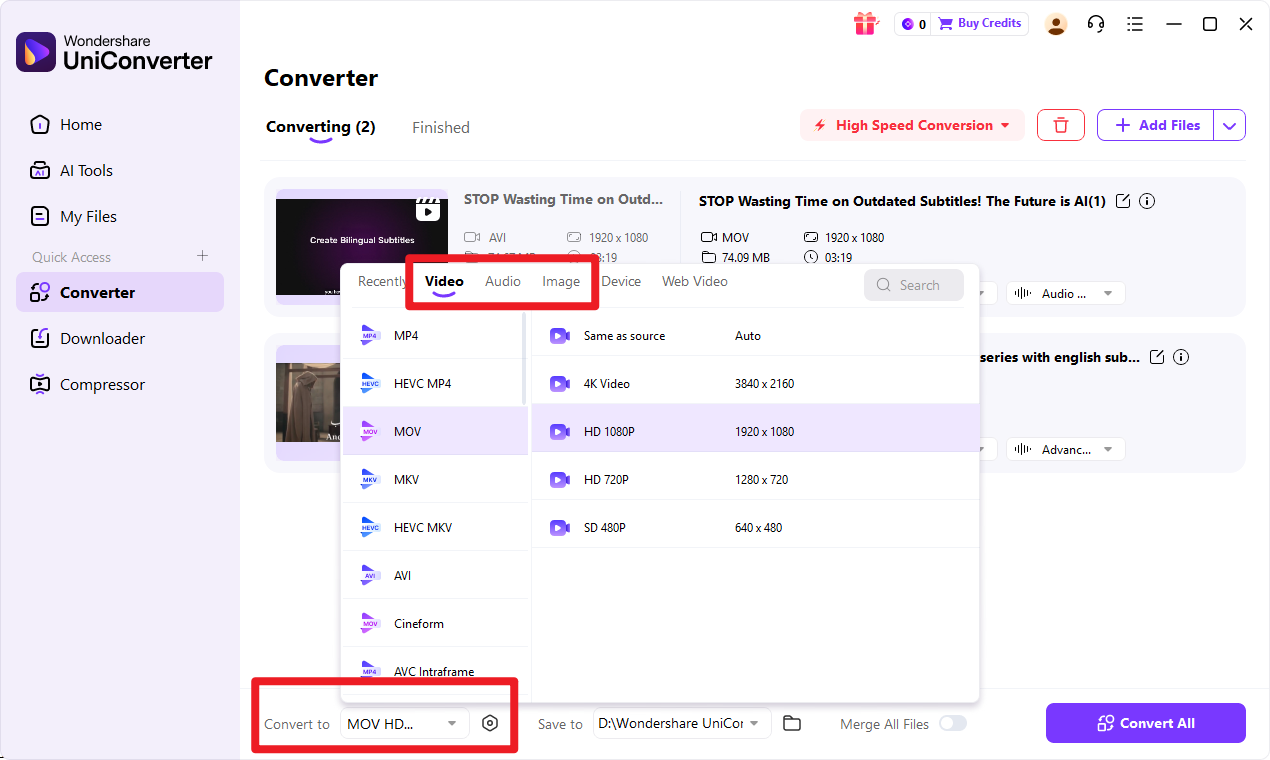
Step 3: Choose Output Format
At the bottom of the window, click on the Output Format menu. A new window will appear. Go to the Video tab. Here, you can select a container format like MP4 or MKV on the left. Then, on the right, click the edit icon to open the settings panel where you can choose H.265 from the Encoder dropdown menu to set it as your target format.
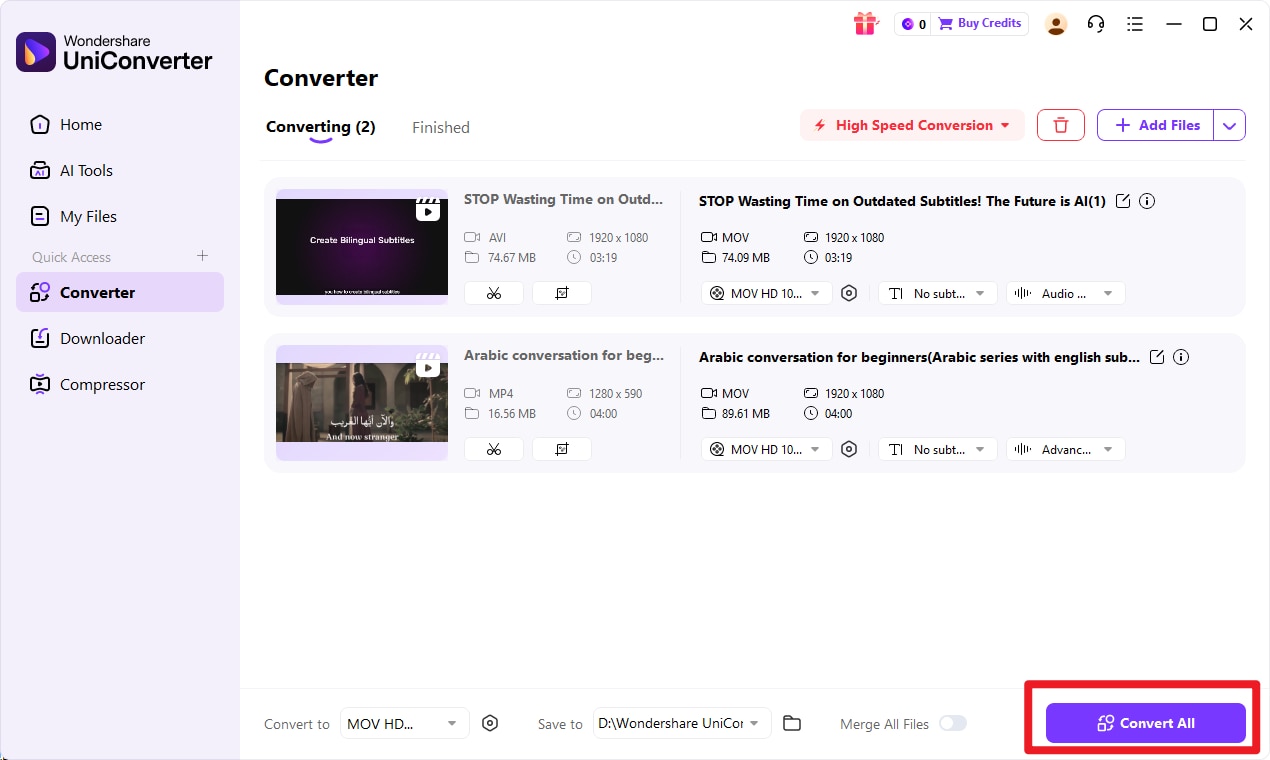
Step 4: Start the Conversion
Before starting, you can specify where to save the converted files by using the File Location menu at the bottom. Once you are ready, click the Start All button in the bottom-right corner. UniConverter will begin converting all your files to H.265 at high speed.

Go Beyond Simple Video Conversion
Conclusion
In the MPEG-2 vs H.265 showdown, H.265 emerges as the undisputed champion for the modern digital era. Its incredible compression efficiency, superior quality at low bitrates, and universal support on current devices make it the go-to codec for streaming, recording, and archiving. While MPEG-2 carved out its place in history with DVDs and early digital broadcasts, its inefficiency makes it a legacy format with very limited use cases in 2026.
For anyone looking to optimize their video library, save storage space, and ensure their content is ready for the future, converting from MPEG-2 to H.265 is a logical and highly beneficial step. With powerful yet simple tools like Wondershare UniConverter, this transition is no longer a complex task but a quick and effortless process accessible to everyone.
FAQs
-
1. Is H.265 higher quality than MPEG-2?
At the same bitrate, H.265 offers significantly higher video quality than MPEG-2. Its advanced algorithms are better at preserving detail and reducing artifacts. Conversely, to achieve the same visual quality as an MPEG-2 file, an H.265 file requires a much lower bitrate, resulting in a much smaller file size. -
2. Will my old TV play H.265 files?
Most likely not. TVs and other media devices manufactured before H.265 became widespread (around 2014-2015) typically lack the dedicated hardware decoder required to play H.265 video. Attempting to play such a file may result in an error message, a black screen, or extremely choppy playback. To watch it, you would need to use a modern external media player or convert the file to a compatible format. -
3. Does converting MPEG-2 to H.265 reduce quality?
All video conversion is "lossy," meaning it involves re-encoding the video, which can technically lead to a slight degradation in quality. However, when using a high-quality conversion program like UniConverter with appropriate settings (e.g., maintaining the original resolution and a high-quality preset), any potential quality loss is visually imperceptible to the human eye. The efficiency gains from the much smaller file size far outweigh the minimal data loss. -
4. Is H.265 the same as MP4?
No, they are different things. H.265 (HEVC) is a codec, which is a standard for compressing and decompressing video data. MP4 is a container format, which is like a digital box that can hold various types of data, including video streams, audio streams, and subtitles. An MP4 file can contain a video stream encoded with the H.265 codec, but it could also contain a video encoded with H.264, MPEG-4 Part 2, or other codecs.
