
MP4 vs M4V: What's the Difference and Which Is Better?
Have you ever downloaded a video file, ready to watch, only to find it won't play on your device? Or perhaps you're a content creator, staring at your export settings, wondering which format will give you the best results. Often, this confusion boils down to a simple but crucial question: what is the difference between MP4 and M4V? While they seem similar, understanding their unique characteristics is key to solving compatibility issues and ensuring your videos are accessible everywhere. The debate of MP4 vs M4V is less about a clear winner and more about choosing the right tool for the right job.
This guide will demystify these two popular video formats. We'll break down their technical differences, explore their ideal use cases, and provide a clear verdict on which one you should use in various scenarios. By the end, you'll not only understand the distinction but also know how to effortlessly convert between them when needed.
In this article:
Part 1. What is MP4? What is M4V?
Before we can compare them, it's essential to understand what each format is on its own. Both are "container formats," which you can think of as digital boxes. These boxes don't just hold the video; they can also contain audio tracks, subtitles, and still images, all synchronized together. The real difference lies in the rules governing these boxes and what they are designed to do.
What is an MP4 File?
MP4, which stands for MPEG-4 Part 14, is the undisputed king of video formats. Developed by the Moving Picture Experts Group (MPEG), it was designed to be a universal standard. Its primary strength is its incredible balance of high-quality video compression, manageable file sizes, and near-universal compatibility.
Because it's an open standard, an MP4 file can play on virtually any device or platform you can think of—Windows PCs, Macs, Android phones, iPhones, smart TVs, gaming consoles, and all major web browsers. This widespread support has made it the default format for web streaming, social media sharing, and general video storage. If you create or download a video online, there's a very high chance it's an MP4.
What is an M4V File?
The M4V file format was developed by Apple and is structurally based on the MP4 format. In fact, an M4V file is often identical to an MP4 file in terms of the video and audio data it contains. You can think of M4V as Apple's specialized version of the MP4 container.
The single most important distinction is M4V's ability to support Apple's FairPlay Digital Rights Management (DRM) technology. This is a form of copy protection used to prevent unauthorized distribution of copyrighted content. As a result, M4V is the default format for all movies, TV shows, and music videos purchased or rented from the Apple iTunes Store. While you can create your own DRM-free M4V files, the format is forever linked to Apple's ecosystem and its DRM capabilities.
Part 2. Quick Comparison Table
To see the differences at a glance, let's put the two formats side-by-side. This table highlights the key attributes that define each format and influence how they are used.
MP4 vs M4V: A Head-to-Head Comparison
| Feature | MP4 (MPEG-4 Part 14) | M4V (Apple MPEG-4 Video) |
| Developer | Moving Picture Experts Group (MPEG) | Apple Inc. |
| Compatibility | Universal (Windows, macOS, Android, iOS, smart TVs, game consoles) | Primarily Apple ecosystem (macOS, iOS); may require special codecs on other platforms. |
| DRM Protection | Does not support DRM. | Can be protected by Apple's FairPlay DRM. |
| Primary Use | Web streaming, video sharing, general video storage. | iTunes Store content, video playback within the Apple ecosystem. |
Part 3. MP4 vs M4V: Which One Is Better?
Now for the main event: which format should you choose? The answer isn't a simple one-size-fits-all. The "better" format depends entirely on your specific goals, your audience, and the devices you're targeting.
For Compatibility: MP4 Is the Winner
If your top priority is ensuring your video can be played by anyone, anywhere, on any device, then MP4 is the clear and undisputed champion. Its status as an open, international standard means it is natively supported by an enormous range of hardware and software. You can upload it to YouTube, send it to a colleague using a Windows PC, or play it on an Android tablet without a second thought.
While an unprotected M4V file can often be played on non-Apple devices (sometimes by simply renaming the file extension to .mp4), it's not a guarantee. The user might need to install specific media players like VLC or additional codec packs to get it to work. For hassle-free, universal playback, MP4 is the safest and most reliable choice.
For the Apple Ecosystem: M4V Has an Edge
If your video content is intended to live exclusively within the Apple ecosystem, then M4V is a perfectly fine, and sometimes even preferable, choice. Since it's Apple's native format, it is guaranteed to play smoothly on iPhones, iPads, Macs, and Apple TVs.
Furthermore, M4V is designed to integrate seamlessly with Apple's applications, like the Apple TV app (formerly iTunes). It can support features like chapter markers, multiple audio tracks, and subtitles in a way that is specifically optimized for these programs. So, if you are creating content for an audience you know uses Apple products exclusively, M4V offers a tailored experience.
For DRM: Only M4V Applies
This is the most significant technical difference and the primary reason M4V exists. Only the M4V container is designed to hold Apple's FairPlay DRM. If a video file is protected by this DRM, it can only be played on devices authorized with the Apple ID that was used to purchase it.
It's crucial to understand that this only applies to content from the iTunes Store. If you create your own M4V file from a personal video, it will not have any DRM by default. This distinction is only relevant when dealing with commercially purchased media from Apple.
The Verdict: It Depends on Your Needs
Ultimately, the choice comes down to your specific use case. Here's a simple breakdown:
- For maximum compatibility, sharing, and uploading to the web, always choose MP4.
- For content that will only be used on Apple devices, M4V is a perfectly acceptable choice.
What if you have a file in the "wrong" format? For example, an M4V file that won't play on your Android TV or an MP4 you want to optimize for your Apple TV library. In these situations, the best solution is to convert the file. A powerful and reliable tool like Wondershare UniConverter can easily convert M4V to MP4 (and vice versa) quickly and without any loss in quality, solving any compatibility problem you might encounter.
Part 4. Use Cases for MP4 and M4V
To make the decision even clearer, let's look at some practical, real-world scenarios where you would choose one format over the other.
When to Use MP4
- Uploading videos to online platforms: When you're sharing content on YouTube, Vimeo, Facebook, Instagram, or TikTok, MP4 is the recommended format. These platforms are optimized to process and stream MP4 files efficiently to a global audience on all types of devices.
- Sending a video to others: If you need to email a video to a client, share it with family members, or collaborate with colleagues, using MP4 ensures that everyone can open and view it without needing special software or technical know-how.
- Creating a long-term video archive: For archiving your personal or professional video projects, MP4 is the most future-proof option. Its universal nature means you'll likely be able to play these files for many years to come, even as technology changes.
When to Use M4V
- Managing your iTunes library: All movies and TV shows you buy or rent from the iTunes Store will be in the M4V format. Your library will naturally be filled with these files, which are managed by the Apple TV app.
- Optimizing for Apple TV: If you are digitizing your personal media collection specifically for playback on an Apple TV, converting your files to the M4V format can ensure perfect compatibility and support for features like chapters and metadata within the Apple ecosystem.
- Integrating with Apple-specific features: If you are creating educational or instructional videos that rely on chapter markers to navigate sections, and your audience is exclusively using Macs or iPads, exporting as M4V from an application like Final Cut Pro can be a valid choice.
Part 5. Step-by-Step Guide to Convert MP4 to M4V Using UniConverter
When you need to ensure your video is perfectly optimized for an Apple device or want to organize your library within Apple's apps, converting it from the universal MP4 format to M4V is a great solution. Wondershare UniConverter is a comprehensive video toolbox that makes this process incredibly simple and fast. It handles conversions between over 1,000 formats, making it the ideal choice for all your video conversion needs in 2026 and beyond.
Step 1: Add Your MP4 File to UniConverter
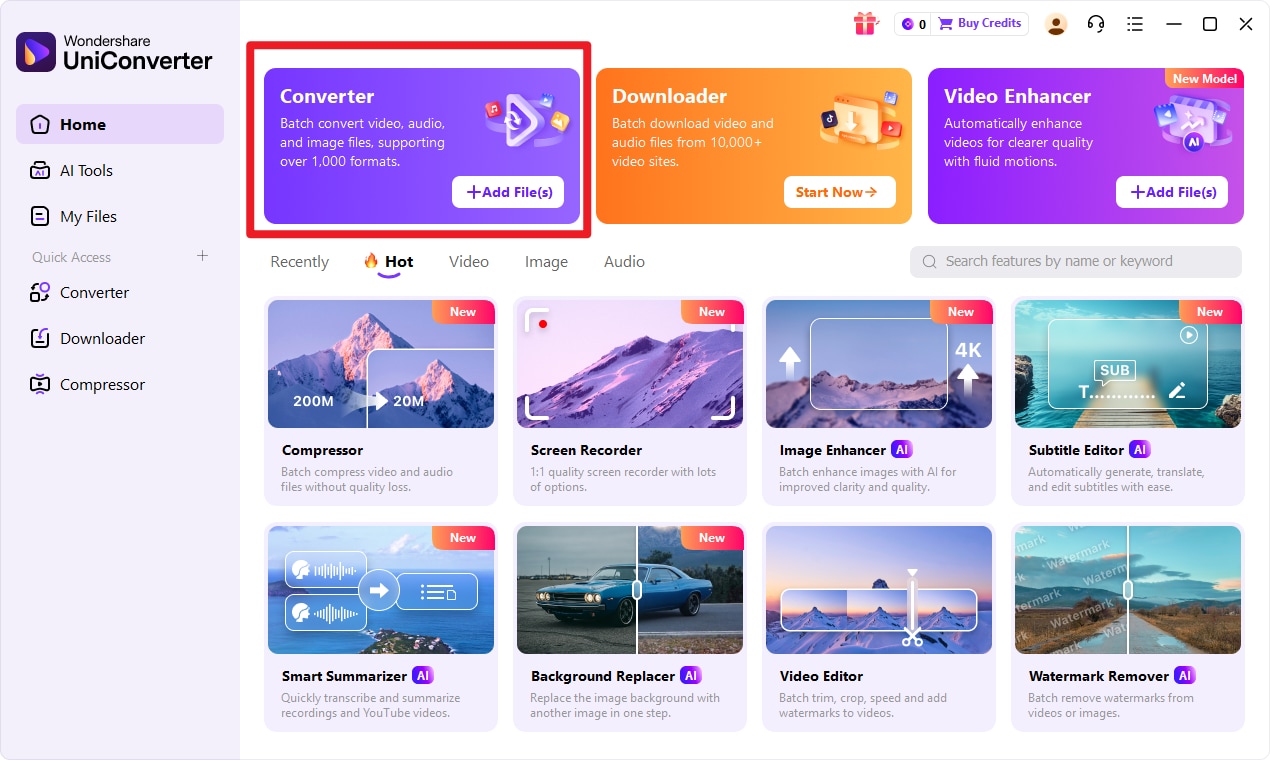
First, launch Wondershare UniConverter on your Windows or Mac computer. In the main interface, select the Converter tool from the menu on the left side. You can now either drag and drop your MP4 file directly onto the program window or click the Add Files button to browse your computer and select the video you want to convert.
Step 2: Choose M4V as the Output Format
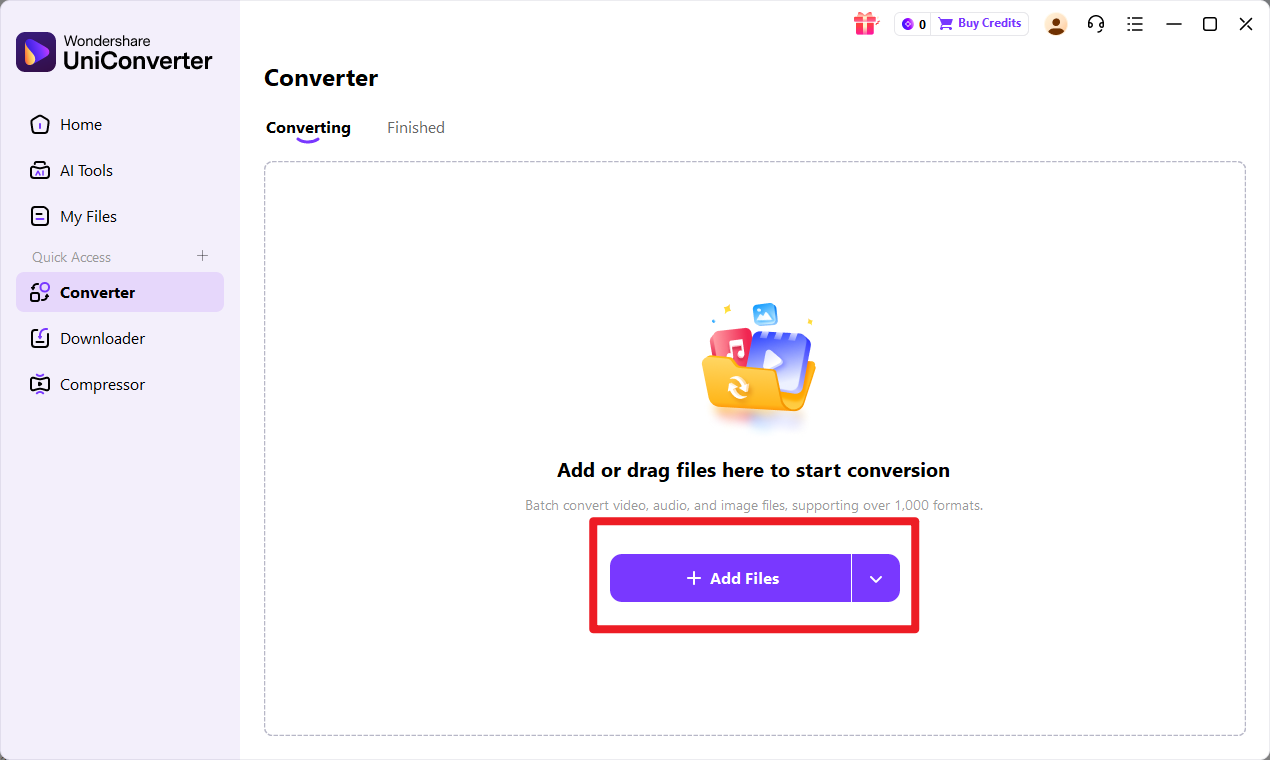
Once your file is loaded, click on the Output Format menu at the bottom of the window (it may also appear as a gear icon next to your file). This will open a new window with a list of format options. Select the Video tab, find and choose M4V from the list of formats on the left, and then select your desired output resolution on the right (such as "Same as source" to maintain quality).
Step 3: Start the Conversion
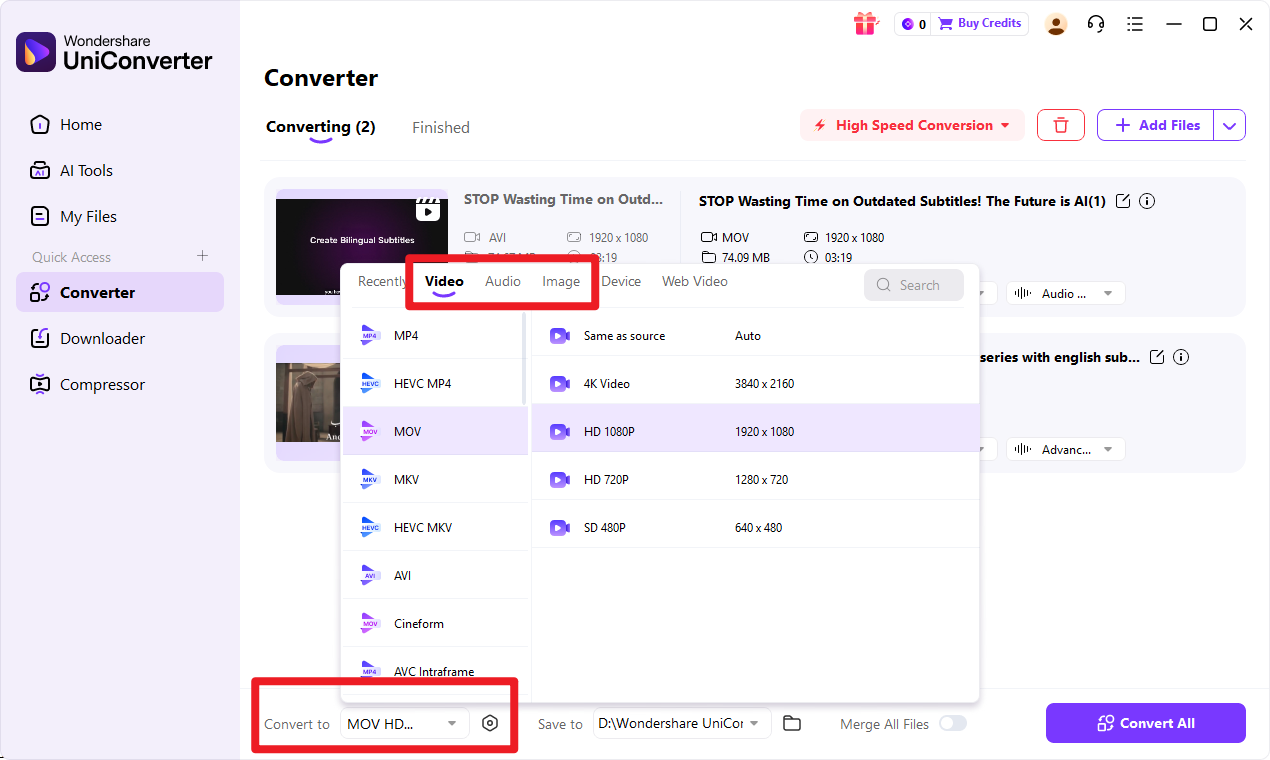
Before starting, you can choose where to save your converted file by using the File Location menu at the bottom of the screen. When you are ready, click the Convert button next to the individual file. If you have loaded multiple files to convert at once, you can click the Start All button in the bottom-right corner to begin the batch conversion process.
Step 4: Access Your Converted M4V File
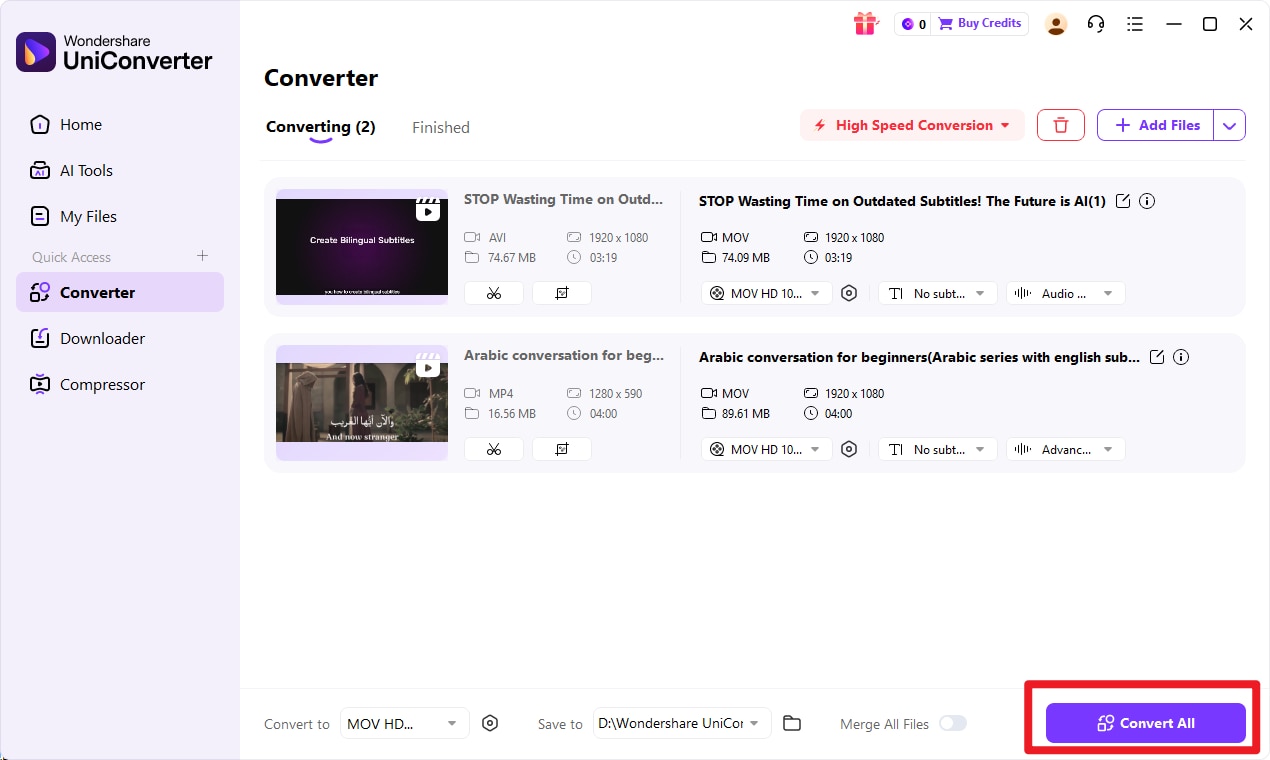
UniConverter will process your file at high speed. Once the conversion is complete, you can find your new M4V file by navigating to the Finished tab at the top of the screen. From there, simply click the Open button next to the file name to immediately locate it in the output folder you selected in the previous step.

Go Beyond Simple Video Conversion
FAQs
-
1. Can I just rename an M4V file to MP4?
For M4V files that do not have DRM protection, you can often simply change the file extension from .m4v to .mp4, and it will play correctly in most media players. This works because the underlying container structure is nearly identical. However, this is not a guaranteed fix and can sometimes cause playback or metadata issues. Performing a proper conversion with a dedicated tool is always the most reliable method to ensure full compatibility. -
2. Does converting M4V to MP4 remove DRM?
No. Standard video converters, including Wondershare UniConverter, respect copyright laws and cannot remove or bypass Digital Rights Management (DRM). If you attempt to convert a DRM-protected M4V file purchased from the iTunes Store, the process will fail or result in an unusable file. The conversion process only works for DRM-free M4V files. -
3. Is M4V a better quality format than MP4?
No, the container format itself (M4V or MP4) does not determine the video quality. Quality is dictated by factors like the video codec used (e.g., H.264, H.265/HEVC), the resolution, and the bitrate set during the encoding process. An M4V file and an MP4 file can have the exact same video and audio quality if they are encoded with identical settings. -
4. Will M4V files play on a Windows PC?
Sometimes. The default Windows Media Player may not recognize and play M4V files out of the box. However, more versatile third-party media players like VLC Media Player or Media Player Classic can almost always play unprotected M4V files without any issue, as they come with their own built-in codec libraries.
Conclusion
The battle of MP4 vs M4V is less about which format is technically superior and more about which is appropriate for your specific situation. MP4 stands out for its universal compatibility, making it the undisputed go-to format for sharing, web uploads, and long-term storage. M4V is Apple's specialized variant, perfectly suited for use within its closed ecosystem and notable as the only one of the two that can carry Apple's FairPlay DRM. For most personal, unprotected content, the two formats are functionally almost identical.
When you inevitably face a compatibility barrier or need to switch between formats, the most effective solution is not to get bogged down in the technical details. Instead, empower yourself with a flexible and powerful tool. A comprehensive video converter like UniConverter removes the guesswork, allowing you to effortlessly convert any file to the exact format you need, ensuring your videos play perfectly every time, on every device.
