
Have you ever noticed that photos and videos from your new iPhone have a strange .heic or .hevc extension? You're not alone. As technology evolves, new file formats emerge, often leaving users confused about how they compare to the familiar standards we've used for years. This brings us to the core of a common digital dilemma: the battle of MP4 vs HEIF. While MP4 has been the undisputed king of video for over a decade, Apple's adoption of HEIF and its underlying HEVC technology has introduced a powerful new contender focused on efficiency.
Many users find themselves struggling to open, edit, or share these new HEIF files on non-Apple devices like Windows PCs or Android phones. This guide is here to clear up the confusion. We will break down the fundamental differences between these formats, exploring their respective strengths and weaknesses in terms of file size, quality, and compatibility. By the end, you'll not only understand which format is right for your needs but also know exactly how to handle them for a seamless workflow.
In this article:
Part 1. What is MP4? What is HEIF?
Before we can compare these two formats, it's essential to understand what they are and what they do. While they are often pitted against each other, they serve slightly different primary functions, and the real comparison lies in the technology they use.
What is MP4 (MPEG-4 Part 14)?
MP4, short for MPEG-4 Part 14, is a digital multimedia container format. Think of a container format like a box. This box doesn't just hold one thing; it can store various types of data, including video, audio, subtitles, and even still images, all synchronized together in a single file. This versatility is one of its greatest strengths.
The most common video compression standard, or "codec," used within an MP4 container is H.264 (also known as AVC, or Advanced Video Coding). The combination of the MP4 container and the H.264 codec is what has made it the universal standard for video. Its defining feature is its incredible compatibility. An MP4 file created today will play on virtually any device—smartphones, computers, smart TVs, and gaming consoles—and is the preferred format for web streaming on platforms like YouTube and Vimeo.
What is HEIF (High Efficiency Image File Format)?
HEIF, or High Efficiency Image File Format, is a modern container format designed primarily for still images and image sequences. It was developed to be a more efficient successor to the aging JPEG format. The key to HEIF's power is its use of a highly advanced compression method: HEVC (High Efficiency Video Coding), also known as H.265.
Thanks to the HEVC codec, HEIF can store images at a significantly smaller file size than a JPEG of comparable quality—often up to 50% smaller. This is a game-changer for saving storage space on devices with high-resolution cameras. While HEIF is technically an image format, the term is often used colloquially to refer to the underlying HEVC video compression standard, which offers the same efficiency benefits for video files. For the purpose of this article, when we compare "HEIF" to MP4, we are primarily comparing the efficient HEVC codec (associated with HEIF) against the ubiquitous H.264 codec (commonly used in MP4).
Part 2. Quick Comparison Table
To get a clear overview at a glance, here is a quick comparison table summarizing the key differences between the technologies associated with MP4 (using the H.264 codec) and HEIF (using the HEVC codec).
| Feature | MP4 (H.264) | HEIF (HEVC) |
| File Size | Larger | Up to 50% smaller for the same quality |
| Quality | Very good, but less efficient compression. | Higher quality at lower bitrates, supports wider color gamuts. |
| Compatibility | Universal support across all devices and platforms. | Native support on modern Apple devices, but limited on Windows, Android, and older hardware. |
| Primary Use | Web streaming, social media sharing, general video playback. | Storing high-quality photos and 4K/8K videos on modern devices to save space. |
Part 3. MP4 vs HEIF: Which One Is Better?
Now that we have a foundational understanding, let's dive deeper into a head-to-head comparison across three critical aspects: compression, quality, and compatibility. The "better" format truly depends on what you prioritize.
Compression and File Size: The Efficiency of HEIF/HEVC
When it comes to saving space, there is a clear winner. The HEVC (H.265) codec used by HEIF is a generational leap forward from the older H.264 codec commonly found in MP4 files. It uses more sophisticated compression algorithms to encode visual information.
What does this mean in practice? A video or image compressed with HEVC can be roughly half the size of one compressed with H.264 while maintaining the same level of visual quality. For anyone shooting high-resolution 4K or even 8K video, or for those simply trying to maximize the storage on their smartphone, this difference is monumental. It allows you to store twice as much content in the same amount of space without sacrificing clarity.
Winner for file size: HEIF/HEVC
Video and Image Quality: The Future is Clearer
While HEVC's primary selling point is its efficiency, it also brings tangible improvements in quality. One of the most significant advancements is its support for more advanced color depths. HEVC can handle up to 10-bit color (and even higher), which allows for over a billion shades of color.
In contrast, the more common H.264 standard is typically limited to 8-bit color, which represents about 16.7 million colors. This wider color gamut in HEVC results in smoother gradients, more vibrant and lifelike images, and a reduction in "color banding" artifacts, especially visible in scenes with subtle color transitions like a blue sky. For content creators and videophiles who demand the highest fidelity, HEVC offers a visibly superior picture.
Winner for quality: HEIF/HEVC
Compatibility and Support: The Power of MP4
This is where the tables turn dramatically. Despite the technical superiority of HEIF/HEVC in size and quality, its greatest weakness is its limited adoption. While it is the default on modern Apple devices (iPhones, iPads, and Macs), the rest of the digital world has been slow to catch up.
Windows and Android devices do not support HEIF or HEVC files out of the box. Opening them often requires downloading special codecs or extensions, which can sometimes cost money and confuse less tech-savvy users. This creates a major barrier to sharing. If you send a .heic photo or an HEVC video to a friend with a Windows PC, they likely won't be able to open it.
In stark contrast, MP4 (H.264) is the undisputed king of compatibility. It is the universal language of video. You can be confident that an MP4 file will play on any device, on any platform, in any browser, without requiring any special software. For sharing, publishing, and ensuring accessibility, MP4 remains the undefeated champion.
If you find yourself with HEIF/HEVC files that you need to share, the compatibility issue can be frustrating. Fortunately, this problem is easily solved. A reliable and powerful video converter like Wondershare UniConverter can effortlessly convert your HEIF/HEVC files into the universally compatible MP4 (H.264) format, bridging the gap between efficiency and accessibility.
Winner for compatibility: MP4 (H.264)
Part 4. Use Cases for MP4 and HEIF
Understanding the strengths and weaknesses of each format helps us determine the best scenarios for using them. Here's a practical guide on when to choose one over the other.
When to Use MP4 (H.264)
Choose the universally compatible MP4 format when your priority is sharing and accessibility. It's the safest and most reliable choice for:
- Sharing on Social Media: Platforms like YouTube, Instagram, Facebook, and X (formerly Twitter) are optimized for MP4 (H.264). Uploading in this format ensures smooth processing and playback for your audience.
- Sending Videos to Others: When you email a video to a colleague or send it to a friend via a messaging app, using MP4 guarantees they can open and view it without any hassle, regardless of their device.
- Broad Device Accessibility: If you are creating content for a public website or a presentation that will be viewed on a variety of unknown devices (including older computers or projectors), MP4 is the only format that ensures everyone will have a consistent viewing experience.
When to Use HEIF/HEVC
Choose the highly efficient HEIF/HEVC format when your priority is saving storage space and maintaining the highest possible quality, especially within a controlled environment. It's the ideal choice for:
- Saving Storage Space: If you're constantly getting "Storage Almost Full" notifications on your iPhone, keeping your photos and videos in the HEIF/HEVC format is the best way to maximize your available space.
- Archiving High-Resolution Footage: For professional videographers or serious hobbyists shooting in 4K or 8K, HEVC is essential. It allows you to store your master footage at the highest quality without needing an enormous amount of hard drive space.
- Working Within a Modern Apple Ecosystem: If you primarily work and share files between your iPhone, iPad, and Mac, you can take full advantage of HEVC's benefits without worrying about compatibility, as all these devices support it natively.
Part 5. Step-by-Step Guide to Convert HEIF to MP4 Using UniConverter
If you are struggling with HEIF compatibility, the easiest solution is to convert your files to a universally supported format like MP4. Wondershare UniConverter is a powerful and intuitive tool that makes this process incredibly simple and fast. It supports over 1,000 formats and offers lightning-fast conversion speeds, making it your first choice for handling any file conversion needs.
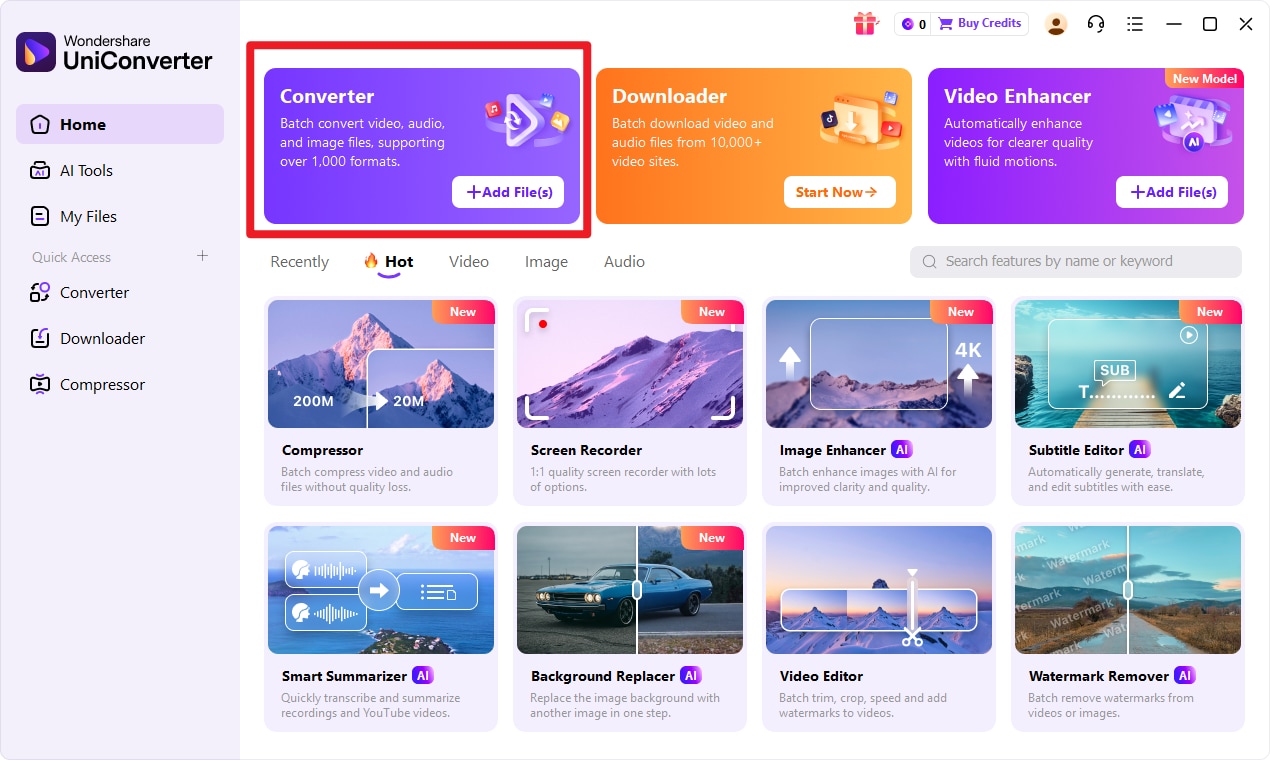
Step 1: Choose Converter in UniConverter
Launch Wondershare UniConverter on your computer. From the main dashboard, look at the menu on the left side and select the Converter tool to begin.
Step 2: Add Files to UniConverter
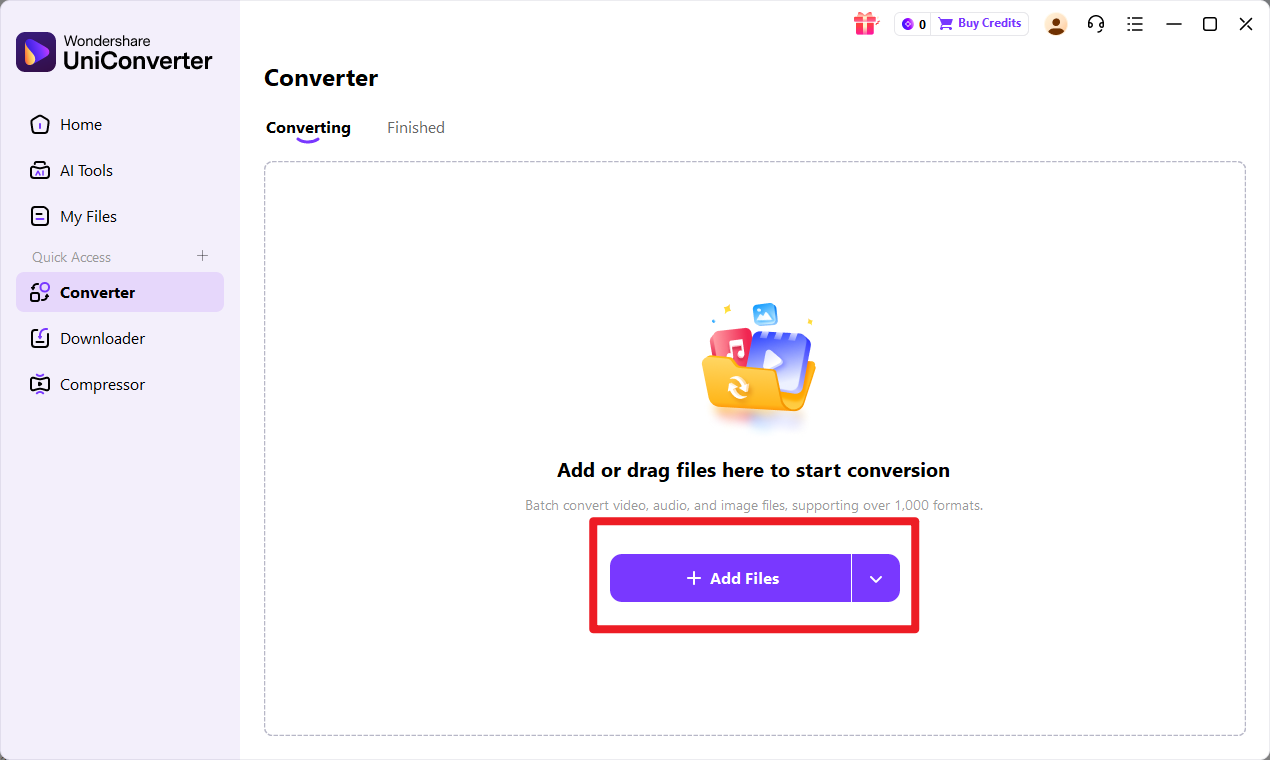
You can now import your files. Click the Add Files icon in the center of the screen to browse your computer for the input format files you wish to convert. Alternatively, you can simply drag and drop your files directly into the converter window. UniConverter supports batch conversion, so feel free to add multiple files at once.
Step 3: Choose Output Format
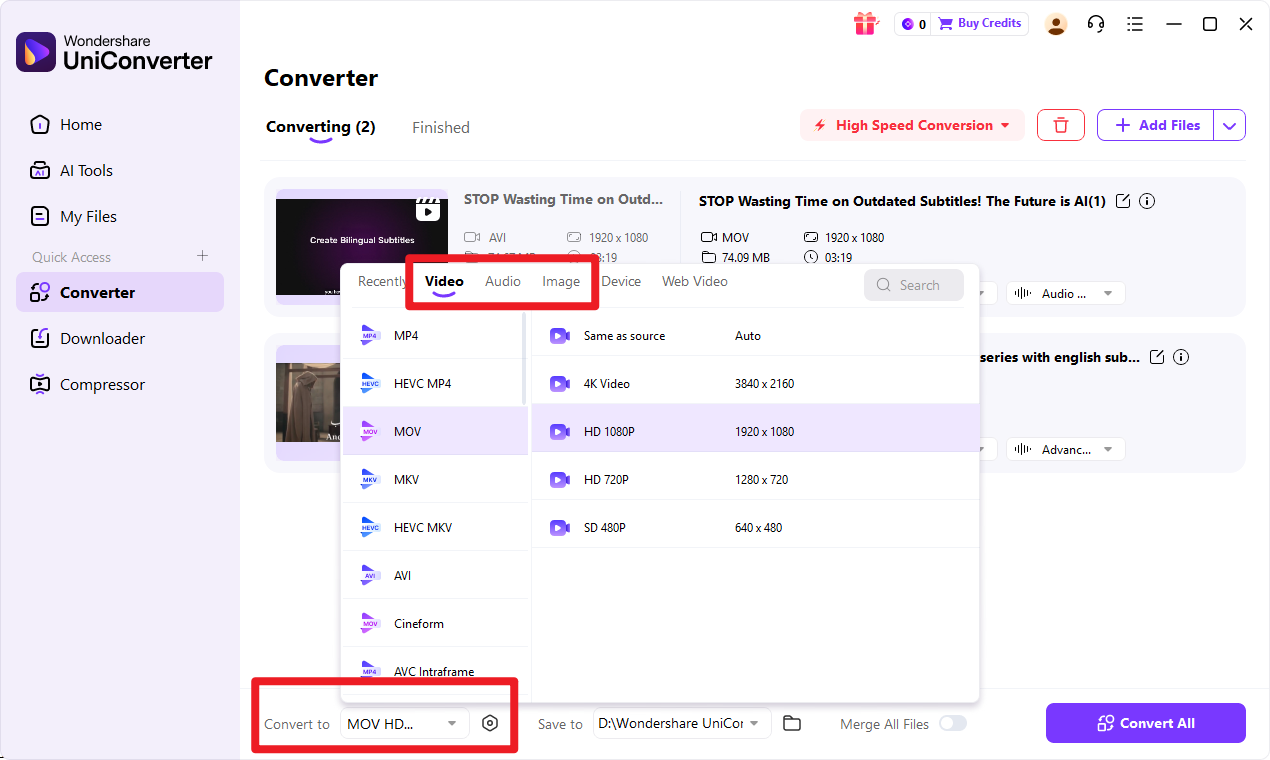
At the bottom of the window, click on the Output Format tab. This will open a new window displaying a comprehensive list of conversion options. Navigate to the Video tab and select your desired target format from the list on the left. You can also choose a preset resolution on the right.
Step 4: Start the Conversion
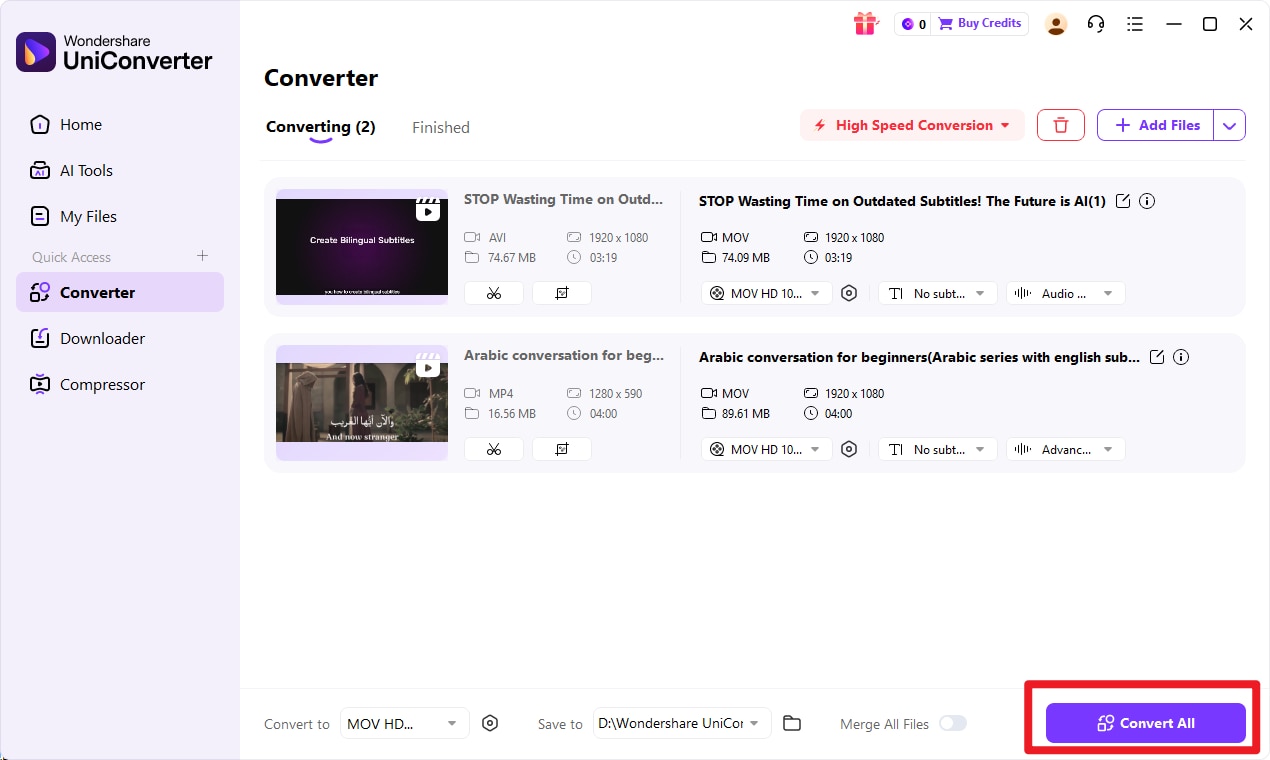
Before starting, you can select a destination for your converted files by clicking the File Location folder icon at the bottom. Once you are ready, click the Start All button in the bottom-right corner to begin the conversion process. UniConverter will quickly process your files and save them to your chosen folder.

Your All-in-One Media Conversion Solution
Conclusion
The choice between MP4 (H.264) and HEIF (HEVC) ultimately boils down to a trade-off between universal compatibility and modern efficiency. There is no single "better" format for every situation. MP4 (H.264) remains the go-to standard for sharing, streaming, and ensuring your content can be viewed by anyone, anywhere. Its strength lies in its unparalleled accessibility. On the other hand, HEIF/HEVC represents the future of media compression, offering superior quality at significantly smaller file sizes. It is the perfect choice for personal storage, archiving high-resolution content, and maximizing space on modern devices.
The smartest workflow involves using both formats to their strengths. Capture and store your precious memories in the high-quality, space-saving HEIF/HEVC format. When it's time to share them with the world, use a trusted and powerful tool like Wondershare UniConverter to seamlessly convert your files to the universally compatible MP4 format. This approach gives you the best of both worlds: pristine quality for your archives and effortless sharing for your audience.
FAQs
-
1. Is HEIF the same as HEVC?
No, they are not the same but are closely related. HEIF (High Efficiency Image File Format) is a container format, like a box designed to hold images and image sequences. HEVC (High Efficiency Video Coding), also known as H.265, is the compression standard (a codec) that does the work of making the file smaller. HEIF files use the HEVC codec to store images very efficiently. -
2. Can Windows 10/11 open HEIF files?
Yes, but it requires an extra step. By default, Windows cannot open HEIF (`.heic`) files. To enable support, you must go to the Microsoft Store and download the "HEIF Image Extensions." In some cases, you may also need to purchase and install the "HEVC Video Extensions" to view videos recorded with this codec. Because of this hassle, many users find it much easier to simply convert the files to a standard format like JPG or MP4. -
3. Does HEIF have better quality than MP4?
This question is really about the codecs they use. The HEVC codec (associated with HEIF) is more advanced than the H.264 codec (commonly used in MP4). This means HEVC can achieve better visual quality than H.264 at the same file size. Alternatively, it can produce the same visual quality at a much smaller file size. So, in terms of compression technology, HEVC offers a higher potential for quality. -
4. Why does my iPhone take HEIF photos?
Apple switched to HEIF as the default image format starting with iOS 11. The primary reason was to save a significant amount of storage space on users' devices without sacrificing image quality. As iPhone cameras became more powerful, capturing higher-resolution photos and 4K videos, file sizes grew rapidly. Adopting HEIF/HEVC allowed Apple to manage this data explosion, letting users store more photos and videos on their devices.
