
Navigating the world of video formats can be confusing, especially with new technologies emerging all the time. A common point of confusion for many is the difference between MP4 vs H.266. You might have seen these terms in your camera settings, video editing software, or when downloading a file, and wondered which one is better. This question is more complex than it seems because it's like comparing a box to what's inside it. Understanding this distinction is crucial for anyone who works with video, from casual content creators to professional filmmakers.
The core of the issue lies in a misunderstanding between a media container and a video codec. Choosing the wrong one can lead to playback issues, unnecessarily large files, or compatibility problems when sharing your work. In this guide, we will demystify these terms, break down their differences, and help you decide which technology is right for your needs in 2026.
In this article, you will learn:
- What MP4 and H.266 (VVC) are and their fundamental differences.
- A quick comparison of their features, goals, and compatibility.
- Which technology is superior for compression versus accessibility.
- Practical use cases for both MP4 and H.266.
- How to easily convert files to and from these formats to solve any compatibility issues.
Part 1. What is MP4? What is H.266?
To settle the debate, we first need to understand that MP4 and H.266 serve different, though related, purposes. One is a container, and the other is a compression method.
What is MP4 (MPEG-4 Part 14)?
MP4, or MPEG-4 Part 14, is a digital multimedia container format. Think of it as a versatile digital box or file wrapper. Its job isn't to compress the video itself but to hold all the different elements of a multimedia file together in one neat package. This package can include:
- A video stream (the moving pictures)
- An audio stream (the sound)
- Subtitles and closed captions
- Chapter information
- Still images (thumbnails)
- Metadata (like the title, author, and creation date)
The single biggest advantage of the MP4 format is its near-universal compatibility. It is supported by virtually every modern device, operating system, web browser, and video editing software. The video data stored inside an MP4 file can be compressed using a variety of codecs, but the most common one you'll find is H.264 (AVC).
What is H.266 (VVC - Versatile Video Coding)?
H.266, officially known as Versatile Video Coding (VVC), is a video compression standard, or codec. A codec's purpose is to encode (compress) video data to make the file size smaller and decode (decompress) it for playback. H.266 is the direct successor to the widely used H.265 (HEVC) and H.264 (AVC) codecs.
The primary goal of H.266 is to achieve a massive improvement in compression efficiency. It can reduce the file size of a video by about 50% compared to H.265 while maintaining the same level of visual quality. This is a game-changer for high-resolution content like 4K, 8K, and even 16K video, as it makes storing and streaming these massive files much more manageable.
The Key Difference: Container vs. Codec Explained
Here's the most important takeaway: MP4 is the container, and H.266 is the codec that can be placed inside that container.
- MP4 is the file format, indicated by the
.mp4file extension. It defines how data is stored and organized within the file. - H.266 is the algorithm used to shrink the size of the raw video data.
This means you can absolutely have an H.266-encoded video stream stored within an MP4 container file. Therefore, the "MP4 vs H.266" comparison is often an indirect way of asking about the practical differences between using the new H.266 codec versus older, more established codecs like H.264, which are most commonly found in MP4 files today.
Part 2. Quick Comparison Table
To make the differences clearer, here is a side-by-side comparison of MP4 and H.266 (VVC).
| Feature | MP4 | H.266 (VVC) |
| Type | Container Format | Video Codec (Compression Standard) |
| Primary Goal | To store multimedia streams in a single, compatible file. | To compress video data to the smallest possible size while maintaining quality. |
| Compression | Does not compress data itself; depends on the internal codec (e.g., H.264, H.265, H.266). | Extremely high compression efficiency. |
| Compatibility | Universal. Supported by virtually all modern devices and software. | Very low. Support is still emerging and not yet widespread in 2026. |
| Typical Use | Web video, social media sharing, general video storage, and playback. | 8K streaming, professional broadcasting, high-efficiency video archiving. |
Part 3. MP4 vs H.266: Which One Is Better?
The answer to "which is better" depends entirely on your priority: file size or compatibility.
For Compression and File Size: H.266 is the Winner
When it comes to pure compression efficiency, H.266 is unequivocally superior. It represents a significant leap forward in video compression technology, building on the successes of its predecessors.
H.266 is specifically designed to handle the demands of ultra-high-definition (UHD) content, such as 4K and 8K video. By creating files that are roughly half the size of those encoded with H.265 (and drastically smaller than H.264) at the same visual quality, it offers incredible benefits. This efficiency translates directly into saving significant storage space on hard drives and reducing the bandwidth required to stream high-quality video over the internet. For anyone dealing with the massive file sizes of modern video, H.266 is the clear winner.
For Compatibility and Accessibility: MP4 is Unbeatable
While H.266 is the future of compression, MP4 (typically containing H.264 video) is the undisputed king of compatibility today. You can create an MP4 file and be confident that it will play on almost any device imaginable—smartphones, tablets, laptops, smart TVs, and gaming consoles. It will upload seamlessly to YouTube, Instagram, and other social platforms, and it will import into virtually any video editor without issue.
In contrast, H.266 is still in its early adoption phase in 2026. Native hardware and software support is limited. This means that if you try to play an H.266-encoded video on an unsupported device, you will likely encounter errors, stuttering playback, or a black screen. This compatibility gap is a major pain point for users and is the primary reason why a powerful video converter like Wondershare UniConverter is so essential. It can bridge this gap by converting modern codecs like H.266 into more universally accepted formats.
The Verdict: A Partnership, Not a Rivalry
Ultimately, thinking of MP4 and H.266 as rivals is the wrong approach. They are partners that serve different roles in the video ecosystem. The real question isn't which is better, but when to use each technology.
- For maximum compatibility and immediate use, an MP4 file with an H.264 codec remains the gold standard. It's the safest and most reliable choice for sharing and general use.
- For future-proofing content and achieving maximum storage efficiency, H.266 is the superior technology. It is the future of video, especially for professional and high-resolution applications.
The ideal combination for the future is an H.266-encoded video stream placed inside a flexible MP4 container. However, until playback support for H.266 becomes as widespread as H.264, managing these files will require tools that can handle the conversion process.
Part 4. Use Cases for MP4 and H.266
Understanding the practical applications of each can help you make the right choice for your project.
When to Use MP4 (with H.264/H.265)
Choose the MP4 container, most likely with an H.264 or H.265 codec, for situations where compatibility is your top priority. This includes:
- Sharing videos online: When uploading to platforms like YouTube, Vimeo, Instagram, Facebook, or TikTok, MP4 (H.264) is the most widely accepted and recommended format.
- Sending videos to others: If you're sending a video to friends, family, or colleagues, using a universally playable format ensures they won't have trouble opening it, regardless of the device they use.
- Editing videos: Most consumer and prosumer video editing software works flawlessly with MP4 files, ensuring a smooth editing workflow without the need for transcoding.
- Archiving personal videos: For home movies and personal memories, MP4 provides a great balance of quality, file size, and the peace of mind that you'll be able to play them back for years to come.
When to Use H.266 (VVC)
H.266 is the choice for cutting-edge applications where efficiency is paramount, and you have control over the playback environment. Key use cases include:
- Professional filmmaking: For cinematographers shooting in 8K or higher resolutions, H.266 allows them to capture pristine quality without being overwhelmed by impossibly large file sizes.
- Streaming services: Companies like Netflix and Amazon Prime Video can use H.266 to deliver 4K and 8K content to viewers using significantly less bandwidth, resulting in a smoother streaming experience with less buffering.
- Large-scale archiving: Broadcasters, film studios, and libraries with vast archives of high-resolution footage can use H.266 to cut their storage costs dramatically.
- Handling incompatible files: If you receive an H.266 file that you can't play, its primary use case for you becomes converting it. A tool like UniConverter is essential for transforming these files into a more compatible format like MP4 (H.264) for viewing or editing.
Part 5. Step-by-Step Guide to Convert MP4 to H.266 Using UniConverter
Whether you have an H.266 video that won't play or you want to convert an existing video to the space-saving H.266 format, a video converter is your best solution. Wondershare UniConverter is a powerful and intuitive tool that supports over 1,000 formats, including the latest H.266 (VVC) codec, making conversions simple and fast. Here is how to convert your files.
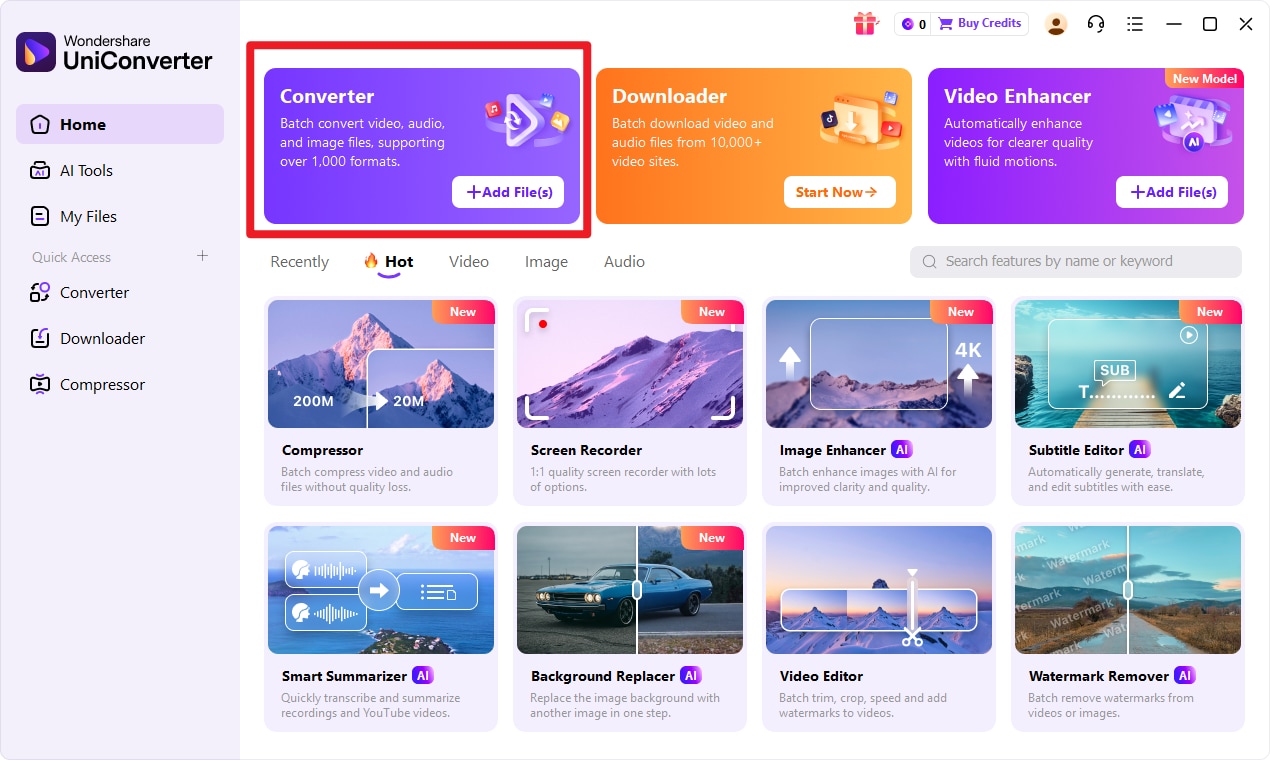
Step 1: Choose Converter in UniConverter
Launch Wondershare UniConverter on your computer. From the main interface, navigate to the menu on the left and select the Converter tool to begin.
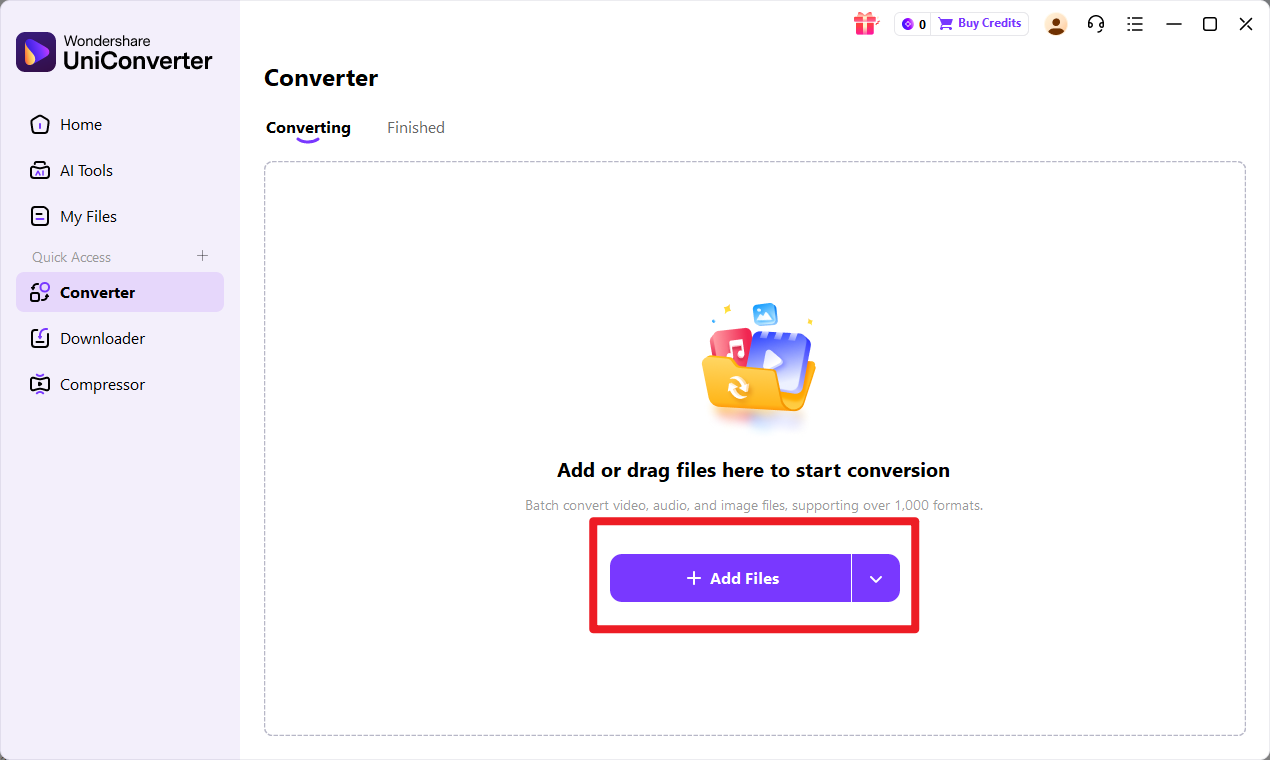
Step 2: Add Files to UniConverter
You can now add your video files with the input format to the program. Either drag and drop the files directly into the converter window or click the Add Files button to browse your computer and import them. UniConverter supports batch conversion, allowing you to add and convert multiple files at once.
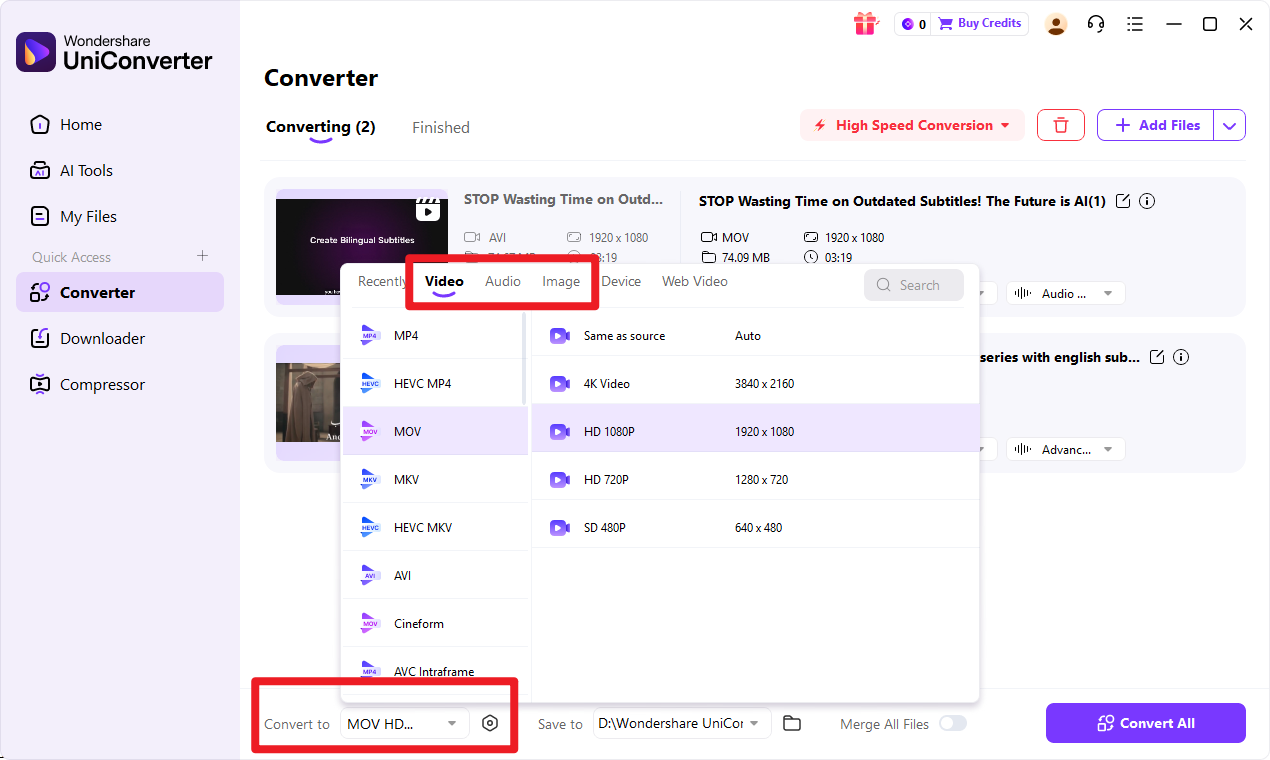
Step 3: Choose Output Format
At the bottom of the window, click on the Output Format menu. This will open a new window with a list of available formats. Select the Video tab. From the list on the left, choose your desired target format, and then select a resolution from the options on the right.
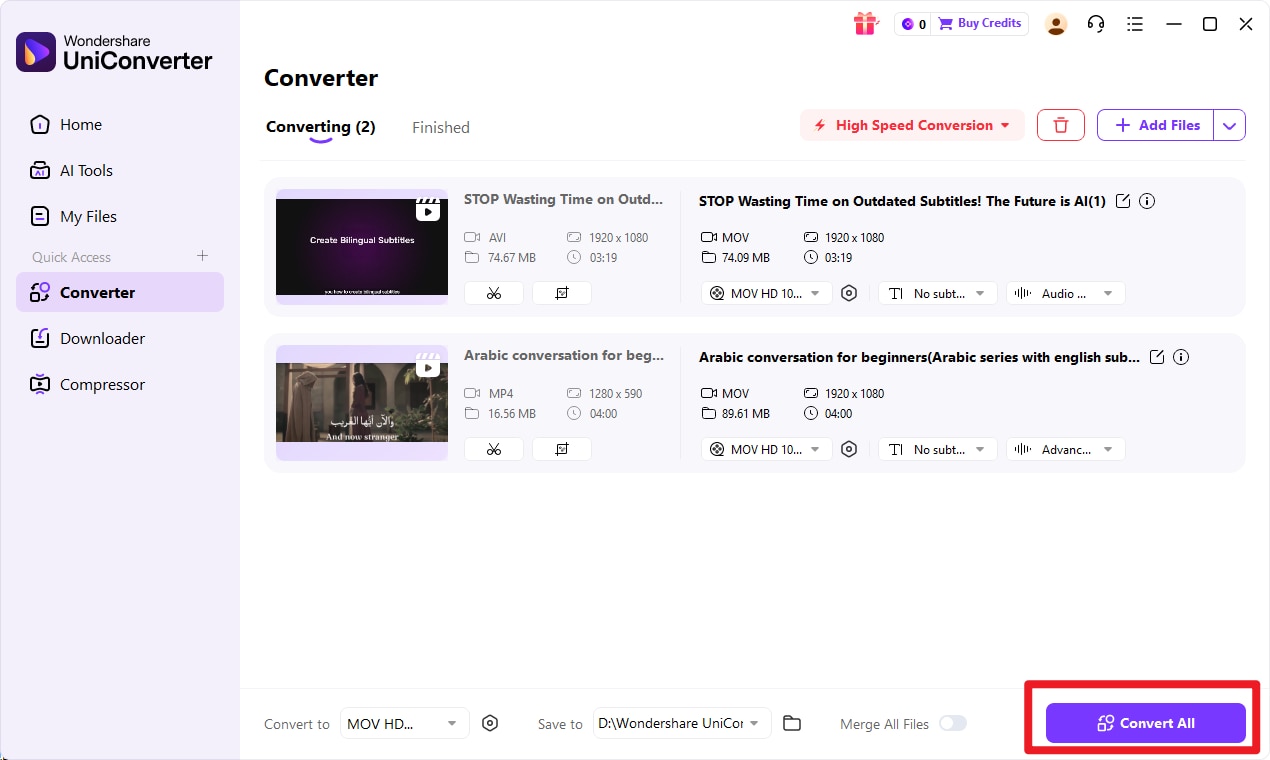
Step 4: Start the Conversion
Before starting, you can specify where to save the converted files by using the File Location option at the bottom. Once you are ready, click the Start All button to begin the conversion process for all your files. After the conversion is complete, you can find your new, ready-to-use files in the Finished tab.

More Than Just an H.266 Converter
Conclusion
To summarize, MP4 and H.266 are not competing technologies but rather complementary ones that work together. MP4 is the versatile and universally recognized container format, while H.266 is the next-generation, highly efficient video codec designed for the future of high-resolution video. For everyday use in 2026, the unparalleled compatibility of an MP4 file (typically with an H.264 codec) remains the industry standard and the safest choice. However, for professionals, streamers, and anyone focused on the future of 8K video and maximizing storage efficiency, H.266 is the clear path forward. To bridge the current compatibility gap, manage conversions between old and new standards, and ensure a seamless video workflow, a reliable and comprehensive tool like Wondershare UniConverter is an indispensable asset for any user.
FAQs
-
1. Can an MP4 file contain H.266 video?
Yes, absolutely. The MP4 container format is designed to be flexible and is fully capable of supporting video streams encoded with the H.266 (VVC) codec, along with corresponding audio tracks, subtitles, and other data. -
2. Is H.266 really better than H.265?
In terms of compression efficiency, yes. H.266 (VVC) is designed to be approximately 50% more efficient than its predecessor, H.265 (HEVC). This means it can deliver the same level of video quality at a significantly lower bitrate, resulting in much smaller file sizes. -
3. My computer won't play an H.266 file. What can I do?
The simplest and most effective solution is to convert the file to a more widely supported format, such as MP4 with an H.264 codec. You can do this quickly and easily using a dedicated video converter program like Wondershare UniConverter, which is specifically designed to handle modern codecs. -
4. Are H.266 and VVC the same thing?
Yes. They refer to the same technology. H.266 is the formal, technical name of the video coding standard designated by the ITU-T. VVC, which stands for Versatile Video Coding, is the more common, marketable name used to promote the technology.
