
If you've ever exported a video, downloaded a movie, or tried to upload a clip to social media, you've likely encountered the terms MP4 and H.264. They often appear together, leading to a common and understandable question: what's the difference? Many people mistakenly believe they are competing formats and wonder which one is "better." This confusion can lead to compatibility issues, oversized files, and poor video quality. The truth is, they aren't competitors at all; they are partners that work together to create the video files we use every day. Understanding the relationship between MP4 vs H.264 is the key to mastering video formats and ensuring your content plays perfectly everywhere.
This guide will demystify the technical jargon and provide a clear, simple explanation of what MP4 and H.264 are, how they relate to each other, and why their combination is the gold standard for digital video in 2026. We'll also show you how to easily convert any video to this universally accepted format.
In this article:
Part 1. What is MP4? What is H.264?
To clear up the confusion, we first need to understand that MP4 and H.264 serve two entirely different functions. One is a container, and the other is a codec. Let's break down what that means.
What is MP4? The Digital Container
MP4, which stands for MPEG-4 Part 14, is a digital multimedia container format. The best way to think of a container is as a box or a wrapper. Its job is to hold various types of data together in a single, synchronized file. An MP4 file doesn't just store video; it can also contain audio tracks, subtitles, chapter information, and still images.
When you play an MP4 file, your media player opens this "box" and accesses all the different data streams inside to present them as a cohesive video experience. Because of its versatility and ability to bundle multiple media types, MP4 has become one of the most widely used container formats in the world. You can almost always identify it by its file extension: .mp4.
What is H.264? The Video Codec
H.264, also known as Advanced Video Coding (AVC), is a video compression standard, or codec. The word "codec" is a portmanteau of "coder-decoder." Its primary function is to compress (encode) raw video data into a much smaller size for storage and transmission, and then decompress (decode) it for playback.
Without codecs like H.264, uncompressed video files would be enormous, making them impractical to stream over the internet, download to your phone, or store on a hard drive. H.264 is renowned for its ability to achieve a very high compression ratio while maintaining excellent visual quality. It's the technology that makes high-definition video streaming on platforms like YouTube and Netflix possible. It's important to note that H.264 is just a standard for video compression; it does not handle audio or exist as a file type on its own.
The Core Relationship: They Work Together
Now, let's put it all together. MP4 and H.264 are not alternatives to each other; they are designed to work in tandem. A typical video file is an MP4 container that holds video data compressed with the H.264 codec and, most commonly, audio data compressed with the AAC (Advanced Audio Coding) codec.
So, the question isn't "Should I use MP4 or H.264?" The real question is, "What combination of container and codecs should I use for my video?" For the vast majority of use cases, the answer is an MP4 container with H.264-encoded video. This powerful duo forms the backbone of modern digital video.
Part 2. Quick Comparison Table
To visualize the differences more clearly, here is a simple side-by-side comparison of MP4 and H.264.
MP4 vs H.264: Side-by-Side Comparison
| Feature | MP4 | H.264 |
| Type | Container Format | Video Codec (Compression Standard) |
| Function | To hold and synchronize multimedia streams (video, audio, etc.) in one file. | To encode and decode video data, reducing its size. |
| File Extension | .mp4 | None. It is a standard, not a file type itself. |
| Analogy | A shipping box. | The method of folding and packing an item to fit in the box. |
Part 3. MP4 vs H.264: Which One Is Better?
As we've established, asking whether MP4 or H.264 is "better" is a fundamentally misleading question. It's based on the false premise that they are competing options.
A Misleading Question: Understanding Their Roles
Comparing MP4 and H.264 directly is like asking whether a cardboard box is better than the bubble wrap inside it. They serve different but equally crucial, complementary functions. The box (MP4) provides the structure and holds everything together, while the bubble wrap (H.264) protects the contents and makes them more compact and efficient to ship. You need both for a successful delivery.
The more practical and useful question to ask is, "What is the best combination of container and codec for my specific needs?" This shifts the focus from a non-existent competition to a practical decision about video creation and distribution.
The Winning Combination: MP4 Container with H.264 Codec
For the overwhelming majority of applications in 2026, the winning combination is an MP4 container with H.264 video. This pairing has become the de facto industry standard for several compelling reasons:
- Universal Compatibility: This format is supported by virtually every modern device, including smartphones, tablets, computers, smart TVs, and gaming consoles. It also works seamlessly in all major web browsers.
- Excellent Quality-to-Size Ratio: H.264 provides fantastic video quality at remarkably low bitrates, resulting in smaller file sizes. This is crucial for fast web loading, smooth streaming, and efficient storage.
- Platform Support: All major video platforms, including YouTube, Vimeo, Instagram, TikTok, and Facebook, recommend or require uploads in the MP4 (H.264) format for optimal processing and playback.
Unless you have a very specific, professional requirement, choosing MP4 (H.264) is the safest and most reliable option for your videos.
When to Consider Alternatives
While MP4 (H.264) is the champion for general use, there are specific scenarios where you might consider other options:
- For 4K/UHD and Beyond: H.265, also known as High Efficiency Video Coding (HEVC), is the successor to H.264. It offers roughly 50% better compression efficiency, meaning it can deliver the same quality at half the file size. This makes it ideal for 4K and 8K video. H.265 video is also commonly stored in an MP4 or MKV container.
- For Professional Editing: In a professional video editing workflow, editors often use intermediate codecs like Apple ProRes or Avid DNxHD. These formats use less compression to preserve maximum image data, which is essential for color grading and effects work. However, the final delivery file for clients or web upload is almost always converted back to MP4 (H.264).
Part 4. Use Cases for MP4 and H.264
The combination of the MP4 container and H.264 codec is ubiquitous. Here are some of the most common use cases where this format excels.
Online Video Streaming (YouTube, Vimeo)
When you upload a video to a platform like YouTube, their servers re-encode it into various formats and resolutions to ensure smooth streaming for viewers on different devices and internet speeds. However, providing a high-quality source file is crucial. YouTube and other platforms explicitly recommend uploading videos in an MP4 container with H.264 video and AAC audio. This ensures the fastest processing and the best possible quality for the final stream.
Mobile Devices and Tablets
Every modern smartphone and tablet, whether running iOS or Android, has built-in hardware decoding support for H.264. This means they can play MP4 (H.264) files smoothly and efficiently without draining the battery. When you record a video with your phone's camera, it is almost certainly being saved in this format by default. This native support makes it the perfect format for any video intended for mobile viewing.
Video Archiving and Sharing
If you want to share a video with friends, family, or colleagues, using MP4 (H.264) is the best way to guarantee they can watch it. Sending a file in a less common format like MKV or AVI might require the recipient to download special software or codecs. By sticking to the MP4 (H.264) standard, you eliminate compatibility headaches and ensure a hassle-free viewing experience for everyone, regardless of their device or technical expertise.
Part 5. Step-by-Step Guide to Convert Videos to MP4 (H.264) Using UniConverter
Now that you understand the importance of the MP4 (H.264) format, what do you do when you have a video in a different format? Perhaps you have a .MOV file from an iPhone, a .MKV file downloaded from the web, or a .AVI file from an old camera.
The Easiest Way to Solve Format Incompatibility
If you have a video that won't play on a specific device, is too large to email, or isn't accepted by a web platform, a video converter is the essential tool you need. A good converter can take your source file and transform it into the universally compatible MP4 (H.264) format quickly and easily.
For this task, our top recommendation is Wondershare UniConverter. It's a powerful, intuitive, and comprehensive application that goes far beyond simple conversion. It supports over 1,000 formats and provides a user-friendly interface that makes converting any video to the standard MP4 (H.264) format an effortless process.
How to Convert Any Video to MP4 (H.264) in 4 Simple Steps
Follow this guide to convert your video files using Wondershare UniConverter.
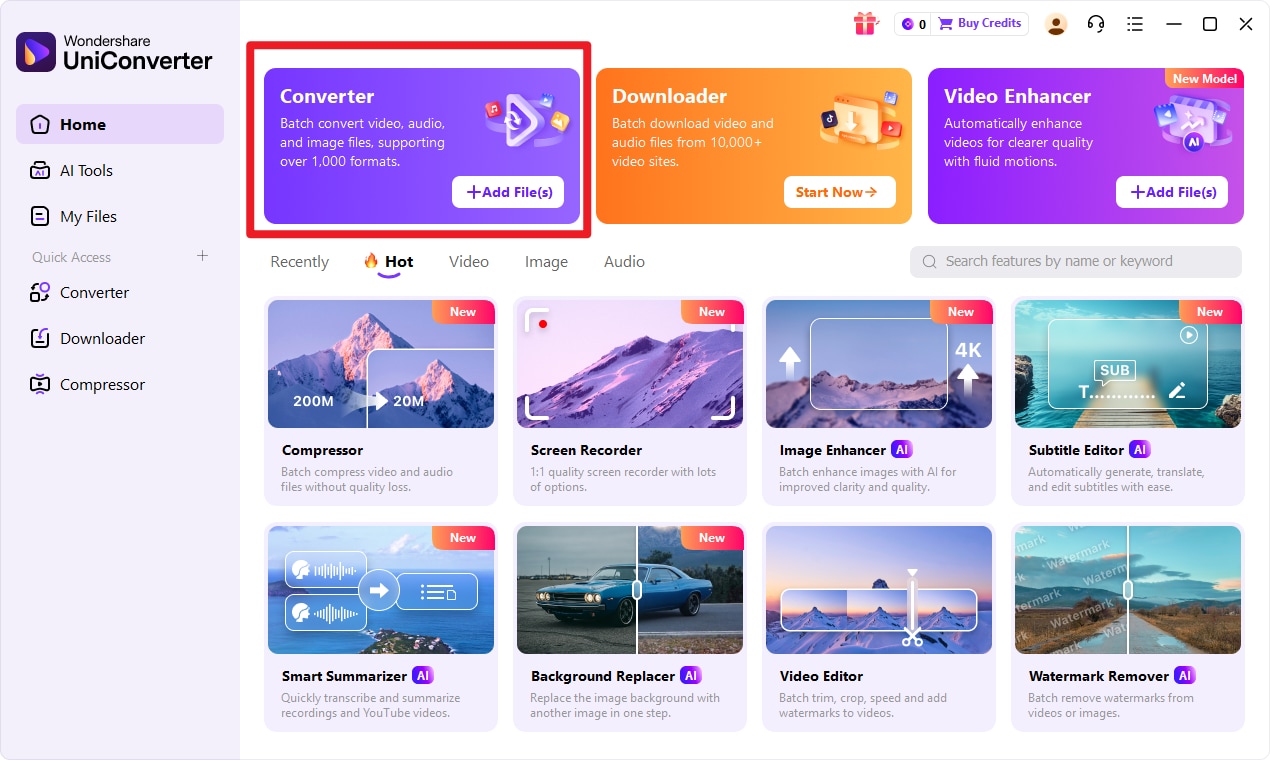
Step 1: Choose Converter in UniConverter
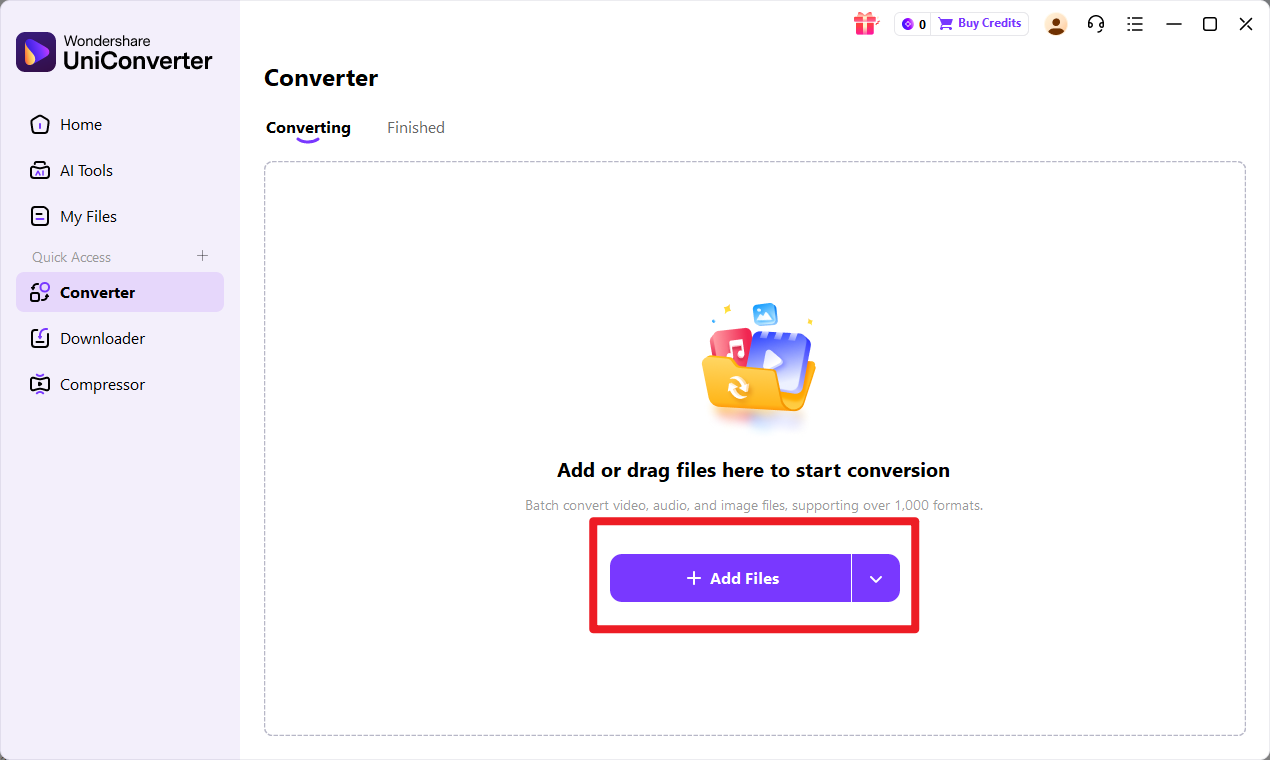
First, download and install Wondershare UniConverter on your Windows or Mac computer. Launch the application. On the main interface, ensure you are on the Converter tab from the left-side menu. You can now either drag and drop your video file directly into the program window or click the Add Files icon to browse your computer and select the file you want to convert.
Step 2: Add Files to UniConverter
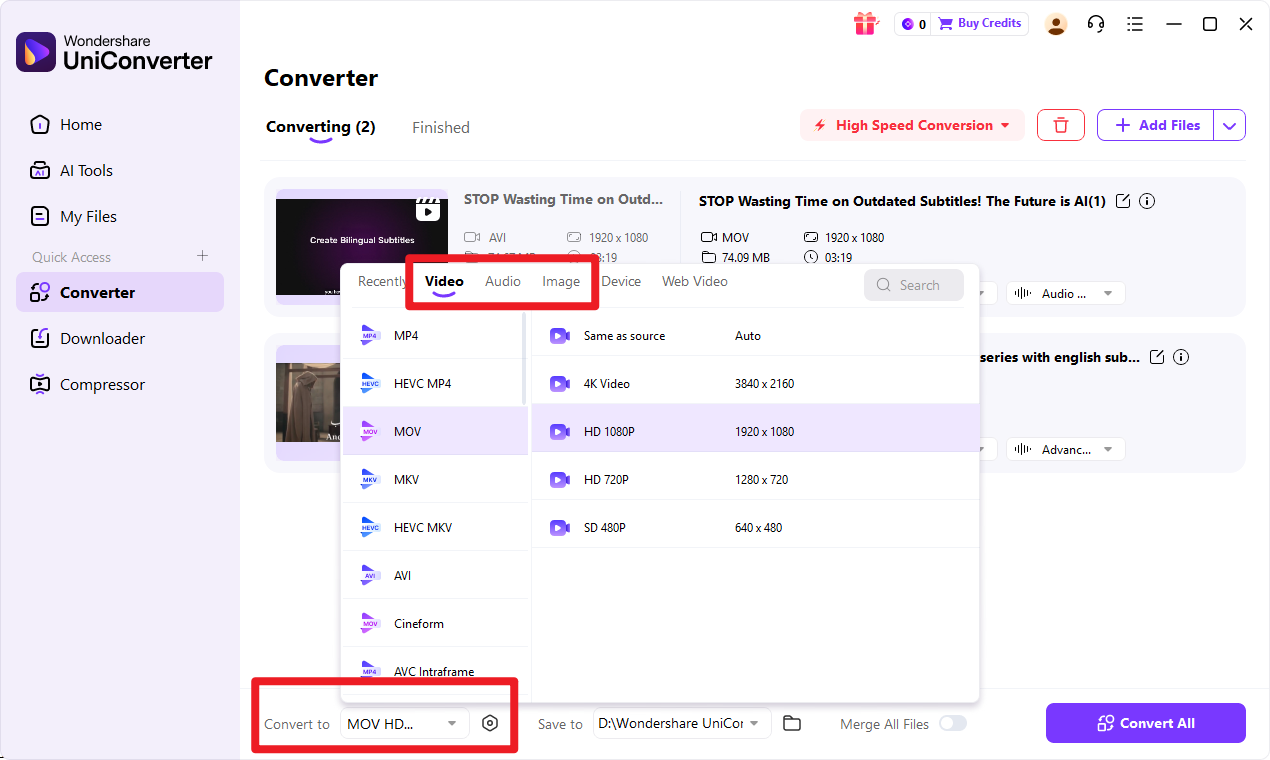
Once your video is loaded, click on the Output Format menu located at the bottom-left of the window. This will open a new dialog box with a list of available formats.
Step 3: Choose Output Format
In the format window, navigate to the Video tab. From the list on the left, select MP4. On the right side, you will see a list of resolution presets. You can choose to keep the original resolution ("Same as source") or select a different one like 1080p or 720p to resize the video. The default video encoder for the MP4 profile is H.264, but you can click the small edit (pencil) icon next to the resolution to open the settings and confirm that H.264 is selected as the encoder.
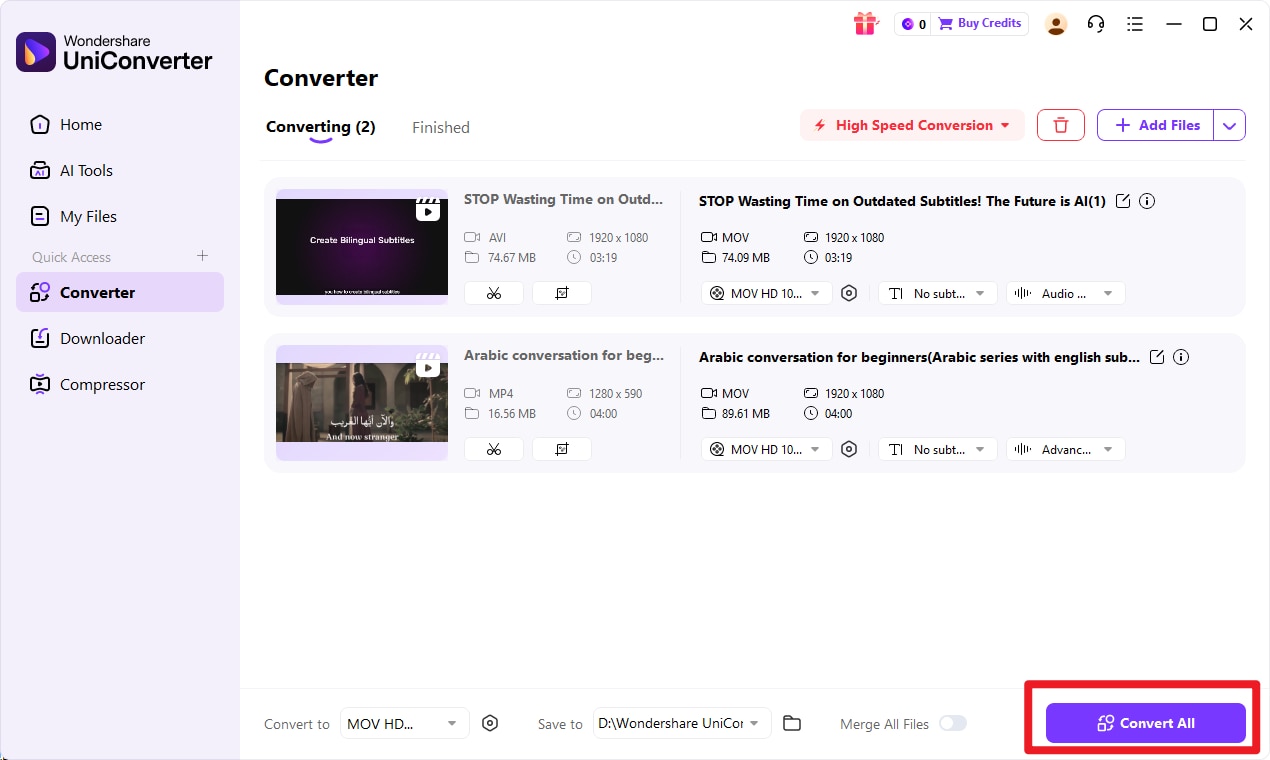
Step 4: Start the Conversion
Finally, at the bottom of the main window, click on the File Location field to choose where you want to save your converted video. Once you're ready, click the Convert button next to the file (or Start All if you've added multiple files). UniConverter will begin the conversion process, which is typically very fast thanks to its GPU acceleration technology. In just a few moments, your new, highly compatible MP4 (H.264) file will be ready in the destination folder.

Go Beyond Simple Video Conversion
Conclusion
To summarize, the MP4 vs H.264 debate is based on a common misunderstanding. They are not competing formats but rather essential components that work together to create the videos we rely on daily. MP4 is the versatile container format—the box—that holds all the different media streams. H.264 is the efficient video codec—the compression method—that shrinks video data while preserving high quality.
For nearly every practical application in 2026, from streaming on YouTube to sharing videos with family, the combination of an MP4 container and an H.264 codec provides the ultimate balance of quality, file size, and universal compatibility. And for any situation where you find yourself with a video in a different format, a reliable and easy-to-use tool like Wondershare UniConverter can simplify the conversion process into just a few clicks, ensuring your videos are ready for any device or platform.
FAQs
-
1. Is H.264 the same as MP4?
No, they are fundamentally different. MP4 is a file container format with a .mp4 extension, designed to hold video, audio, and other data. H.264 is a video compression codec, which is a standard for encoding and decoding video data to reduce its size. An MP4 file often contains video that has been encoded with H.264. -
2. Can an MP4 file not use H.264?
Yes, absolutely. The MP4 container is very flexible and can hold video encoded with various other codecs. For example, an MP4 file can contain video encoded with H.265 (HEVC), MPEG-4 Part 2, or even older codecs like MPEG-2. However, H.264 remains the most common and widely supported codec found within MP4 files. -
3. How can I check the codec of my video file?
There are several easy ways to check a video's codec. You can use a versatile media player like VLC; simply open the file, go to "Tools" in the menu bar, and select "Codec Information." Alternatively, you can import the file into a program like Wondershare UniConverter. It will display detailed information about the video, including its format, resolution, and the specific video and audio codecs used. -
4. Is H.265 better than H.264?
In terms of compression efficiency, yes. H.265 (HEVC) is a more modern and advanced codec that can achieve the same visual quality as H.264 at about half the file size. This makes it superior for high-resolution content like 4K and 8K video. However, H.264 still enjoys broader compatibility, especially with older devices and software. For maximum reach and guaranteed playback, H.264 is often the safer choice, while H.265 is the future-proof option for high-fidelity video.
