
In the ever-evolving landscape of digital media, choosing the right file format is crucial for balancing quality, performance, and compatibility. Two formats that often come up in discussions, especially for web content, are MP4 and AVIF. While they might seem to serve similar purposes at a glance, they are fundamentally different, each with its own strengths and ideal use cases. Understanding the MP4 vs AVIF distinction is key for web developers, designers, and content creators aiming to deliver the best possible user experience. This guide will break down everything you need to know to make an informed decision for your projects.
In this article
Part 1. What is MP4? What is AVIF?
Before we dive into a head-to-head comparison, it's essential to understand what each format is and what it was designed to do. Their core purposes are distinct and dictate their respective advantages and disadvantages.
What is MP4?
MP4, short for MPEG-4 Part 14, is a digital multimedia container format. Think of it as a versatile box that can hold various types of data, including video, audio, subtitles, and still images, all synchronized together. Developed by the Moving Picture Experts Group (MPEG), it has become the de facto standard for digital video worldwide.
Its immense popularity is due to a combination of high-quality video, efficient compression (commonly using codecs like H.264 or H.265/HEVC), and near-universal compatibility. Whether you're streaming a movie on Netflix, watching a video on YouTube, or sharing a clip on social media, you are almost certainly interacting with an MP4 file. Its ability to store high-quality video and audio in a relatively small file size has made it the backbone of modern video distribution.
What is AVIF?
AVIF, or AV1 Image File Format, is a much newer format designed primarily for still images and animated image sequences. It utilizes the compression power of the AV1 video codec, which is known for its superior efficiency. This allows AVIF to offer significantly better compression than older image formats like JPEG, PNG, and especially the animated GIF.
The key feature of AVIF is its ability to store sequences of images to create animations, much like a GIF. However, it does so with far greater efficiency, resulting in dramatically smaller file sizes for animations of comparable or even higher visual quality. This makes it an ideal format for modern web design, where performance and fast loading times are paramount. It's important to note that AVIF is strictly an image and animation format; it does not support audio.
Part 2. Quick Comparison Table
To get a quick overview of the key differences between MP4 and AVIF, here is a side-by-side comparison table.
| Feature | MP4 (MPEG-4 Part 14) | AVIF (AV1 Image File Format) |
| Format Type | Digital Multimedia Container | Image / Animation Format |
| Compression Codec | Typically H.264, H.265/HEVC, etc. | AV1 |
| Audio Support | Yes | No |
| File Size | Larger for short clips | Significantly smaller for animations |
| Quality | Excellent for complex video | Superior for animations at low file sizes |
| Browser & Device Support | Universal (supported by virtually all devices) | Modern browsers only (Chrome, Firefox, Safari, etc.) |
| Best For | General video content, streaming, social media | Short, silent web animations, replacing animated GIFs |
Part 3. MP4 vs AVIF: Which One Is Better?
The question of which format is "better" depends entirely on the specific application. Let's break down the comparison across four critical areas: compression, quality, compatibility, and audio support.
Compression and File Size: The AVIF Advantage
When it comes to pure compression efficiency for short, silent animations, AVIF is the clear winner. It leverages the cutting-edge AV1 codec, which was developed by the Alliance for Open Media (a consortium including Google, Mozilla, and Apple) to be a royalty-free, ultra-efficient successor to codecs like HEVC. For a short animated sequence, an AVIF file can be up to 10 times smaller than an equivalent animated GIF and significantly smaller than an MP4 file of the same content and visual quality.
MP4, while offering excellent compression for video, is optimized for longer and more complex scenes. Its common codecs, like H.264, are highly efficient but cannot match the raw compression power of AV1 for the simple, looping animations where AVIF shines. If your primary goal is to create the smallest possible file for a web animation, AVIF is unmatched.
Visual Quality
Visual quality is closely tied to compression. Because AVIF is so efficient, it can maintain a higher level of visual fidelity at much lower file sizes compared to other formats. For its intended use—web graphics and animations—AVIF often provides a noticeably sharper and cleaner image than an MP4 compressed to a similarly small file size. It supports 10-bit color depth and high dynamic range (HDR), features that allow for richer and more vibrant visuals than what is typically seen in web animations.
However, MP4 remains the king of quality for its intended purpose: video. It is designed to handle complex, high-motion scenes with frequent changes, something AVIF is not optimized for. For full-fledged video content, MP4 delivers the excellent, smooth playback and quality that users expect. The choice here is about context: AVIF for high-quality animated graphics, MP4 for high-quality video.
Compatibility and Support
This is where MP4 has an undeniable and massive advantage. MP4 is the most universally supported video format on the planet. It plays natively on virtually every smartphone, tablet, computer, smart TV, and gaming console made in the last 15 years. Every modern web browser and video editing software supports it without issue. If your priority is to ensure your content can be viewed by the largest possible audience without any friction, MP4 is the only choice.
AVIF, being a newer format, has more limited support. While it has been adopted by all major modern browsers—including Chrome, Firefox, Safari (since iOS 16 and macOS 13), and Opera—it will not work on older browser versions or legacy devices. This means developers often need to implement a fallback (e.g., to a GIF or MP4) for users on unsupported systems. As of 2026, AVIF support is strong and growing, but it has not yet reached the universal status of MP4.
Audio: The Deciding Factor
The most fundamental difference between the two formats is audio support. This is often the single factor that makes the decision for you.
MP4 is a multimedia container designed to bundle video and audio tracks together. Any content that requires sound—from a movie trailer to a tutorial video with narration to a social media clip with background music—must use a format like MP4.
AVIF, on the other hand, is a visuals-only format. The AVIF specification does not include any provision for storing audio data. This immediately limits its use to silent animations, icons, and decorative visual elements. It is a replacement for the animated GIF, not a replacement for video. If your content has sound, AVIF is not an option.
Part 4. Use Cases for MP4 and AVIF
Based on the differences we've explored, here are the practical scenarios where you should choose one format over the other.
When You Should Use MP4
- For any video content that requires an audio track. This is the most important rule. If there's sound, you need MP4 (or a similar video container). This includes marketing videos, vlogs, tutorials, movie clips, and music videos.
- When ensuring maximum compatibility is your top priority. If you need your content to play on any device, old or new, without fail, MP4 is the safest and most reliable choice.
- For longer-form video content. MP4 is optimized for streaming and efficiently handling video that is more than a few seconds long. Its playback is robust and designed for sustained viewing.
- Sharing on social media platforms. Most social media sites like Instagram, Facebook, and X (formerly Twitter) have standardized their video pipelines around the MP4 format.
When You Should Use AVIF
- To replace animated GIFs. This is AVIF's primary mission. It offers vastly superior quality, smaller file sizes, and more colors, making it the modern, efficient alternative for web animations.
- For short, silent product animations or demonstrations. Showcasing a product's features with a quick, looping, high-quality animation on an e-commerce site is a perfect use case for AVIF.
- For animated icons and user interface feedback. Using a small, lightweight AVIF for a loading spinner, an animated checkmark, or other UI elements can enhance user experience without bogging down page load times.
- When optimizing page load speed is critical. In performance-focused web development, every kilobyte matters. Swapping heavy GIFs or short MP4 videos (used as animations) for ultra-lightweight AVIFs can significantly improve website speed and Core Web Vitals scores.
Part 5. Step-by-Step Guide to Convert MP4 to AVIF Using UniConverter
If you have a short MP4 video clip that you want to use as a lightweight web animation, converting it to AVIF is the perfect solution. Wondershare UniConverter is a powerful and intuitive tool that simplifies this process. As a comprehensive video toolbox, it stands out for its ease of use and support for a vast range of formats, making it easy to bridge the gap between video and web animation.
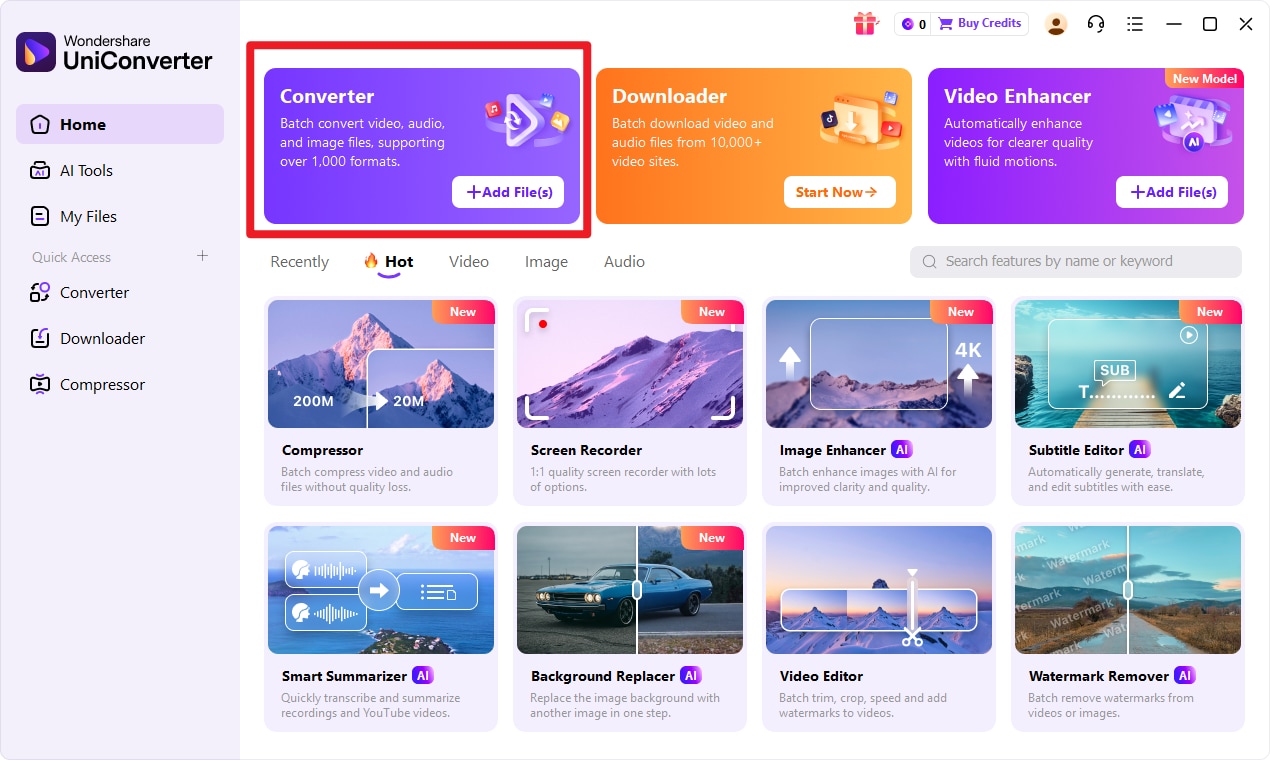
Step 1: Choose Converter in UniConverter
Launch Wondershare UniConverter on your computer. On the main interface, navigate to and select the Converter tool from the left-side menu to begin the process.
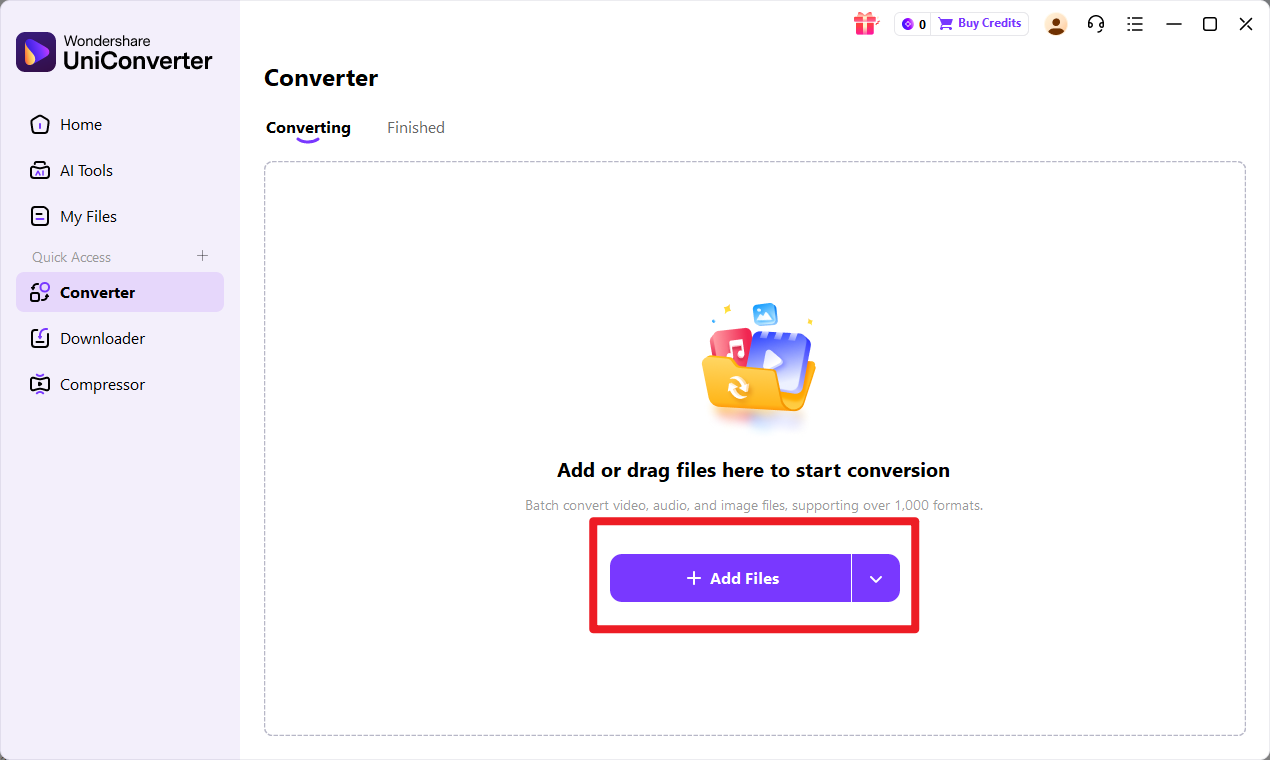
Step 2: Add Files to UniConverter
Click the Add Files button in the center of the screen or drag and drop your input format video file directly into the main window. You can add multiple files to convert them in a batch.
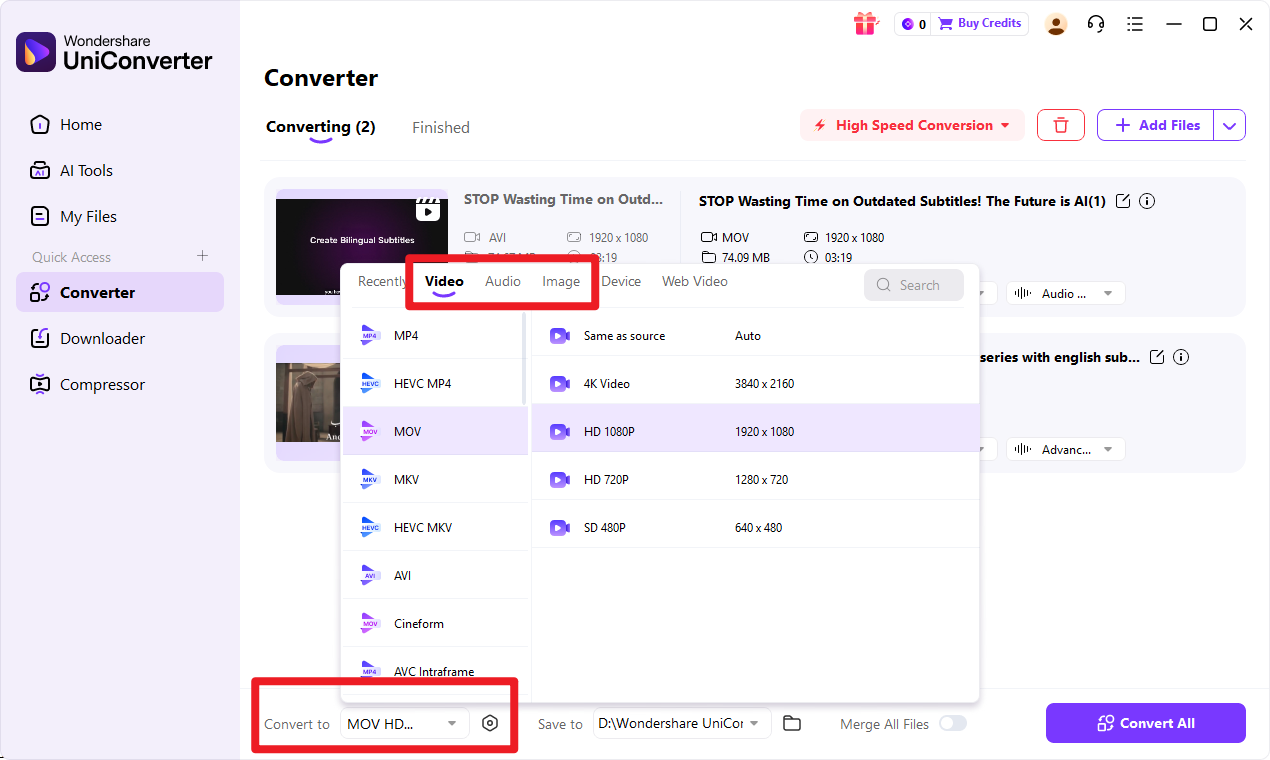
Step 3: Choose Output Format
Click on the Output Format menu located at the bottom of the window. In the new dialog that appears, navigate to the Image tab. From the list of formats on the left, select AVIF as your target format.
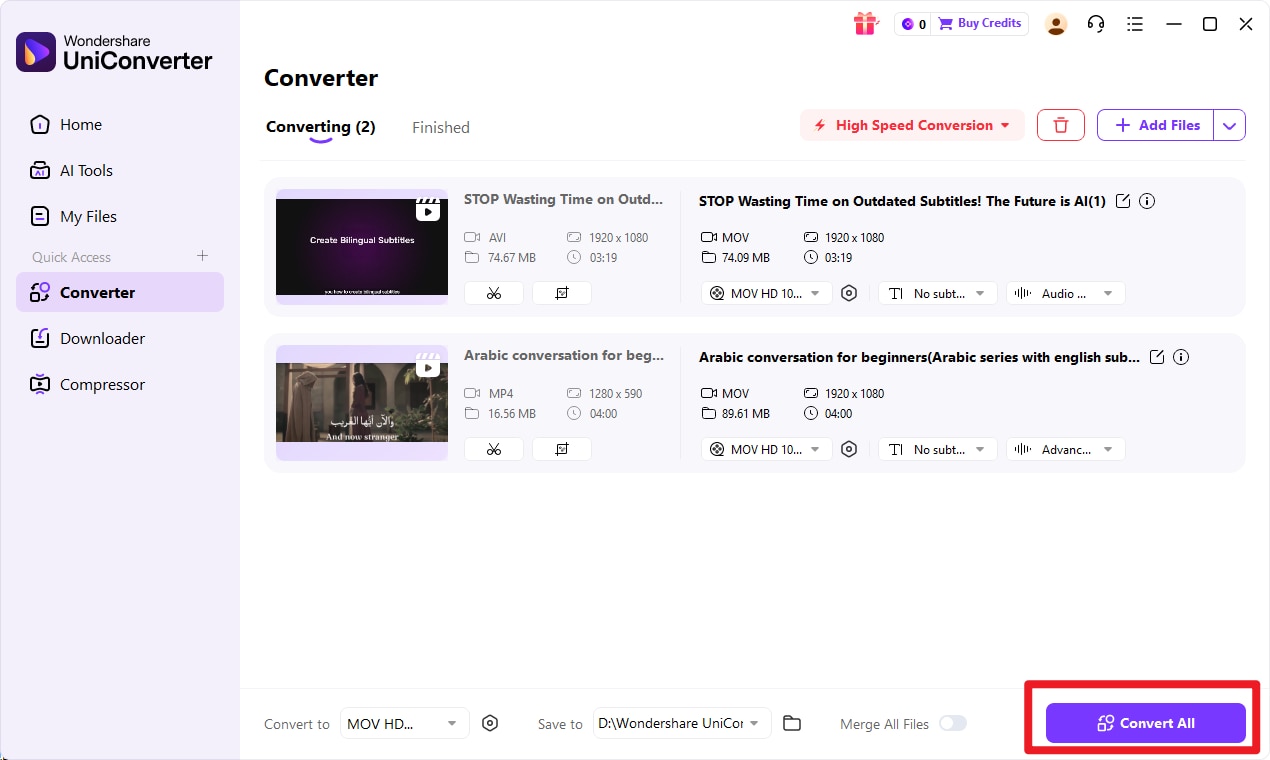
Step 4: Start the Conversion
Before converting, you can select a destination folder for your new file by using the File Location option at the bottom. Once you are ready, click the Start All button in the bottom-right corner to initiate the conversion process. UniConverter will quickly process your file and save the new AVIF animation to your chosen folder.

More Than Just an MP4 to AVIF Converter
Conclusion
The MP4 vs AVIF debate isn't about finding a single winner, but about understanding the right tool for the right job. MP4 remains the undisputed champion and industry standard for all-purpose video content. Its universal compatibility and crucial support for audio make it essential for streaming, social media, and virtually any video you see online. AVIF, in contrast, is a specialized and highly effective modern solution for a different problem: creating high-quality, low-filesize silent animations for the web. It is the rightful successor to the animated GIF, offering superior performance and visual fidelity. Your choice should always be guided by your project's specific requirements for audio, compatibility, and performance. For those moments when you need to transition between these and over 1,000 other formats, having a versatile tool like Wondershare UniConverter in your arsenal is an invaluable asset.
FAQs
-
1. Can AVIF replace MP4?
No, they serve different primary functions. AVIF is an image and animation format that lacks audio support. It is designed to replace formats like animated GIF and WebP for web animations, not to replace a general-purpose video container like MP4, which is essential for any content with sound. -
2. Does AVIF support sound?
No, the AVIF specification does not include support for audio tracks. It is a visuals-only format, designed for static images and animated image sequences. If you need audio, you must use a video format like MP4. -
3. Which format is smaller, MP4 or AVIF?
For short, silent animated sequences, AVIF files are significantly smaller than MP4 files of comparable visual quality. This is due to the more advanced and efficient AV1 compression algorithm that AVIF uses. For longer, more complex video content, the comparison is less direct, but AVIF is purpose-built for maximum compression on short animations. -
4. How can I convert an MP4 to an animated AVIF?
You can use a dedicated file conversion tool that supports both formats. A program like Wondershare UniConverter allows you to easily import an MP4 video file, select AVIF from the image output options, and convert the video into a high-quality, lightweight animated AVIF file in just a few clicks.
