
Have you ever downloaded a video file only to find it won't play on your device? Or perhaps you're a budding content creator trying to decide the best format to export your project for sharing online. In the world of digital video, you'll often encounter a confusing array of acronyms and file types. Two terms that frequently come up are MOV and XviD, often leading to questions about which is better. The confusion is understandable, as they represent different aspects of a video file. Making the wrong choice can lead to compatibility headaches, unnecessarily large files, or a disappointing loss in quality. This guide is here to clear up the confusion surrounding the MOV vs XviD debate.
Understanding the fundamental differences between a container format like MOV and a video codec like XviD is the first step toward mastering your media files. Whether you're trying to save storage space, ensure your video plays on a specific device, or maintain the highest possible quality for editing, knowing when to use each is crucial. We will break down their characteristics, compare their strengths and weaknesses, and provide clear use cases so you can make an informed decision every time.
In this article, you will learn:
- We will define what MOV and XviD are and their primary functions.
- A quick comparison table will highlight their key differences at a glance.
- We will conduct an in-depth analysis of quality, file size, compatibility, and editing capabilities.
- You'll learn the specific scenarios where each format excels.
- A step-by-step guide will show you how to easily convert files between these formats.
Part 1. What is MOV? What is XviD?
Before we can compare MOV and XviD, it's essential to understand that we are comparing two different things: a container format and a video codec. Think of a container as a box and a codec as the method used to pack the contents (the video and audio data) inside that box.
What is MOV?
MOV is a multimedia container format developed by Apple Inc. It was created as the native file format for its QuickTime Framework, which is why you'll often see MOV files referred to as QuickTime files. As a container, an MOV file can hold multiple types of data in different tracks, including video, audio, text (like subtitles), and effects. This multi-track capability makes it incredibly versatile.
Because of its origins, MOV is deeply integrated into the Apple ecosystem. It's the default format for videos recorded on iPhones and iPads and is the preferred format for professional video editing software like Final Cut Pro. MOV files are renowned for their ability to store very high-quality video, including uncompressed or losslessly compressed streams, making them a top choice for professional production and archiving master copies where preserving every detail is paramount.
What is XviD?
XviD is not a container format; it is a video codec. A codec (short for coder-decoder) is a piece of software that compresses and decompresses digital video data. XviD is an open-source project that implements the MPEG-4 Part 2 video compression standard. Its primary goal is to compress video into very small file sizes while maintaining a good level of visual quality.
You will almost never find a file with a ".xvid" extension. Instead, the XviD-encoded video stream is placed inside a container format, most commonly AVI (Audio Video Interleave). So, when people talk about an "XviD file," they are usually referring to an AVI file that uses the XviD codec for its video track. Due to its excellent compression efficiency and open-source nature, XviD became extremely popular for sharing videos over the internet and on peer-to-peer networks in the early 2000s. It allowed for standard-definition movies to be compressed to fit on a single CD while still being watchable.
Part 2. Quick Comparison Table
For a quick overview, this table summarizes the main characteristics of MOV and XviD. Remember that MOV is a container, and XviD is a codec often found within an AVI container.
| Feature | MOV | XviD |
| Developer | Apple Inc. | XviD open-source project |
| Type | Container Format | Video Codec |
| Compression | Varies (can be lossless, e.g., ProRes) | Lossy |
| Quality | Generally higher, especially with professional codecs | Good quality at low bitrates |
| File Size | Can be very large | Typically small |
| Compatibility | Excellent in Apple ecosystem; good on other platforms with right players | Widely compatible on PCs and standalone players; less so on mobile without specific apps |
| Primary Use | Video editing, professional workflows, Apple devices | Video sharing, digital archiving, playback on older devices |
Part 3. MOV vs XviD: Which One Is Better?
The question of which is "better" depends entirely on your specific needs. Let's break down their performance across several key categories to help you decide.
Quality and Compression
When it comes to pure, unadulterated quality, MOV has a distinct advantage. As a container, MOV is incredibly flexible and can house video streams compressed with a wide range of codecs, from highly compressed ones like H.264 to professional-grade, nearly lossless codecs like Apple ProRes. This makes MOV the format of choice for filmmakers and video editors who need to preserve the maximum amount of image data for post-production work like color grading and effects.
XviD, on the other hand, is a codec built for efficiency. It uses a lossy compression method, which means it strategically discards some video data to achieve a much smaller file size. While this inevitably leads to a reduction in quality compared to a lossless source, XviD is highly regarded for its ability to deliver impressive visual quality at very low bitrates. For standard-definition content, an XviD-encoded video can look sharp and clear, making it perfect for viewing but not for intensive editing.
Winner: MOV for professional-grade quality; XviD for efficient, good-quality compression.
File Size
This is where XviD truly shines. The entire purpose of the XviD codec is to drastically reduce the file size of a video. A feature-length film that might occupy 25-50 GB on a Blu-ray disc can be compressed with XviD to a file size of just 700 MB to 1.4 GB. This remarkable compression ratio made it the king of internet video sharing for many years and is still incredibly useful for anyone looking to save storage space or send videos over slow connections.
MOV files, in contrast, are often significantly larger. An MOV file using a professional codec like ProRes will be massive, as it retains a huge amount of image information. Even when using a more common delivery codec like H.264, MOV files can still be larger than their XviD/AVI counterparts, especially if they are configured for high-bitrate quality. The file size of an MOV is a direct trade-off for its quality and editing flexibility.
Winner: XviD, by a large margin.
Compatibility and Playback
Compatibility is a mixed bag for both. MOV is the undisputed standard within the Apple ecosystem. Any Mac, iPhone, or iPad will play MOV files natively without any issues. However, on Windows, the story is different. While modern versions of Windows have improved support, older systems may require the installation of Apple's QuickTime player or a versatile third-party media player like VLC Media Player to handle MOV files correctly.
XviD, typically in an AVI container, enjoys widespread compatibility on Windows-based PCs. For years, it was the de facto standard for downloaded videos, and most media players on Windows support it out of the box. Furthermore, a vast number of standalone hardware devices, such as DVD players and early media centers with USB ports, were designed specifically to support DivX/XviD playback. However, its native support on mobile devices like iPhones and Androids is poor. You will almost always need to install a third-party player app from the app store to watch XviD videos on your phone.
Winner: A tie. MOV for the Apple ecosystem; XviD for Windows PCs and older hardware players.
Editing and Post-Production
There is no contest in this category: MOV is the clear winner for video editing. Professional editing software like Adobe Premiere Pro and Final Cut Pro are built to work seamlessly with MOV containers. The format's ability to hold high-quality, minimally compressed video streams (like ProRes) and multiple audio tracks makes it ideal for the demanding process of post-production. Editing with these high-quality files allows for extensive color correction, effects work, and multiple re-renders without significant degradation of the image.
Editing a video compressed with XviD is highly discouraged. XviD is a final delivery codec, meaning it's designed for viewing, not for further manipulation. Because it's already heavily compressed, trying to edit and re-encode an XviD file will introduce severe compression artifacts and result in a dramatic loss of quality. The editing process would be slow, inefficient, and yield a poor final product.
Winner: MOV, unequivocally.
Part 4. Use Cases for MOV and XviD
Based on the comparison above, here are the practical scenarios where you should choose one over the other.
When to Use MOV
- Professional Video Editing: If you are editing a project in software like Final Cut Pro, Adobe Premiere Pro, or DaVinci Resolve, MOV is the industry-standard container. It ensures your footage retains the quality needed for professional post-production.
- Archiving Master Files: When you finish a video project, saving a master copy in a high-quality MOV format (using a codec like ProRes) is the best way to archive it. This preserves the best possible quality for any future use.
- Apple Ecosystem Workflows: If you are recording video on an iPhone and editing it on a Mac, staying with the MOV format throughout your workflow is the most seamless and efficient path.
- Creating Videos with Alpha Channels: MOV is one of the few common formats that supports alpha channels (transparency), which is essential for creating motion graphics and video overlays.
When to Use XviD
- Sharing Videos Online: If you need to send a video via email or a messaging service with file size limits, compressing it with XviD (in an AVI container) is an excellent way to make it small enough to transfer quickly.
- Storing a Large Video Library: To build a large collection of movies or TV shows on a hard drive with limited capacity, XviD provides a great balance of watchable quality and very small file sizes.
- Playback on Older Hardware: If you have an older DVD/DivX player or a media center that explicitly supports XviD, it's the most reliable format to ensure playback without any issues.
- Streaming over Slow Internet: For personal media servers or streaming to a location with poor bandwidth, the low bitrate of XviD files ensures smoother playback with less buffering.
Part 5. Step-by-Step Guide to Convert MOV to XviD Using UniConverter
Often, you'll find yourself with a file in one format but needing it in another. For example, you might have a high-quality MOV master file that you want to share with a friend, requiring the small file size of XviD. Or you might have an old XviD file that you want to import into an editing project. In these cases, a reliable video converter is essential. Wondershare UniConverter is a powerful and user-friendly tool that makes this process simple. It can expertly handle conversions from MOV to an XviD-compatible format like AVI, and vice versa, with just a few clicks.
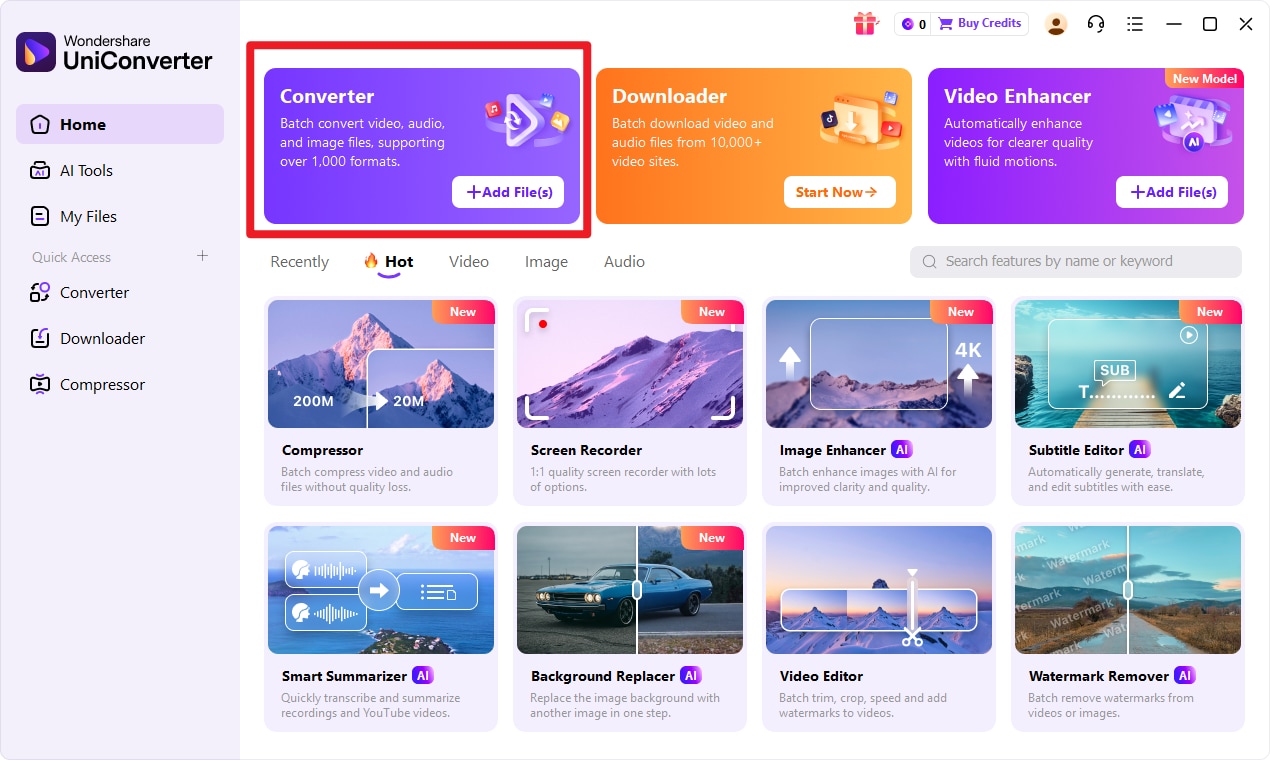
Step 1: Choose Converter in UniConverter
Launch the Wondershare UniConverter application on your Windows or Mac computer. From the main screen, look at the menu on the left side and click on the Converter tool to open the video conversion interface.
Step 2: Add Files to UniConverter
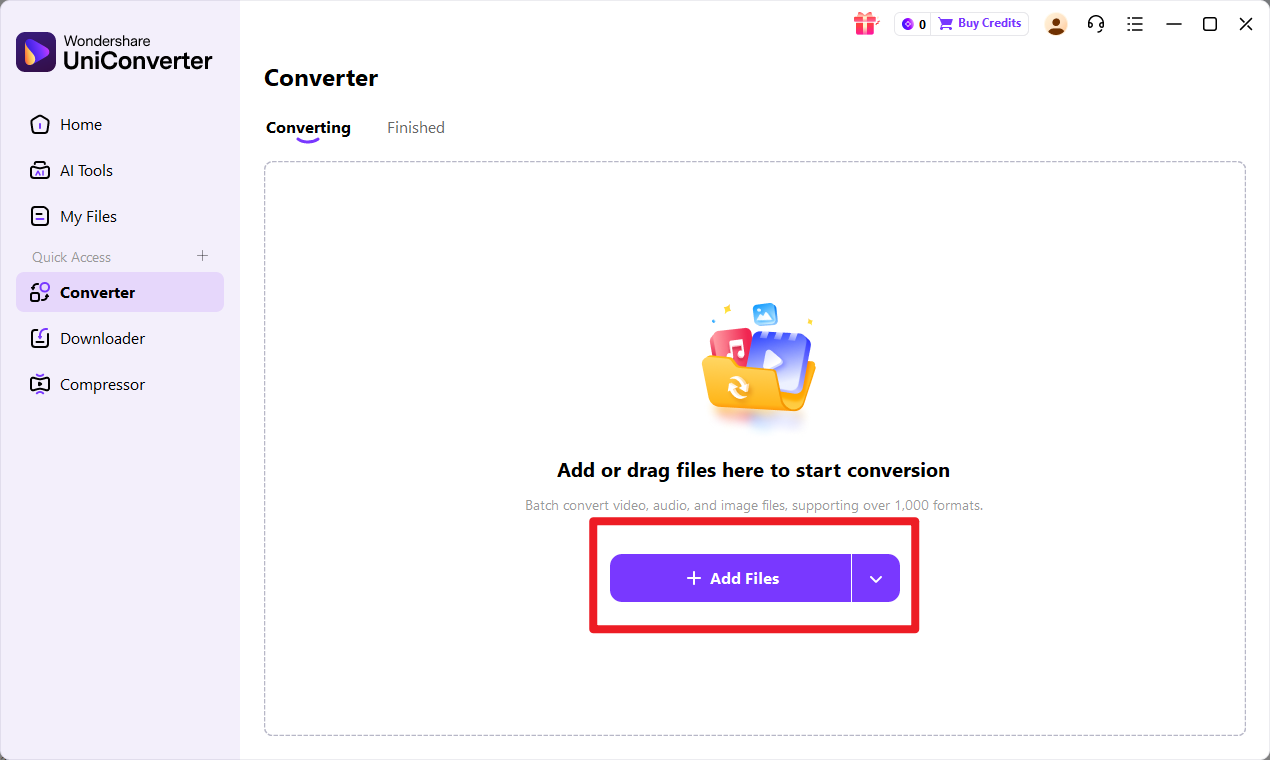
Now, you need to import your input format file. You can do this easily by dragging the video file from its folder and dropping it directly onto the UniConverter window. Alternatively, you can click the Add Files button in the top-left corner to open a file browser and select the video you wish to convert.
Step 3: Choose Output Format
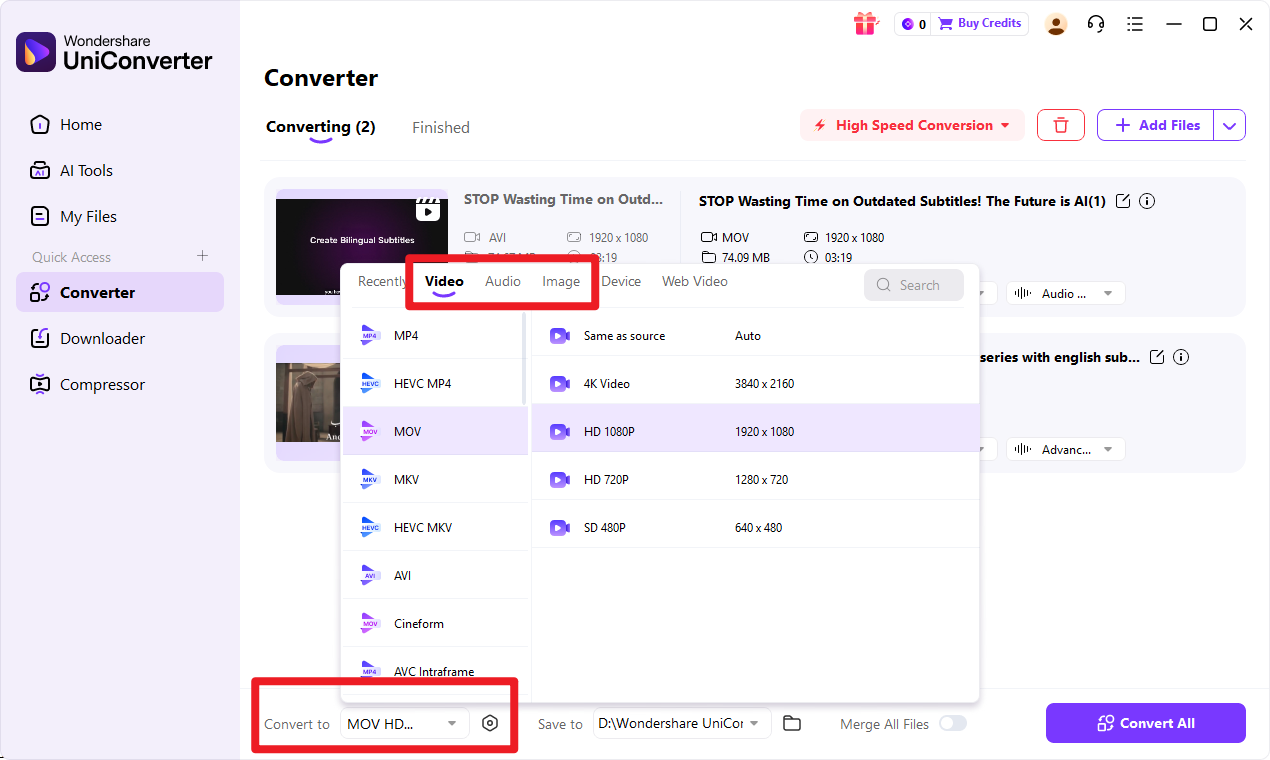
At the bottom of the window, click the Output Format menu to open the format selection panel. In the new window, select the Video tab. To create an XviD file, choose AVI as the container. On the right, select your desired resolution. To be certain, you can click the small Edit (pencil) icon next to the resolution to open the settings and manually select XviD from the Encoder dropdown menu for your target format.
Step 4: Start the Conversion
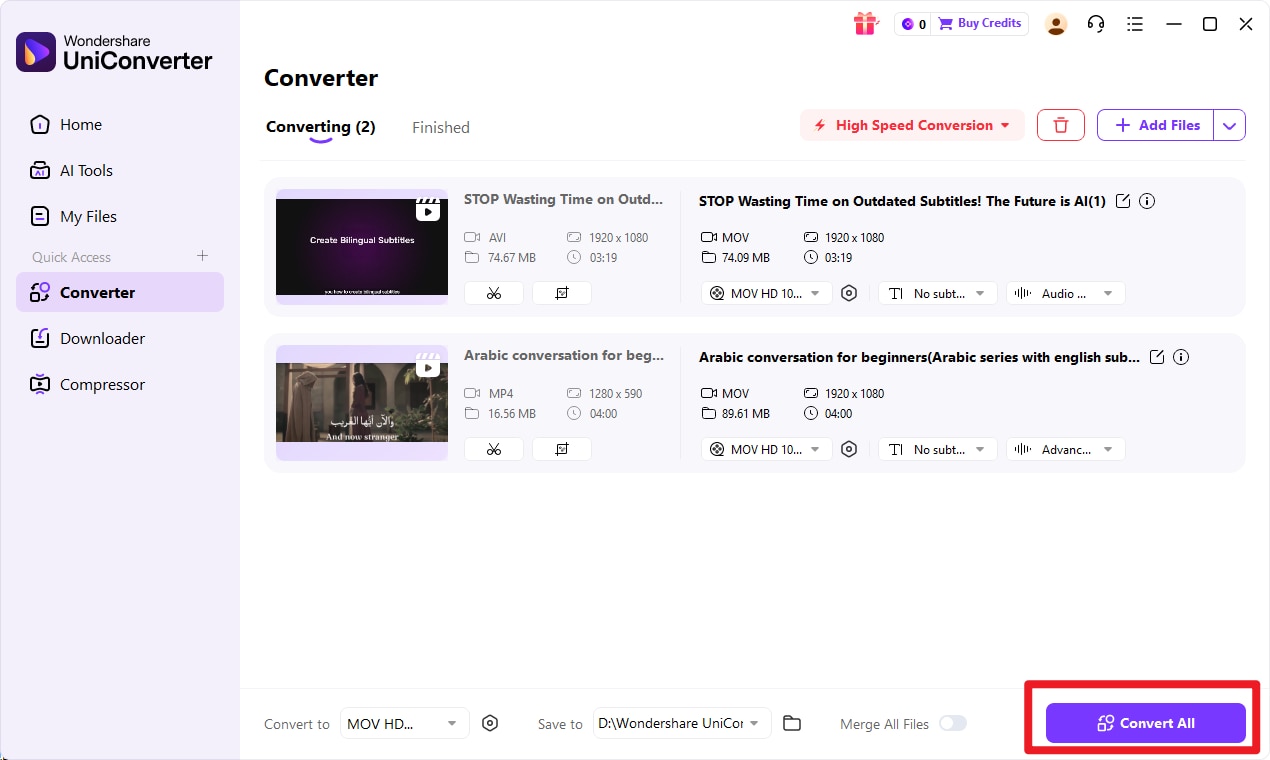
After configuring your target format, you are ready to convert. You can set a destination folder using the File Location option at the bottom. Finally, click the Convert button to the right of the file. If you have added multiple files, you can click the Start All button in the bottom-right corner. UniConverter will process your video at high speed, and you can access the finished file from the Finished tab at the top of the screen.

Your All-in-One Video Processing Solution
Conclusion
In the MOV vs XviD comparison, it's clear there is no single "best" format for everyone. The right choice is entirely dependent on your specific objective. MOV stands out as a robust and versatile container format, making it the superior option for high-quality video editing and professional workflows, particularly within the Apple ecosystem. Its ability to hold pristine, minimally compressed video is unmatched for post-production. On the other hand, XviD is a highly efficient video codec that excels at creating small, easily shareable video files with good quality, making it ideal for storage and online distribution. Understanding these core differences empowers you to choose the right format for the right job. For those moments when you need to bridge the gap between these two worlds, a reliable tool is indispensable. Wondershare UniConverter offers a fast, simple, and high-quality solution to convert your video files, ensuring they are perfectly suited for any task, from professional editing to casual sharing.
FAQs
-
1. Is XviD the same as AVI?
No, they are not the same, but they work together. AVI (Audio Video Interleave) is a container format, like a box. XviD is a video codec, which is the technology used to compress the video stream that goes inside the AVI box. So, you will often have an AVI file that contains video encoded with XviD. -
2. Can I play MOV files on a Windows PC?
Yes. While MOV files are native to Apple's macOS, you can easily play them on a Windows PC. Modern versions of Windows 10 and 11 have better native support than older versions. For guaranteed playback, you can use a free, versatile media player like VLC Media Player, which includes all the necessary codecs. -
3. Will I lose quality when converting from MOV to XviD?
Yes, you will experience some quality loss. MOV files, especially those used for editing, often contain high-bitrate or nearly lossless video. XviD uses lossy compression to achieve its small file size, which works by permanently discarding some video data. This conversion is a trade-off: you sacrifice some of the original quality to gain a much smaller, more portable file. -
4. Can UniConverter convert other formats besides MOV and XviD?
Absolutely. Wondershare UniConverter is a comprehensive video toolkit that supports over 1,000 input and output formats. Whether you're working with MP4, MKV, WMV, WebM, or more obscure formats, UniConverter can handle all your conversion, compression, basic editing, and downloading needs in one easy-to-use application.
