
Have you ever found yourself staring at two video files, one ending in .mov and the other in .vob, wondering what the difference is? You're not alone. In the world of digital video, file formats can be confusing, and choosing the right one is crucial for everything from editing to playback. The MOV vs VOB debate is a common one, especially for users who work with both modern digital videos and physical DVDs. Whether you're a content creator trying to burn a project to a disc or a casual user trying to watch an old home movie on your new laptop, understanding these formats is key to avoiding compatibility headaches.
These two formats were designed for very different eras and purposes. MOV is a modern, flexible container developed by Apple, while VOB is the standard for storing video on DVDs. This fundamental difference leads to significant variations in quality, file size, and, most importantly, where and how you can play them. This guide will break down everything you need to know, helping you make an informed decision for your specific needs.
In this article, you will learn:
- The definitions, structures, and primary uses of MOV and VOB files.
- A direct, head-to-head comparison of the two formats in a simple table.
- A detailed analysis of which format is better in terms of quality, size, and compatibility.
- Specific use cases to help you decide when to use MOV and when to use VOB.
- A step-by-step guide on how to convert your files from MOV to VOB.
Part 1. What is MOV? What is VOB?
Before we can compare these two formats, it's essential to understand what each one is on its own. They originate from different technologies and are optimized for completely different tasks.
What is a MOV file?
A MOV file, also known as the QuickTime File Format (QTFF), is a multimedia container format developed by Apple. It was designed to work seamlessly within the QuickTime framework, which is Apple's proprietary media player and development environment.
As a container, a MOV file can hold various types of data in different tracks. This can include video, audio, text (like subtitles), and even effects or interactive elements. This multi-track architecture makes it incredibly versatile and a favorite in professional post-production workflows. It's the default recording format for all iPhones and iPads, meaning anyone in the Apple ecosystem has likely created and shared countless MOV files. Its key advantages lie in its ability to support high-quality, modern video codecs and its widespread compatibility with professional editing software like Final Cut Pro and Adobe Premiere Pro, on both macOS and Windows.
What is a VOB file?
VOB stands for "Video Object" and is the container format used to store video, audio, subtitle, and menu content on a physical DVD. When you look at the files on a standard movie DVD, you'll find them inside a folder named VIDEO_TS, and the main movie content will be contained within VOB files.
The structure of a VOB file is based on the MPEG program stream format. It typically contains video encoded with the older MPEG-2 codec and audio streams in formats like AC-3 (Dolby Digital) or DTS. Because of DVD capacity limitations, a single movie is often split into multiple VOB files, each about 1 GB in size. The primary disadvantage of the VOB format in 2026 is its poor compatibility with modern devices. Computers without DVD drives, smartphones, and tablets cannot play VOB files natively, making them difficult to watch, edit, or share without first converting them to a more modern format.
Part 2. Quick Comparison Table
To see the differences at a glance, here is a direct comparison of the key attributes of MOV and VOB files. This table highlights their origins, technical specifications, and primary functions.
MOV vs VOB: Head-to-Head Comparison
| Feature | MOV | VOB |
| Developer | Apple Inc. | DVD Forum |
| Full Name | QuickTime File Format | Video Object |
| Compatibility | Excellent on Apple devices, Windows, and modern software | Primarily for DVD players; requires specific codecs on computers |
| Quality | Generally higher due to support for modern codecs like H.264 | Good, but limited by older MPEG-2 compression |
| File Size | More efficient and generally smaller for similar quality | Often larger and can be split into 1GB chunks |
| Primary Use | Video editing, online streaming, mobile recording | Storing movies on physical DVDs |
Part 3. MOV vs VOB: Which One Is Better?
The question of which format is "better" depends entirely on your goal. One is a modern workhorse for digital creation, while the other is a legacy format for physical media. Let's break down their performance in three critical areas: quality, file size, and compatibility.
Quality and Compression
When it comes to visual quality, MOV has a distinct advantage. As a container, MOV can utilize a wide range of codecs, including highly advanced ones like H.264 (AVC) and H.265 (HEVC). These codecs are designed to deliver excellent video quality at significantly lower bitrates than older technologies. This means you can have a crisp, clear video that doesn't take up an enormous amount of space.
VOB, on the other hand, is almost exclusively tied to the MPEG-2 codec. While MPEG-2 was the gold standard for DVD-Video and broadcast television for years, it is far less efficient than modern codecs. The quality is fixed to standard definition (SD) resolutions (720x480 for NTSC, 720x576 for PAL), which looks fine on older televisions but falls short of today's HD, 4K, and even 8K standards. For any project where high-fidelity visuals are a priority, MOV is the clear winner.
File Size and Efficiency
The difference in compression technology directly impacts file size. Thanks to the efficiency of codecs like H.264, a MOV file will almost always be smaller than a VOB file of the same duration and comparable visual quality. This makes MOV a much better choice for storing videos on a hard drive, sharing them online, or sending them via email or messaging apps.
VOB files are part of a rigid DVD file structure. They are often split into 1 GB segments, which can be cumbersome to manage. Their larger size, a result of the less efficient MPEG-2 compression, makes them impractical for anything other than their intended purpose: being stored on a DVD. If storage space or bandwidth is a concern, MOV is the more efficient and practical format.
Compatibility and Playback
Compatibility is perhaps the most significant pain point for users dealing with VOB files today. MOV is natively supported across the entire Apple ecosystem (macOS, iOS, iPadOS) and plays without issue on Windows with QuickTime or compatible players like VLC. It's also the preferred format for many video editing applications and online video platforms.
VOB files, however, present a major challenge for modern users. Most computers no longer have built-in DVD drives, and operating systems like macOS and Windows do not include native support for playing VOB files directly. To watch a VOB file on a computer, you typically need to install a third-party media player that includes the necessary MPEG-2 codecs. Playing them on a smartphone or tablet is even more difficult. For this reason, converting VOB files to a universally compatible format like MOV or MP4 is often the only practical solution. For seamless playback on any device, converting VOB files is often necessary. Wondershare UniConverter is an excellent tool for this purpose, simplifying the process of making your old DVD rips watchable everywhere.
Part 4. Use Cases for MOV and VOB
Understanding the ideal scenarios for each format can help you avoid future compatibility issues and streamline your workflow.
When to Use MOV
The flexibility and quality of the MOV format make it the superior choice for most modern video tasks. You should use MOV in the following situations:
- Editing Video Projects: If you are editing a video, especially in professional software like Final Cut Pro or Adobe Premiere Pro, MOV is an excellent choice. It preserves high quality and is designed to handle complex, multi-track timelines.
- Recording on Apple Devices: Since MOV is the default format for iPhones, iPads, and Mac screen recordings, it's the natural choice when working within the Apple ecosystem.
- Sharing High-Quality Videos: When you need to share a video online, through a file transfer service, or on social media, a well-compressed MOV file offers a great balance of quality and manageable file size.
When to Use VOB
The use cases for VOB in 2026 are much more niche and are almost exclusively tied to physical DVD media. You should use VOB in these specific circumstances:
- Authoring a Playable DVD: If your final goal is to create a physical DVD that can be played in a standard, standalone DVD player, you must use the VOB format as part of the DVD-Video structure.
- Archiving Content from a DVD: If you are ripping a DVD to create a 1:1 backup of the disc, preserving the original VOB files along with the IFO and BUP files will maintain the full DVD structure, including menus and chapters.
- Projects Requiring DVD Features: If your video project specifically requires interactive DVD menus, multiple language tracks, or selectable subtitle streams in the classic DVD style, working with the VOB format is necessary.
Part 5. Step-by-Step Guide to Convert MOV to VOB Using UniConverter
If you have a MOV file—perhaps a finished movie project or a family video—and you want to burn it to a DVD to watch on a TV or share with relatives, you'll need to convert it to the VOB format first. Wondershare UniConverter is the top recommended tool that makes this process simple and fast. It handles all the complex settings for you, ensuring your file is ready for DVD authoring without any quality loss.
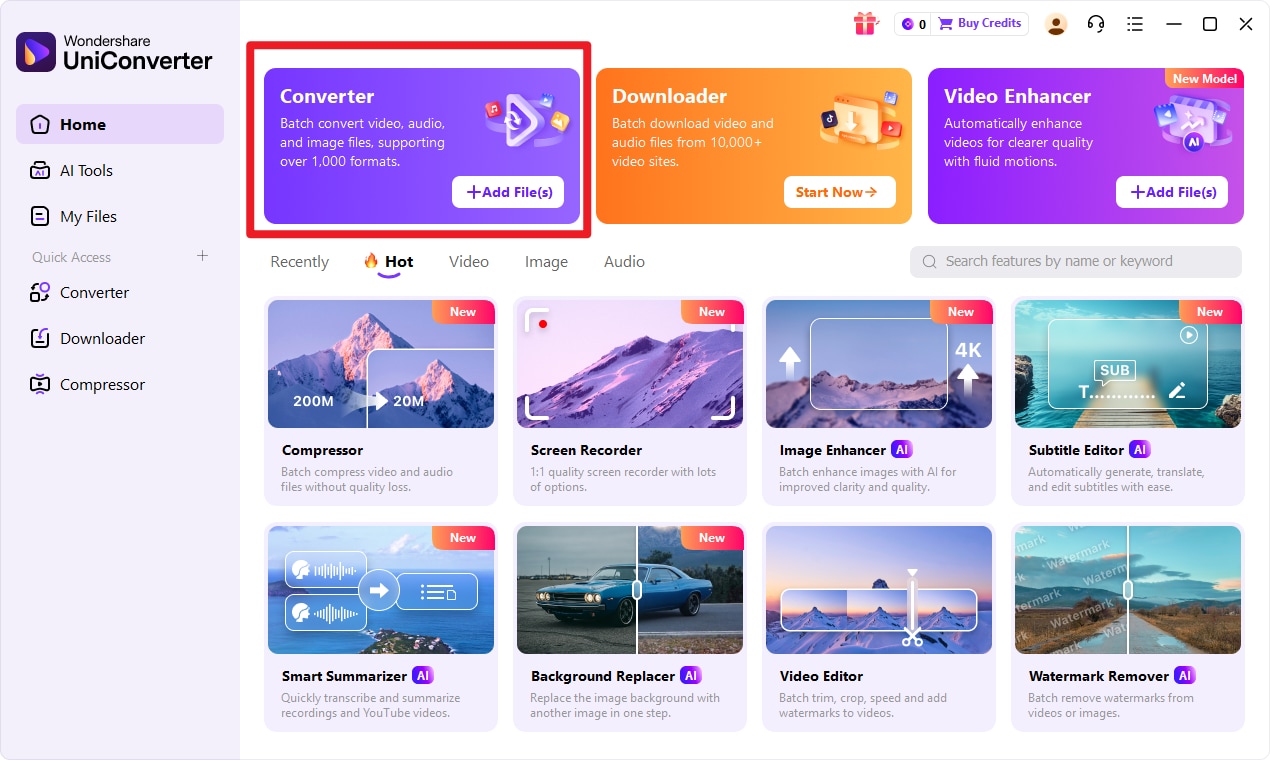
Step 1: Choose Converter in UniConverter
Launch Wondershare UniConverter on your computer. From the main interface, look at the menu on the left side and click on the Converter tool to open the video conversion window.
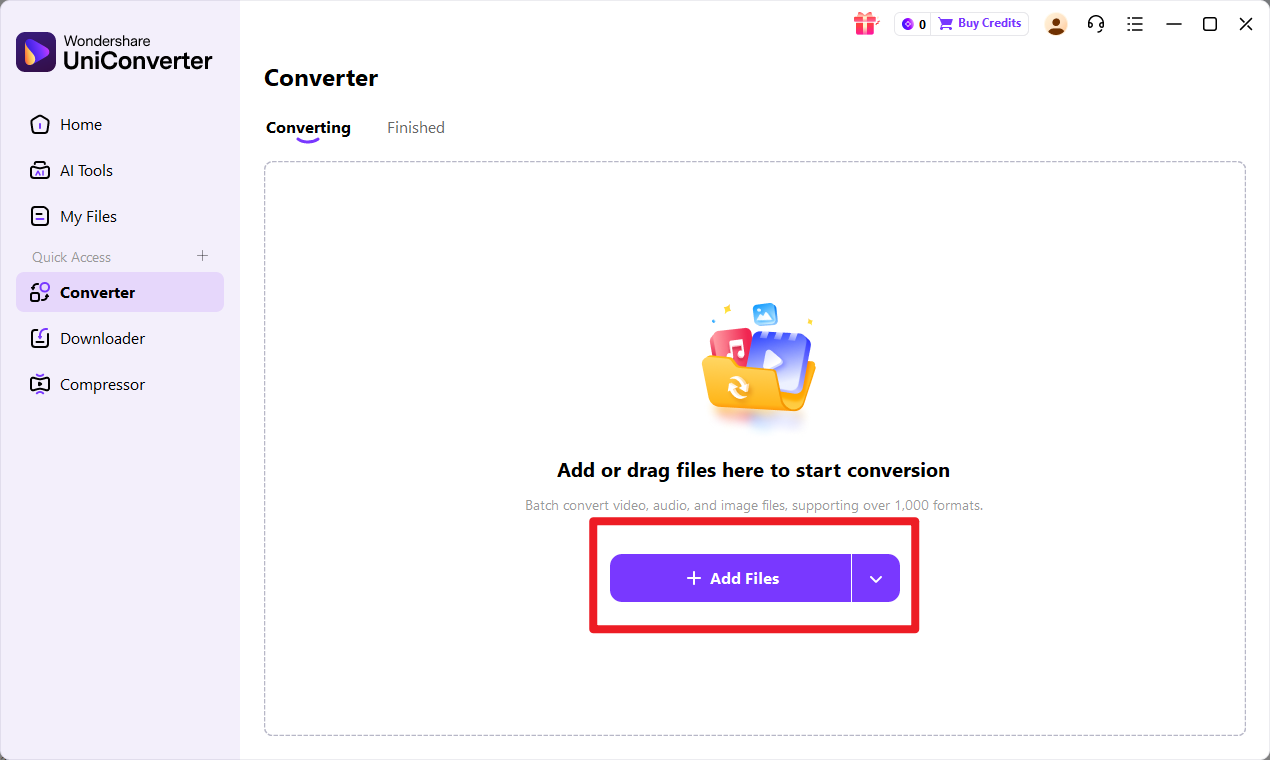
Step 2: Add Files to UniConverter
Now, you need to import your input format file. You can simply drag the file from your folder and drop it directly onto the UniConverter window. Alternatively, click the Add Files icon in the top-left corner to open a file browser and select the video you want to convert.
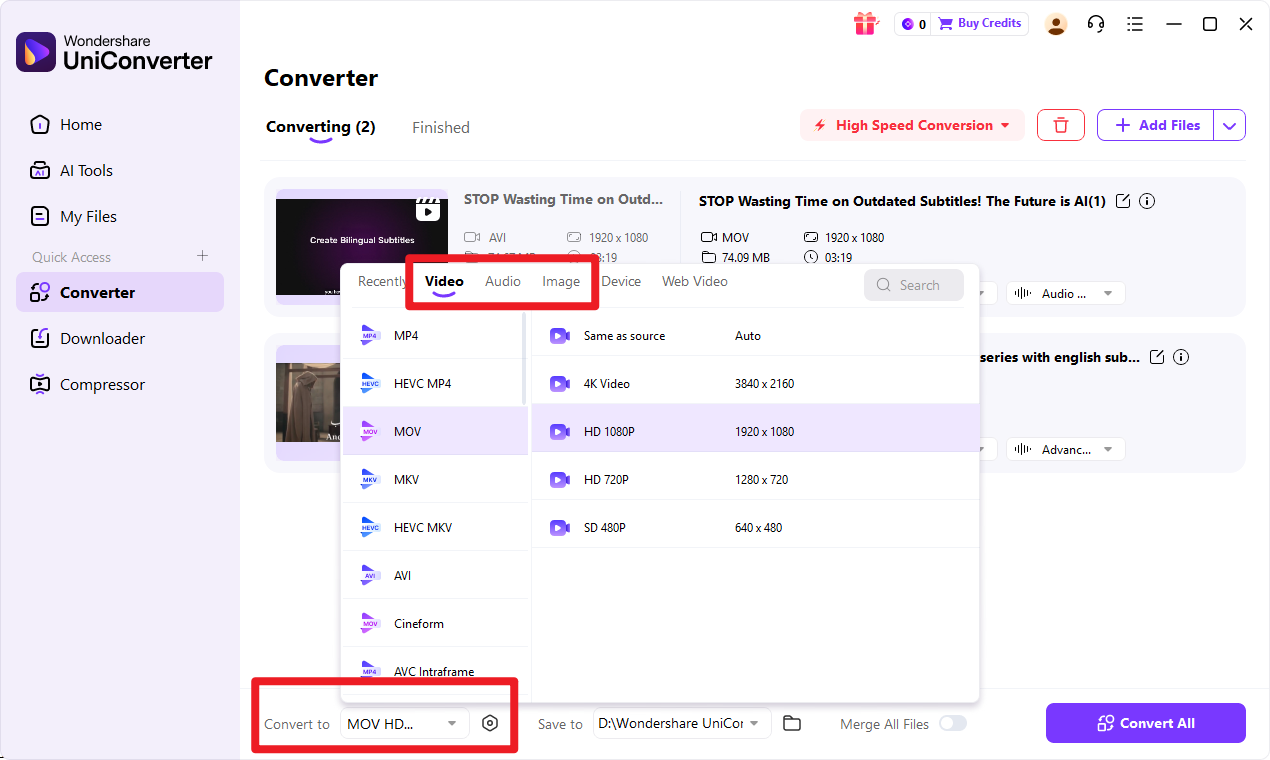
Step 3: Choose Output Format
At the bottom of the window, click on the Output Format menu. A new window will appear. Go to the Video tab, scroll through the list of formats on the left, and select the target format. On the right, you can choose the desired resolution for your output file.
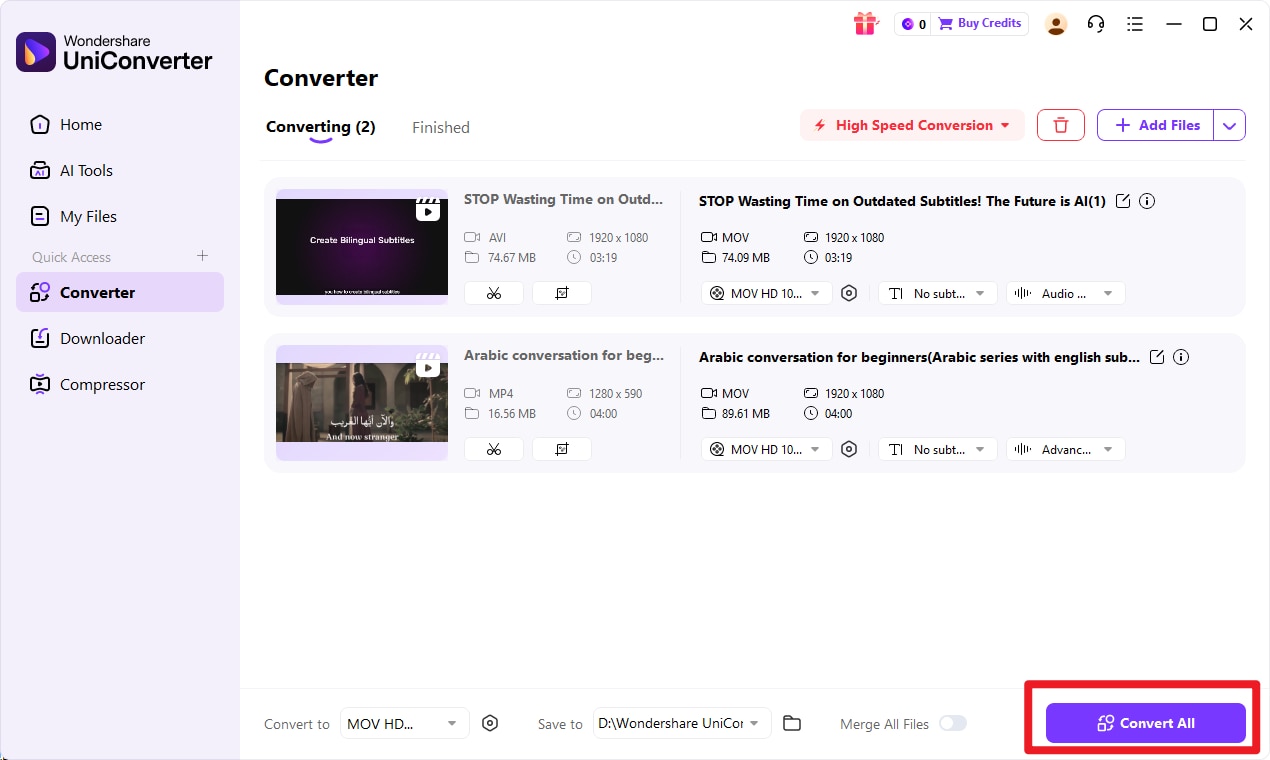
Step 4: Start the Conversion
Before starting, you can set a destination folder by clicking the File Location option at the bottom. Once you are satisfied with your settings, click the Start All button in the bottom-right corner to begin the conversion process. After it's finished, you can find your newly converted files in the Finished tab at the top of the screen.

Go Beyond Simple Video Conversion
Conclusion
To summarize, MOV and VOB are two video formats that serve fundamentally different purposes, shaped by the technology of their time. MOV is a modern, versatile, and high-quality container format that is perfect for editing, digital storage, and playback on a wide array of devices, especially within the Apple ecosystem. In contrast, VOB is a legacy format designed specifically for the rigid structure of DVD-Video, making it ideal for creating playable DVDs but highly impractical for most other uses in today's digital landscape.
The choice between them is not about which is universally "better," but which is right for your specific task. If your goal involves editing, sharing online, or watching on a computer or smartphone, MOV is the clear winner. If you need to create a physical DVD for a standard player, VOB is a necessity. For any situation where you need to bridge the gap between these two worlds, a reliable conversion tool is essential. Wondershare UniConverter provides a simple, fast, and effective solution, allowing you to seamlessly convert between MOV, VOB, and over 1,000 other formats to eliminate any compatibility issues you might face.
FAQs
-
1. Can I play VOB files on my Mac?
Playing VOB files on a Mac can be difficult with native applications like QuickTime Player. Because macOS does not include the necessary codecs, the files often won't open. To play them, you will need to either use a third-party media player that supports VOB, such as the popular and free VLC Media Player, or convert the VOB file to a Mac-friendly format like MOV. -
2. Is MOV better quality than VOB?
Generally, yes. MOV is a more modern container that can support advanced and efficient video codecs like H.264 and HEVC. These codecs can produce higher-quality video (including HD and 4K) in a smaller file size compared to the older MPEG-2 codec, which is standard for VOB files and is typically limited to standard definition. -
3. How do I convert a VOB file to MOV?
The easiest and most reliable method is to use a dedicated video converter program. Tools like Wondershare UniConverter are designed for this task. You simply import your VOB file, select MOV as the output format, and start the conversion. This will create a new file that is easy to edit and play on any Mac, iPhone, or other modern device. -
4. Is MOV a lossless format?
MOV is a container, not a codec, which means it can hold both lossless and lossy video streams. For professional archival or editing purposes, MOV can contain lossless codecs like Apple ProRes or Animation. However, most MOV files you encounter in daily use—such as those recorded on an iPhone or downloaded from the web—use a lossy codec like H.264. While technically lossy, the compression is so efficient that the quality remains very high and is visually indistinguishable from the original for most viewers.
