
Navigating the world of digital video can often feel like swimming in an alphabet soup of file extensions. You have MP4, AVI, MKV, and countless others, each with its own purpose and quirks. Among these, two formats that frequently cause confusion are MOV and TS. You might receive a .ts file from a broadcast recording and find it won't open in your editor, or export a .mov file from your camera only to have it struggle during a live stream. Understanding the core differences in the MOV vs TS debate is crucial for any content creator, video editor, or media enthusiast looking to streamline their workflow and avoid compatibility headaches.
Both MOV and TS are container formats, meaning they act like a box that holds video, audio, and other data together. However, they were designed for vastly different purposes, which dictates their strengths and weaknesses. One is a master of the editing suite, while the other is a champion of live broadcasting. This guide will demystify these two formats, breaking down their technical differences, ideal use cases, and ultimately helping you decide which one is the right choice for your specific project in 2026.
In this article:
Part 1. What is MOV file What is TS file?
Before we can compare these two formats, it's essential to understand what each one is on a fundamental level. They may both hold video, but their internal structure and intended application are worlds apart.
What is a MOV file?
A MOV file, designated by the .mov extension, is a multimedia container format developed by Apple Inc. It was created as the native file format for its QuickTime Framework, which is why you'll often hear it referred to as a QuickTime file. A MOV file acts as a digital container that can store various types of media data—including video, audio, text (like subtitles), and effects—on separate tracks.
This multi-track architecture is one of its greatest strengths, making it exceptionally well-suited for post-production. Video editing software like Apple's own Final Cut Pro and iMovie, as well as Adobe Premiere Pro, can easily access and manipulate these individual tracks. This makes tasks like audio syncing, adding effects, and editing video sequences much more fluid. While MOV files are known for maintaining high quality, this often comes at the cost of larger file sizes, making them ideal for editing and archiving but less so for web streaming or sharing on platforms with size limitations.
What is a TS file?
TS stands for Transport Stream, and it is a standard digital container format specified in MPEG-2 Part 1. As its name suggests, the TS format was designed primarily for transmission and is the go-to format for digital broadcasting applications like DVB (Digital Video Broadcasting) and ATSC (Advanced Television Systems Committee) standards. You'll also find it used as the standard format for Blu-ray discs.
The defining feature of a TS file is its exceptional error resilience. It's designed to be broadcast over unreliable media where data loss (packet loss) is a real possibility. The format incorporates features for error correction and stream synchronization, allowing a decoder to continue playing a stream smoothly even if parts of the data are lost or arrive out of order. This robustness makes it perfect for live streaming and broadcasting but comes with a trade-off: TS files are not designed for non-linear editing. Their structure makes it difficult for editing software to import and manipulate them, often leading to sync issues or import failures.
Part 2. Quick Comparison Table
To get a clear, at-a-glance overview of the key differences between MOV and TS, let's put them side-by-side. This table highlights their core attributes, from their origins to their primary functions.
MOV vs TS: A Head-to-Head Comparison
| Feature | MOV | TS |
| Full Name | Apple QuickTime Movie | MPEG-2 Transport Stream |
| Developer | Apple Inc. | MPEG (Moving Picture Experts Group) |
| Primary Use | Video editing and storage, especially in the Apple ecosystem. | Digital broadcasting, streaming, and Blu-ray discs. |
| Compatibility | Native to macOS and iOS, well-supported by editing software. | Widely supported by hardware players, TVs, and streaming software. |
| Editing Friendliness | Excellent. Designed for easy, non-linear editing. | Poor. Not designed for editing and can be difficult to import. |
| Error Resilience | Low. A file can become corrupted if the transfer is interrupted. | High. Designed to handle packet loss and errors during transmission. |
Part 3. MOV vs TS: Which One Is Better?
The question of which format is "better" doesn't have a single answer. The best choice is entirely dependent on your specific goal. Let's break down the comparison across three critical factors: quality, file size, and overall usability.
Quality and Compression
A common misconception is that the container format itself (MOV or TS) dictates the video quality. This isn't true. Both MOV and TS are just containers; the actual visual quality is determined by the video and audio codecs used to compress the data inside them. Common codecs include H.264 (AVC), H.265 (HEVC), and Apple ProRes.
If you take the same source video and encode it using the H.264 codec at an identical bitrate, the resulting visual quality of the MOV file and the TS file will be virtually indistinguishable. The container is simply the wrapper, not the content. Therefore, when it comes to pure visual fidelity, neither format has an inherent advantage over the other. The key difference lies not in the quality they can hold but in the structure and purpose of the container itself.
File Size
Similar to quality, the file size is primarily dictated by the codec, bitrate, and compression settings used during encoding, not by the MOV or TS container. A higher bitrate will result in better quality and a larger file, regardless of the format.
However, there can be a slight difference. TS files can sometimes be marginally larger than MOV files containing the exact same video and audio streams. This is because the Transport Stream format includes additional overhead data. This extra data consists of timestamps, synchronization information, and error correction packets that are essential for its robustness in broadcasting environments. While this overhead is typically small, it can add up, making a TS file slightly bulkier than its MOV counterpart.
Compatibility and Usability
This is where the differences between MOV and TS become most apparent.
- MOV: For anyone working within the Apple ecosystem, MOV is the undisputed king. It's the native format for macOS and iOS, ensuring seamless playback and editing on iPhones, iPads, and Macs. Professional video editors using software like Final Cut Pro rely on MOV for its flexible, multi-track structure that makes post-production a breeze. However, its compatibility on other platforms, like Windows or Android, can be hit-or-miss. While many modern players support MOV, older systems may require the installation of specific codecs to play the files correctly.
- TS: The strength of TS lies in its universal support among hardware devices and broadcasting software. It is the standard for digital television, set-top boxes, and Blu-ray players. If your goal is to stream a video live or broadcast it, TS is the superior choice due to its error resilience. It ensures a stable viewing experience for the end-user, even with a less-than-perfect internet connection. The trade-off is its poor performance in editing environments. Most non-linear editors struggle to import TS files, and even when they do, you may encounter audio sync problems or other glitches.
In short, MOV wins for editing and Apple-centric workflows, while TS is the champion for broadcasting and hardware playback.
Part 4. Use Cases for MOV and TS
To make the choice even clearer, let's look at some practical, real-world scenarios where you would choose one format over the other.
When to Use MOV
Choose the MOV format in the following situations:
- Editing Videos on a Mac: If you are using Final Cut Pro, iMovie, or even Adobe Premiere Pro on a macOS device, MOV is your best friend. Its structure is optimized for the demands of non-linear editing.
- Creating High-Quality Master Files: When you finish an edit, exporting a high-bitrate MOV file (perhaps using the ProRes codec) is an excellent way to create a master copy for archival purposes. This preserves the maximum amount of quality before you compress it for other delivery formats.
- Sharing Videos Between Apple Devices: If you're sending a video from your Mac to an iPhone or vice-versa, saving it as a MOV file guarantees it will play without any issues or need for third-party apps.
When to Use TS
Opt for the TS format in these specific cases:
- Streaming Live Video: If you are setting up a live stream for a webinar, event, or online broadcast, using the TS format (often within protocols like HLS) will provide the most stable and reliable stream for your audience.
- Recording from Digital TV: Many PVRs (Personal Video Recorders) and TV tuner cards record over-the-air broadcasts as .ts files because it's the native format of the broadcast signal.
- Authoring Blu-ray or DVD Discs: The official specifications for Blu-ray and AVCHD discs require video to be in a Transport Stream format.
- Transmitting Over Unreliable Networks: Anytime you need to send video over a connection that might experience interruptions or packet loss, the error-resilience of TS makes it the safest choice to ensure the file remains playable.
Part 5. Step-by-Step Guide to Convert A to B Using UniConverter
Given their distinct advantages, you will inevitably face situations where you have a file in one format but need it in the other. For example, you might have a .ts recording of a TV show that you want to edit in Final Cut Pro, requiring a conversion to MOV. Or, you may have a finished .mov project that needs to be prepared for a broadcast stream, necessitating a conversion to TS.
To solve these compatibility issues, a powerful and reliable video converter is essential. We recommend Wondershare UniConverter, a comprehensive tool that handles conversions between over 1000 formats with speed, precision, and no quality loss. It simplifies the process of bridging the gap between MOV and TS.
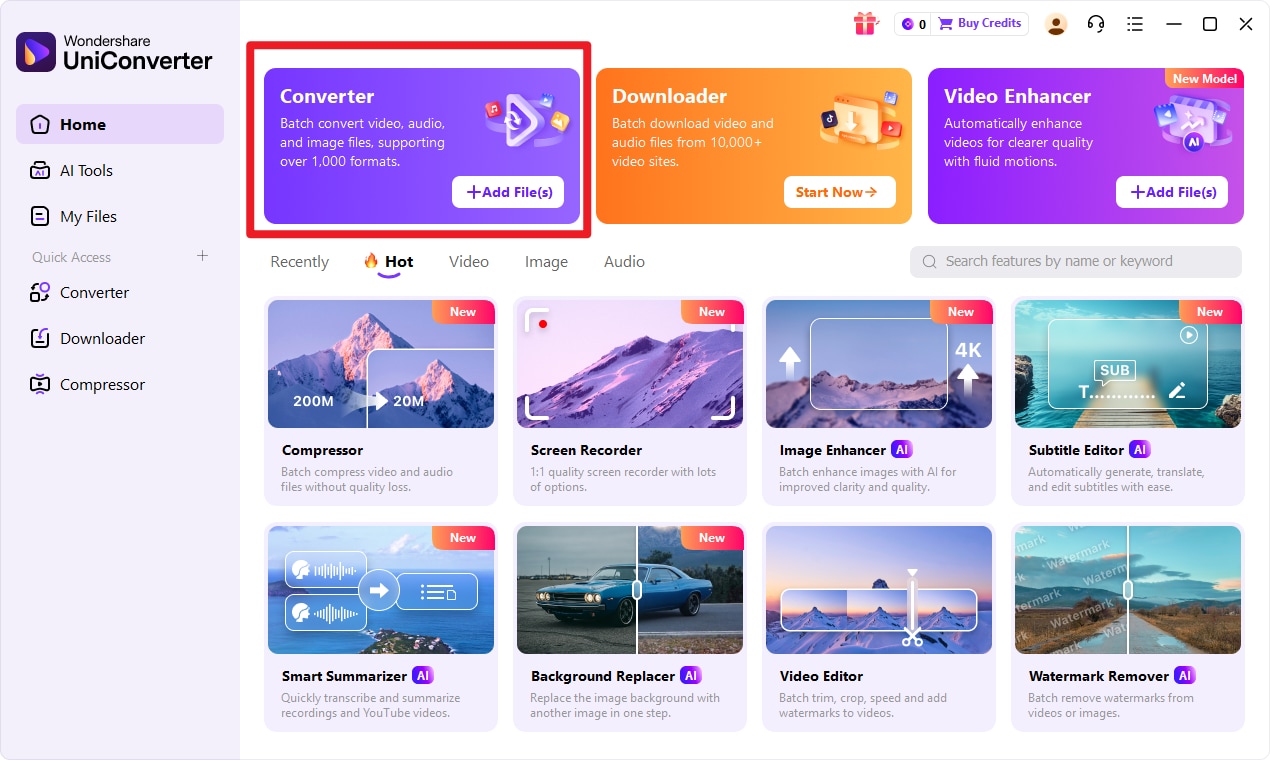
Step 1: Choose Converter in UniConverter
Launch Wondershare UniConverter on your computer. From the main home screen, navigate to the left-side menu and click on the Converter tool to open the conversion interface.
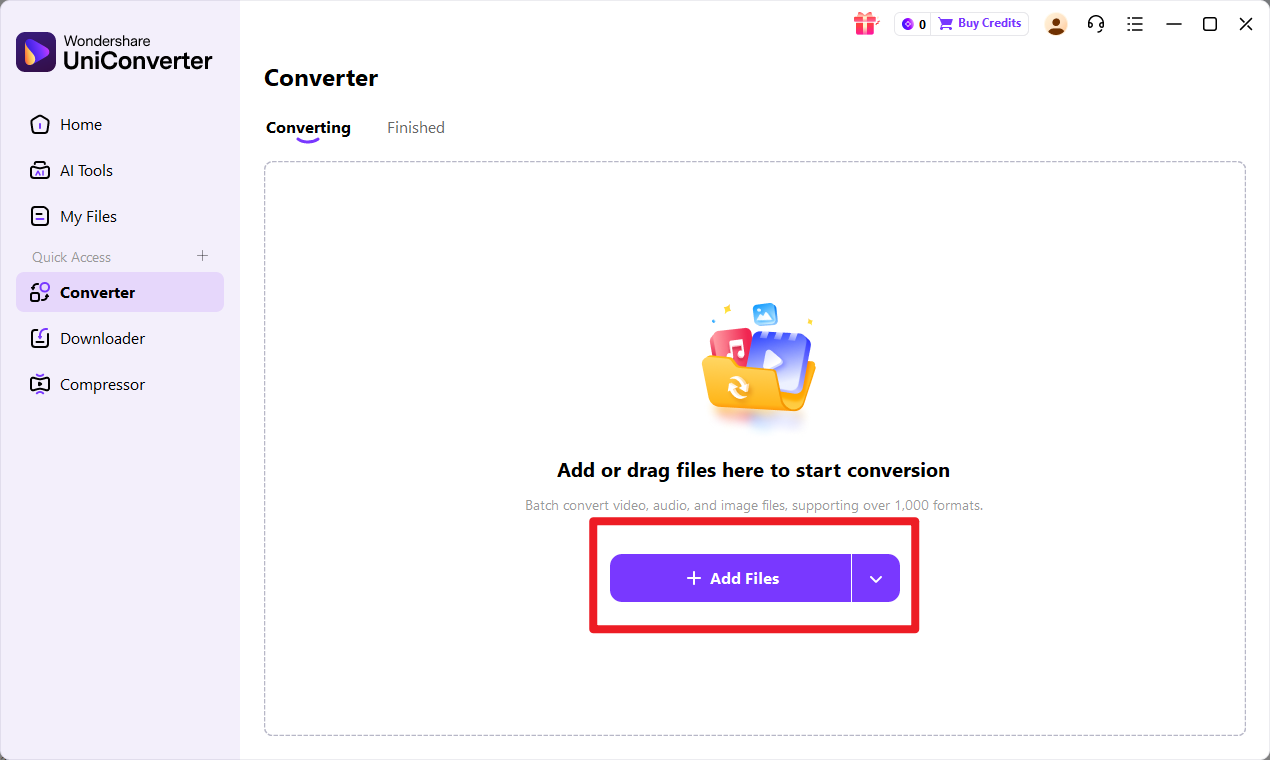
Step 2: Add Files to UniConverter
You can now import your video files. Either click the Add Files icon in the center or top-left corner to browse your computer, or simply drag and drop your input format files directly into the program window. UniConverter supports batch conversion, so you can add multiple files at once.
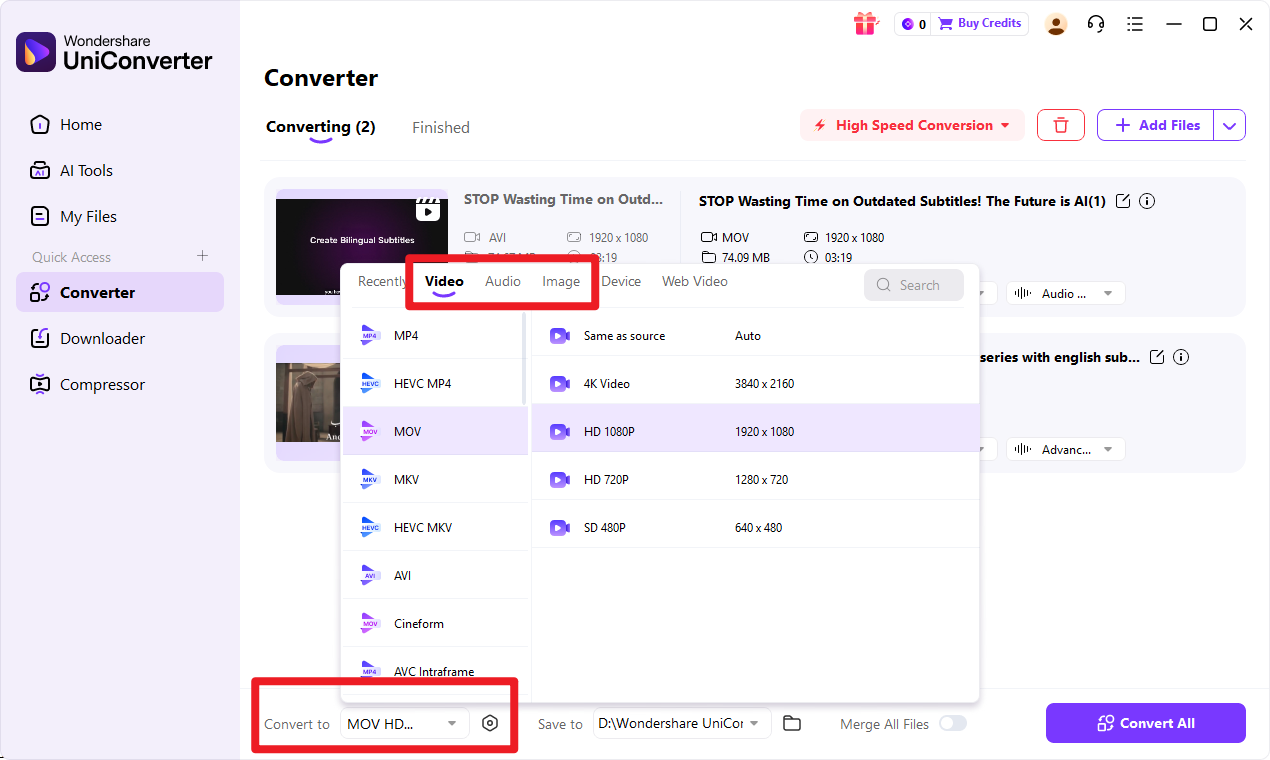
Step 3: Choose Output Format
At the bottom of the window, click on the Output Format menu. This will open a new dialog box. Go to the Video tab. From the list of formats on the left, select your desired target format. On the right, you can choose the desired resolution, such as "Same as source" to maintain the original quality.
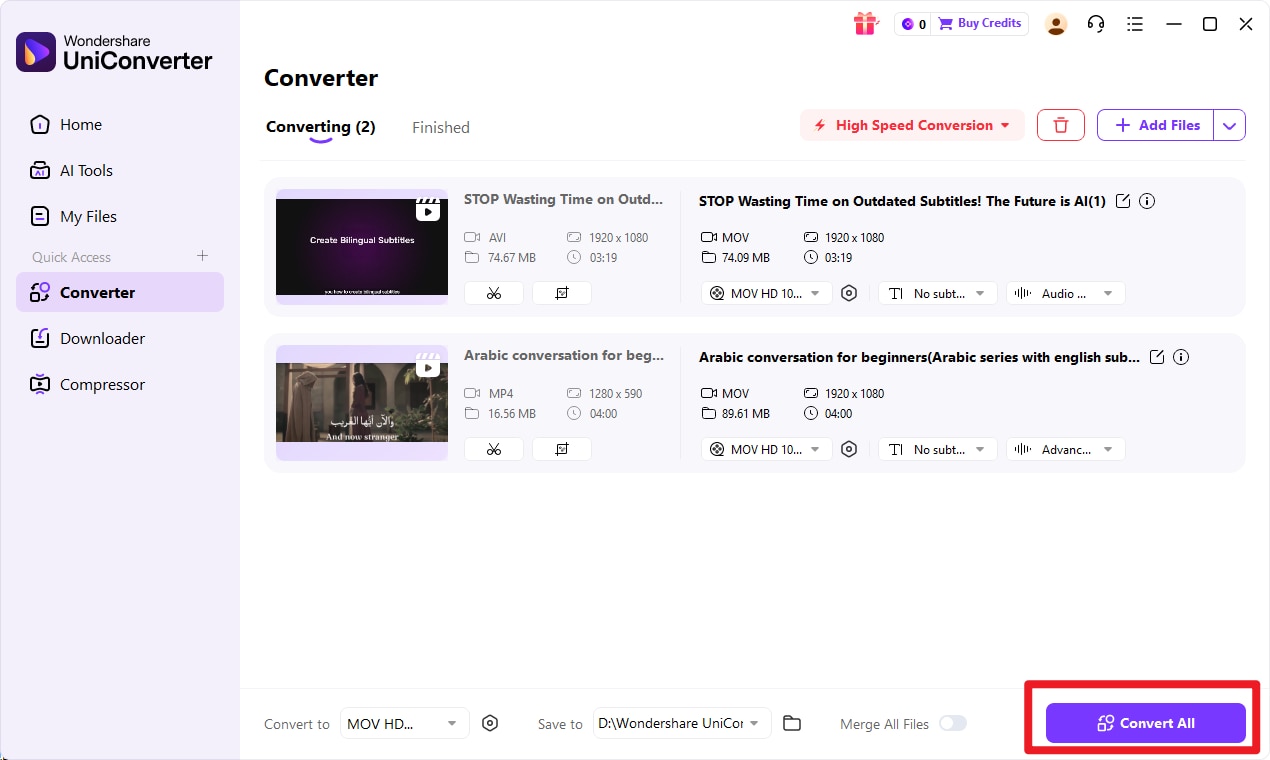
Step 4: Start the Conversion
Before starting, you can specify where to save the converted files by clicking the File Location field at the bottom. Once you are ready, click the Start All button in the bottom-right corner to begin the conversion process for all your added files.

Go Beyond Simple Video Conversion
Conclusion
In the MOV vs TS comparison, there is no single winner. The "better" format is the one that aligns with your specific task. They are two different tools for two different jobs. Choose MOV when your priority is video editing, creating high-quality archives, or working within the Apple ecosystem. Its structure is built for the flexibility and precision required in post-production. On the other hand, choose TS when your goal is broadcasting, live streaming, or ensuring playback on hardware devices like TVs and Blu-ray players. Its unparalleled error resilience guarantees a stable and robust transmission, even over imperfect networks.
Ultimately, the key is to understand their respective strengths and weaknesses. And for those times when you need to bridge the compatibility gap between them, a versatile tool like Wondershare UniConverter is indispensable. It empowers you to convert files between MOV, TS, and a vast array of other formats effortlessly, ensuring your media is always ready for any project or platform.
FAQs
-
1. Is MOV better than TS for quality?
No. Both MOV and TS are container formats. The ultimate video quality depends entirely on the codec (e.g., H.264, HEVC) and the bitrate used for encoding. If you use the same settings for both, the visual quality will be identical. -
2. Can I play TS files on my Mac?
Yes, you can. While Apple's native QuickTime Player might struggle with TS files, versatile third-party media players like VLC Media Player can play them on a Mac without any issues. -
3. Why are TS files sometimes larger than MOV files?
TS files contain a small amount of additional data for error correction, packet synchronization, and timing information. This "overhead" is crucial for its role in broadcasting but can make the overall file size slightly larger than a MOV file containing the exact same video and audio streams. -
4. Is it safe to convert MOV to TS?
Yes, it is completely safe to convert between MOV and TS, provided you use a reputable and reliable video converter. A good program like Wondershare UniConverter will create a new file in the desired format without altering or harming your original source file, all while preserving the video and audio quality.
