
Have you ever downloaded an old movie file that wouldn't play on your Mac, or recorded a video on your iPhone that was too large to email? You've likely encountered the classic video format dilemma. Two formats that often cause confusion are MOV and RMVB. While they both store video, they were designed for completely different purposes and eras. Understanding the MOV vs RMVB debate is key to solving compatibility issues and managing your digital video library effectively.
This guide will break down the essential differences between these two formats. We'll explore their history, compare their strengths and weaknesses in terms of quality, file size, and compatibility, and help you decide which one is right for your needs. More importantly, we'll show you the ultimate solution for when you have the wrong format for the job.
In this article
Part 1. What is a MOV File? What is an RMVB File?
Before we can compare them, it's important to understand what each format is and what it was designed to do. They come from different developers and serve very different primary functions.
What is a MOV File?
A MOV file is a video container format developed by Apple Inc. It was created as the native file format for Apple's QuickTime framework, which is why you'll often see it referred to as a QuickTime File Format (QTFF). MOV files are renowned for their ability to store high-quality video, audio, and even text tracks (like subtitles) within a single file.
Because of its ability to maintain pristine quality, MOV is a favorite among video professionals and is the default recording format for iPhones and iPads. It's excellent for video editing in software like Final Cut Pro and Adobe Premiere Pro because it preserves the original data with minimal compression. This focus on quality, however, often results in very large file sizes. Its compatibility is excellent across the Apple ecosystem and is widely supported on Windows and other platforms with the right media players.
What is an RMVB File?
RMVB stands for RealMedia Variable Bitrate. This format was developed by RealNetworks, the company behind the once-popular RealPlayer. RMVB became famous in the early 2000s, during the era of slower internet connections. Its main selling point was its incredibly high compression ratio.
Using a variable bitrate, RMVB could significantly shrink video file sizes while maintaining a decent level of visual quality. This made it the go-to format for sharing movies and TV shows online when bandwidth and storage space were at a premium. However, this advantage has faded over time. Modern compression technologies have caught up, and RMVB's biggest drawback is its poor native compatibility with modern operating systems and devices. You often need to install a special third-party media player to watch an RMVB file, and it's almost impossible to play one on a smartphone or tablet without first converting it.
Part 2. Quick Comparison Table
To see the differences at a glance, here is a direct comparison of the key features of MOV and RMVB.
| Feature | MOV | RMVB |
| Developer | Apple Inc. | RealNetworks |
| Quality | High to Lossless | Good to Medium |
| File Size | Large | Small |
| Compatibility | Excellent on Apple devices, wide support elsewhere | Limited native support on modern systems |
| Primary Use | Video editing and storing high-quality files | Streaming and sharing highly compressed videos (legacy) |
Part 3. MOV vs RMVB: Which One Is Better?
Now that we understand the basics, let's dive deeper into a head-to-head comparison to determine which format is superior for modern use.
Quality and Performance
When it comes to video quality, MOV is the undisputed winner. The format is designed to store video with minimal to no loss of data, which is crucial for professional video editing and archiving. When you edit a MOV file, you are working with a much richer source of information, resulting in a cleaner final product. RMVB, on the other hand, prioritizes compression above all else. This aggressive compression can lead to visible artifacts, such as blockiness or blurring, especially in fast-moving scenes. While the quality was considered acceptable for standard-definition content on small screens years ago, it doesn't hold up well on today's high-resolution displays.
File Size and Compression
This is the one area where RMVB has a clear historical advantage. The core purpose of the RMVB format was to create the smallest possible file size. By using a variable bitrate, it allocates more data to complex scenes and less to simple ones, optimizing for size. A feature-length movie in RMVB could be a fraction of the size of the same movie in MOV. However, MOV files are large for a reason—they contain more data to preserve quality. While this makes them less ideal for sharing over slow connections, storage is much cheaper and internet speeds are faster in 2026, diminishing RMVB's primary benefit.
Compatibility and Support
Compatibility is arguably the most important factor for the average user, and here, MOV is vastly superior. As an Apple-native format, it works seamlessly on Mac, iPhone, and iPad. It's also widely supported on Windows PCs and is a standard format in virtually all video editing software. RMVB, by contrast, is a legacy format with very poor native support. Neither Windows Media Player nor Apple's QuickTime can play RMVB files out of the box. You'll need to hunt down a specific media player like VLC or convert the file to a more universal format like MP4 or MOV to watch it on most computers, and especially on mobile devices.
The Verdict: Which Format Is Right for You?
For nearly every modern application, MOV is the better format. If you are editing video, archiving precious memories, or simply want the best quality and hassle-free playback on your devices, MOV is the way to go. Its wide compatibility and focus on quality make it a reliable and future-proof choice.
RMVB should be considered a legacy format. Its main use today is for playing old video files you may have downloaded years ago. If you have a library of RMVB files, your best course of action is to convert them to a more modern and compatible format. This is where a powerful video converter becomes essential. If you have an RMVB file you can't play or a MOV file that's too large to share, a reliable tool like Wondershare UniConverter can solve the problem instantly by converting it to the exact format you need.
Part 4. Use Cases for MOV and RMVB
Understanding the ideal scenarios for each format can help you manage your video files more effectively.
When to Use MOV
- Editing Video Projects: If you're working with video editing software like Final Cut Pro, Adobe Premiere Pro, or DaVinci Resolve, MOV is an excellent choice for your source files as it preserves the quality needed for post-production.
- Archiving High-Quality Footage: For storing master copies of home videos, professional shoots, or any footage you want to keep in the highest possible quality, MOV is the perfect archival format.
- Sharing Within the Apple Ecosystem: Since MOV is the native format for Apple devices, it's the most seamless way to share videos between an iPhone, iPad, and Mac without any compatibility issues.
When to Use RMVB
- Playing Older Downloaded Content: The primary and perhaps only legitimate use for RMVB today is to play old movies or TV shows that were distributed in this format.
- Storing a Large Library on a Limited Drive: If you have an old hard drive with very limited space and a media player that supports RMVB, you could use it to store a large number of videos.
- Note: For almost all modern needs, it is highly recommended to convert RMVB files to a more universal format like MP4 or MOV. This will ensure you can play them on any device, now and in the future.
Part 5. Step-by-Step Guide to Convert MOV to RMVB Using UniConverter
If you need to convert your files for compatibility or size reasons, UniConverter is the perfect tool. It supports over 1000 formats, including MOV and RMVB, and makes conversion a breeze. As our top recommended conversion software, it ensures a fast and high-quality process. Here is how to convert your MOV files to RMVB.
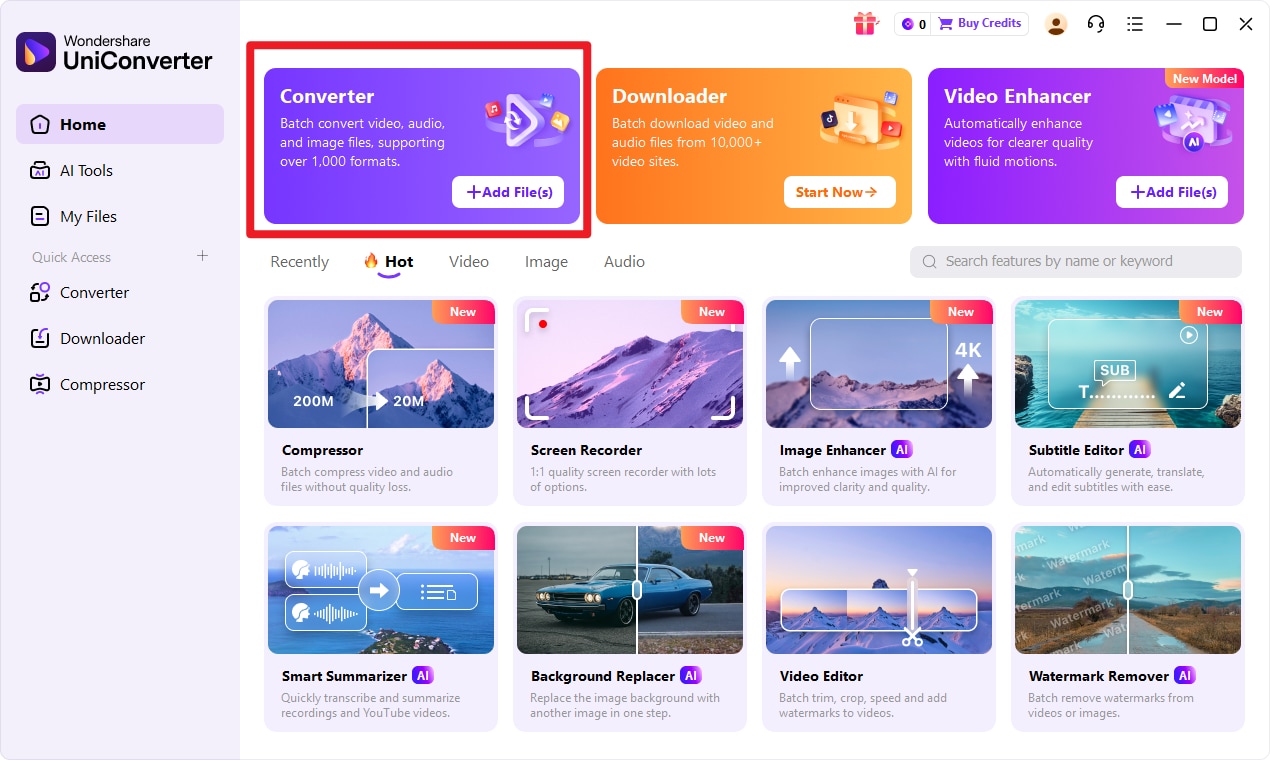
Step 1: Choose Converter in UniConverter
After launching Wondershare UniConverter on your computer, navigate to the main interface. On the left-side tool menu, select the Converter option to open the video conversion window.
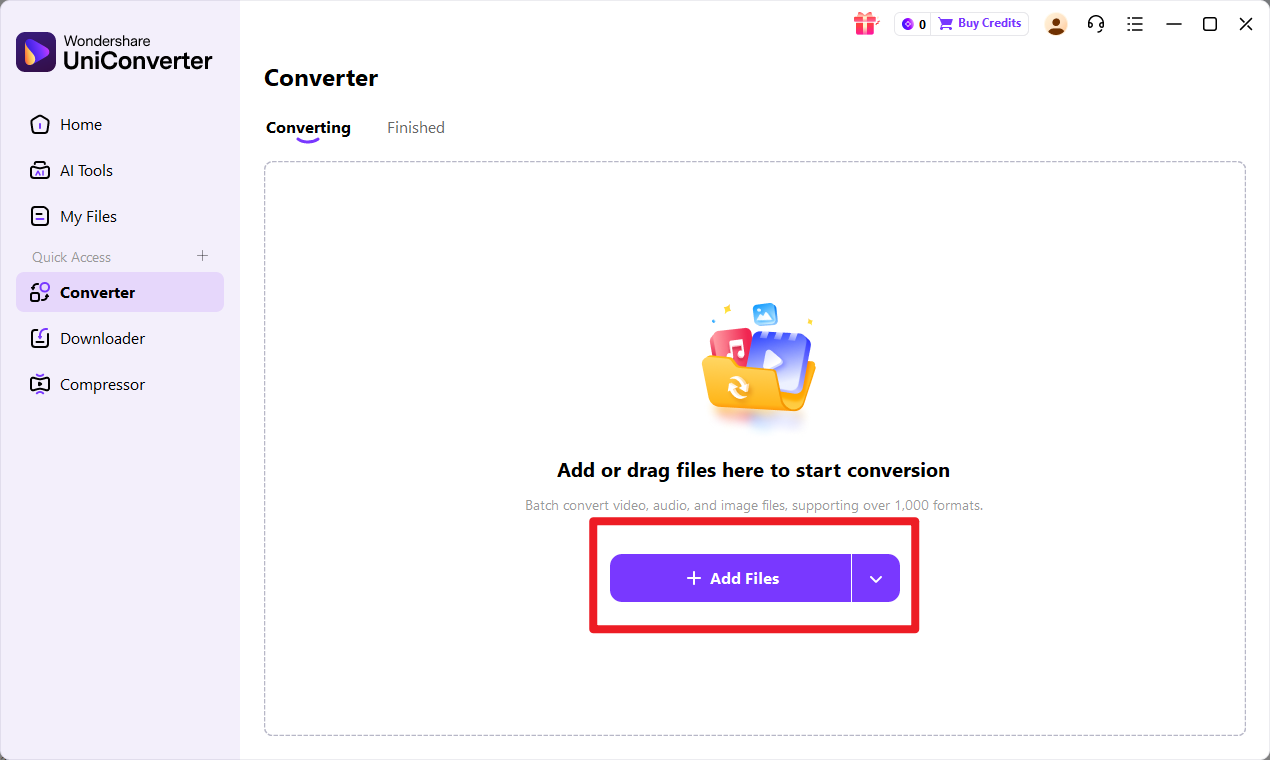
Step 2: Add Files to UniConverter
You can now add your input format files to the program. Either drag and drop the files directly onto the converter window or click the Add Files icon in the top-left corner to browse your computer's folders and import them.
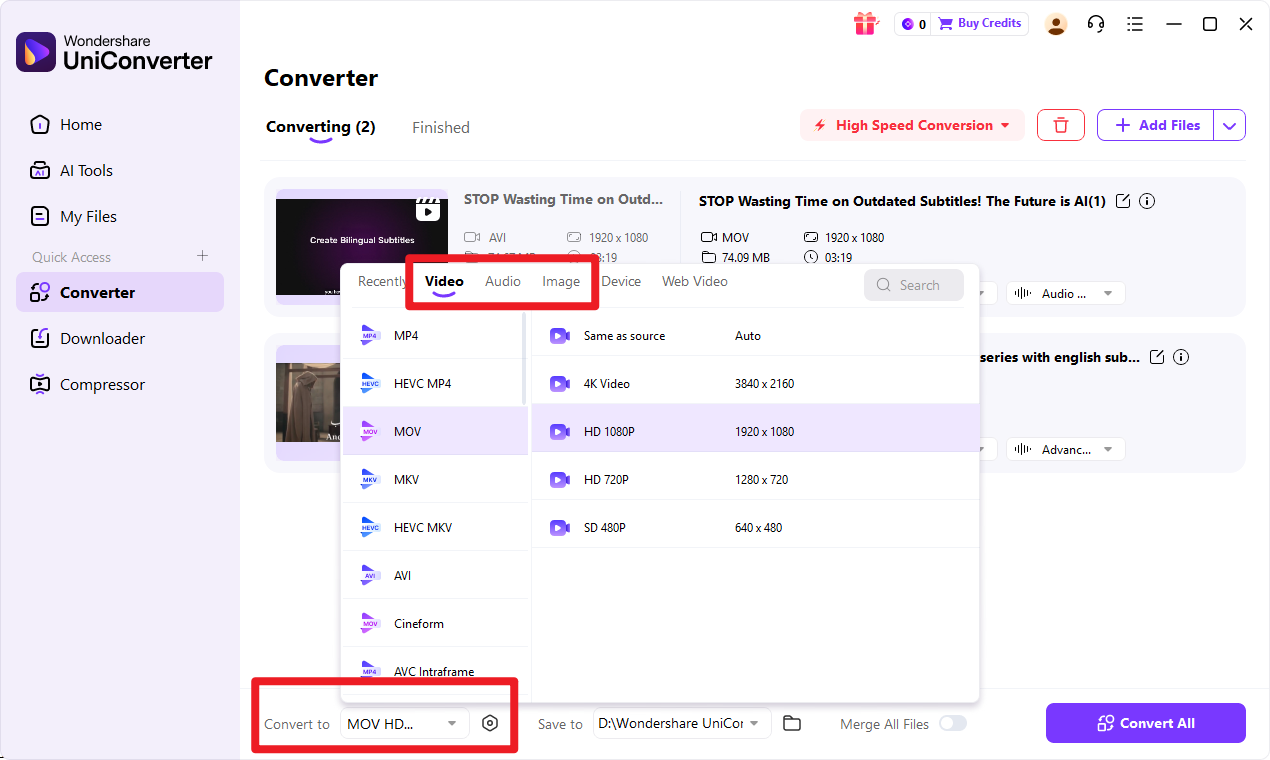
Step 3: Choose Output Format
Click on the Output Format tab located at the bottom of the window. This will open a new panel with a list of supported formats. Go to the Video tab, select your desired target format from the list on the left, and then choose a resolution on the right.
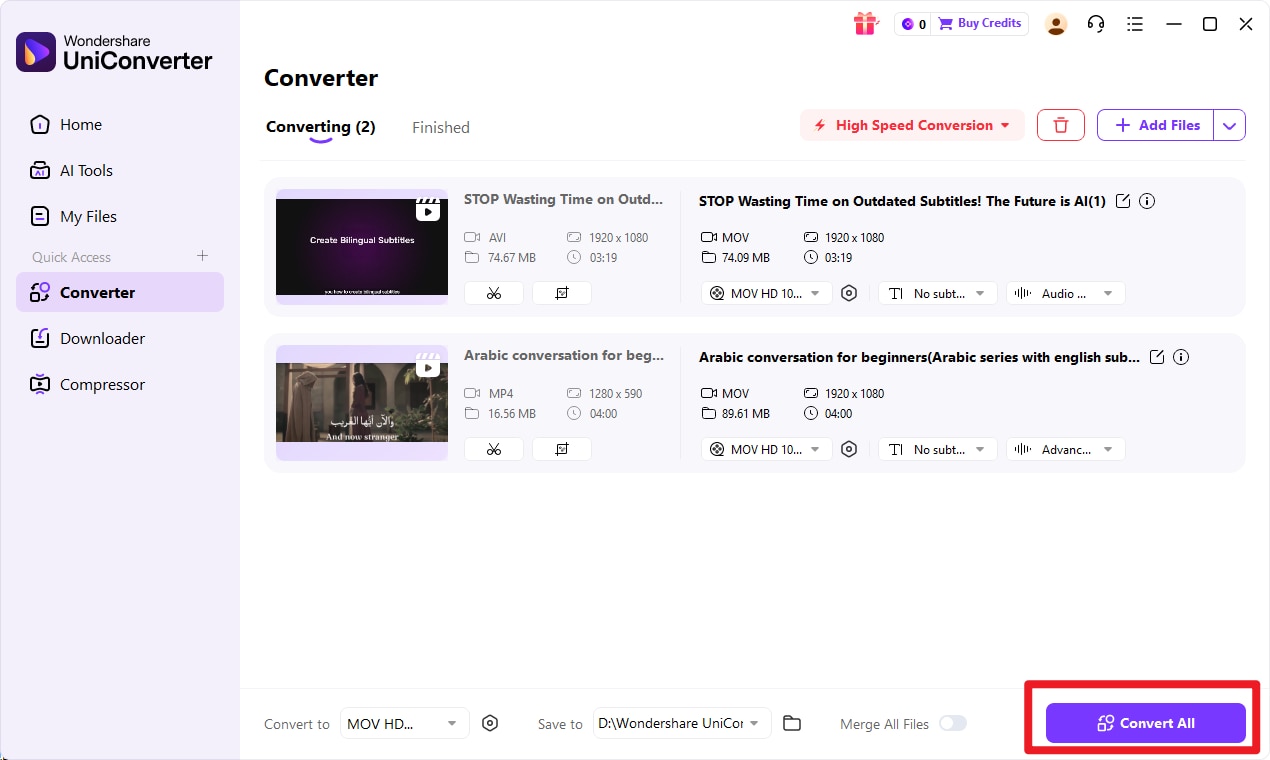
Step 4: Start the Conversion
Finally, choose a destination for your converted file by using the File Location menu at the bottom. Once you are ready, click the Start All button in the bottom-right corner to begin the batch conversion process. Your files will be converted quickly and saved to your chosen folder.

More Than Just a Video Converter
Conclusion
In the MOV vs RMVB debate, MOV emerges as the clear winner for all modern use cases. Its superior quality, broad compatibility, and central role in professional and consumer video workflows make it the go-to format for editing, archiving, and sharing. RMVB, while historically significant for its impressive compression, is now a legacy format plagued by playback challenges on contemporary devices. Its primary advantage of small file size has been largely superseded by more efficient, modern codecs like H.264 and H.265, which are often housed in universal containers like MP4.
Ultimately, the best way to handle any format-related problem—whether it's an unplayable RMVB file or a MOV file that's too large—is to use a versatile video converter. UniConverter stands out as the ideal choice, offering a user-friendly interface, lightning-fast conversion speeds, and support for over 1,000 formats. It empowers you to effortlessly convert MOV, RMVB, and countless other files, ensuring your videos are ready to play anywhere, anytime.
FAQs
-
1. Is RMVB still a good format?
For modern use, RMVB is not considered a good format. Its primary drawback is poor compatibility with current operating systems, media players, and mobile devices. It has been largely replaced by more efficient and widely supported formats like MP4, which can offer similar or better compression with far greater accessibility. -
2. Can I play RMVB on an iPhone?
No, you cannot play RMVB files natively on an iPhone or any other iOS device. The iOS operating system does not support the RMVB format. To watch an RMVB video on your iPhone, you must first convert the file to a compatible format like MOV or MP4 using a tool like UniConverter. -
3. Why should I convert MOV to RMVB?
This is an uncommon conversion, but the primary reason would be to drastically reduce a video's file size for storage on a device with extremely limited space, assuming that device has a player capable of handling RMVB files. In most scenarios, converting RMVB to MOV or MP4 is a much more common and practical need for improving compatibility. -
4. What is the best converter for MOV and RMVB?
UniConverter is a highly recommended tool for converting between MOV, RMVB, and over 1,000 other formats. It is celebrated for its speed, ease of use, and ability to maintain high quality during the conversion process, making it an excellent solution for both beginners and advanced users.
