
If you're a video editor, you've undoubtedly encountered the terms MOV and ProRes. You might have a camera that records in MOV, but your editing software struggles to keep up. Or perhaps a colleague told you to convert everything to ProRes for a smoother workflow, but you were shocked by the massive file sizes. This common dilemma often leads to confusion, wasted time, and workflow inefficiencies. Understanding the core differences between these two is crucial for anyone serious about video production. The debate over MOV vs ProRes isn't about which one is universally "better," but which one is the right tool for a specific job in your post-production pipeline.
Choosing the correct format at the right stage can be the difference between a fluid, creative editing session and a frustrating battle with lagging timelines and unexpected crashes. This guide will demystify these formats, break down their technical differences into practical terms, and provide you with a clear roadmap for when and how to use each one to optimize your video editing workflow in 2026.
In this article
Part 1. What is MOV? What is ProRes?
Before we can compare them, it's essential to understand that we're not always comparing two equal things. This is the most common point of confusion: MOV is a container, while ProRes is a codec. Think of it like this: the container is the box, and the codec is the item inside the box.
What is MOV?
MOV, which stands for QuickTime File Format, is a multimedia container format developed by Apple. As a "container," its job is to hold various types of data together in a single file, synchronized for playback. A MOV file can contain:
- A video track (the moving pictures)
- One or more audio tracks (dialogue, music, sound effects)
- Text tracks (subtitles or captions)
- Other metadata
The crucial thing to understand is that the video inside a MOV file can be compressed using many different codecs. The most common codecs you'll find in a MOV file are H.264 (AVC) and H.265 (HEVC), which are designed for efficient compression and small file sizes. However, a MOV file can also contain video encoded with ProRes. So, when someone gives you a ".mov" file, you know the container type, but you don't know the specific video codec inside without inspecting it further.
What is ProRes?
ProRes is a family of high-quality, lossy video compression formats—or codecs—also developed by Apple. Unlike H.264/H.265, which are designed primarily for final delivery and streaming, ProRes was specifically engineered as an intermediate codec. This means it's optimized for use during the video editing and post-production process.
Its main goal is to strike a balance between two competing needs: maintaining incredibly high visual quality and providing excellent real-time editing performance. It achieves this through a compression method called "intra-frame" compression, where each video frame is compressed individually. This requires less computational power to decode during editing, leading to a much smoother experience on the timeline, even with multiple layers and effects. This performance comes at the cost of a much larger file size compared to more heavily compressed delivery codecs.
Part 2. Quick Comparison Table
To make the differences clearer, here is a quick comparison table outlining the key characteristics of MOV (when using a typical delivery codec like H.264) versus ProRes.
| Feature | MOV (with H.264/H.265) | ProRes |
| Type | Container Format | Codec (usually within a MOV container) |
| Primary Use | General purpose, final delivery, and consumer-level recording. | Professional video editing and post-production. |
| Compression | High compression, inter-frame. | Low compression, intra-frame. |
| File Size | Small. | Very Large. |
| Editing Performance | Demanding on CPU, can be slow. | Smooth and fast, optimized for editing software. |
| Quality | Good for viewing, but quality degrades with re-editing. | Excellent, maintains visual fidelity through post-production. |
Part 3. MOV vs ProRes: Which One Is Better?
Now that we have the technical foundation, let's answer the practical question: which one should you use? The answer depends entirely on what you are trying to accomplish.
For Editing Performance and Speed
Winner: ProRes
There is no contest here. ProRes is the undisputed champion for editing performance. The reason lies in its intra-frame compression. When you scrub through a ProRes timeline, the editing software only needs to decompress and display one frame at a time.
In contrast, a MOV file using H.264/H.265 uses inter-frame compression. To display a single frame, your computer's CPU has to decode a group of pictures (GOP), looking at previous and subsequent frames to reconstruct the one you want to see. This is computationally intensive and the primary reason your timeline stutters, lags, or drops frames when editing footage straight from your camera, drone, or phone. By converting to ProRes, you are pre-processing the footage into a format your computer can handle with ease, resulting in a buttery-smooth editing experience.
For File Size and Sharing
Winner: MOV (with H.264/H.265)
The incredible editing performance of ProRes comes at a steep price: file size. A ProRes file can be 5x to 10x larger, or even more, than a visually similar H.264 MOV file. This makes ProRes impractical for many common scenarios.
When you need to upload a video to YouTube, send a preview to a client for review, or simply store a final project without consuming terabytes of storage, a MOV file with an H.264 or H.265 codec is the far superior choice. Its high compression efficiency creates small, portable files that are perfect for delivery and sharing over the internet.
For Video Quality and Color Grading
Winner: ProRes
While a high-bitrate H.264 file can look excellent to the naked eye, ProRes retains significantly more image information. Most ProRes variants support 10-bit color depth and 4:2:2 chroma subsampling. In simple terms, this means the file contains more granular information about color and brightness.
This extra data is a massive advantage during post-production, especially for color grading. When you push and pull the colors in a ProRes file, the image holds up beautifully, allowing for precise and dramatic adjustments without introducing ugly artifacts like banding or blockiness. Attempting the same level of grading on a heavily compressed 8-bit H.264 file will quickly cause the image to fall apart, as the necessary color information simply isn't there.
For Compatibility
Winner: MOV (with H.264/H.265)
A MOV file encoded with H.264 is one of the most universally compatible video formats in the world. It will play back on virtually any modern device—Windows PCs, Macs, Android phones, iPhones, smart TVs, and web browsers—without any special software.
ProRes, on the other hand, is a professional codec. While its adoption has grown, many consumer devices and basic media players cannot play it natively. A client trying to view a ProRes file on their Windows laptop without the proper codecs installed will likely just see an error message. Therefore, for final delivery to anyone outside a professional video environment, a standard MOV file is the safe and reliable choice.
Part 4. Use Cases for MOV and ProRes
Understanding the theory is one thing; applying it to your real-world workflow is another. Here's a practical breakdown of when to use each format.
When to Use MOV
- Final Delivery: This is the primary use case. After you've finished editing your masterpiece in ProRes, you should export it as a high-bitrate H.264 or H.265 MOV file for the final version. This creates a small, high-quality, and universally compatible file.
- Uploading to the Web: Platforms like YouTube, Vimeo, and Instagram are optimized for delivery codecs. Uploading a MOV (H.264) file will be significantly faster and is the recommended format for these services.
- Consumer-Level Recording: Most DSLRs, mirrorless cameras, drones, and smartphones record in MOV or MP4 containers with H.264/H.265 codecs. This is done to maximize recording time on memory cards and internal storage.
When to Use ProRes
- Editing and Post-Production: This is its reason for being. The best practice workflow is to take the MOV (H.264) files from your camera and transcode them into a ProRes format before you even start editing. This is known as creating "proxies" or "mezzanine" files. It's an extra step upfront that saves countless hours of frustration during the edit.
- High-Quality Capture: For professional productions, videographers often use external recorders (like an Atomos Ninja or Blackmagic Video Assist) connected to their camera. These devices can capture the video signal directly from the camera's sensor and encode it into ProRes, bypassing the camera's internal, more compressed recording format.
- Intensive Visual Effects and Color Grading: If your project involves heavy VFX, compositing, or aggressive color correction, working in ProRes is non-negotiable. It provides the robustness and data integrity needed to manipulate the image without destroying its quality.
Bridging the Gap: The Need for Conversion
As you can see, a professional video workflow isn't about choosing one format over the other; it's about using both at the appropriate stages. You start with a compressed MOV from your camera, need to convert it to ProRes for smooth editing, and then need to convert your final ProRes timeline back into a compressed MOV for delivery.
This constant need to move between formats makes a powerful and reliable video converter an essential tool in any editor's arsenal. You need software that is fast, supports professional codecs like ProRes, and maintains the highest possible quality during the conversion process. For managing these critical workflow conversions reliably, we recommend Wondershare UniConverter as a top-tier solution that handles these tasks with ease and efficiency.
Part 5. Step-by-Step Guide to Convert MOV to ProRes Using UniConverter
To gain the performance benefits of ProRes for editing, you can easily convert your MOV files. Here is how to do it in four simple steps with UniConverter.
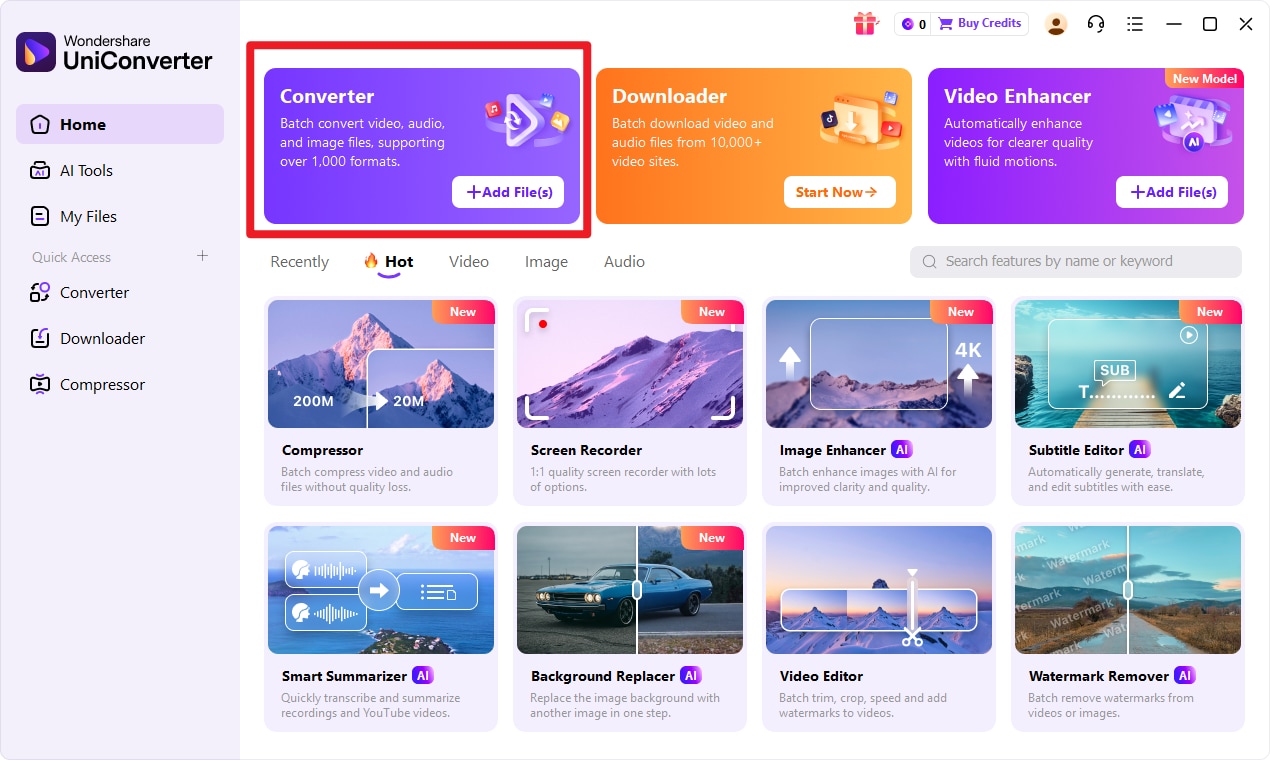
Step 1: Launch Wondershare UniConverter
Launch Wondershare UniConverter on your computer. Click on the 'Converter' Tab to jump to converter feature panel.
Step 2: Add Your MOV File to UniConverter
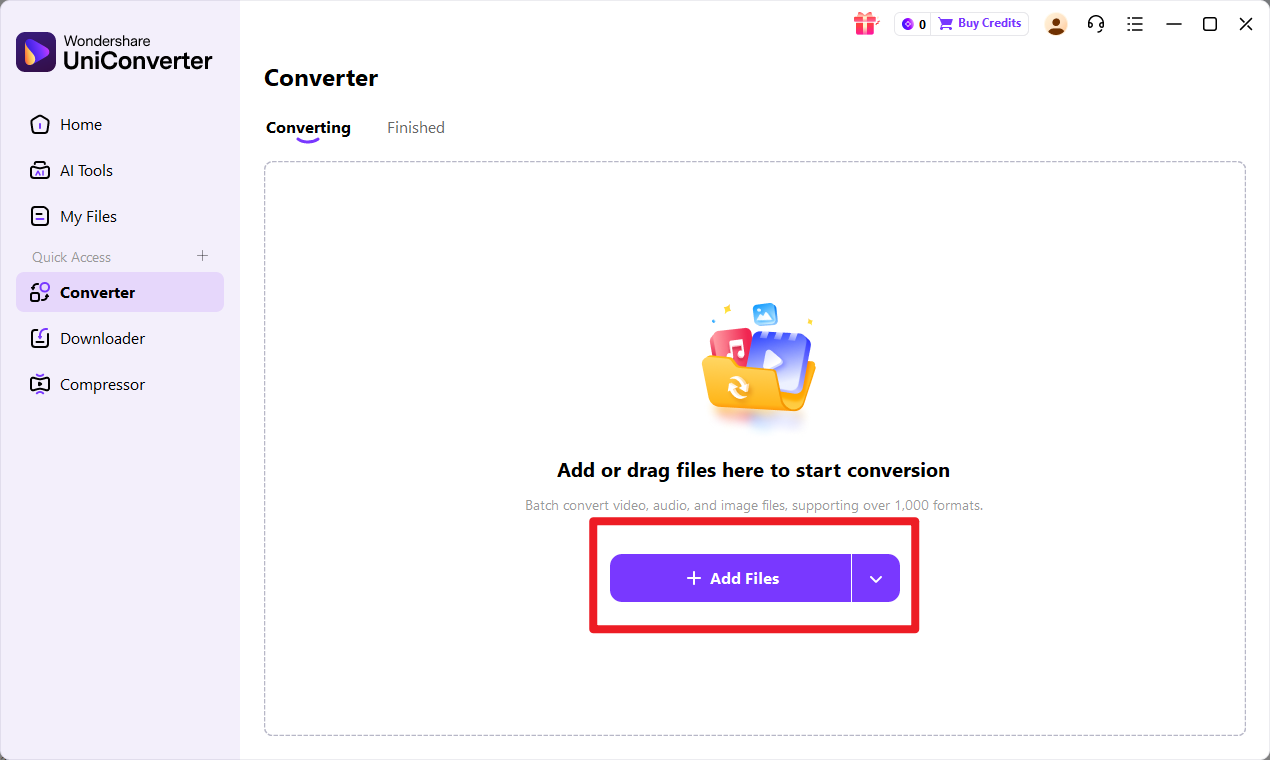
On the main 'Converter' screen, you can either drag and drop your MOV file directly into the program window or click the 'Add Files' icon in the top-left corner to browse and import your video from your computer.
Step 3: Choose Output Format
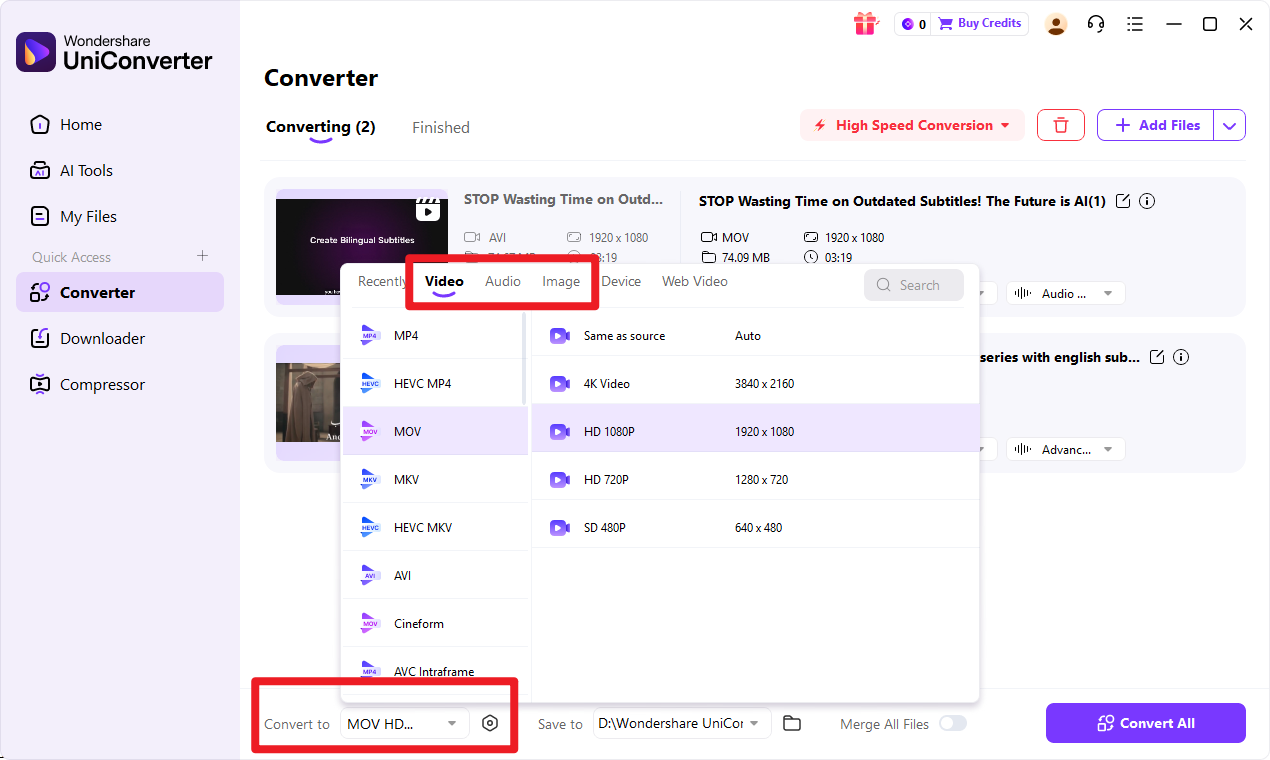
Click on the 'Output Format' menu located at the bottom of the window. This will open a new dialog box with a wide range of format options. Navigate to the 'Editing' tab. From the list of professional codecs on the left, select 'ProRes'. On the right, you can then choose your desired quality level, such as ProRes 422 or ProRes 422 HQ for a great balance of quality and performance.
Step 4: Start the Conversion
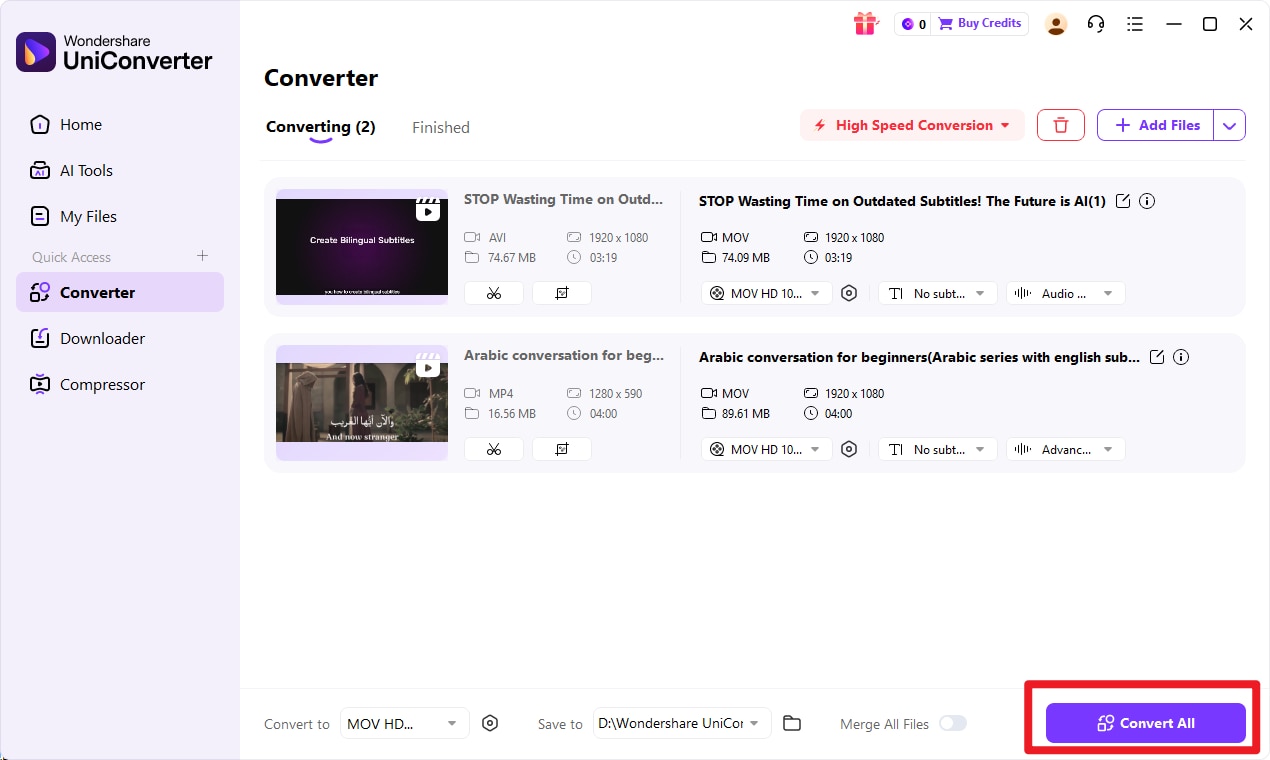
Before starting the conversion, you need to tell UniConverter where to save the new file. At the bottom of the main window, you'll find the 'File Location' field. Click on it to browse your computer's folders and select a destination where you want the converted ProRes file to be saved. It's good practice to create a dedicated "ProRes Media" folder within your project directory.
Once you have your file loaded and the settings configured, you're ready to convert. Simply click the 'Convert' button located to the right of the file. If you have added multiple files to convert in a batch, you can click the 'Start All' button in the bottom-right corner. UniConverter will then efficiently process your file(s) and create a new, edit-ready ProRes video in your chosen destination folder.

More Than Just a Video Converter
Conclusion
In the MOV vs ProRes debate, it's clear there is no single "best" format—only the right format for the right task. The key to a professional and efficient video production workflow is understanding the strengths and weaknesses of each. Use the high-performance, data-rich ProRes format for a smooth, high-quality editing experience where creative flow is paramount. When your edit is complete, switch to a universally compatible and highly compressed MOV (with an H.264/H.265 codec) for final delivery, sharing, and archiving.
By embracing this two-format strategy, you get the best of both worlds: speed and quality during post-production, and convenience and compatibility for distribution. For seamless and reliable transitions between these essential formats, a powerful tool like Wondershare UniConverter is an indispensable asset for any modern video creator in 2026.
FAQs
-
1. Is ProRes always in a MOV container?
Yes, for the vast majority of use cases, this is true. When you create or export a video using any of the Apple ProRes codecs, the video and audio data are typically wrapped inside a QuickTime (.mov) container file. While technically other containers could be used, .mov is the native and standard implementation. -
2. Does converting a standard MOV to ProRes improve its quality?
No, you cannot create image detail that wasn't captured in the original file. Converting a compressed H.264 MOV file to ProRes does not magically add quality or sharpness. What it does is transcode the video into a format that perfectly preserves its current quality and is structurally much easier for your computer to handle during editing. This prevents further quality loss from repeated re-compression during the editing process and, most importantly, gives you a massive performance boost. -
3. Why is editing H.264 MOV files so slow?
H.264 uses a highly efficient but complex compression scheme called "inter-frame" compression. This means that to save space, most frames only store the *changes* from the previous frame. When you ask your editing software to play or jump to a specific frame, the CPU has to decode a whole group of surrounding frames to reconstruct the image. This is very CPU-intensive and causes the lag and stuttering you experience. ProRes's "intra-frame" compression avoids this by compressing every frame independently, making it much easier to decode. -
4. Can I use ProRes for my final YouTube upload?
You can, but it is highly discouraged. YouTube's ingestion system will accept ProRes files, but the file sizes are enormous. A short video in ProRes can be many gigabytes, which will lead to extremely long upload times, even on a fast internet connection. After you upload it, YouTube will re-compress it to its own delivery standards anyway. It is far more efficient to export a high-bitrate H.264 MOV file from your editor and upload that instead.
