
If you've ever worked with footage from a high-definition camcorder, you've likely encountered MTS files. And if you've tried to edit or play that footage, especially on a Mac, you've probably run into compatibility issues. This often leads to a crucial question in the video world: what's the deal with MOV vs MTS? While both are video file formats, they serve very different purposes and have distinct advantages and disadvantages. Understanding these differences is key to creating a smooth and efficient video workflow, from capture to final edit.
Many users, from budding videographers to seasoned editors, find themselves needing to convert MTS files to a more universally friendly format like MOV. This guide is here to demystify these two formats. We'll break down their technical specifications, compare them head-to-head, and show you the best scenarios for using each. Most importantly, we'll provide a straightforward solution for converting your MTS files to MOV without sacrificing the quality you worked so hard to capture.
In this article:
Part 1. What is MOV? What is MTS?
Before we can compare these two formats, it's essential to understand what each one is on a fundamental level. They are both "containers," meaning they can hold various data streams like video, audio, and metadata, but their design and intended use are quite different.
What is a MOV file?
The MOV format, also known as the QuickTime File Format (QTFF), was developed by Apple. As its name suggests, it is intrinsically linked to Apple's QuickTime framework. This native integration makes it the go-to format for anyone working within the Apple ecosystem. If you're using a Mac, iPhone, or iPad, MOV files will play and edit seamlessly without the need for third-party software or codecs.
Beyond simple playback, MOV is highly regarded in the professional video editing community. Major non-linear editing systems (NLEs) like Apple's Final Cut Pro and Adobe Premiere Pro offer robust support for MOV. The format is capable of containing high-quality, minimally compressed video data (using codecs like ProRes), which makes it ideal for post-production where maintaining image fidelity is paramount. A single MOV file can package video tracks, multiple audio channels, subtitles, and other metadata, making it a versatile and powerful container for complex projects.
What is an MTS file?
MTS, which stands for MPEG Transport Stream, is a video container format primarily associated with the AVCHD (Advanced Video Coding High Definition) standard. This format is the default for a vast range of consumer and prosumer HD camcorders manufactured by brands like Sony and Panasonic. When you record video on one of these cameras, the footage is typically saved as .mts files.
The format uses the H.264/MPEG-4 AVC video compression standard, which is highly efficient at creating high-quality video files at relatively small sizes. However, this efficiency comes at a cost. MTS files are part of a complex AVCHD directory structure and are not designed for direct editing or universal playback. Their primary purpose is to store captured footage on the camera's memory card. As a result, many users encounter significant compatibility and performance problems when trying to use MTS files on computers, particularly on macOS, which does not natively support the format.
Part 2. Quick Comparison Table
To get a clear, at-a-glance understanding of the key differences between MOV and MTS, here is a side-by-side comparison table.
| Feature | MOV | MTS |
| Developer | Apple Inc. | Sony & Panasonic (as part of the AVCHD standard) |
| Primary Use | Video editing, playback on Apple devices, professional post-production. | High-definition video recording on camcorders. |
| Compatibility | Excellent, especially on macOS and iOS. Widely supported by editing software and media players. | Limited. Often requires specific codecs or players; poor native support on Mac. |
| Quality | Can be very high (lossless) depending on the codec (e.g., ProRes). | Excellent source quality, as it's the direct output from the camera sensor. |
| File Size | Can be very large, especially when using professional, less-compressed codecs. | Highly compressed, resulting in smaller file sizes for the quality. |
| Common Codecs | H.264, H.265 (HEVC), Apple ProRes, and others. | H.264/MPEG-4 AVC. |
Part 3. MOV vs MTS: Which One Is Better?
The question of which format is "better" ultimately depends on your specific needs and what you intend to do with the video file. Let's break it down by the most common user concerns: compatibility, editing, and quality.
For Compatibility and Playback
When it comes to compatibility, MOV is the undisputed winner. Its native integration with all Apple products—Macs, iPhones, iPads, Apple TV—means you can play, share, and airdrop MOV files without a second thought. QuickTime Player handles them perfectly, as do most other media players across both Windows and macOS.
MTS, on the other hand, is a frequent source of frustration. Trying to open an MTS file on a Mac with QuickTime will result in an error. While third-party players like VLC can often handle them, it's not a guaranteed or seamless experience. For sharing with others or ensuring your video plays on any device, MTS is an unreliable choice. For universal playback and ease of use, MOV is far superior.
For Video Editing
For video editing workflows, MOV is the industry-preferred format, especially for those using Final Cut Pro, iMovie, or Adobe Premiere Pro on a Mac. MOV files, particularly when encoded with editing-friendly codecs like Apple ProRes, are less compressed. This means the computer's processor doesn't have to work as hard to decompress the file in real-time as you scrub through the timeline. The result is a smoother, more responsive editing experience with fewer dropped frames, lags, or crashes.
Editing MTS files directly is possible in some modern NLEs, but it is often a resource-intensive process that can lead to poor performance. The highly compressed nature of the H.264 codec in an MTS container can strain your system. For this reason, a common professional practice is to transcode MTS footage to an editing-friendly format like MOV (ProRes) before starting the post-production process. This "proxy" or "mezzanine" workflow ensures maximum stability and performance.
For Quality and Storage
This is where the distinction becomes more nuanced. Both MOV and MTS are simply containers; the actual video quality is determined by the data inside—specifically, the codec, bitrate, resolution, and frame rate used during recording.
An MTS file straight from a high-quality camera contains excellent, pristine footage. It is the original source material. A MOV file can contain anything from a highly compressed web video to a completely lossless master file. Therefore, you cannot say one container inherently has better quality than the other.
The critical factor is what happens during conversion. If you convert an MTS file to MOV using a subpar tool, you will likely see a degradation in quality. However, when using a professional-grade converter, you can transcode your MTS file to a high-quality MOV (for example, using the same H.264 codec or a visually lossless one like ProRes) with virtually no perceptible loss of quality. The goal of conversion isn't to improve quality but to change the file's "wrapper" to one that is better suited for editing and playback, while preserving the integrity of the original footage.
Part 4. Use Cases for MOV and MTS
Understanding the ideal scenarios for each format can help you build a more efficient video production pipeline.
When to Use MOV
The versatility of the MOV format makes it suitable for a wide range of applications after the initial recording phase. You should use or convert to MOV in the following situations:
- Editing on a Mac: If your post-production workflow involves Final Cut Pro, iMovie, or even Adobe Premiere Pro on macOS, MOV is the most stable and performant choice.
- Content for Apple Devices: When creating videos intended for playback on iPhones, iPads, or Apple TV, saving them as MOV files ensures flawless compatibility.
- Professional Archives and Delivery: For delivering final projects to clients or creating master archive files, MOV (often with a ProRes codec) is a standard in the professional video industry due to its ability to maintain high quality.
- Sharing and Collaboration: When you need to share a video file and be confident that the recipient can open it, MOV is a much safer bet than MTS.
When to Use MTS
The use case for MTS is much more specific and limited. In reality, you don't "choose" to use MTS; it is the format your camera provides.
- Initial Video Capture: The primary and virtually only use case for the MTS format is the act of recording high-definition video footage onto a camcorder's memory card. It is optimized for capturing high-quality video efficiently within the camera's hardware.
- Source Footage Archive: Some videographers choose to keep the original MTS files from the camera card as a raw backup of the source footage.
For any subsequent step—be it editing, color grading, sharing, or uploading—it is almost always recommended to convert the MTS files into a more flexible and widely supported format like MOV or MP4. Think of MTS as the raw negative and MOV as the developed print ready for display and manipulation.
Part 5. Step-by-Step Guide to Convert MTS to MOV Using UniConverter
If you're struggling with MTS file incompatibility or poor editing performance, the most effective solution is to convert them to a universally supported format like MOV. Wondershare UniConverter is a powerful and intuitive tool that makes this process simple and fast while maintaining the original video quality. It supports over 1000 formats and is designed for high-speed, lossless conversions, making it the first choice for any video conversion needs in 2026.
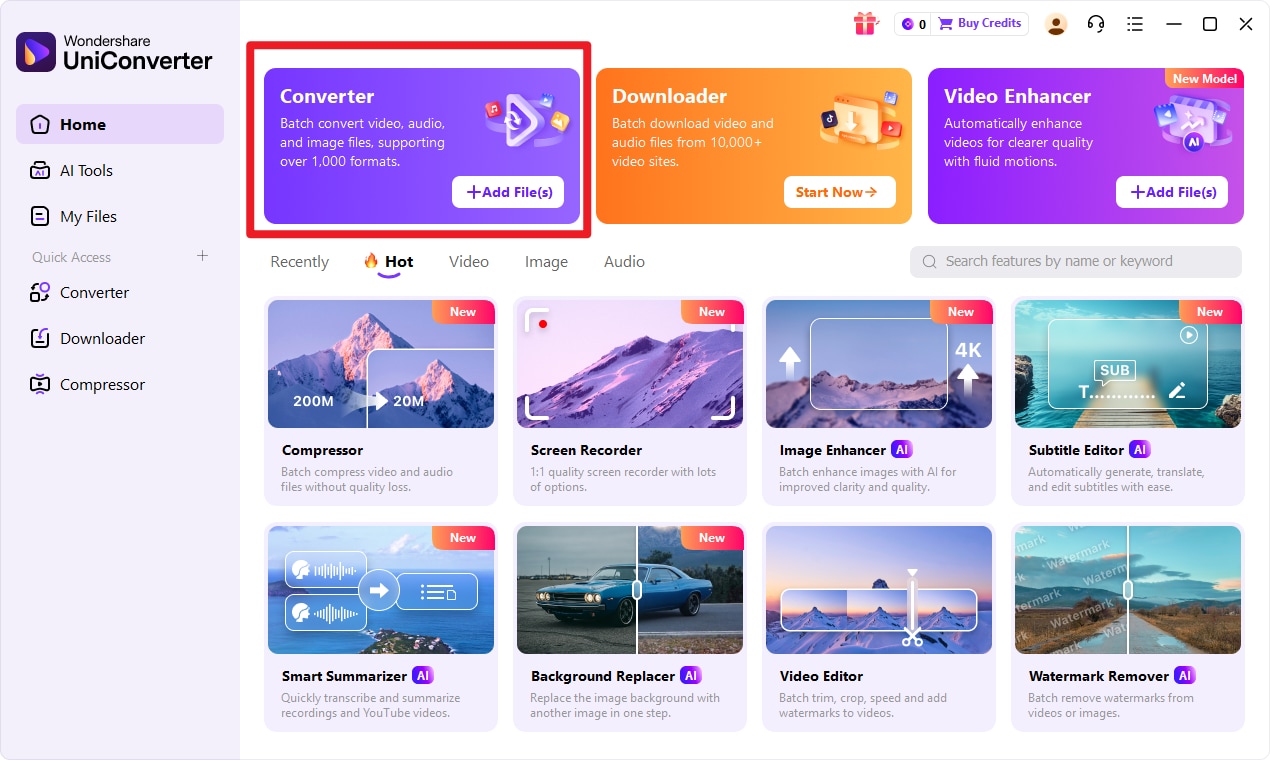
Step 1. Choose Converter in UniConverter
Launch Wondershare UniConverter on your computer. On the main interface, look at the menu on the left side and click on the Converter tool to open the video conversion window.
Step 2. Add Files to UniConverter
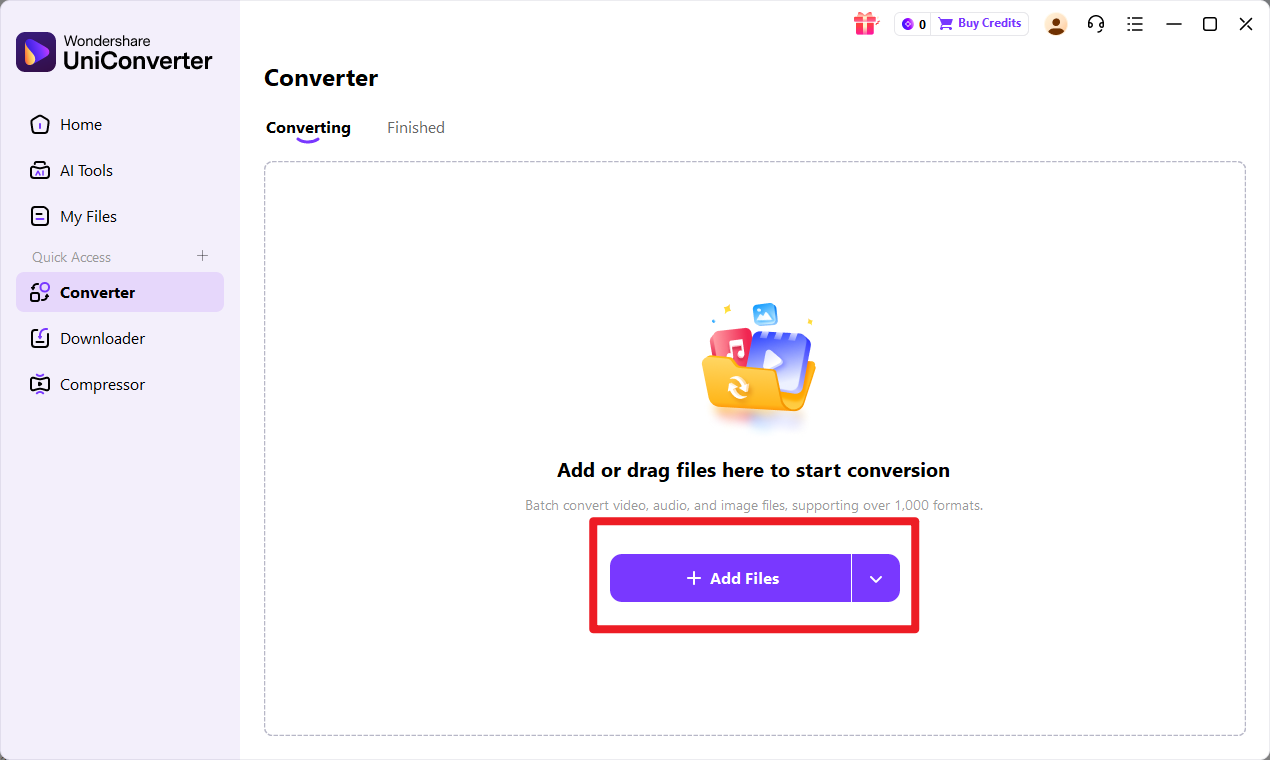
You can now add your MTS files to the program. Either drag the input format files from your folder and drop them directly onto the UniConverter window, or click the Add Files button in the top-left corner to browse your computer's storage and select the files you want to convert.
Step 3. Choose Output Format
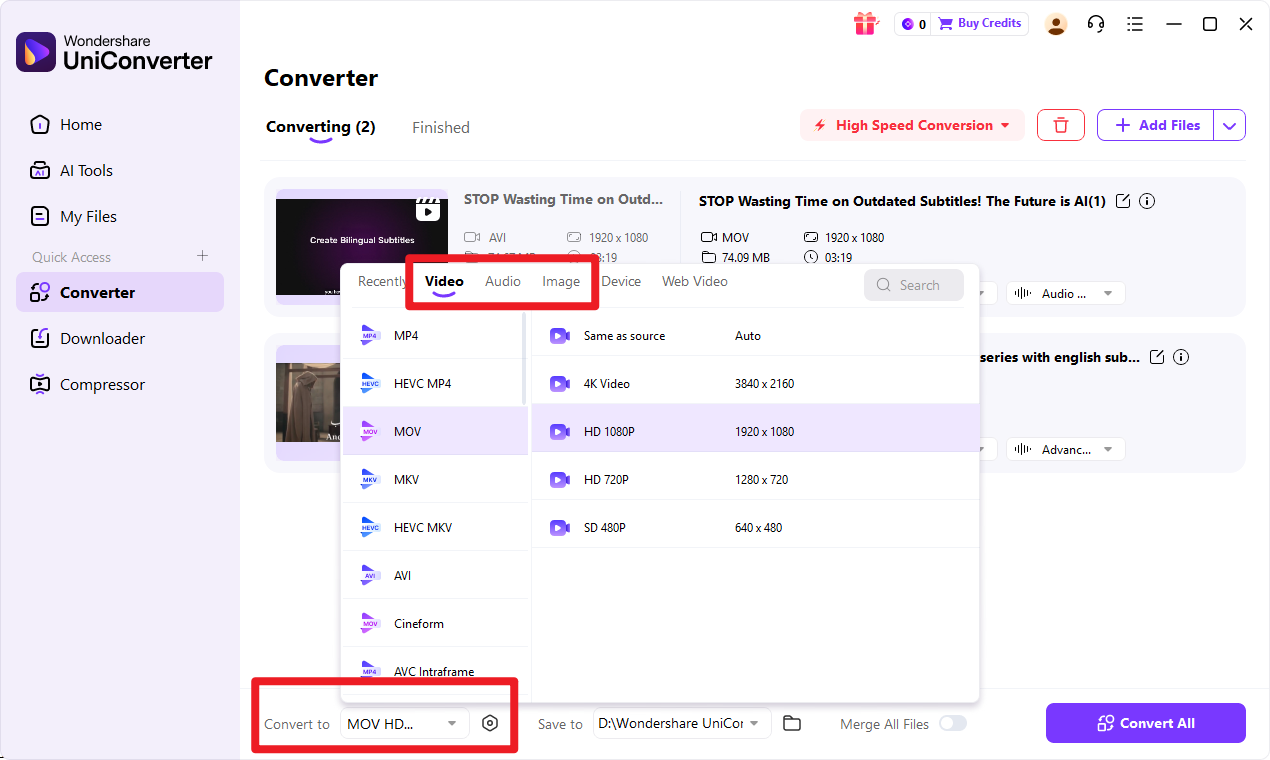
At the bottom of the window, click on the Output Format menu. A new window will appear. Select the Video tab, and from the list on the left, choose your desired target format. You can also select the desired resolution on the right.
Step 4. Start the Conversion
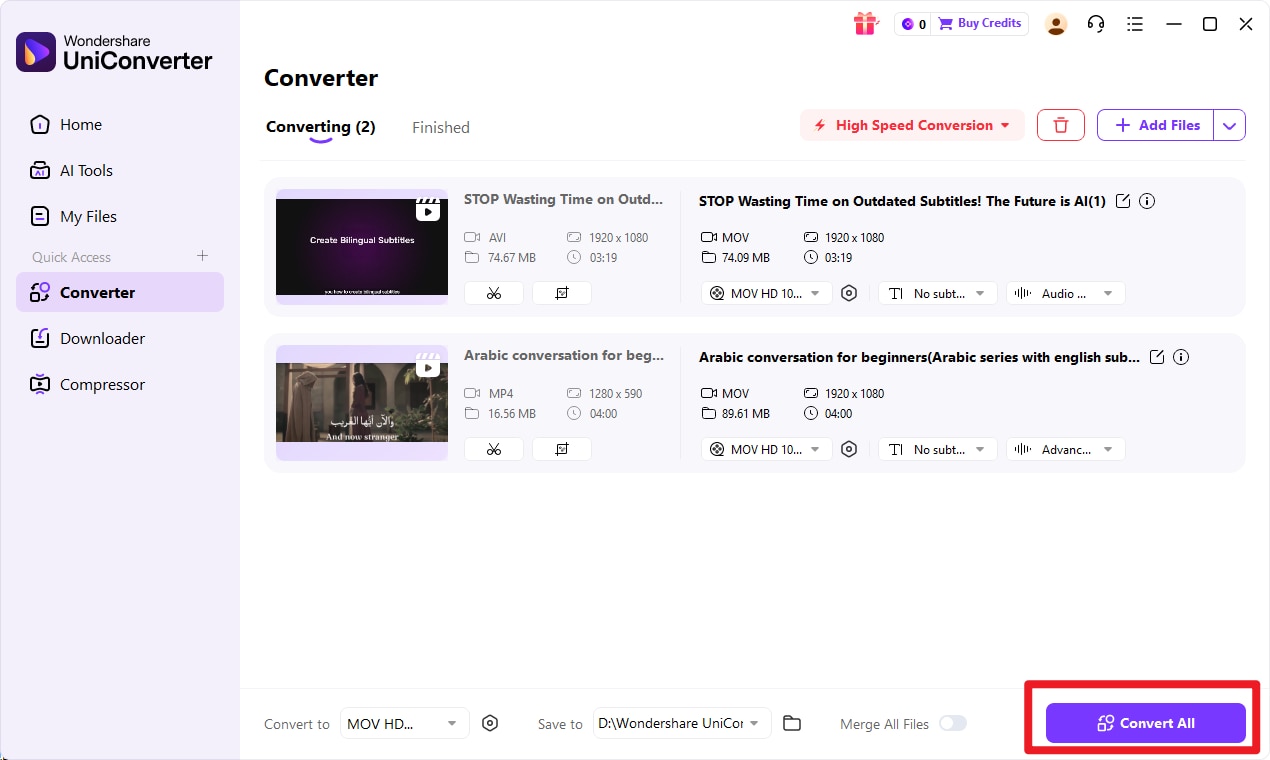
Before starting, you can specify where to save the converted files by using the File Location option at the bottom. Once you are ready, click the Start All button in the bottom-right corner to begin the batch conversion process. Your files will be converted quickly and saved to your chosen folder.

More Than Just an MTS to MOV Converter
Conclusion
In the MOV vs MTS debate, there is no single "better" format; the right choice depends entirely on the context. MTS excels at its designated job: capturing high-definition video footage directly on a camcorder. However, for nearly every other task—editing, playback, sharing, and archiving—MOV is the far superior, more compatible, and more stable format. For anyone working with MTS footage from a camera, the most practical and professional workflow involves converting it to MOV. This crucial step bridges the gap between raw capture and a smooth post-production process. By using a reliable and efficient tool like UniConverter, you can ensure this conversion is fast, easy, and completely lossless, preserving the pristine quality of your original footage while unlocking universal compatibility.
FAQs
-
1. Is MTS the same as AVCHD?
Not exactly. AVCHD (Advanced Video Coding High Definition) is the name of the recording format or standard. MTS is the file extension (.mts) used for the actual video files that are created within the AVCHD folder structure on the camera's memory card. So, MTS is the file, and AVCHD is the framework it belongs to. -
2. Will I lose quality when converting MTS to MOV?
Quality loss is a valid concern, but it entirely depends on the software you use. Free or low-quality converters may re-compress your video and cause visible degradation. However, a professional tool like Wondershare UniConverter is engineered to perform conversions with zero quality loss. It can change the container from MTS to MOV while keeping the internal video and audio data intact, preserving the original high-definition footage. -
3. Can I play MTS files on a Mac?
Natively, no. Apple's default applications like QuickTime Player and the Photos app cannot open or play .mts files. While you can install third-party media players like VLC, which usually have the necessary codecs to play MTS files, this is just a playback solution. For seamless integration with the Apple ecosystem, including editing in iMovie or Final Cut Pro, converting the files to MOV is the best and most reliable option. -
4. Why is MOV better for video editing?
MOV is generally better for video editing for two main reasons. First, it is natively supported by most professional editing software, especially on Mac, which ensures stability. Second, MOV files can use editing-friendly codecs (like Apple ProRes) that are less compressed than the H.264 codec found in MTS files. This "intra-frame" compression is much easier for a computer to process, allowing for smoother timeline scrubbing, faster rendering, and a more responsive, crash-free editing experience.
