
Navigating the world of video formats can often feel like learning a new language. You've just finished editing a brilliant video, and now you're faced with a crucial decision: which format should you export it in? Two common options you'll encounter are MOV and MPG. While they may seem similar on the surface, they serve very different purposes. Choosing the wrong one can lead to compatibility headaches, oversized files, or a noticeable drop in quality. This guide will demystify the MOV vs MPG debate, helping you understand their core differences so you can make the best choice for your project every time.
Whether you're a professional video editor, a student creating a multimedia presentation, or simply someone trying to share a family video, this article will provide the clarity you need. We'll break down the strengths and weaknesses of each format and show you how to get the best of both worlds.
In this article:
Part 1. What is a MOV File? What is an MPG File?
Before we can compare these two formats, it's essential to understand what each one is and where it came from. Their origins and design philosophies are the root of their differences.
What is a MOV File?
The MOV format, also known as the QuickTime File Format (QTFF), was developed by Apple in the early 1990s. It was designed to work seamlessly within the QuickTime framework, Apple's proprietary multimedia architecture. A MOV file is a "container" format, which means it doesn't just hold video data; it can also contain audio, text (like subtitles), images, and other metadata all within a single file.
Because of its Apple origins, MOV is the native format for devices running macOS and iOS. It's the default export format for many applications in the Apple ecosystem, including professional video editing software like Final Cut Pro and consumer-level tools like iMovie. MOV files are renowned for their ability to maintain high video quality, making them a favorite among video professionals for editing and archiving master copies of their work. They can use a variety of codecs, from older ones to modern, efficient ones like H.264 and HEVC (H.265), which allows for a great balance between quality and file size.
What is an MPG File?
The MPG (also seen as MPEG) format was developed by the Moving Picture Experts Group, a working group responsible for setting standards for audio and video compression and transmission. Unlike MOV, which is tied to a specific company, MPG is an international standard. The primary goal behind the MPG format was to create a method for compressing video and audio into smaller files without a catastrophic loss of quality, making them easier to store and share.
MPG files use lossy compression, meaning some data is permanently discarded during the compression process to achieve a smaller file size. While this sounds like a major drawback, the compression is designed to remove information that the human eye is less likely to notice. This makes MPG an incredibly efficient format for distribution. Its status as an international standard ensures a very high degree of compatibility. An MPG file will play on virtually any computer, media player, or device, regardless of the operating system, often without needing any additional software or codecs. This universal playability is its greatest strength.
Part 2. Quick Comparison Table
To see the differences at a glance, here is a direct comparison of MOV and MPG based on several key factors.
| Feature | MOV | MPG |
| Developer | Apple Inc. | Moving Picture Experts Group (MPEG) |
| Compatibility | Excellent on Apple devices; may require third-party players or codecs on Windows/Android. | Excellent across all platforms and devices (Windows, macOS, Linux, Android, etc.). |
| Typical Use Case | Professional video editing, high-quality archiving, content creation within the Apple ecosystem. | Web video, streaming, email attachments, DVD video, sharing for broad compatibility. |
| Compression Quality | Can be lossless or lossy. Often uses advanced codecs (e.g., H.264, ProRes) to preserve high quality. | Primarily uses lossy compression (MPEG-1, MPEG-2) to reduce file size. |
| File Size | Can be very large (for high quality) or relatively small (with modern codecs). | Generally smaller and more compressed than a high-quality MOV file. |
| Platform Preference | macOS and iOS. | Platform-agnostic; works universally. |
Part 3. MOV vs MPG: Which One Is Better?
"Better" is a subjective term that depends entirely on your specific needs. Let's break down the comparison into three critical areas: compatibility, quality, and file size, to help you decide which is better for your situation.
Compatibility: The Universal Player
When it comes to playing a video on the widest possible range of devices, MPG is the undisputed champion. As an industry standard, it was designed from the ground up for cross-platform compatibility. You can be confident that an MPG file you create will play on almost any Windows PC, Mac, Linux machine, smart TV, or mobile device without any fuss. This makes it the safest choice when you're distributing a video to a large, diverse audience and you don't know what devices they'll be using.
MOV, on the other hand, lives most comfortably in the Apple ecosystem. It plays natively and perfectly on iPhones, iPads, and Macs. However, when you move outside of that ecosystem, you can run into trouble. A standard Windows PC might not be able to play a MOV file out of the box. The user would need to install a media player that supports it, like the popular VLC Media Player, or install specific codecs to enable playback in Windows Media Player. This extra step can be a barrier for less tech-savvy viewers.
Winner for Compatibility: MPG
Quality and Compression: The Editor's Choice
This is where MOV truly shines. As a container format, MOV can utilize a wide range of codecs, including very high-quality and even lossless ones like Apple ProRes. This flexibility allows video editors to work with footage that retains as much of the original data as possible. When you're color grading, adding effects, and making precise edits, working with a high-quality source file is crucial to avoid introducing artifacts or degradation. Modern MOV files often use the H.264 codec, which provides excellent video quality at manageable file sizes.
MPG, particularly the older MPEG-1 and MPEG-2 standards, relies on more dated compression techniques. Its primary goal is to make the file small, and it achieves this through lossy compression. While the quality is perfectly acceptable for general viewing, it's not ideal for a professional editing workflow. Editing and re-exporting a compressed MPG file multiple times can lead to a noticeable cumulative loss of quality. Therefore, for any task that involves serious editing or archiving a master version of your video, MOV is the superior choice.
Winner for Quality: MOV
File Size: Efficiency Matters
The relationship between file size and format is complex. An uncompressed MOV file will be enormous, while a highly compressed MPG file will be very small. However, a more useful comparison is to look at file size for a similar level of visual quality.
Thanks to its ability to use modern and efficient codecs like H.264 or HEVC (H.265), a MOV file can often achieve better visual quality at a smaller file size than an equivalent MPG file using an older codec like MPEG-2. The newer codecs are simply better at compressing video without sacrificing as much detail.
However, the purpose of the formats often dictates the typical file size. MPG is designed for distribution, so files are usually heavily compressed to be as small as possible for easy sharing. MOV is often used for editing, where quality is prioritized over file size. So, while a MOV can be smaller, an MPG file is intended to be small.
Winner for Efficiency: It's a tie, depending on the codec used and the intended purpose.
The Verdict: Which Format Should You Use?
The decision comes down to your workflow and your audience.
- Choose MOV if: You are editing a video project, especially on a Mac using software like Final Cut Pro. You need to preserve the highest possible quality for archiving or further post-production. The primary audience for your video uses Apple devices.
- Choose MPG if: Your top priority is ensuring your video can be played by anyone, on any device, without any issues. You need to send the video via email, embed it on a website, or share it on a platform with strict file size limits.
Part 4. Use Cases for MOV and MPG
Understanding the theory is one thing, but seeing how these formats are used in the real world makes the choice even clearer.
When to Use MOV
- Professional Video Editing: If you're working in Final Cut Pro, Adobe Premiere Pro, or DaVinci Resolve, using MOV (often with a ProRes codec) is standard practice for maintaining maximum fidelity throughout the editing process.
- Archiving Master Files: After you've finished a project, saving a high-quality master copy in MOV format ensures you have a pristine version you can return to later to create different versions or exports.
- Apple-Centric Content: If you are creating a video tutorial specifically for iPhone users or a presentation to be shown on a MacBook, MOV is the natural and most reliable choice.
When to Use MPG
- Website Video: When you embed a video on your website, you want it to load quickly and play for all visitors. MPG's small file size and universal compatibility make it an excellent choice.
- Emailing Videos: Email servers have strict attachment size limits. Compressing a video into a small MPG file is often the only way to share it directly via email.
- Legacy Devices: If you need to create a video that will play on an older DVD player, digital photo frame, or other hardware with limited codec support, the MPG format is your most reliable bet.
Bridging the Gap: Getting the Best of Both Worlds
You don't have to be locked into one format. In fact, the most effective professional workflow often involves using both. You can edit your project in a high-quality MOV file to preserve all the detail and creative flexibility. Then, once the edit is complete and you're ready to share it with the world, you can export or convert a version to the highly compatible MPG format.
This gives you the best of both worlds: a high-quality master file for your archives and a universally playable version for distribution. The key to this process is using a powerful and reliable video converter that can make the switch without a significant loss in quality. This is precisely where a tool like Wondershare UniConverter becomes invaluable. It's designed to handle these conversions smoothly, allowing you to easily adapt your video for any purpose.
Part 5. Step-by-Step Guide to Convert MOV to MPG Using UniConverter
If you have a high-quality MOV file that you need to share with a wider audience, converting it to the universally compatible MPG format is the perfect solution. Wondershare UniConverter makes this process incredibly simple and fast.
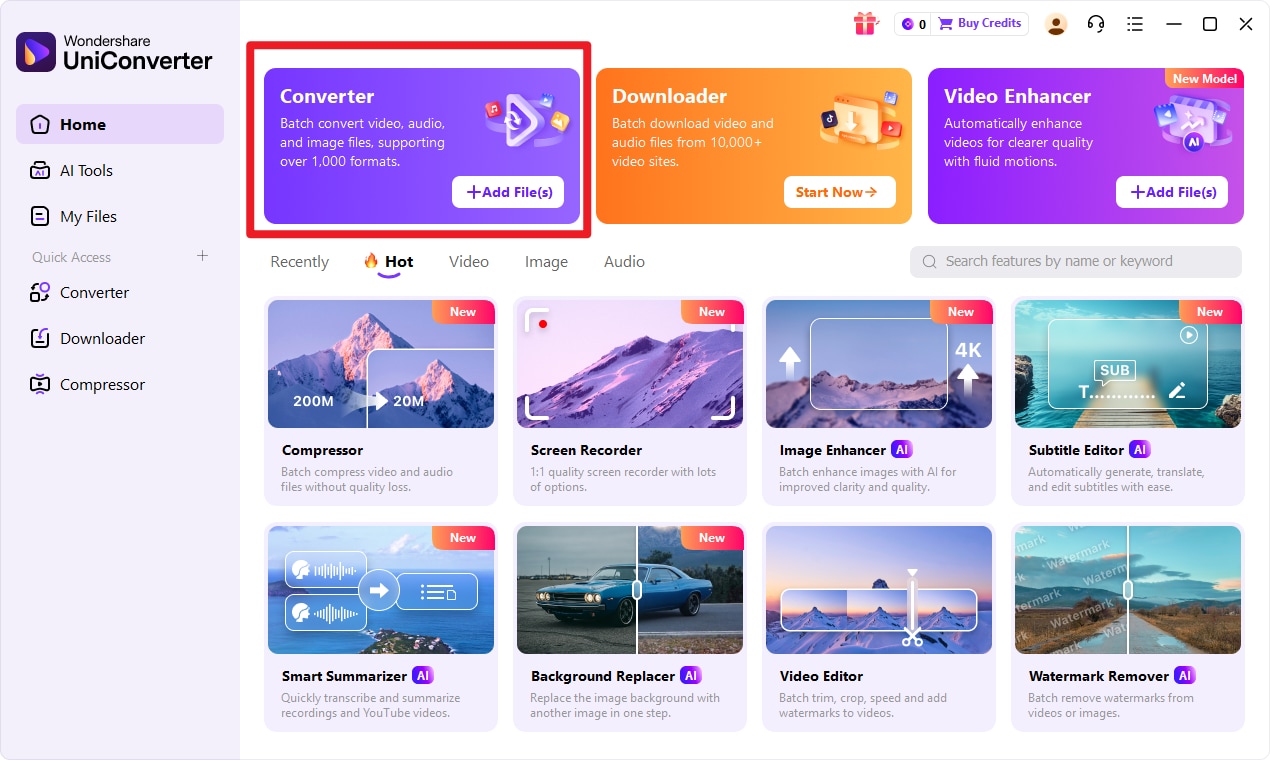
Step 1: Choose Converter in UniConverter
Launch Wondershare UniConverter on your computer. From the main interface, look at the menu on the left side and click on the Converter tool to open the conversion window.
Step 2: Add Files to UniConverter
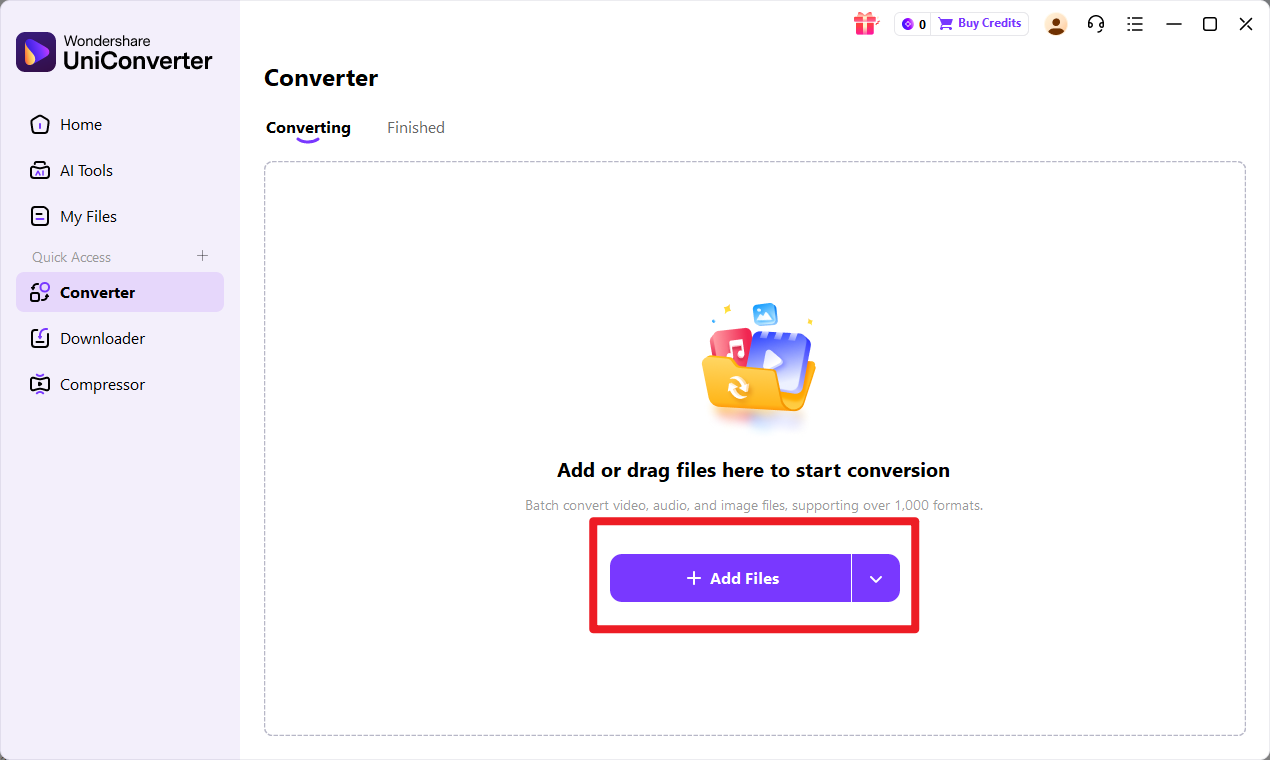
You can now add your input format file to the program. The easiest way is to simply drag and drop the file directly from your folder into the center of the UniConverter window. Alternatively, you can click the Add Files icon in the top-left corner to open a file browser and select the video from your computer.
Step 3: Choose Output Format
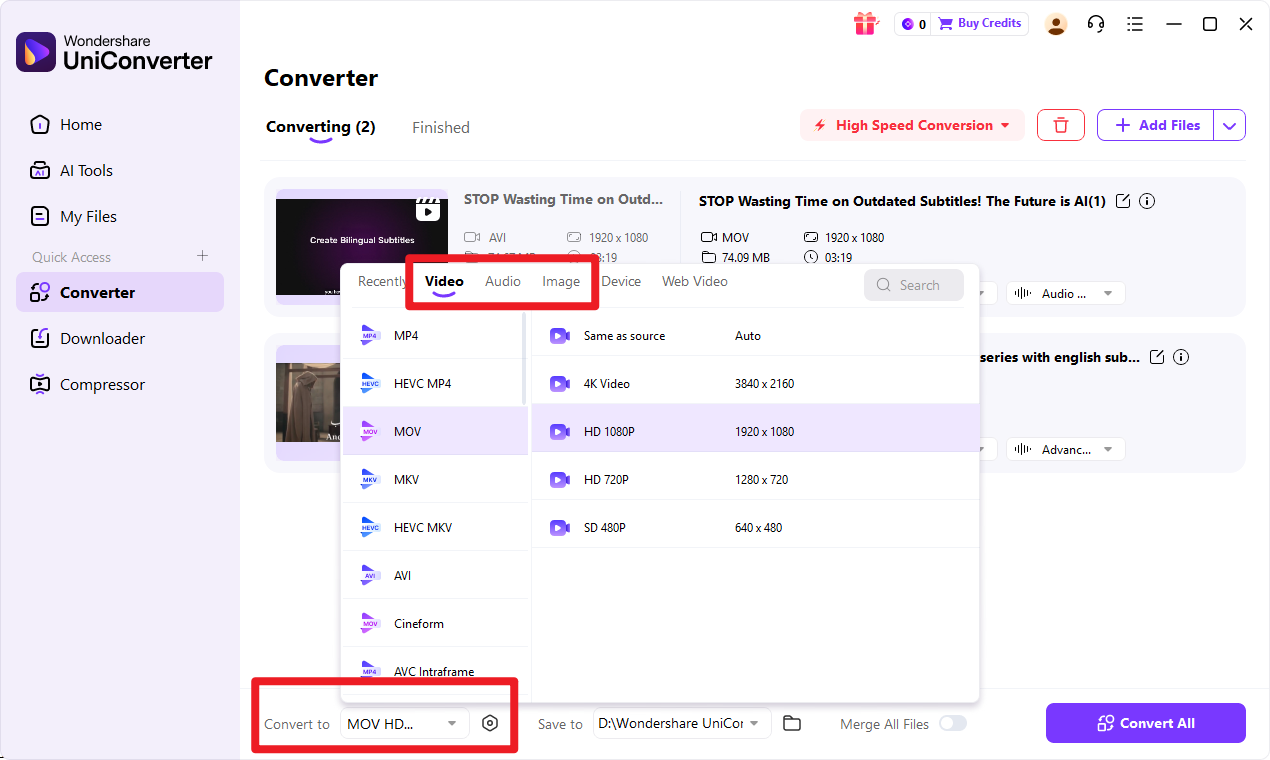
At the bottom of the window, click on the Output Format menu. This will open a new dialog box with a list of available formats. Select the Video tab, and from the list of formats on the left, choose your target format. You can also select the desired resolution on the right.
Step 4: Start the Conversion
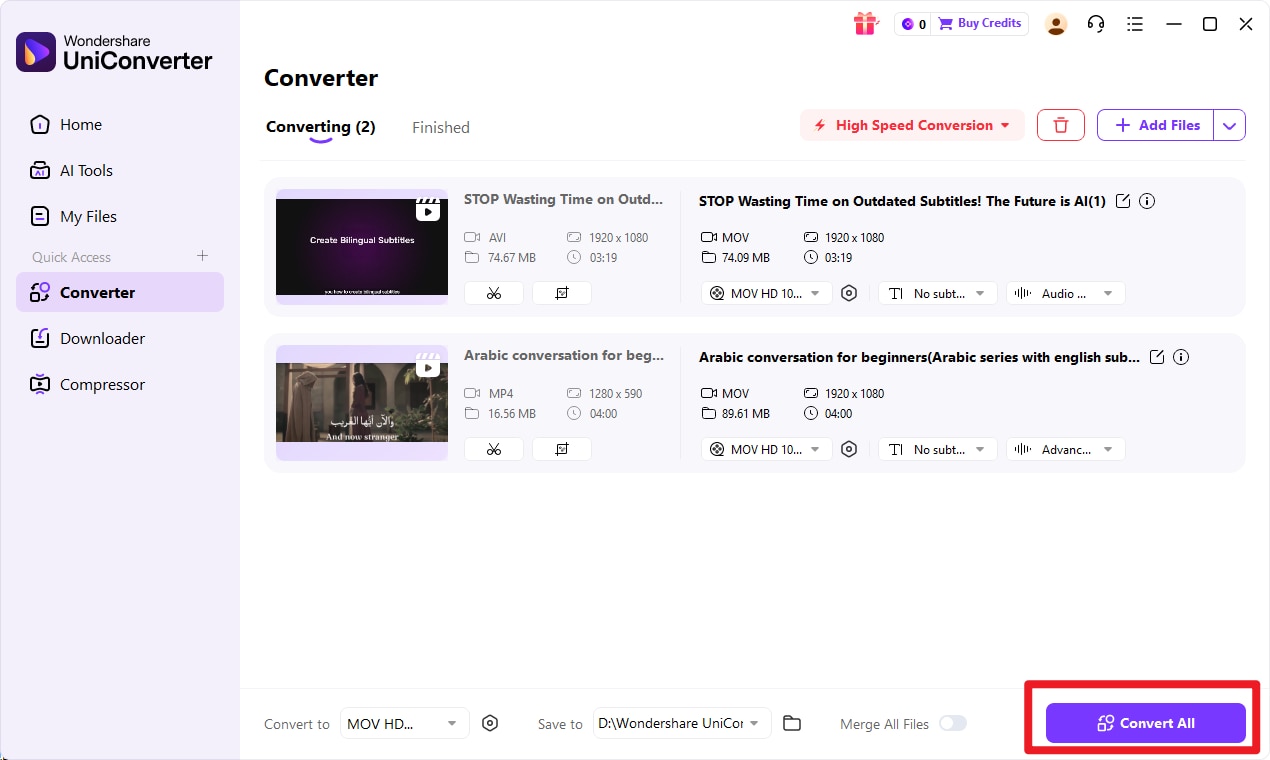
Before starting, you can choose where to save your new file by using the File Location menu at the bottom. Once you are ready, click the Start All button in the bottom-right corner. UniConverter will quickly convert your file to the new format.

Go Beyond Simple Video Conversion
Conclusion
In the MOV vs MPG matchup, there is no single winner, only the right tool for the right job. MOV stands out for its superior quality and flexibility, making it the format of choice for video editors and anyone working within the Apple ecosystem. MPG, with its foundation as an international standard, offers unparalleled compatibility, ensuring your video can be viewed by anyone, anywhere, on any device. Understanding these fundamental differences is the key to a smooth and successful video workflow. By choosing MOV for editing and MPG for distribution, you can leverage the strengths of both. And when you need to bridge the gap between them, a robust and efficient tool like Wondershare UniConverter is your best ally, providing fast, high-quality conversions to solve any format challenge you encounter.
FAQs
-
1. Is MOV a better quality than MPG?
Not necessarily. The final quality of a video depends more on the codec, bitrate, and resolution than the container format itself. However, MOV is more commonly associated with high-quality, professional editing workflows because it can use advanced or even lossless codecs. MPG is typically used for distribution and relies on lossy compression, so it's generally associated with "good enough" quality for wide playback. -
2. Can I play a MOV file on Windows?
Yes, you can. While Windows doesn't support MOV files natively in all its players, you can easily play them by installing a versatile third-party media player like VLC Media Player. Another option is to install a codec pack that adds MOV support to your system's default players. -
3. Will I lose quality when converting MOV to MPG?
Since MPG is a lossy format, some data will be discarded during the conversion, which technically means there is some quality loss. However, when using a professional conversion tool like Wondershare UniConverter, you have control over the output settings, such as bitrate and resolution. This allows you to minimize any perceptible quality loss and create an MPG file that looks virtually identical to the original MOV source. -
4. Why is UniConverter recommended for converting videos?
Wondershare UniConverter is highly recommended for several reasons. It supports an extensive library of over 1,000 formats, meaning it can handle almost any conversion task. It utilizes GPU acceleration for incredibly high-speed conversions, saving you valuable time. Furthermore, it includes features for batch conversion, basic editing, and compression, all while focusing on preserving the original video quality. Its user-friendly interface makes it accessible to both beginners and professionals.
