
Have you ever found yourself staring at two video files, one an MOV and the other an M2TS, wondering what sets them apart? You're not alone. In the world of digital video, container formats can be confusing, and choosing the right one is crucial for a smooth workflow, whether you're editing, storing, or sharing your footage. The MOV vs M2TS debate is particularly relevant for videographers, content creators, and anyone working with high-definition video from camcorders or Blu-ray discs. You might have a high-quality M2TS file from your camera that won't play on your Mac, or you need to decide which format is best for your next editing project. This decision can impact everything from file size and compatibility to editing performance.
Understanding the core differences between these two formats is the first step toward solving common pain points like playback errors, software incompatibility, and concerns about quality loss during conversion. This guide will demystify MOV and M2TS, providing a clear, comprehensive comparison to help you make an informed decision. We'll explore their strengths, weaknesses, and ideal use cases, and show you how to easily convert between them when the need arises.
In this article, you will learn:
- What MOV and M2TS files are and their primary characteristics.
- A direct, side-by-side comparison of their key features.
- A detailed analysis of which format is better for compatibility, quality, and editing.
- Specific use cases to help you decide when to use MOV and when to use M2TS.
- A step-by-step guide on how to convert between these formats without losing quality.
Part 1. What is a MOV File? What is an M2TS File?
Before we dive into a head-to-head comparison, it's essential to understand the fundamentals of each format. Both MOV and M2TS are container formats, which means they are like digital boxes that can hold various types of data, including video, audio, and metadata. However, the way they are designed and the purposes they serve are quite different.
What is a MOV File?
The MOV file format, also known as the QuickTime File Format (QTFF), was developed by Apple Inc. It is the native video format for macOS and iOS devices, making it instantly familiar to anyone in the Apple ecosystem. A MOV file is a multimedia container that can encapsulate multiple tracks of data, including video streams, audio streams, text (like subtitles), and even effects.
One of its greatest strengths is its versatility. MOV files can use a wide variety of codecs for compression, allowing users to strike a perfect balance between video quality and file size. For example, it can contain video compressed with H.264, H.265 (HEVC), or Apple's own ProRes codec, which is a favorite among professional video editors for its high quality and smooth performance in post-production. Due to its strong support in professional editing software like Final Cut Pro and Adobe Premiere Pro, and its wide compatibility across both Mac and Windows platforms, MOV has become a go-to format for video production, editing, and online distribution.
What is an M2TS File?
M2TS, which stands for MPEG-2 Transport Stream, is a container format primarily used for high-definition video on Blu-ray discs and in the AVCHD (Advanced Video Coding High Definition) format. AVCHD is a popular recording format used by many high-end consumer and prosumer camcorders from brands like Sony and Panasonic.
The M2TS format is designed to store high-quality, high-bitrate video, often with minimal compression to preserve the raw fidelity of the footage. It can hold video encoded with codecs like H.264/MPEG-4 AVC or VC-1, along with audio in formats such as Dolby Digital (AC-3) or uncompressed LPCM. Because it's based on the MPEG-2 transport stream standard, it's excellent for streaming and broadcast applications where data integrity is paramount. However, this focus on high-quality storage comes at a cost: M2TS files are typically very large and suffer from limited native compatibility. Most default media players and editing software cannot handle M2TS files without the help of third-party plugins or prior conversion.
Part 2. Quick Comparison Table
To get a quick overview of the key differences between MOV and M2TS, here is a side-by-side comparison table.
| Feature | MOV | M2TS |
| Full Name | QuickTime File Format | MPEG-2 Transport Stream |
| Developer | Apple Inc. | MPEG (Moving Picture Experts Group) |
| Compatibility | Excellent, especially on Apple devices and most editing software. Widely supported on the web. | Limited. Often requires specific players (like VLC) or conversion for playback and editing. |
| File Size | Generally smaller and more manageable due to efficient compression options. | Typically very large due to high bitrate and minimal compression, preserving source quality. |
| Primary Use | Video editing, online streaming, general video sharing, and storage on Apple devices. | Storing raw, high-quality footage from AVCHD camcorders and authoring Blu-ray discs. |
Part 3. MOV vs M2TS: Which One Is Better?
Deciding whether MOV or M2TS is "better" depends entirely on your specific needs. Each format excels in different areas. Let's break down their performance in three critical categories: compatibility, quality, and editing friendliness.
Compatibility and Playback
When it comes to compatibility, MOV is the undisputed champion. As the native format for all Apple products, it plays seamlessly on Macs, iPhones, and iPads using the built-in QuickTime Player. Beyond the Apple ecosystem, MOV enjoys broad support across Windows systems (with QuickTime or compatible players), major web browsers, and countless third-party applications. This universal acceptance makes it a reliable choice for sharing videos with others, knowing they will likely be able to play them without any issues.
M2TS, on the other hand, presents significant compatibility challenges. It is not natively supported by macOS or Windows Media Player. If you try to open an M2TS file on a Mac, QuickTime will greet you with an error message. To play these files, you typically need to install a versatile third-party media player like VLC Media Player, which contains its own set of codecs. For most users who just want to click and play, this extra step is a major inconvenience. This lack of native support is the primary reason why converting M2TS files is such a common task.
Video Quality
Both MOV and M2TS are capable of storing video of exceptional quality. The final visual fidelity depends more on the codec, bitrate, and resolution used during encoding rather than the container format itself.
M2TS is often perceived as having higher quality simply because it is the format used to store raw, high-bitrate footage directly from AVCHD camcorders and Blu-ray discs. In this context, the M2TS file is a near-perfect copy of the source material, with minimal compression applied. It's designed to preserve every detail, making it an excellent archival format.
MOV is a highly flexible container. It can hold visually lossless video using professional codecs like Apple ProRes, making it a staple in high-end production workflows. It can also use highly efficient codecs like H.264 or HEVC to create files that offer a fantastic balance of high quality and manageable file size, which is ideal for streaming and general distribution. So, while an M2TS file from a Blu-ray will likely be of higher quality than a compressed MOV file intended for the web, a MOV file encoded with a professional codec can match or even exceed the quality of a typical M2TS file from a camcorder.
Editing Friendliness
For video editing, MOV is the clear winner and the industry standard. Its structure is optimized for post-production workflows. When you import a MOV file into editing software like Final Cut Pro, Adobe Premiere Pro, or DaVinci Resolve, the program can easily access the video and audio tracks for frame-accurate editing. The format's support for a wide range of editing-friendly codecs, like ProRes, ensures smooth playback and scrubbing without putting excessive strain on your computer's processor.
Editing M2TS files directly can be a frustrating experience. Many popular video editors either do not support the format at all or struggle to handle it efficiently. Importing M2TS files can be slow, and playback within the editor's timeline is often choppy and prone to lagging. This is because the transport stream structure of M2TS is not designed for the non-linear, random-access demands of video editing. Consequently, the standard professional workflow involves converting M2TS files to an editing-friendly format like MOV (often using the ProRes codec) before starting the editing process. For this crucial step, a reliable and high-quality conversion tool like Wondershare UniConverter is highly recommended to ensure a smooth transition without compromising the original footage's quality.
Part 4. Use Cases for MOV and M2TS
Understanding the ideal scenarios for each format will help you manage your video files more effectively. Here's when you should choose one over the other.
When to Use MOV
The versatility and wide compatibility of the MOV format make it the preferred choice in several common situations:
- For Editing Videos: If your primary goal is to edit footage, MOV is the superior choice. Its seamless integration with professional editing software on both Mac and Windows systems ensures a smooth and efficient post-production workflow.
- For Broad Compatibility: When you need to create a video that can be played on a wide range of devices, platforms, and web browsers, MOV is a safe and reliable option. Its native support on Apple devices and strong support elsewhere minimizes playback issues for your audience.
- For Online Sharing and Streaming: Thanks to its support for efficient compression codecs, you can create high-quality MOV files with manageable file sizes. This makes it perfect for uploading to platforms like YouTube and Vimeo or for sharing via email and messaging apps.
When to Use M2TS
Despite its compatibility drawbacks, the M2TS format serves a few specific and important purposes, primarily related to preserving source quality:
- For Archiving Original Footage: If you are shooting with an AVCHD camcorder, the M2TS files it produces are the purest form of your raw footage. It is best practice to keep these original files as a master archive before you start converting or editing them. This ensures you always have the highest-quality source to return to if needed.
- For Authoring Blu-ray Discs: The M2TS format is a fundamental part of the Blu-ray Disc specification. If you are creating a Blu-ray disc with menus, multiple audio tracks, and subtitles, your video content will need to be in the M2TS format to comply with the standard.
- For Preserving All Data Streams: M2TS files from a Blu-ray disc can contain multiple video angles, several language audio tracks, and various subtitle tracks all in one file. If you need to preserve this complex structure, keeping the file in its original M2TS container is necessary.
Part 5. Step-by-Step Guide to Convert MOV to M2TS Using UniConverter
While converting M2TS to MOV is a more frequent task for improving compatibility, there are times when you might need to do the reverse—for instance, when preparing a video for a Blu-ray authoring project. Wondershare UniConverter is a powerful and intuitive tool that handles both conversion directions with ease, supporting over 1000 formats with GPU-accelerated speed and no quality loss.
Here's how to convert your MOV files to M2TS in four simple steps.
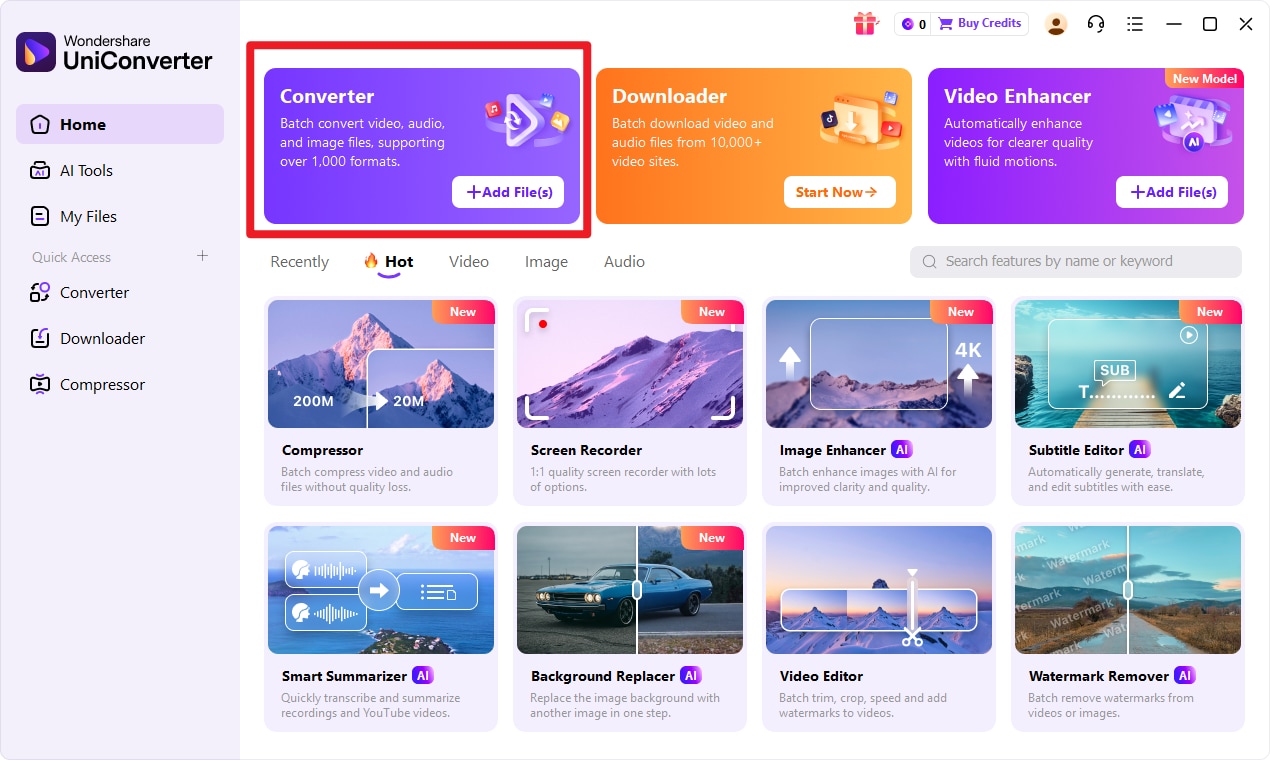
Step 1. Choose Converter in UniConverter
Launch Wondershare UniConverter on your computer. From the home screen, navigate to the left-side menu and select the Converter tool. This will open the main conversion interface.
Step 2. Add Files to UniConverter
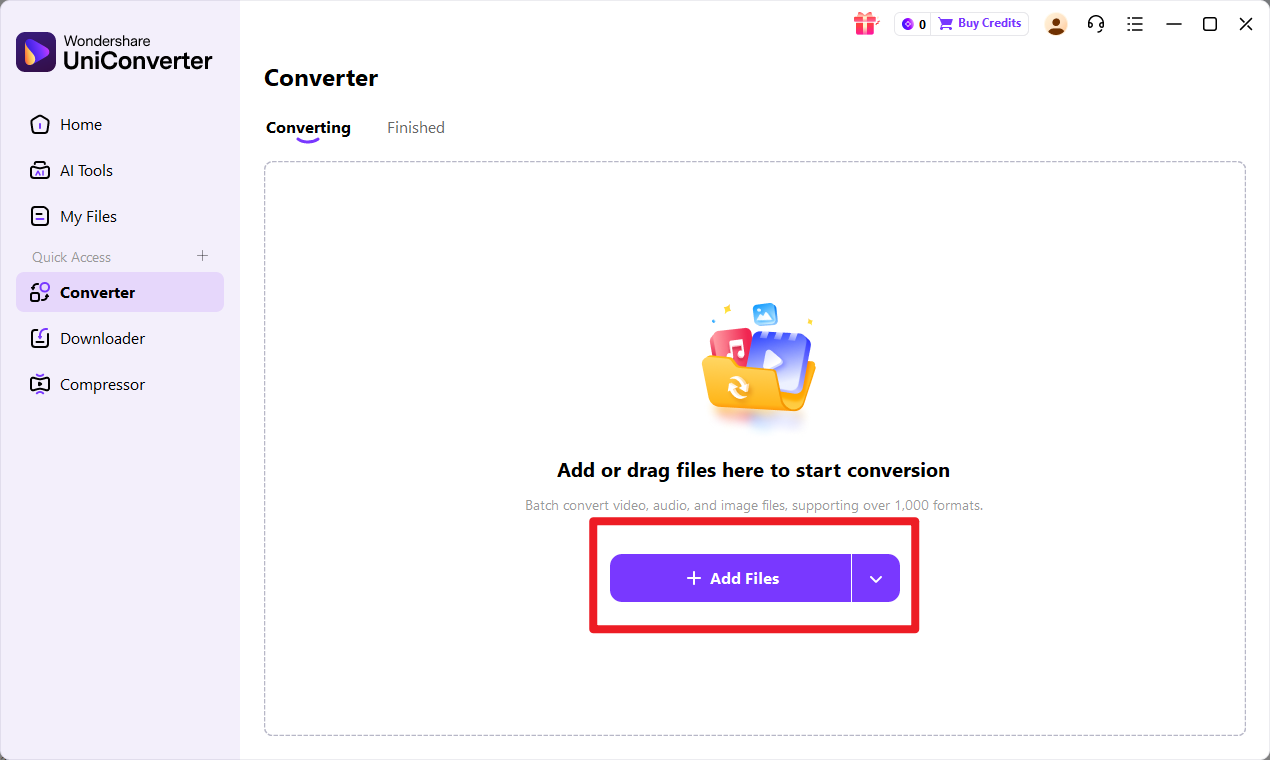
You can now import your video files. Click the Add Files button in the top-left corner to browse and select your input format files. Alternatively, you can simply drag and drop the files directly from your folder into the center of the UniConverter window. The software supports batch conversion, so feel free to add multiple files at once.
Step 3. Choose Output Format
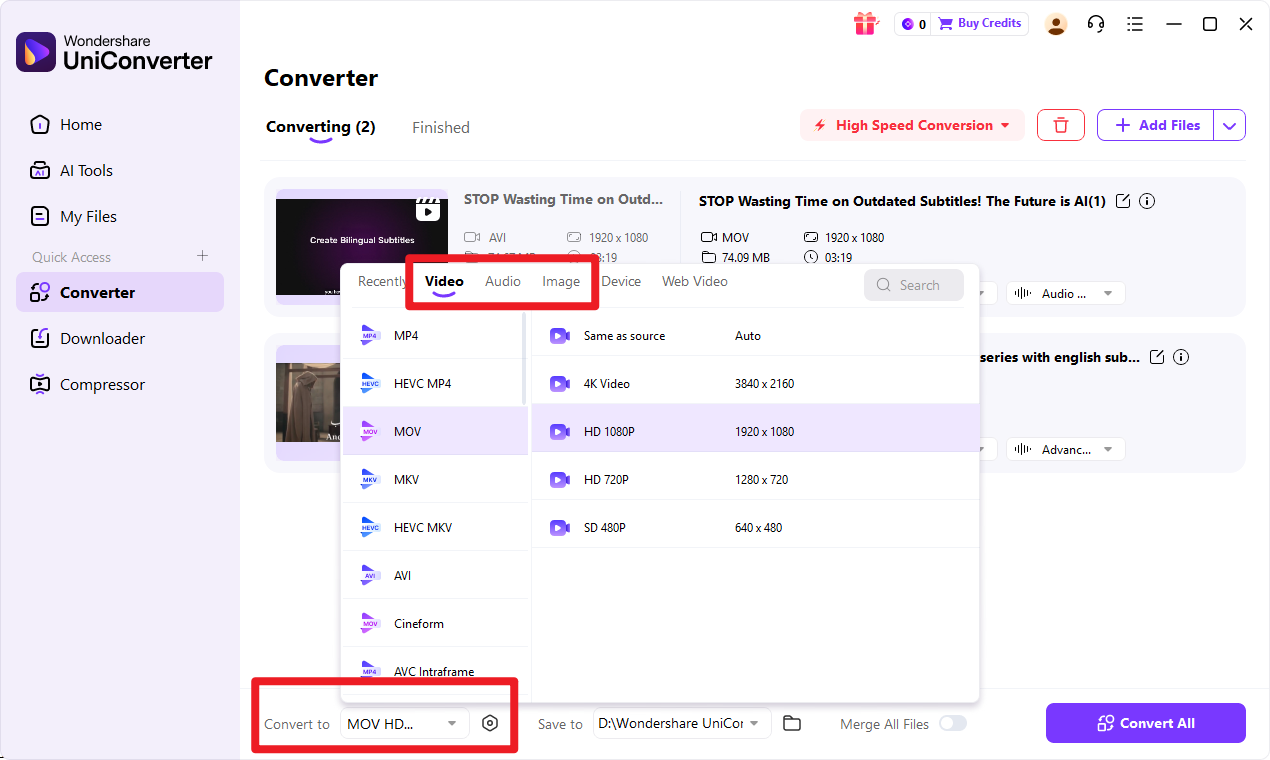
At the bottom of the window, click on the Output Format menu. A new window will appear. Select the Video tab. From the list of formats on the left, choose your desired target format. On the right, you can select the output resolution, such as "Same as source" to maintain the original quality, or choose a different resolution if needed.
Step 4. Start the Conversion
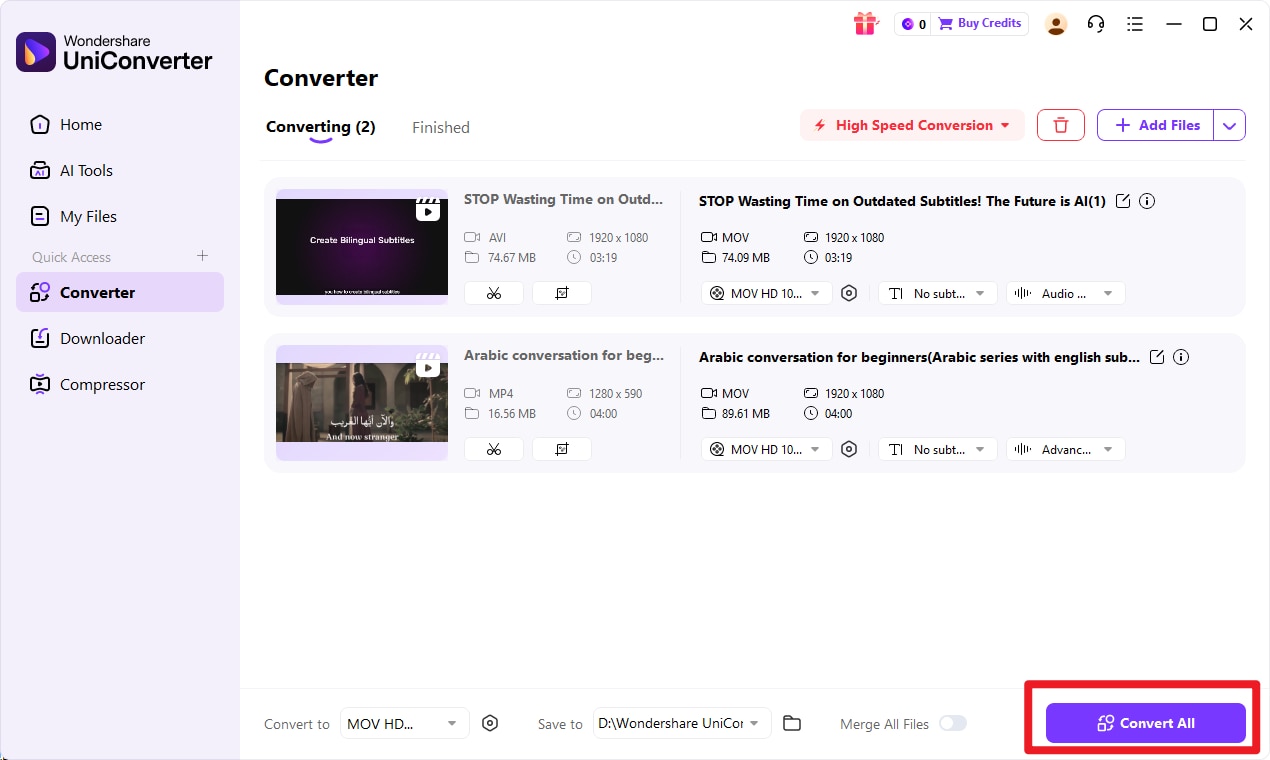
Before starting, you can specify where to save the converted files by clicking the File Location field at the bottom. Once you are ready, click the Start All button in the bottom-right corner to begin the conversion process. UniConverter will process your files quickly, and you can find the finished videos in your designated output folder.

Go Beyond Simple Video Format Conversion
Conclusion
In the MOV vs M2TS comparison, there is no single "best" format—the right choice is entirely dependent on your objective. For everyday use, including editing, sharing, and general playback across multiple devices, MOV is the clear winner due to its superior compatibility, editing-friendliness, and flexible balance of quality and file size. It is the workhorse format for most content creators and general users. On the other hand, M2TS shines as an archival format, perfectly suited for storing the pristine, original quality footage from AVCHD camcorders and Blu-ray discs. Its purpose is preservation, not widespread use.
Ultimately, you will likely encounter both formats in your video journey. When you face the inevitable compatibility roadblocks or need to switch from an archival format to an editable one, having a reliable tool in your arsenal is essential. A versatile video converter like Wondershare UniConverter bridges the gap between these formats, allowing you to perform seamless, high-quality conversions effortlessly. This ensures your workflow is never interrupted by format limitations, giving you the freedom to use your media however you see fit.
FAQs
-
1. Is M2TS higher quality than MOV?
Not necessarily. Both formats are containers, and the quality is determined by the video codec, bitrate, and resolution within them. M2TS is often associated with very high quality because it's used for uncompressed or minimally compressed source footage from Blu-rays and AVCHD cameras. However, a MOV file can be encoded with a professional, visually lossless codec like Apple ProRes and achieve the same or even better quality. The quality depends on the encoding settings, not just the container. -
2. Can I play M2TS files on a Mac?
You cannot play M2TS files on a Mac using the default QuickTime Player. macOS does not have native support for the M2TS container. To play these files, you will need to either use a versatile third-party media player like VLC Media Player, which has its own built-in codecs, or convert the M2TS file to a Mac-compatible format like MOV. -
3. Does converting M2TS to MOV lose quality?
Quality loss is a valid concern during any video conversion. If you use a subpar converter with poor encoding settings, you can definitely see a degradation in quality. However, using a professional and powerful tool like Wondershare UniConverter allows you to convert M2TS to MOV while preserving the original video quality. By selecting a high-quality codec and choosing the "Same as source" resolution, you can ensure the conversion is visually lossless. -
4. Why are M2TS files so large?
M2TS files are typically very large for a simple reason: they are designed to prioritize quality over file size. They contain high-definition video (1080p or higher) recorded at a very high bitrate with minimal compression. This approach ensures that the maximum amount of visual and audio data from the source (like a camcorder sensor or a Blu-ray master) is preserved, resulting in large, data-rich files.
