
Have you ever saved a photo and been asked to choose between JPEG and PNG? Or wondered why a streamed movie looks slightly less sharp than its Blu-ray counterpart? The answer lies in the fundamental difference between two types of data compression. The lossy vs lossless compression debate is at the heart of how we store, share, and consume digital media. Choosing the right method can dramatically impact file size, quality, and usability.
Understanding this distinction is crucial for everyone, from professional content creators managing massive video files to everyday users trying to free up space on their smartphones. This guide will demystify these concepts, helping you make informed decisions for all your digital files. We'll break down the technical details into simple, practical terms, explore real-world use cases, and show you how to manage your files effectively.
In this article, you will learn:
- The definitions of lossy and lossless compression and how they work.
- A quick comparison table highlighting their key differences.
- When to use lossy compression versus when to choose lossless.
- Practical use cases for both methods in photography, audio, video, and more.
- How to easily convert files between different formats.
Part 1. What is Lossy Compression? What is Lossless Compression?
At its core, data compression is about making files smaller. Both lossy and lossless methods achieve this, but they take fundamentally different approaches with very different outcomes. Let's explore each one.
What is Lossy Compression?
Lossy compression is a method that reduces file size by permanently and strategically eliminating certain information from the original file. The term "lossy" refers to this loss of data.
This method works by identifying and removing data that is considered least perceptible to human senses. For an image, this might mean discarding subtle variations in color that the human eye is unlikely to notice. For an audio file, it could involve removing frequencies that are outside the typical range of human hearing. The goal is to achieve a significant reduction in file size while keeping the perceived loss in quality to a minimum.
Key characteristics of lossy compression include:
- Significant File Size Reduction: Lossy algorithms can often reduce a file to a fraction of its original size, making it ideal for storage and transmission over the internet.
- Some Loss of Quality: Because data is permanently removed, there is always some degradation in quality. The degree of this loss depends on the level of compression applied—higher compression results in a smaller file but more noticeable quality loss.
- Irreversible Process: Once a file has been compressed using a lossy method, the discarded data cannot be recovered. You can't "un-compress" a JPEG back to its original, pristine state.
What is Lossless Compression?
Lossless compression is a method that reduces file size without any loss of the original data. It's like neatly packing a suitcase—everything is still there, just organized more efficiently to take up less space.
This method works by identifying and eliminating statistical redundancy in the data. Instead of deleting information, it finds patterns and represents them more efficiently. For example, in a text file, instead of storing the word "compression" ten times, a lossless algorithm might store the word once and then place a small marker every other time it appears. When the file is uncompressed, the algorithm reconstructs the data perfectly, restoring the original file bit for bit.
Key characteristics of lossless compression include:
- Moderate File Size Reduction: Lossless compression typically reduces file size by about 50-60%, which is less dramatic than what lossy methods can achieve. The exact amount depends on the redundancy present in the file.
- No Loss of Quality: The primary advantage of lossless compression is that the quality of the original file is perfectly preserved. The decompressed file is an identical clone of the original.
- Fully Reversible Process: Because no data is discarded, the compression process is completely reversible. You can compress and decompress a file multiple times without any degradation.
Part 2. Quick Comparison Table
To help you visualize the differences at a glance, here is a quick comparison table summarizing the key attributes of lossy and lossless compression.
| Feature | Lossy Compression | Lossless Compression |
| Data Quality | Degrades with compression; some data is lost. | Preserved perfectly; no data is lost. |
| File Size | Very small; significant reduction. | Moderately small; less reduction than lossy. |
| Reversibility | Irreversible; lost data cannot be recovered. | Fully reversible; original file can be restored. |
| Best For | Speed, online streaming, and storage efficiency. | Archiving, professional editing, and data integrity. |
| Common Formats | JPEG, MP3, MP4, AAC, OGG, WebM | PNG, FLAC, ALAC, ZIP, RAR, WAV, RAW |
Part 3. Lossy vs Lossless: Which One Is Better?
A common question is, "Which compression method is better?" The answer is that neither is universally superior. The best choice depends entirely on your specific needs and priorities. The decision boils down to a fundamental trade-off.
The Core Trade-Off: File Size vs. Quality
The central conflict between lossy and lossless compression is the balance between file size and data quality.
- If your primary goal is to minimize file size for fast loading, easy sharing, or saving storage space, and you can tolerate a minor, often imperceptible, drop in quality, then lossy compression is the better choice.
- If your primary goal is to preserve the original quality in its entirety for professional work, archiving, or future editing, and you can accommodate a larger file size, then lossless compression is the clear winner.
Understanding your end goal is the key to making the right decision.
When to Choose Lossy Compression
Lossy compression is the workhorse of the modern internet. Its ability to create small, manageable files makes it indispensable in many scenarios. You should choose lossy compression for:
- Online Distribution: For any media shared on the web, speed is critical. Lossy formats like JPEG, MP3, and MP4 allow websites, streaming services, and social media platforms to deliver content quickly to users, even on slower connections. This is why YouTube, Netflix, and Spotify all rely on lossy compression.
- Personal Media Storage: If you're storing thousands of photos or a large music library on a device with limited space, such as a smartphone, tablet, or laptop, lossy compression is a lifesaver. You can store significantly more content without running out of room.
- Final Delivery Files: When you're sending a finished project to a client for review or for final use (not for further editing), a lossy format is often sufficient and much easier to transfer via email or a file-sharing service.
When to Choose Lossless Compression
Lossless compression is the gold standard for quality and preservation. It's the preferred choice when every single bit of data matters. You should choose lossless compression for:
- Archiving and Master Copies: When you want to save the most important version of a file—the "digital negative"—you should always use a lossless format. This applies to original photographs (RAW or TIFF), master audio recordings (WAV or FLAC), and important documents. This ensures you have a perfect copy to return to in the future.
- Professional Workflows: If a file is going to be edited repeatedly, lossless is essential. Each time you save a file in a lossy format, it gets re-compressed, and more quality is lost—a phenomenon known as "generation loss." Working with lossless formats like PNG or TIFF prevents this degradation during the editing process.
- Detail-Critical Content: For files where every detail is crucial, such as medical images (X-rays, MRIs), technical diagrams, scientific data, or text documents, lossless compression is non-negotiable. It guarantees that no information is altered or lost.
Part 4. Use Cases for Lossy and Lossless Compression
To make this even clearer, let's look at some specific, real-world examples of where each type of compression is used.
Use Cases for Lossy Compression
- Photography: The most common lossy image format is JPEG (or JPG). It's the default format for most digital cameras and smartphones. It's perfect for sharing photos on social media like Instagram, embedding them in blog posts, or sending them via email. The compression allows for a vibrant, detailed image in a small file size.
- Music: When you listen to music on Spotify, Apple Music, or Amazon Music, you're hearing lossy audio. Formats like MP3 and AAC (Advanced Audio Coding) are used to compress songs to a size that can be streamed smoothly over the internet. For most listeners, the quality is excellent and indistinguishable from a CD.
- Video: Virtually all online video is compressed using lossy methods. The MP4 container, often with the H.264 or H.265 (HEVC) codec, is the standard for YouTube, Vimeo, Netflix, and other streaming platforms. It allows for high-definition video to be delivered efficiently without constant buffering.
Use Cases for Lossless Compression
- Graphics and Logos: The PNG (Portable Network Graphics) format is a popular lossless choice for web graphics. Its key advantage is its support for transparency, which is essential for logos, icons, and other design elements that need to be placed over different backgrounds without a white box around them. It also keeps text and sharp lines crisp.
- Archiving and File Transfer: When you compress a folder of documents or a software application into a ZIP or RAR file, you are using lossless compression. This ensures that when the recipient unzips the file, every single document and line of code is exactly as it was originally, with no data corruption.
- Professional Audio Production: In a recording studio, audio engineers work with uncompressed WAV files or losslessly compressed FLAC (Free Lossless Audio Codec) files. This preserves the full dynamic range and frequency detail of the original recording, which is critical for mixing, mastering, and archiving the master tracks.
Part 5. Step-by-Step Guide to Convert Lossy to Lossless Using UniConverter
While you cannot magically restore quality that has already been removed from a lossy file, you may need to convert it to a lossless format for compatibility with certain editing software or for specific project requirements. For example, some platforms may require a PNG instead of a JPEG.
Wondershare UniConverter is a powerful and intuitive tool that simplifies all kinds of file conversions. It can help you easily change your file from a lossy format to a lossless one in just a few clicks, supporting over 1,000 formats.
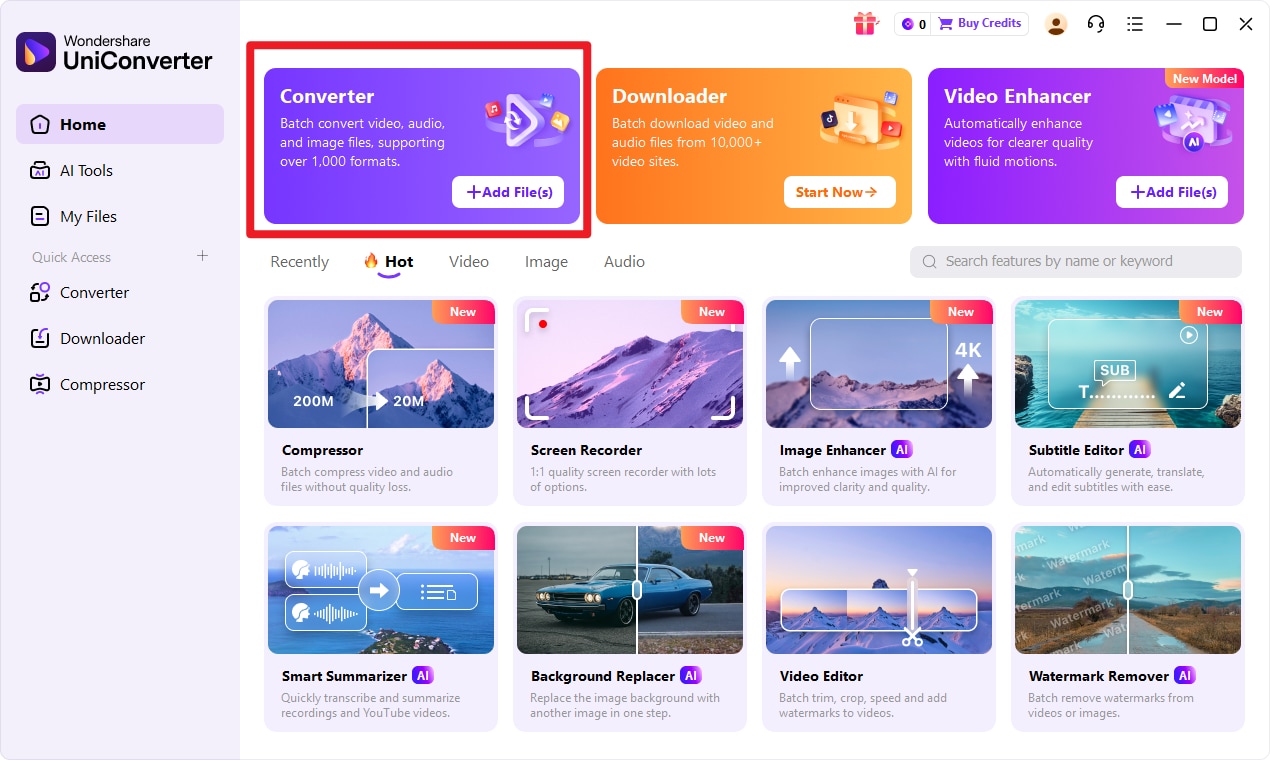
Step 1: Choose Converter in UniConverter
Launch the Wondershare UniConverter software on your computer. From the main interface, navigate to the left-side menu and select the Converter tool to begin.
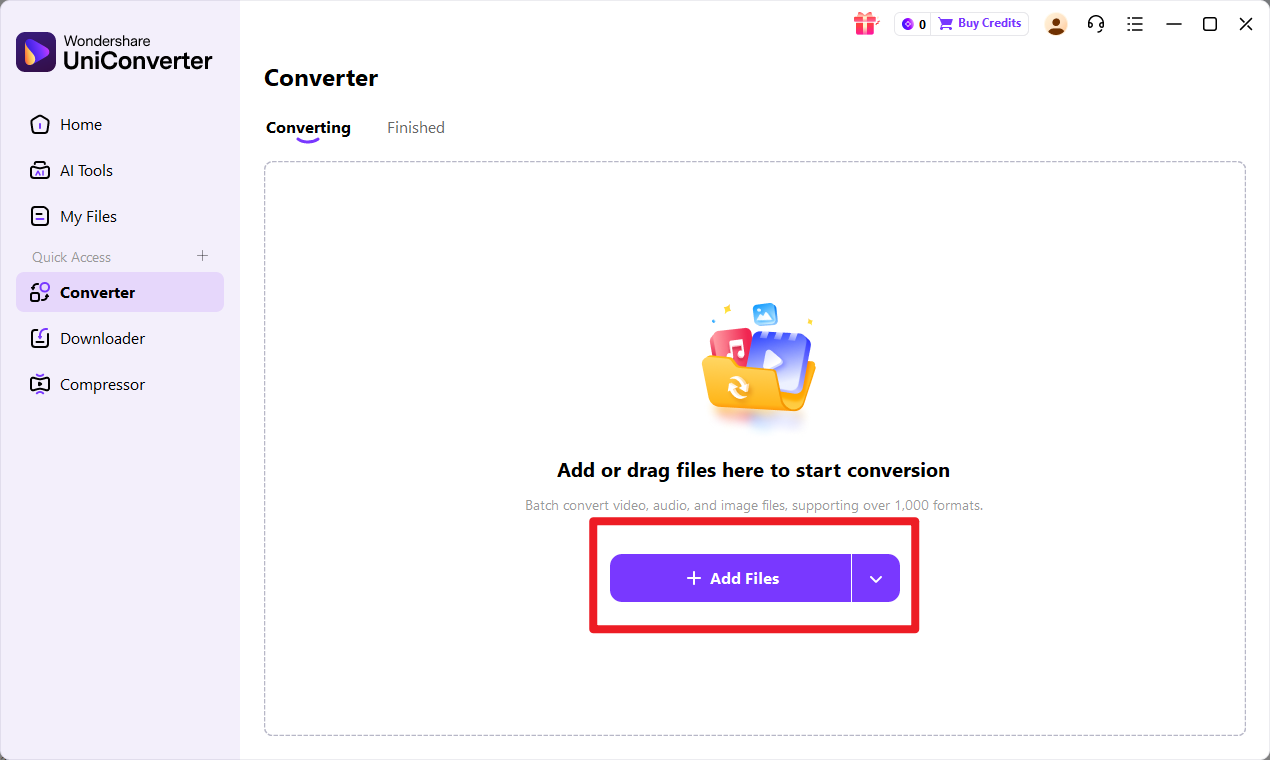
Step 2: Add Files to UniConverter
Next, you need to import your source files. You can either drag and drop your input format files directly into the UniConverter window for convenience or click the Add Files icon in the top-left corner to browse your computer's folders and select the files you wish to convert.
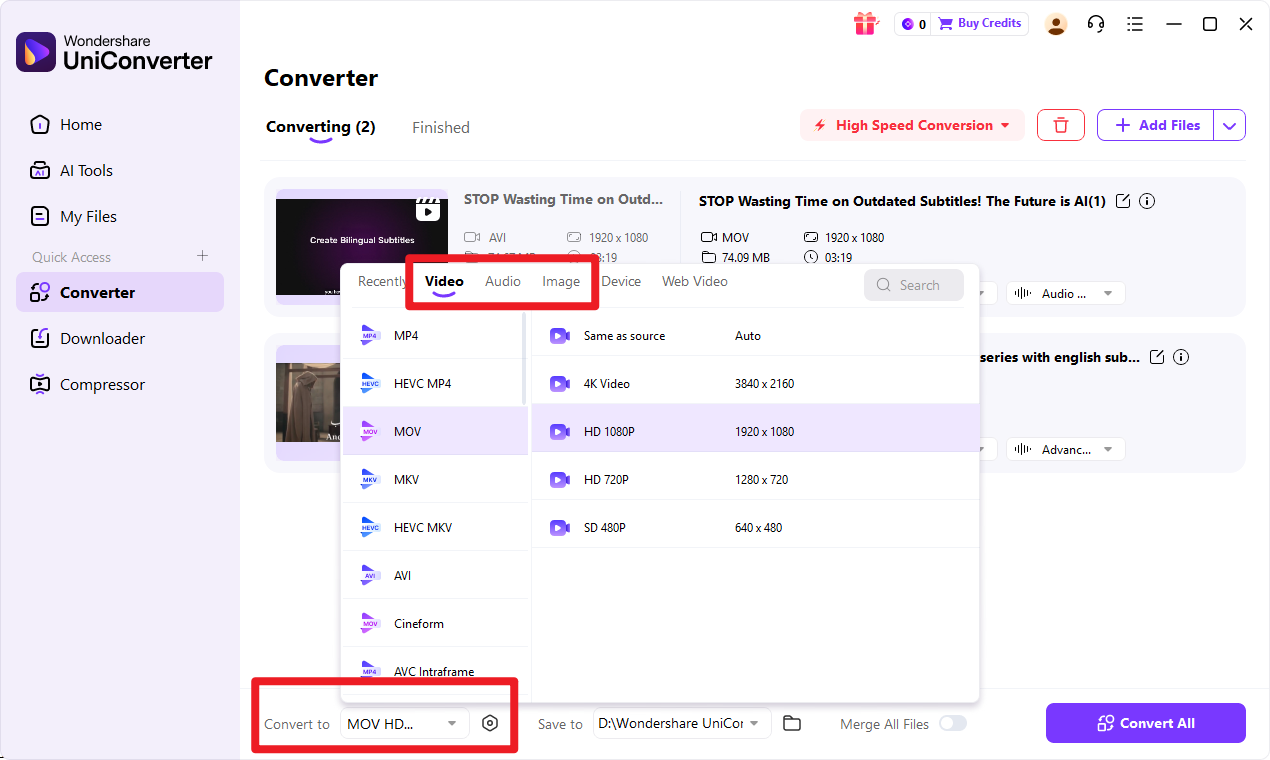
Step 3: Choose Output Format
Click on the Output Format tab located at the bottom of the window. This will open a new dialog box displaying a comprehensive list of formats. Select your desired target format from the Video, Audio, or Device tabs. You can also choose the resolution or quality settings here.
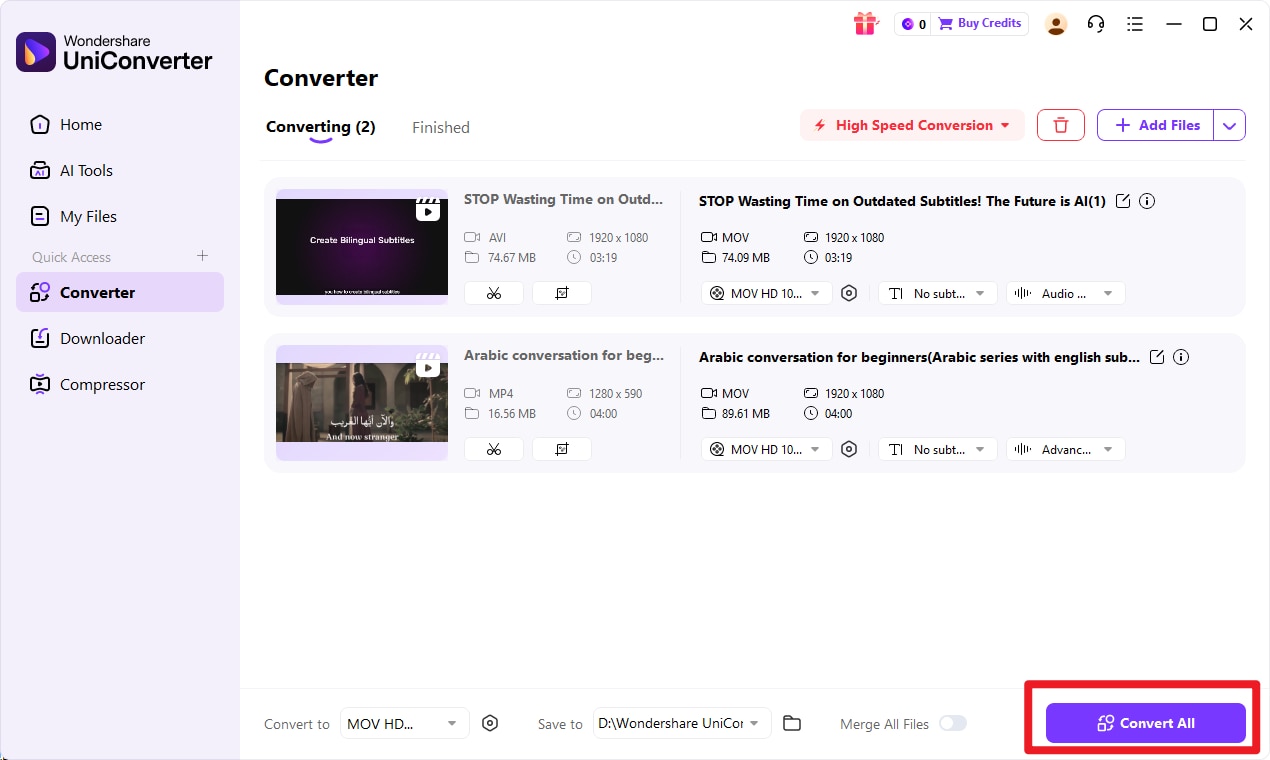
Step 4: Start the Conversion
Once you have configured the output format, you can specify a destination for your converted file under the File Location tab at the bottom. When you are ready, click the Start All button in the bottom-right corner to begin the conversion process for all your imported files.

Your All-in-One Media Conversion Toolkit
Conclusion
The debate of lossy vs. lossless compression is ultimately a classic trade-off between efficiency and fidelity. Lossy compression champions smaller file sizes and faster speeds at the cost of some irreversible quality loss, making it the engine of the internet and ideal for streaming, sharing, and personal storage. In contrast, lossless compression prioritizes perfect data integrity, preserving every bit of the original file, which makes it the undisputed standard for professional editing, archiving master copies, and any application where quality is paramount.
Understanding your end goal is the key to choosing the right method for the job. There is no single "best" option, only the most appropriate one for your specific task. For users who frequently work with different media types and need the flexibility to handle both compression methods, a versatile and comprehensive tool is invaluable. Wondershare UniConverter stands out as an all-in-one solution, empowering you to effortlessly convert, compress, and manage all your media files, ensuring you always have the right format for your needs.
FAQs
-
1. Can you make a lossy file lossless?
You can convert a file from a lossy format (like JPEG) to a lossless format (like PNG), but this action does not recover the image data that was already discarded during the initial lossy compression. The file will become larger because it's now stored in a lossless container, but the quality will not improve beyond what the lossy file already offered. -
2. Is ZIP compression lossy or lossless?
ZIP is a 100% lossless compression format. It is specifically designed to reduce the size of files and folders for storage or transfer without altering or losing any of the original data. This makes it perfect for archiving documents, software, and other files where data integrity is essential. -
3. Is JPEG lossy or lossless?
JPEG (or JPG) is a lossy compression format. It is the most popular format for digital photographs because it can achieve very high compression ratios (creating small files) with what is often a minimal and barely perceptible loss in visual quality, especially for complex images with many colors and gradients. -
4. Which is better for web graphics, PNG or JPEG?
It depends on the graphic. PNG is generally better for web graphics like logos, icons, text-based images, and illustrations that require sharp, clean lines and/or a transparent background. Since PNG is lossless, it avoids the fuzzy artifacts that JPEG can create around sharp edges. JPEG is better for photographs and complex images where its superior compression capabilities can create a much smaller file with little visible difference in quality.
