
In the ever-evolving world of digital video, codecs are the unsung heroes that make everything possible, from streaming your favorite 4K movie to storing precious family videos. Two of the most talked-about names in this space are HEVC and MPEG. However, understanding the nuances between them can be confusing. Are you struggling to decide which format to use for your projects? Do you encounter playback errors with certain video files? This guide is here to demystify the HEVC vs MPEG debate, helping you understand their core differences, strengths, and ideal use cases.
Choosing the right video codec is crucial. It impacts file size, visual quality, and whether your video will play on a specific device. While one codec excels in efficiency and future-proofing, the other offers unparalleled compatibility. By the end of this article, you'll have a clear understanding of which codec best suits your needs and how to handle any compatibility issues that arise.
In this article:
Part 1. What is HEVC? What is MPEG?
Before we dive into a head-to-head comparison, it's essential to understand what each of these technologies is. They are both video compression standards, or "codecs," which are methods for encoding and decoding digital video data to reduce its size for storage and transmission.
What is HEVC (H.265)?
HEVC, which stands for High Efficiency Video Coding, is also known as H.265. It is the modern successor to the widely used Advanced Video Coding (AVC or H.264) standard. Developed to meet the demands of high-resolution video, HEVC was designed with one primary goal in mind: superior compression efficiency.
Its core advantage is its ability to deliver video quality identical to older standards but in a file that is roughly half the size. This remarkable efficiency is achieved through more advanced compression algorithms. This makes HEVC the go-to codec for 4K and 8K UHD content, as it allows for high-quality streaming without consuming excessive bandwidth and enables users to store large video files without quickly filling up their hard drives.
What is MPEG?
MPEG, an acronym for the Moving Picture Experts Group, is not a single codec but a family of digital video and audio compression standards. When people refer to "MPEG" in a general sense, they are often talking about older, foundational standards that paved the way for digital video as we know it.
The most common standards in this family include MPEG-2, which is the standard used for DVDs and standard-definition digital television, and MPEG-4 Part 2 (often just called "MPEG-4"), which was popular for web video before the rise of AVC. The key feature and enduring strength of these MPEG standards is their broad, almost universal compatibility. Having been around for decades, they are supported by a vast range of legacy devices, software, and hardware, from old DVD players to basic media players on computers.
Part 2. Quick Comparison Table
To get a clear, at-a-glance overview of the key differences between HEVC and MPEG, here is a quick comparison table.
| Feature | HEVC (H.265) | MPEG (MPEG-2/MPEG-4 Part 2) |
| Compression Efficiency | High (offers up to 50% better compression than AVC) | Low to Medium (less efficient than modern codecs) |
| File Size | Smaller for the same quality | Larger for the same quality |
| Video Quality | Excellent, supports up to 8K resolution and beyond | Good, typically used for SD and HD resolutions |
| Compatibility | Good on modern devices, but may require specific hardware/software | Excellent, universally supported on most devices |
| Licensing | Complex and potentially costly due to multiple patent pools | Simpler and generally less expensive or royalty-free |
Part 3. HEVC vs MPEG: Which One Is Better?
Determining which codec is "better" depends entirely on your specific priorities. Do you value cutting-edge efficiency and quality, or is universal compatibility your main concern? Let's break down their performance in three critical areas.
Compression and File Size: The Efficiency Champion
When it comes to compression and file size, HEVC is the undisputed champion. Its advanced encoding techniques allow it to compress video data far more effectively than the older algorithms used by MPEG-2 and MPEG-4 Part 2. In practical terms, HEVC can reduce a video's file size by up to 50% compared to its predecessor, AVC, and even more when compared to older MPEG standards, all without any noticeable degradation in visual quality.
This efficiency has profound implications. For content creators and distributors, it means lower bandwidth costs for streaming high-definition video. For the average user, it means you can store twice as many 4K videos on your hard drive or smartphone. If your primary goal is to save disk space or stream high-resolution content smoothly, HEVC is the clear winner.
Video Quality: The Modern Standard
Video quality is intrinsically linked to compression. At the same bitrate (the amount of data used to encode one second of video), HEVC provides a visibly superior image compared to MPEG. It can preserve more fine details, produce more accurate colors, and show fewer compression artifacts (like blockiness or blurring) in fast-moving scenes.
HEVC was specifically designed to handle the demands of Ultra High Definition (UHD) content, making it the preferred codec for both 4K and 8K video. It supports a wider color gamut and higher dynamic range (HDR), which contribute to a more vibrant, lifelike, and immersive viewing experience. While MPEG is perfectly adequate for standard-definition (SD) and basic high-definition (HD) content, HEVC is the modern standard for anyone who prioritizes the best possible visual fidelity.
Compatibility: The Universal Player
This is the one area where MPEG holds a significant advantage. Because MPEG standards like MPEG-2 have been around for decades, they have become universally adopted. Virtually every digital video device made in the last 20 years—from DVD players and old gaming consoles to modern computers and smart TVs—can play MPEG files without any special software or hardware.
HEVC, being a newer technology, has a more limited support base. While most modern devices (smartphones released in the last few years, 4K TVs, and current-generation computers) have built-in hardware decoding for HEVC, older devices often do not. Attempting to play an HEVC file on unsupported hardware can result in choppy playback, stuttering, or the file not opening at all.
For these situations, a reliable video converter becomes an essential tool. If you have a high-quality HEVC video that you need to play on an older device or share with someone who might have compatibility issues, a program like Wondershare UniConverter can effortlessly convert the HEVC file into a more universally compatible MPEG or AVC format, solving the problem in minutes.
Part 4. Use Cases for HEVC and MPEG
Understanding the technical differences is one thing, but knowing when to use each codec in a real-world scenario is what truly matters. Here are some practical use cases for both HEVC and MPEG.
When to Use HEVC
Choose HEVC when efficiency and quality are your top priorities. It's the ideal choice for:
- Streaming High-Definition Content: Major streaming platforms like Netflix, YouTube, and Amazon Prime Video use HEVC to deliver 4K and HDR content to your screen. It allows them to provide stunning visual quality while minimizing buffering and data usage.
- Recording Video on Modern Devices: Most new smartphones (including iPhones and high-end Android devices) and digital cameras record video in HEVC by default. This allows you to capture high-resolution 4K footage without quickly running out of storage space.
- Archiving a Large Video Collection: If you are digitizing a large library of home movies or building a personal media server, encoding your files in HEVC will drastically reduce the amount of hard drive space required, allowing you to store more content in the same physical space.
- Creating 4K and 8K Video Content: For video professionals and content creators working with ultra-high-definition footage, HEVC is the industry standard for delivering the final product.
When to Use MPEG
Choose MPEG when maximum compatibility is non-negotiable. It remains the best choice for:
- Authoring DVDs or Standard Blu-rays: The DVD-Video specification is built around the MPEG-2 codec. If you need to create a disc that will play in any standard DVD or Blu-ray player, you must use MPEG-2.
- Working with Older Editing Software or Hardware: If your video editing setup is a few years old, it may not have native support for HEVC. In such cases, working with or exporting to an MPEG format ensures a smooth and stable workflow without performance issues.
- Creating Videos for Broadcast Television: Many digital television broadcast standards, such as DVB and ATSC, still rely on MPEG-2 for distributing content. Broadcasters must adhere to these standards to ensure their signal can be received by all viewers.
- Sharing Videos with a Wide, Non-Technical Audience: If you're sending a video to family members or clients and you can't be sure what device they'll use to watch it, encoding it in a highly compatible format like MPEG-4 or AVC (H.264) is the safest bet.
Part 5. Step-by-Step Guide to Convert HEVC to MPEG Using UniConverter
If you have an HEVC file that won't play on your device or in your editing software, the simplest solution is to convert it. Wondershare UniConverter is a powerful yet intuitive tool that makes this process incredibly easy. It supports over 1,000 formats, leverages GPU acceleration for lightning-fast conversions, and maintains excellent video quality.
Follow these four simple steps to convert your HEVC files to the more universally compatible MPEG format.
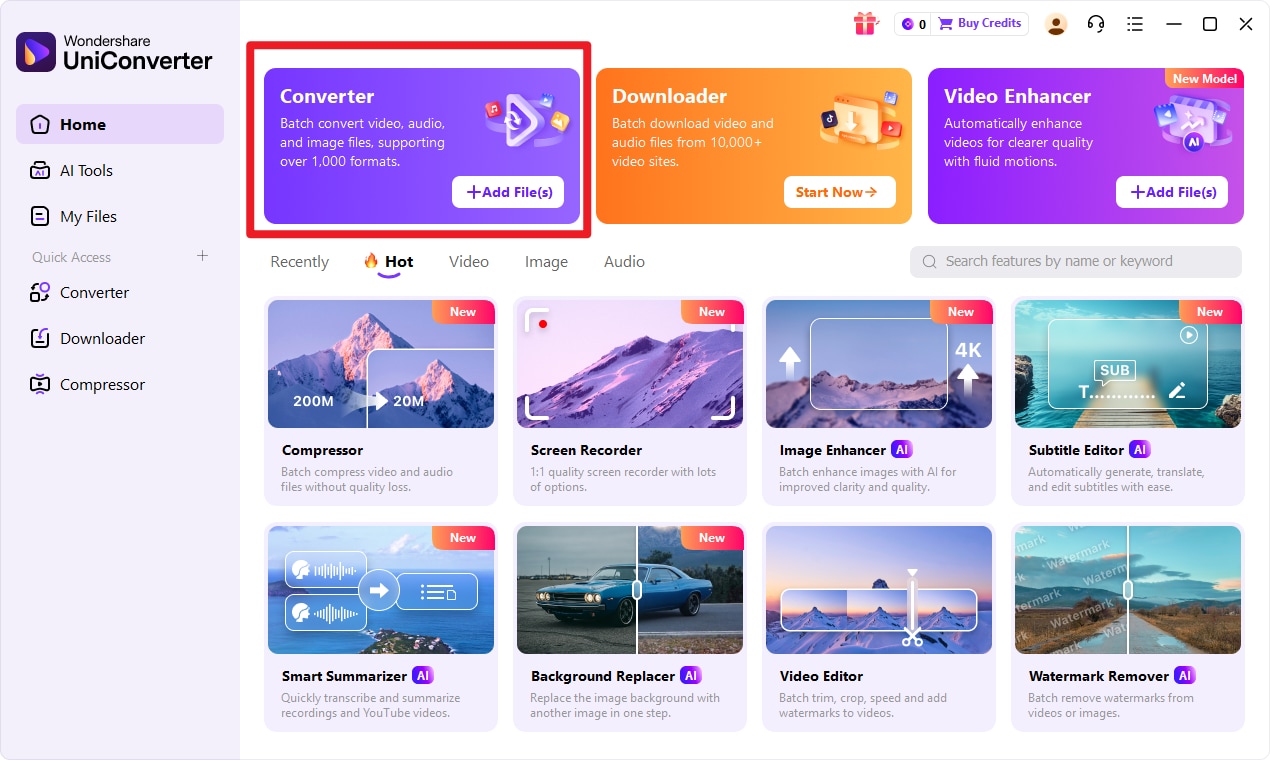
Step 1: Choose Converter in UniConverter
First, launch Wondershare UniConverter on your Windows or Mac computer. From the main screen, look at the menu on the left side and click on the Converter tool to open the conversion interface.
Step 2: Add Files to UniConverter
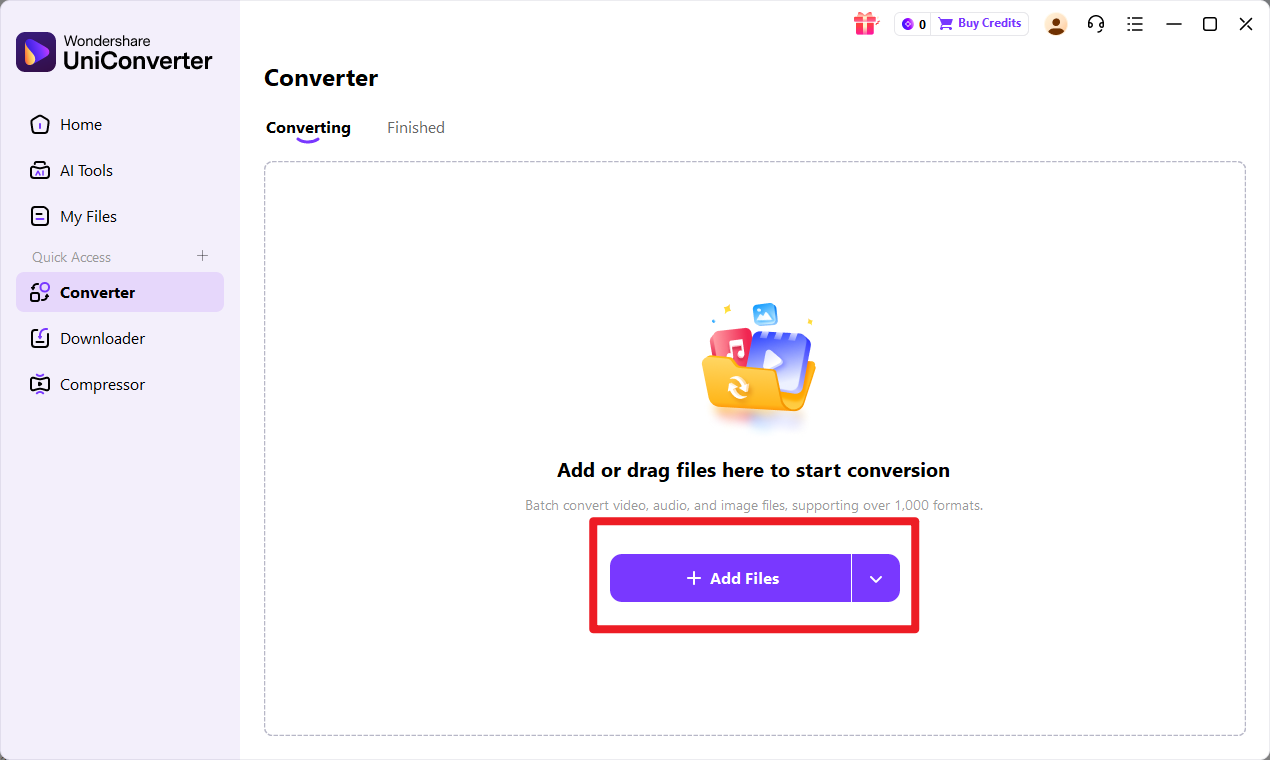
Next, you need to import your HEVC video file. You can either click the Add Files icon in the center or top-left corner to browse your computer's folders, or you can simply drag and drop your input format files directly into the program window.
Step 3: Choose Output Format
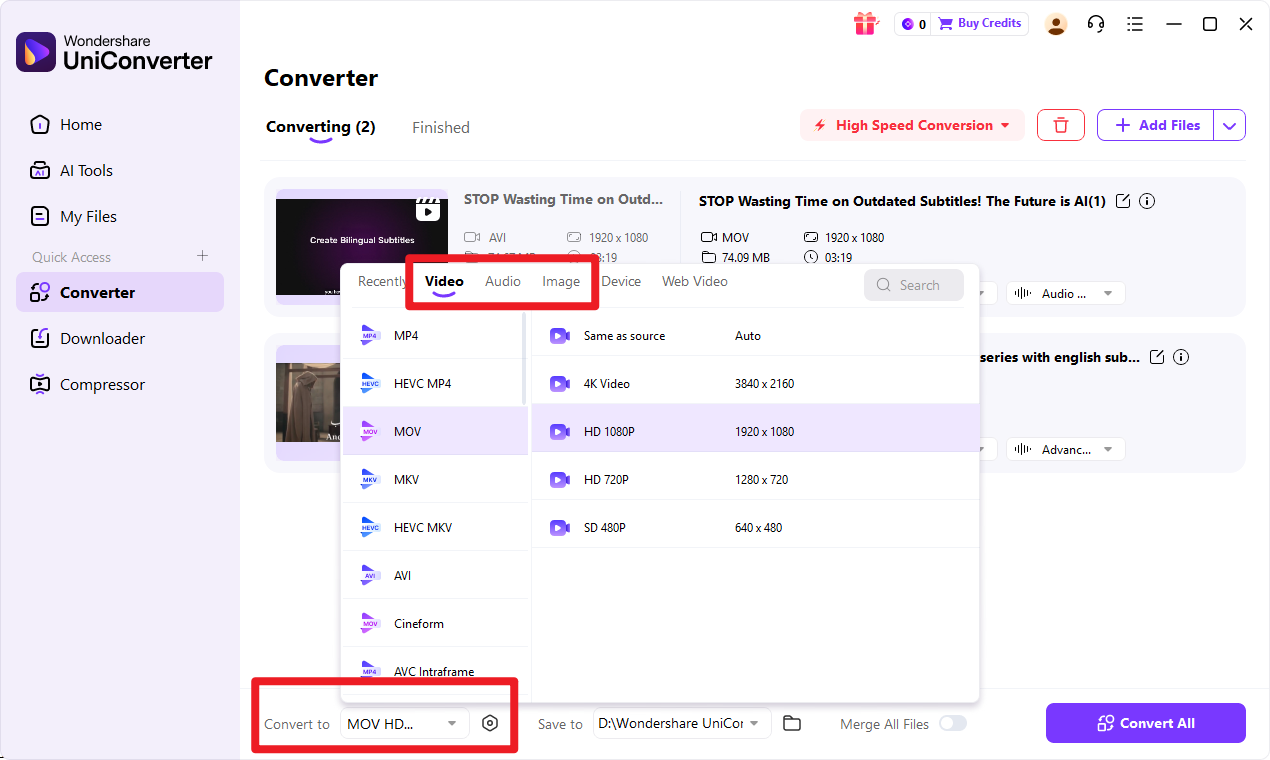
With your file loaded, click on the Output Format menu located at the bottom of the window. This will open a new panel with a list of available formats. Navigate to the Video tab, select MPEG from the list of formats on the left, and then choose your desired resolution on the right (e.g., "Same as source").
Step 4: Start the Conversion
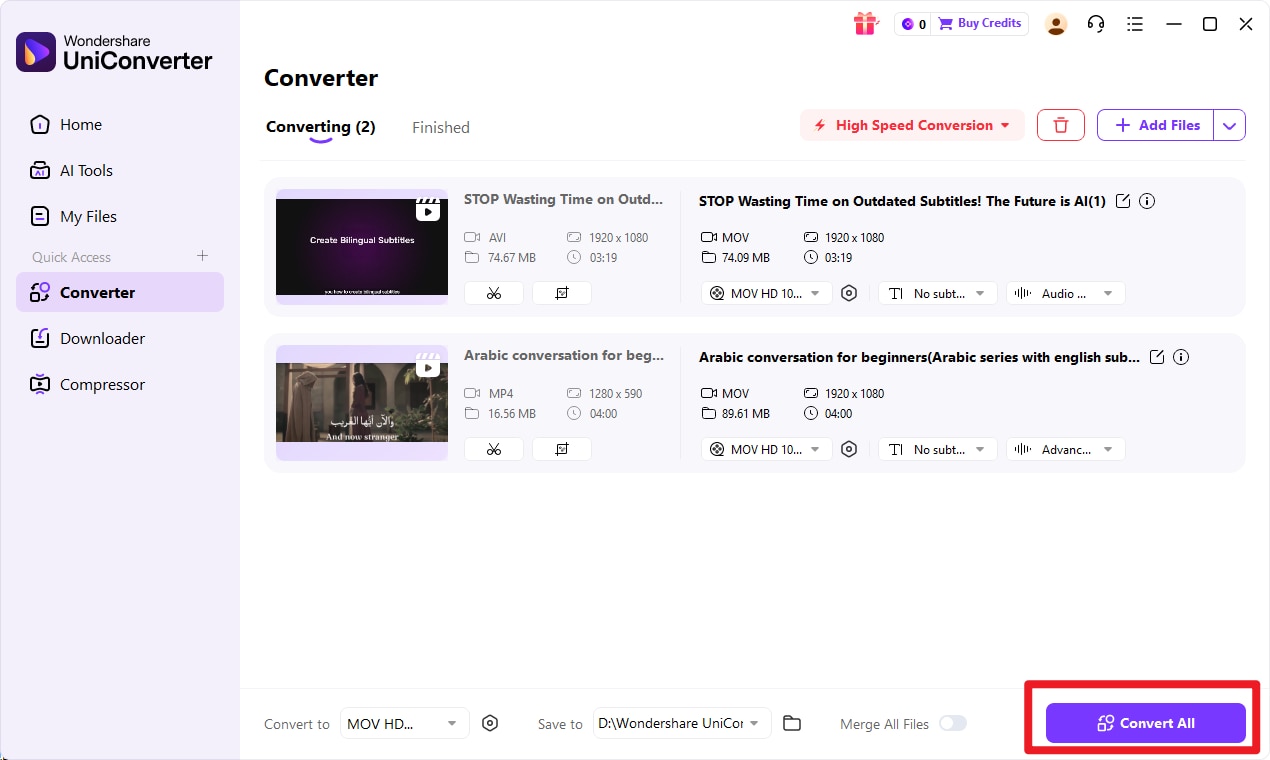
Finally, choose where you want to save the converted file by using the File Location field at the bottom. Once you are ready, click the Start All button (or the Convert button next to the individual file) to begin the conversion process. UniConverter will quickly process your file and save the new MPEG video to your specified folder.

More Than Just a Video Converter
Conclusion
Ultimately, the choice in the HEVC vs MPEG debate comes down to a simple trade-off between modern efficiency and legacy compatibility. HEVC (H.265) is the technically superior codec, offering significantly better compression that results in smaller file sizes and higher quality, making it the standard for the modern era of 4K streaming and high-resolution video. On the other hand, MPEG's strength lies in its history; its universal support across nearly all devices and software makes it a reliable and safe choice when compatibility is your number one priority.
You don't have to be locked into one format. The best approach is to use the right tool for the job. When you encounter a situation where the advanced efficiency of HEVC clashes with the compatibility requirements of an older device, a versatile tool like Wondershare UniConverter provides the perfect bridge. It empowers you to easily convert your files between formats, ensuring that your videos can be stored efficiently and played anywhere, anytime.
FAQs
-
1. Is HEVC better than MPEG-4?
Yes, in terms of technical performance, HEVC (H.265) is significantly better than MPEG-4 Part 2. It offers much higher compression efficiency, meaning it can produce a video of the same visual quality at a much smaller file size. This makes it superior for storing and streaming high-resolution video. However, MPEG-4 is still more widely compatible with older devices that may not support HEVC. -
2. Why do I need to convert HEVC files?
You may need to convert HEVC files for several reasons. The most common one is compatibility. If your media player, smart TV, video editing software, or another device does not have native support for the HEVC codec, the file will either fail to play or exhibit severe performance issues like stuttering. Converting the file to a more universally supported format like MPEG or AVC (H.264) resolves these playback and editing issues. -
3. Can all devices play HEVC?
No, not all devices can play HEVC files natively. Most modern devices manufactured in the last few years—including 4K smart TVs, current-generation smartphones, and computers with modern processors and graphics cards—have built-in hardware decoding for HEVC. However, older computers, media players, and other legacy hardware often lack this capability, making them unable to play HEVC content smoothly, if at all.
