
In the ever-evolving landscape of digital video, codecs are the unsung heroes that make high-quality streaming and manageable file sizes possible. Two of the most prominent players in this space are HEVC (H.265) and AV1. Choosing between them can be a daunting task, as each offers a unique set of advantages and disadvantages. Whether you're a content creator aiming for the best quality, a developer building a new streaming platform, or simply a user trying to play a video file, understanding the HEVC vs AV1 debate is crucial. This decision impacts everything from storage space and streaming bandwidth to device compatibility and licensing costs.
This comprehensive guide will break down the complexities of both codecs, providing a clear, side-by-side comparison to help you determine which one is the perfect fit for your specific needs in 2026. We'll explore their technical specifications, real-world performance, and ideal use cases, ensuring you can make an informed choice.
In this article:
- An introduction to HEVC (H.265) and AV1 codecs.
- A quick comparison table for an at-a-glance overview.
- A detailed analysis of compression, quality, performance, and compatibility.
- Specific use cases to help you decide when to use each codec.
- A step-by-step guide on how to convert files between formats.
Part 1. What is HEVC? What is AV1?
Before diving into a direct comparison, it's essential to understand what each of these codecs is and where it came from. Both represent significant advancements in video compression technology, but they were born from different philosophies and serve distinct corners of the market.
What is HEVC (H.265)?
HEVC, which stands for High Efficiency Video Coding, is an advanced video compression standard also known as H.265. It was developed by the Joint Collaborative Team on Video Coding (JCT-VC) as the direct successor to the ubiquitous AVC (H.264). The primary goal of HEVC was to offer substantially better compression efficiency—about 50% better than AVC at the same level of visual quality.
This leap in efficiency was critical for the dawn of the 4K and 8K eras. By using HEVC, broadcasters, streaming services, and content creators could deliver ultra-high-definition video without requiring double the bandwidth or storage. It has become the standard for 4K Ultra HD Blu-ray discs and is widely adopted in the Apple ecosystem and professional video cameras. However, its power comes with a significant caveat: HEVC operates on a complex, royalty-based licensing model, which can be a barrier for some developers and distributors.
What is AV1?
AV1, or AOMedia Video 1, is a modern, open-source, and royalty-free video coding format. It was developed by the Alliance for Open Media (AOMedia), a consortium of the world's biggest technology companies, including Google, Amazon, Netflix, Apple, Microsoft, and Meta. The creation of AV1 was a direct response to the restrictive licensing associated with HEVC.
The primary mission of AV1 is to provide a next-generation codec that is optimized for video delivery over the internet. It aims to offer even better compression than HEVC (up to 30% more efficient), allowing streaming giants to deliver higher-quality video while using less data. This is especially beneficial for adaptive streaming in variable network conditions. As a royalty-free standard, AV1 encourages widespread, permissionless adoption, and it has quickly become the dominant codec for major web browsers and streaming platforms.
Part 2. Quick Comparison Table
For a quick overview of the key differences between these two powerful codecs, here is an at-a-glance comparison table.
| Feature | HEVC (H.265) | AV1 (AOMedia Video 1) |
| Developer | JCT-VC (ITU-T & ISO/IEC) | Alliance for Open Media |
| Licensing | Royalty-based | Royalty-free |
| Compression Efficiency | High | Very High (up to 30% more efficient than HEVC) |
| Encoding Speed | Faster | Slower |
| Decoding Requirement | Lower (widespread hardware support) | Higher (requires modern hardware) |
| Adoption | Strong in 4K Blu-ray, Apple ecosystem, digital cameras | Dominant in web browsers and major streaming services |
Part 3. HEVC vs AV1: Which One Is Better?
Determining which codec is "better" isn't a simple question with a single answer. The best choice depends entirely on your priorities, whether they are file size, quality, speed, or compatibility. Let's break down their performance across several key categories.
Compression and File Size: The AV1 Advantage
When it comes to pure compression efficiency, AV1 holds a clear edge. On average, AV1 can achieve the same level of visual quality as HEVC while using up to 30% less data. This means it can produce significantly smaller file sizes.
This advantage is a game-changer for two major applications. First, for streaming services like YouTube and Netflix, reducing bandwidth costs by 30% across millions of users translates to massive savings and a smoother viewing experience, especially for those on slower internet connections. Second, for users looking to archive a large video library, AV1 allows them to store more content in the same amount of space without sacrificing quality. For anyone whose primary concern is minimizing file size, AV1 is the superior choice.
Quality: A Close Contest
Both HEVC and AV1 are capable of delivering stunning video quality, making them suitable for the most demanding 4K and 8K content. At high bitrates—the amount of data used to encode one second of video—the visual difference between the two is often imperceptible to the human eye. Both codecs produce sharp, clean, and vibrant images.
Where AV1 often pulls ahead is at very low bitrates. Thanks to its more advanced compression algorithms, AV1 can maintain better visual integrity and suffer from fewer compression artifacts (like blockiness) when bandwidth is limited. This is a crucial benefit for adaptive streaming, where video quality must be dynamically adjusted to match the viewer's network speed. While HEVC is excellent, AV1's performance under pressure gives it a slight edge in quality for real-world internet streaming.
Performance: Encoding and Decoding
Performance is a more complex story. Here, HEVC has a historical advantage due to its maturity. The ecosystem for HEVC is well-established, with widespread hardware acceleration support built into most modern CPUs, GPUs, and mobile chips. This means encoding (creating) and decoding (playing) HEVC files is generally fast, efficient, and requires less processing power.
AV1, being a newer and more complex codec, is much more computationally intensive to encode. Encoding an AV1 video can take significantly longer than encoding the same video in HEVC on the same hardware. However, the industry is rapidly catching up. Hardware decoding for AV1 is now standard in the latest GPUs from NVIDIA, AMD, and Intel, as well as in new CPUs and mobile chipsets. This makes playback smooth and power-efficient. For demanding conversion tasks, a powerful tool like Wondershare UniConverter is invaluable, as it leverages hardware acceleration to dramatically speed up both HEVC and AV1 processing, bridging the performance gap.
Compatibility and Ecosystem
Compatibility is often the deciding factor for many users. HEVC enjoys deep integration and widespread support in several key areas. It is the default codec for 4K video recording on iPhones and many professional digital cameras. It's also the standard for 4K Ultra HD Blu-ray discs and is universally supported across the Apple ecosystem (iPhones, iPads, Macs, Apple TV). If your workflow is centered around these devices, HEVC is the path of least resistance.
AV1, on the other hand, rules the web. It is the preferred codec for the world's largest streaming platforms, including YouTube, Netflix, and Twitch. It is also natively supported in all major web browsers, such as Google Chrome, Mozilla Firefox, and Microsoft Edge. As more smart TVs, streaming devices, and mobile chipsets add native AV1 decoding, its compatibility is growing at an explosive rate, positioning it as the codec of the future for online content.
Licensing: The Deciding Factor for Developers
For businesses, software developers, and large-scale content distributors, the licensing model is arguably the most important difference. HEVC is encumbered by a complex web of patents held by various companies, managed through multiple patent pools. To include HEVC support in a product, developers must navigate this landscape and pay royalties, which can be costly and complicated.
AV1 was created specifically to solve this problem. Its royalty-free license means that anyone can implement and use the codec in their hardware or software without paying licensing fees. This open, permissionless model has fueled its rapid adoption and encourages innovation, making it the clear choice for developers who want to avoid legal complexities and financial barriers.
Part 4. Use Cases for HEVC and AV1
Based on the detailed comparison, here are some practical scenarios to help you decide which codec to use.
When You Should Choose HEVC
- Recording High-Resolution Video: If you are shooting 4K or 8K video on most modern digital cameras, drones, or smartphones (especially iPhones), HEVC is often the default and most efficient option for capturing high-quality footage directly.
- Creating Content for the Apple Ecosystem: When your target audience primarily uses iPhones, iPads, and Macs, encoding in HEVC ensures seamless, native playback without the need for extra software or plugins.
- Authoring 4K Ultra HD Blu-ray Discs: HEVC is the mandatory video codec for the 4K Blu-ray standard, making it the only choice for creating physical media discs.
- When Encoding Speed is Your Highest Priority: If you need to process and export videos quickly and are working with hardware that has mature HEVC acceleration, it will almost always be faster than encoding in AV1.
When You Should Choose AV1
- Streaming Video Over the Internet: If you are distributing video content to a wide audience online, AV1's superior compression will save you bandwidth and provide a better experience for your viewers, especially those with slower connections.
- Archiving a Large Video Library: To maximize storage space without compromising visual quality, converting your video collection to AV1 is an excellent long-term strategy.
- Developing a Web Service or Application: If you are building a product that involves video and want to avoid the high costs and legal complexities of licensing, the royalty-free AV1 is the logical and financially sound choice.
- Future-Proofing Your Content: As hardware support becomes universal, AV1 is poised to become the dominant standard for all forms of digital video. Encoding in AV1 today ensures your content is ready for the next generation of devices and platforms.
Part 5. Step-by-Step Guide to Convert HEVC to AV1 Using UniConverter
Solving Compatibility with a Powerful Converter
There will be many times when you have a file in one format but need it in another. For instance, you might have an HEVC file recorded on your camera but need the superior compression of AV1 for web streaming or long-term archiving. In these situations, a reliable video converter is essential. Wondershare UniConverter is an all-in-one toolkit that simplifies this process. It supports over 1,000 formats, including both HEVC and AV1, and is engineered for high-speed, high-quality conversions by taking full advantage of your computer's hardware acceleration.
How to Convert HEVC to AV1 in 4 Simple Steps with UniConverter
Here's how you can easily convert your HEVC files to the highly efficient AV1 format.
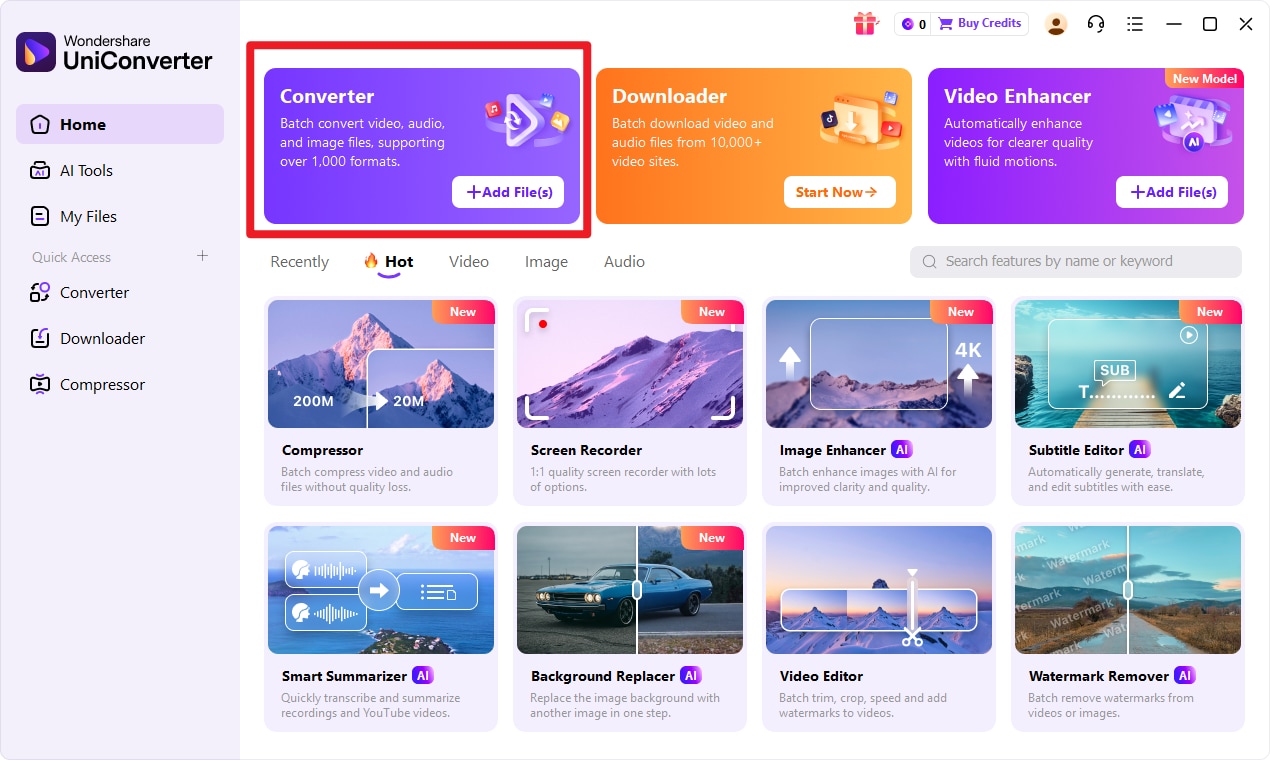
Step 1. Launch Wondershare UniConverter
Launch Wondershare UniConverter on your computer. From the main interface, select the Converter tool from the menu on the left.
Step 2. Add Files to UniConverter
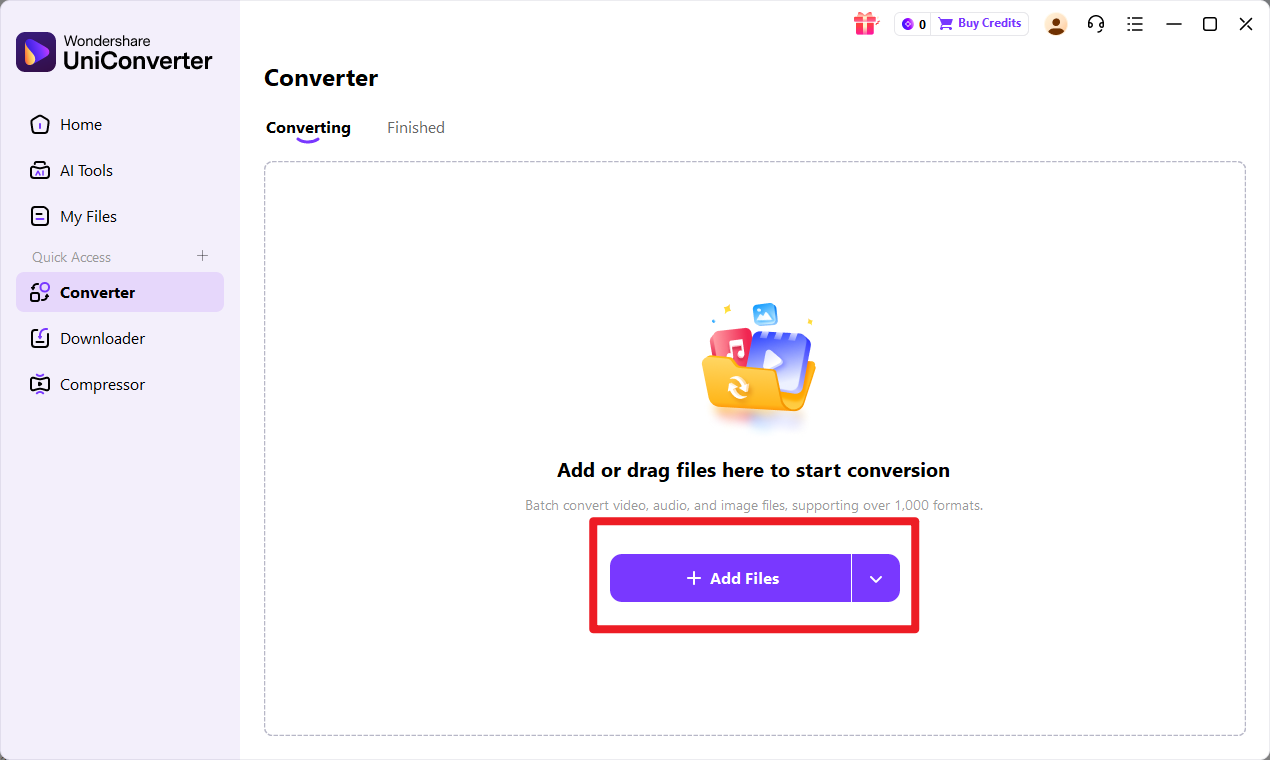
You can either drag and drop your HEVC video file directly into the program window or click the Add Files button to browse and import it from your computer.
Step 3. Choose Output Format
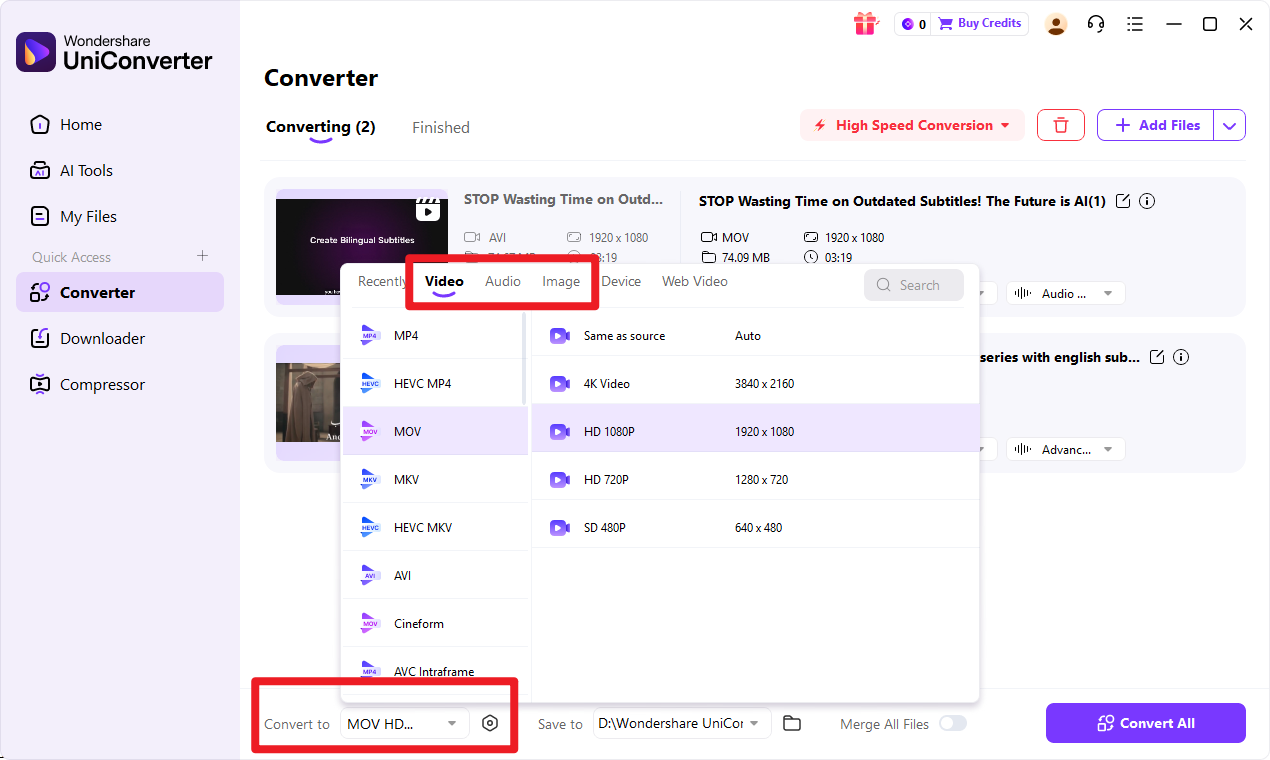
Click on the Output Format icon located at the bottom of the window. This will open a new dialog box. Navigate to the Video tab. From the list of formats on the left, select AV1. On the right, you can choose your desired output resolution, such as "Same as source" to maintain the original quality.
Step 4. Start the Conversion
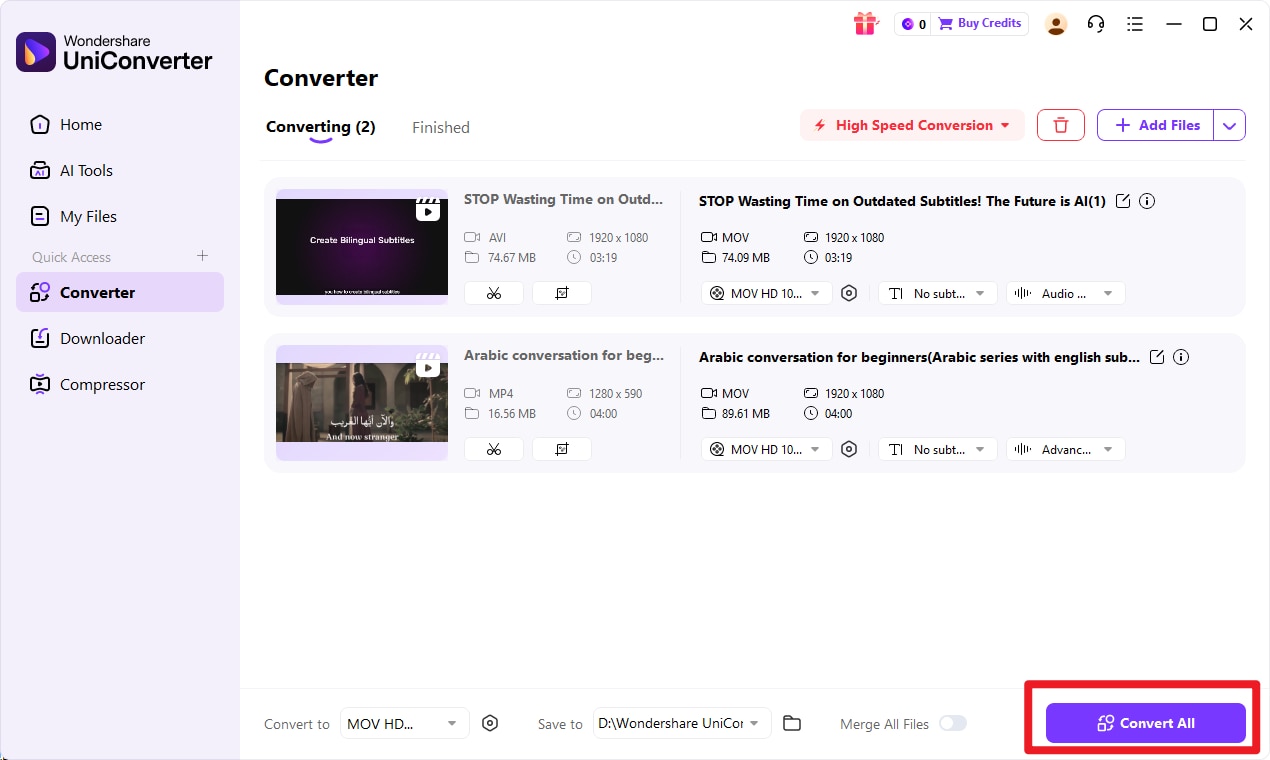
Before starting, you can specify where the converted file will be saved. Use the File Location field at the bottom of the main interface to choose a destination folder on your computer. This helps you easily find your new AV1 file after the conversion is complete.
Once you are ready, click the Convert button next to the file. If you have added multiple files to convert in a batch, you can click the Start All button at the bottom right. UniConverter's high-speed conversion engine will efficiently process your video from HEVC to AV1. After it's done, you can find the finished file in the Finished tab or in the output folder you selected.

Go Beyond Basic Video Conversion
Conclusion
The choice between HEVC vs AV1 is not about finding a single winner, but about selecting the right tool for the right job. HEVC remains the established, highly compatible standard for high-quality video capture and playback, particularly within closed ecosystems like Apple's or for physical media like 4K Blu-rays. Its mature hardware support ensures fast and efficient performance. On the other hand, AV1 is the forward-looking, royalty-free powerhouse that is rapidly taking over the world of web streaming. Its unmatched compression efficiency makes it the ideal choice for delivering high-quality video over the internet and for archiving large media libraries. As the industry continues to transition, versatile tools like Wondershare UniConverter serve as an indispensable bridge, ensuring your video files are always in the perfect format for any device, platform, or purpose.
FAQs
-
1. Is AV1 higher quality than HEVC?
At the same file size or bitrate, AV1 can generally produce higher quality video than HEVC. This advantage is most noticeable at lower bitrates, where AV1 is better at preserving detail and avoiding compression artifacts. At very high bitrates, the quality difference between the two codecs is often negligible to the human eye. -
2. Why is AV1 encoding so slow?
AV1's superior compression is the result of more complex and advanced encoding algorithms. These algorithms require significantly more processing power and time to analyze and compress a video compared to the more established HEVC. However, as hardware encoders for AV1 become more common and software becomes more optimized, this speed gap is gradually narrowing. -
3. Do I need to pay to use HEVC?
As an end-user, you typically do not pay a direct fee to play HEVC files on your devices. The costs are handled by the manufacturers. Device makers (like Apple) and software developers must pay licensing fees to the patent holders to include HEVC encoders or decoders in their products. These costs are then indirectly passed on to the consumer in the product's price. -
4. How can I play an AV1 file if my device does not support it?
If your device lacks native hardware support for AV1, you still have several options. You can use a modern web browser like Chrome, Firefox, or Edge, as they all have built-in software decoders for AV1. Alternatively, a versatile media player like VLC can play almost any format, including AV1. If you still encounter playback issues or need the file for an unsupported device (like an older TV), the easiest solution is to use a video converter like Wondershare UniConverter to change the AV1 file to a more universally compatible format, such as H.264 (AVC).
