
When navigating the world of digital video, you'll inevitably encounter a host of technical terms. Among the most crucial for video quality and workflow are codecs and bit depth. The H.265 codec, also known as HEVC (High-Efficiency Video Coding), is a modern standard celebrated for its ability to deliver high-quality video at lower bitrates. However, within this standard lies a critical choice: should you use H.265 8-bit vs 10-bit? This decision impacts everything from visual fidelity and file size to editing flexibility and device compatibility.
For videographers, content creators, and even tech-savvy consumers, understanding the distinction is key to achieving the desired results. Whether you're choosing recording settings on your new drone, exporting a project for YouTube, or archiving precious footage, the choice between 8-bit and 10-bit color can make a significant difference. This guide will demystify these concepts, helping you make an informed decision for your specific needs in 2026.
In this article:
Part 1. What is H.265 8-bit? What is H.265 10-bit?
Before we can compare them, it's essential to understand what "bit depth" means in the context of video and how it defines both 8-bit and 10-bit H.265.
What is H.265 8-bit?
Bit depth refers to the amount of color information stored in an image. In video, color is created by combining three primary channels: red, green, and blue (RGB). An 8-bit video allocates 8 bits of data for each of these three channels.
Mathematically, this means each channel can represent 2^8, or 256, different shades. When you combine the three channels, you get a total color palette of 256 x 256 x 256, which equals approximately 16.7 million possible colors. For years, 8-bit color has been the industry standard for most consumer content, including DVDs, Blu-rays, broadcast television, and the majority of videos on the web. It is the foundation of Standard Dynamic Range (SDR) video.
What is H.265 10-bit?
As its name suggests, H.265 10-bit video allocates 10 bits of data for each of the red, green, and blue color channels. This seemingly small increase from 8 to 10 bits has an exponential impact on the color information.
With 10 bits per channel, each can represent 2^10, or 1024, different shades. When combined, this results in a staggering total of 1024 x 1024 x 1024, or over 1.07 billion possible colors. This massive increase in color data allows for much smoother and more nuanced gradations between shades, virtually eliminating the visual artifacts known as "color banding." 10-bit color is a fundamental component of High Dynamic Range (HDR) video, which provides greater realism through a wider range of colors and luminance.
Part 2. Quick Comparison Table
To get a clear, at-a-glance overview of the differences, here is a side-by-side comparison of H.265 8-bit and 10-bit video.
| Feature | H.265 8-bit | H.265 10-bit |
| Bit Depth | 8 bits per channel | 10 bits per channel |
| Total Colors | 16.7 million | 1.07 billion |
| Color Banding | More prone to banding in smooth gradients (e.g., skies). | Significantly reduces or eliminates color banding. |
| File Size | Smaller. | Approximately 20-25% larger for the same resolution and bitrate. |
| Compatibility | Universally supported by most modern devices and software. | Requires newer, more powerful hardware and compatible software/players. |
| Editing Flexibility | Limited flexibility in color grading before artifacts appear. | Much greater flexibility for color correction and grading in post-production. |
Part 3. H.265 8-bit vs 10-bit: Which One Is Better?
The question of which is "better" depends entirely on your priorities. Let's break down the comparison across four key areas: visual quality, file size, compatibility, and editing flexibility.
Visual Quality: Color Accuracy and Gradients
When it comes to pure visual fidelity, 10-bit video is the undisputed winner. The ability to display over a billion colors means it can reproduce scenes with far greater realism. This is most noticeable in footage with subtle gradients, such as a clear blue sky, a sunset, or a smoothly lit wall.
In an 8-bit video, these gradients may exhibit "color banding" or "posterization," where the smooth transition of color is replaced by visible steps or bands. This happens because there aren't enough "in-between" shades to create a seamless gradient. With its 1024 shades per channel compared to 8-bit's 256, 10-bit video renders these transitions flawlessly, resulting in a cleaner, more professional, and more immersive image.
Verdict: 10-bit is objectively better for visual fidelity and color accuracy.
File Size vs. Efficiency
Storing more color information naturally requires more data. As a result, a 10-bit H.265 file will typically be about 20-25% larger than an 8-bit H.265 file of the same resolution, frame rate, and perceived quality. For users with limited storage space or slower internet connections for uploading, this can be a significant factor.
However, it's important to consider the "efficiency" of the codec. H.265 is already incredibly efficient at compressing video. The modest increase in file size for 10-bit is often a worthwhile trade-off for the substantial leap in color information and editing potential. While 8-bit saves space, 10-bit provides more quality per byte, making it more efficient for high-end production.
Verdict: 8-bit is better for minimizing file size, but 10-bit offers a more efficient use of data for achieving high-quality results.
Hardware and Software Compatibility
This is where 8-bit H.265 holds a clear advantage. Having been the standard for so long, 8-bit video is universally supported. Nearly every modern smartphone, computer, smart TV, and media player can decode and play 8-bit H.265 files without any issues.
10-bit H.265, on the other hand, is more demanding. It requires more powerful hardware (CPUs and GPUs with dedicated decoding support) to play back smoothly. Older devices may struggle, leading to stuttering, dropped frames, or a complete failure to play the file. Similarly, not all video editing software or media players can correctly handle 10-bit color, sometimes resulting in washed-out or inaccurate colors if they can't process the HDR information properly.
Verdict: 8-bit is the winner for maximum compatibility across the widest range of devices.
Post-Production and Color Grading
For anyone involved in video editing, especially color correction and grading, 10-bit is not just a preference—it's often a necessity. The vast amount of color information in a 10-bit file provides enormous flexibility in post-production. You can make significant adjustments to exposure, contrast, and color balance without the image "breaking" or falling apart. You can push and pull the colors dramatically to achieve a specific creative look.
Attempting the same aggressive color grading on an 8-bit file will quickly lead to problems. Because there is less color data to work with, even minor adjustments can reveal banding, create blocky artifacts, and degrade the overall image quality. The limited color palette simply doesn't hold up to heavy manipulation.
Verdict: 10-bit is essential for any serious color grading or post-production work.
Part 4. Use Cases for H.265 8-bit and H.265 10-bit
Understanding the strengths and weaknesses of each format helps clarify when to use them.
When to Choose H.265 8-bit
- Final Delivery for Broad Audiences: If you're exporting a video for platforms like social media or general websites where you can't control the viewer's device, 8-bit ensures everyone can watch it without issues.
- Limited Storage or Processing Power: When recording on devices with small memory cards (like some drones or action cameras) or editing on an older computer, 8-bit's smaller file sizes and lower processing demands are a practical choice.
- SDR Viewing: If you know your content will only be viewed on standard, non-HDR displays, the benefits of 10-bit color will be largely lost. 8-bit is perfectly sufficient for SDR content.
- Minimal Post-Production: For projects that require little to no color grading ("straight out of camera" looks), 8-bit is often adequate.
When to Choose H.265 10-bit
- Professional Video Production: For any commercial, cinematic, or high-end video project, shooting in 10-bit is the professional standard. It provides the quality and flexibility required for a polished final product.
- Creating HDR Content: If your goal is to produce true High Dynamic Range (HDR) video for viewing on HDR-capable displays, 10-bit color is a non-negotiable requirement.
- Extensive Color Grading: Whenever you plan to perform significant color correction or apply creative color grades (e.g., cinematic LUTs), 10-bit footage is essential to maintain image integrity.
- Archiving and Future-Proofing: Recording your master footage in 10-bit is a great way to future-proof your work. Even if your final delivery is 8-bit today, having a high-quality 10-bit master allows you to re-export for future formats and standards.
Part 5. Step-by-Step Guide to Convert Between H.265 8-bit and 10-bit Using UniConverter
If you need to convert your 10-bit H.265 files to 8-bit for better compatibility, or handle other complex video conversion tasks, a powerful tool is essential. Wondershare UniConverter is a highly recommended solution that simplifies this process. It is the top choice for handling various video formats and specifications with ease. Follow these four simple steps to convert your files.
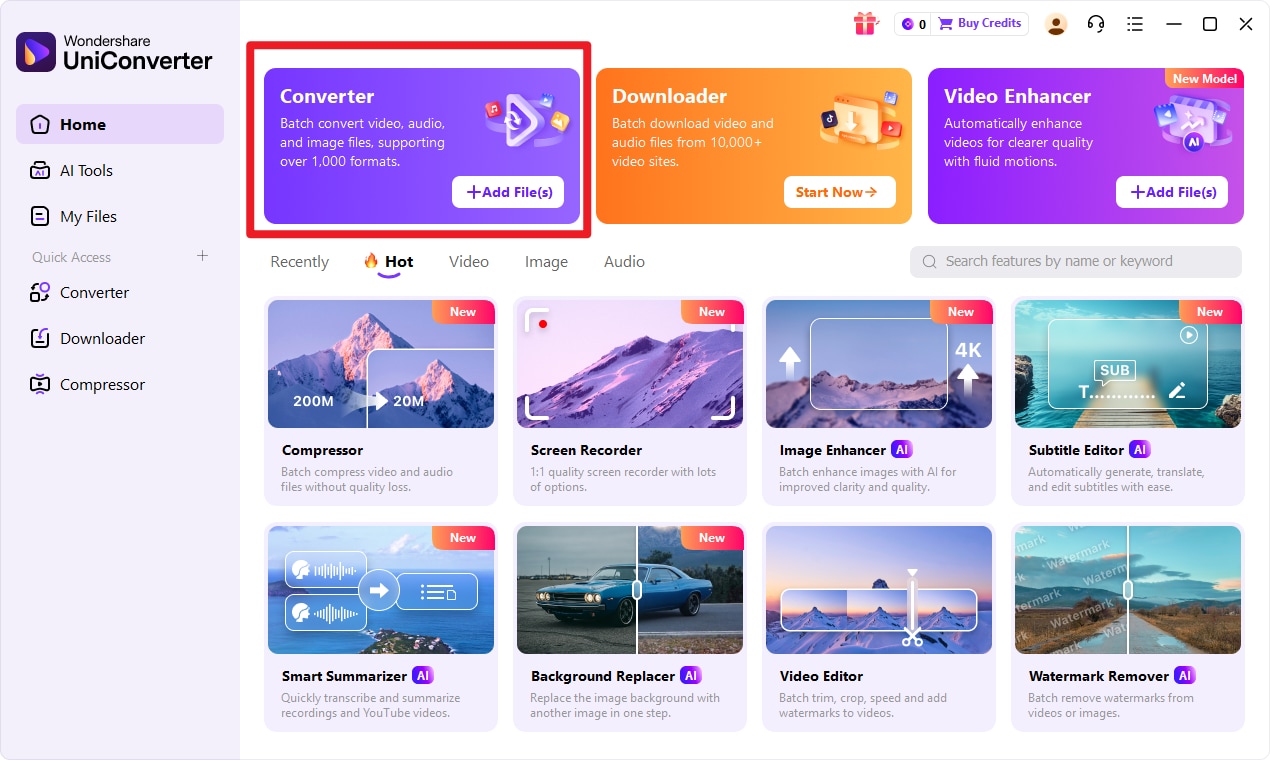
Step 1: Choose Converter in UniConverter
Launch Wondershare UniConverter on your computer. On the main interface, select the Converter tab from the left-side menu.
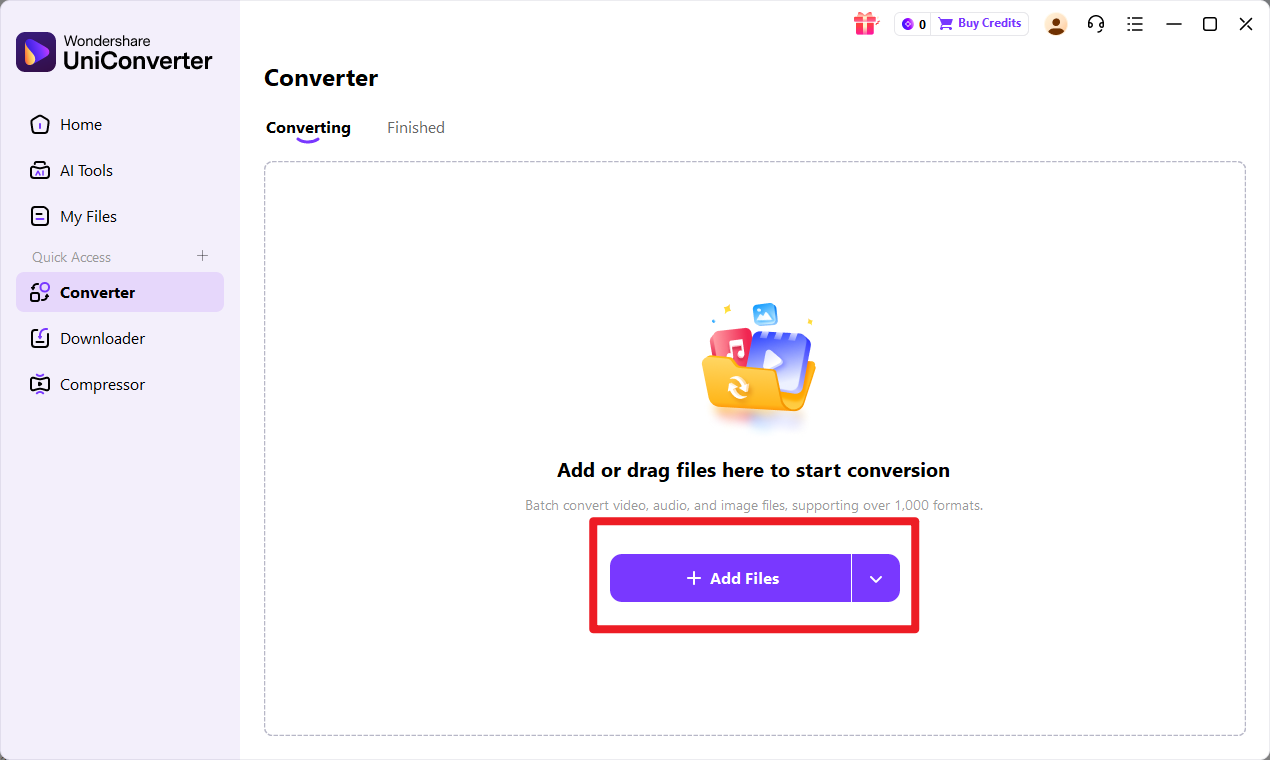
Step 2: Add Files to UniConverter
Click on the Add Files icon or drag and drop your video file with the input format directly into the converter window. You can add multiple files to perform a batch conversion.
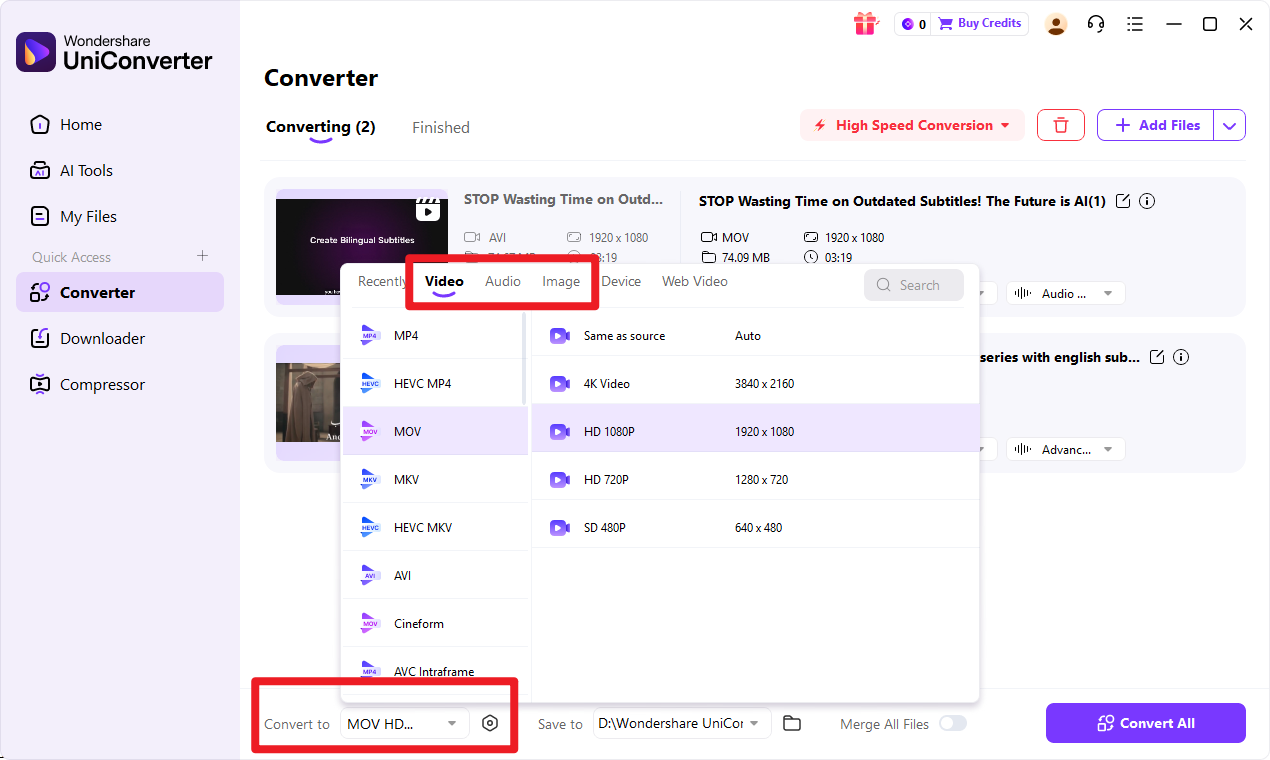
Step 3: Choose Output Format
Click on the Output Format icon at the bottom of the window. Go to the Video tab, select HEVC from the left panel, and then choose a resolution. Click the settings icon to open the configuration window where you can select the Encoder profile and change the bit depth to your target format.
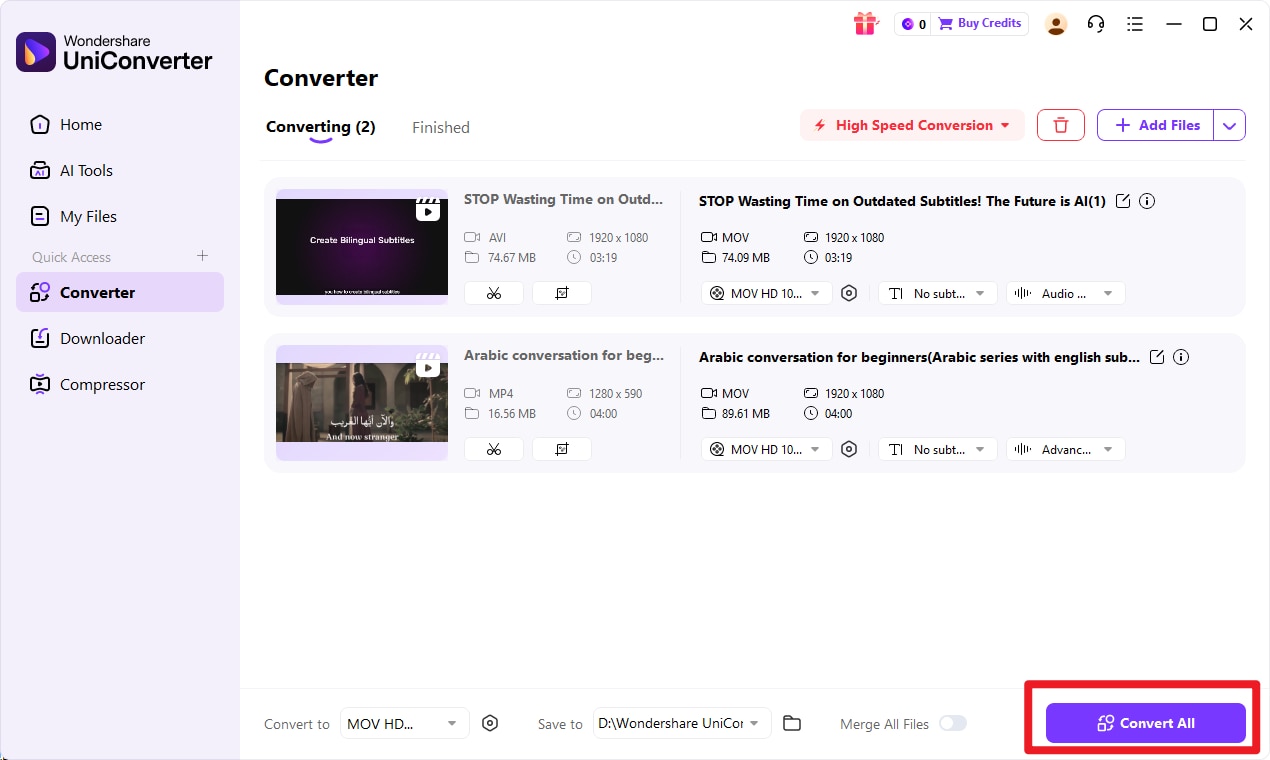
Step 4: Start the Conversion
Once you have configured the output settings, choose a file location for the converted video. Finally, click the Start All button to begin the conversion process.

Go Beyond H.265 Bit Depth Conversion
Conclusion
The choice between H.265 8-bit vs 10-bit is not about which is universally best, but which is right for your specific purpose. H.265 10-bit offers superior color depth, smoother gradients, and incredible flexibility in post-production, making it the ideal choice for professional production, HDR content, and intensive color grading. In contrast, H.265 8-bit provides maximum compatibility and smaller file sizes, making it perfect for standard distribution and projects where storage and processing power are concerns. Understanding your project's requirements—from capture to final delivery—is key to making the right decision and getting the most out of your video workflow.
FAQs
-
1. Can my TV play H.265 10-bit video?
It depends on the model. Most modern 4K HDR TVs from 2018 onwards support H.265 10-bit playback, but older 4K TVs or non-HDR models may not. The best way to be sure is to check your TV's specifications for "HEVC 10-bit," "HDR10," or "Dolby Vision" support. -
2. Is H.265 10-bit the same as HDR?
Not exactly. 10-bit color depth is a prerequisite for true HDR (High Dynamic Range) content, but you can have 10-bit video that is not HDR (i.e., it's recorded in a standard color space like Rec. 709). HDR involves more than just bit depth; it also includes specific metadata about brightness levels and a wider color gamut (like Rec. 2020) to tell the display how to show the image. -
3. Will converting 8-bit video to 10-bit improve its quality?
No. Converting an 8-bit source to 10-bit will not add color information that wasn't there to begin with. The process will wrap the 16.7 million colors of the 8-bit file within a 10-bit container, but it cannot magically create the billion colors of a native 10-bit file. The file will become larger, but the visual quality will not improve. It's like saving a low-resolution photo as a high-resolution file; you don't gain any detail. -
4. Why do my 10-bit videos look washed out on some players?
This is a common issue that usually happens when an HDR (10-bit) video is played on an SDR (8-bit) screen or through a player that doesn't support proper tone mapping. The player doesn't know how to correctly interpret the wider color and brightness information of the HDR signal for an SDR display. As a result, it displays the raw data, which appears flat, desaturated, and "washed out." Using a capable media player or converting the file to SDR 8-bit with a tool like UniConverter can solve this problem for incompatible devices.
