
Whether you're a professional video editor, a content creator for YouTube, or simply someone managing a personal media library, you've likely encountered the terms H.264 and H.265. These are video codecs, the technologies responsible for compressing video files to a manageable size. Choosing the right one can dramatically impact your file sizes, video quality, and compatibility with different devices. The debate of H.264 vs H.265 is crucial in today's world of 4K streaming and ever-growing video archives. Understanding their differences is key to optimizing your workflow and viewing experience.
This guide will break down everything you need to know about these two powerful codecs. We'll explore their technical specifications, compare their performance, and help you decide which one is the right choice for your specific needs in 2026.
In this article
Part 1. What is H.264? What is H.265?
Before we dive into a detailed comparison, let's establish a clear understanding of what each codec is and what it was designed for.
What is H.264 (AVC)?
H.264, also known as Advanced Video Coding (AVC), has been the undisputed king of video compression for over a decade. It became an industry standard shortly after its introduction and is praised for its incredible balance of quality, compression, and, most importantly, widespread compatibility.
If you have watched a video on the web, streamed a movie, or viewed a Blu-ray disc, you have almost certainly experienced H.264. Its ability to deliver good quality video at reasonable bitrates made it the go-to choice for everything from web streaming and broadcasting to video conferencing and digital video recording. Its universal support across nearly all devices, browsers, and platforms makes it a reliable and safe choice for content distribution.
What is H.265 (HEVC)?
H.265, also known as High Efficiency Video Coding (HEVC), is the direct successor to H.264. It was developed to address the demands of the new era of high-resolution video, such as 4K and 8K. The primary goal of H.265 is to provide substantially improved compression efficiency.
The main advantage of H.265 is its ability to deliver the same level of video quality as H.264 but at approximately half the file size. This remarkable efficiency is achieved through more advanced and complex compression techniques. This makes H.265 the ideal codec for streaming ultra-high-definition content, reducing data usage on mobile devices, and archiving large video libraries without sacrificing visual fidelity.
Part 2. Quick Comparison Table
To get a quick overview of the key differences between these two codecs, here is a side-by-side comparison table.
| Feature | H.264 (AVC) | H.265 (HEVC) |
| Compression Ratio | Good | Excellent |
| File Size (at same quality) | Larger | Up to 50% Smaller |
| Video Quality (at same bitrate) | Good | Better |
| Compatibility | Universal | Good (Modern Devices) |
| System Requirements | Low | High |
| Use Case | General Streaming & Compatibility | 4K/8K Streaming & Archiving |
Part 3. H.264 vs H.265: Which One Is Better?
The question of "which is better" isn't a simple one. The best codec depends entirely on your priorities. Let's break down the comparison across four critical aspects: compression, quality, compatibility, and performance.
Compression and File Size: The Efficiency Winner
When it comes to pure compression efficiency, H.265 is the undisputed winner. Its advanced encoding algorithms allow it to compress video data far more effectively than H.264. In practical terms, this means an H.265 video file can be up to 50% smaller than an H.264 file of the exact same visual quality.
This is a game-changer for several reasons. For content creators and distributors, it means significantly lower bandwidth costs for streaming and faster downloads for users. For individuals, it means you can store twice as many movies, TV shows, or personal videos on your hard drive or cloud storage without compromising on quality. If your primary concern is minimizing file size and saving storage space, H.265 is the superior choice.
Quality and Bitrate: Getting More for Less
Bitrate refers to the amount of data used to encode one second of video. In the H.264 vs. H.265 debate, quality is directly tied to bitrate. Because H.265 is more efficient, it can achieve a higher quality image at a lower bitrate.
Imagine you have a fixed bandwidth limit for streaming, say 8 Mbps. At that bitrate, an H.265 stream will look noticeably sharper, with fewer compression artifacts and more detail, than an H.264 stream. This makes H.265 the ideal codec for high-resolution and high-dynamic-range (HDR) content. It's the technology that makes streaming 4K and even 8K video over a standard internet connection possible. If maximum visual fidelity at a given bitrate is your goal, H.265 has the edge.
Compatibility: The Universal Standard
This is the one area where H.264 maintains a significant advantage. Having been the industry standard for so long, H.264 enjoys near-universal support. Virtually every smartphone, tablet, computer, smart TV, and game console made in the last 15 years can play H.264 video without any issues. It's supported natively in all web browsers and video editing software.
H.265, being the newer technology, has less comprehensive support. While most modern devices (manufactured since roughly 2017) include hardware decoding for H.265, older devices may struggle or be completely unable to play it. Some software and web browsers may also require plugins or updates for smooth H.265 playback. If your video needs to be played by the widest possible audience on the largest number of devices, H.264 is still the safest and most reliable option.
Performance: The Processing Power Trade-off
The advanced compression that makes H.265 so efficient comes at a cost: processing power. The complex algorithms used by H.265 require significantly more computational resources to both encode (create) and decode (play) the video.
For video editors, this can mean much longer rendering and export times when choosing H.265. For viewers, trying to play a 4K H.265 video on an older computer without dedicated hardware decoding can result in stuttering, dropped frames, or high CPU usage. H.264 is far less demanding, making it faster to encode and easier to play back on a wider range of hardware. If you are working on an older machine or need the fastest possible export times, H.264 is the more practical choice.
Part 4. Use Cases for H.264 and H.265
Now that you understand the trade-offs, let's look at some practical scenarios to help you decide which codec to use.
When You Should Stick with H.264
- For Maximum Compatibility: If you are uploading a video to social media, sending it to a client with unknown technical specs, or embedding it on a website, H.264 is the safest bet. It guarantees that almost anyone, on any device, can watch it without a problem.
- When Creating Content for Older Devices: If your target audience includes users with older smartphones, tablets, or computers, using H.264 ensures a smooth playback experience for them.
- If You Have a Slower Computer: If you find that exporting videos takes too long or that your computer struggles during the editing process, sticking with the less-demanding H.264 codec can significantly speed up your workflow.
When You Should Upgrade to H.265
- For Archiving Your Video Library: If you have a large collection of home movies, ripped Blu-rays, or other video files, converting them to H.265 can cut your storage requirements in half. This is a perfect use case for future-proofing your media library.
- When Shooting and Delivering 4K or 8K Video: The massive file sizes generated by 4K and 8K cameras make H.265 essential. It keeps files manageable for editing and is the standard for delivering ultra-high-definition content.
- For Reducing Streaming Bandwidth: If you are a streamer or host your own videos, using H.265 can drastically reduce your data costs and allow viewers with slower internet connections to watch your content at a higher quality.
- If you need to convert your existing H.264 library to save space, a tool like Wondershare UniConverter makes the process simple and efficient. It can handle batch conversions, allowing you to upgrade your entire library to the more efficient H.265 format with just a few clicks.
Part 5. Step-by-Step Guide to Convert H.264 to H.265 Using UniConverter
To take advantage of H.265's superior efficiency and save valuable storage space, you can convert your existing H.264 videos. We recommend UniConverter for this task due to its batch processing capabilities, high-speed conversion, and user-friendly interface. It is the ideal tool for upgrading your video library.
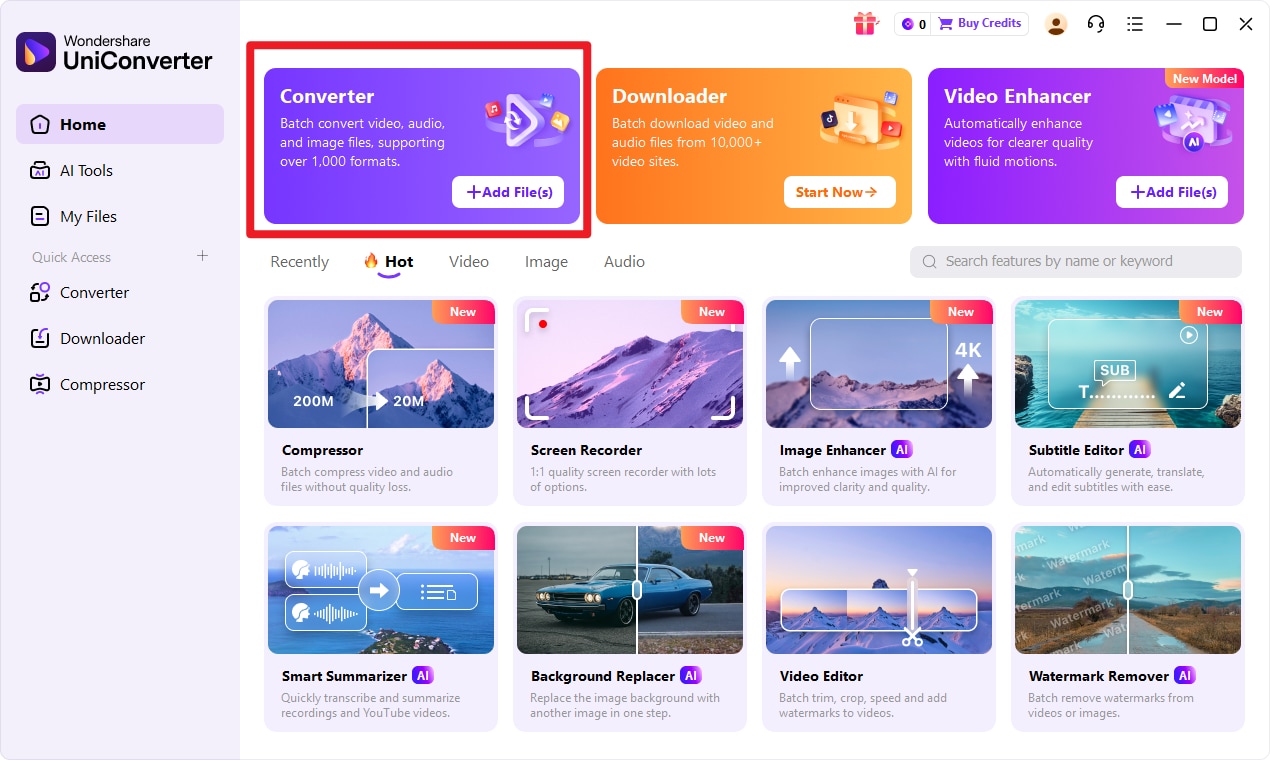
Step 1: Add Files to UniConverter
Launch Wondershare UniConverter on your computer. In the main interface, ensure you are in the Converter section. You can either drag and drop your H.264 video files directly into the program window or click the Add Files button to browse and import them from your computer.
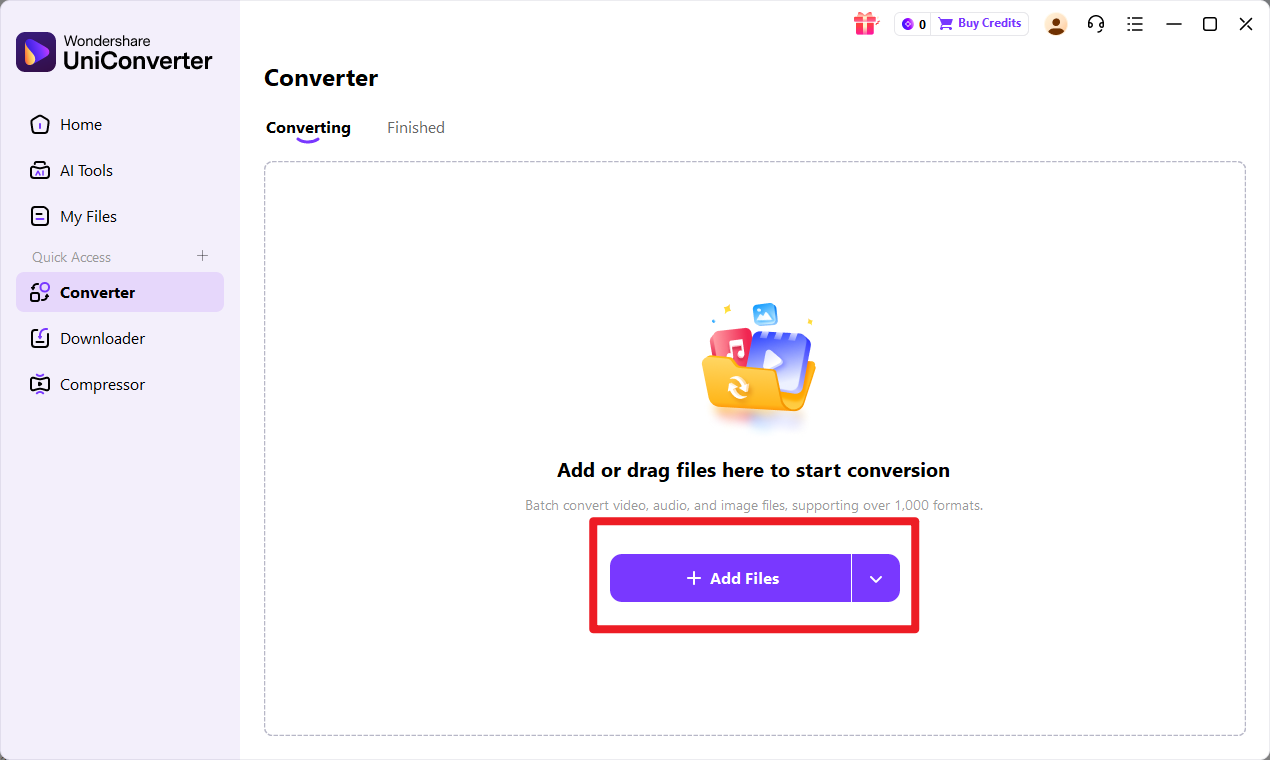
Step 2: Choose Output Format
Click on the Output Format menu at the bottom of the window. This will open a new panel with format options. Go to the Video tab, select a container format like MP4 or MKV from the list on the left, and then choose your desired resolution on the right. To select the H.265 codec, click the small edit icon next to the resolution to open the settings window, and from the Encoder dropdown menu, select HEVC.
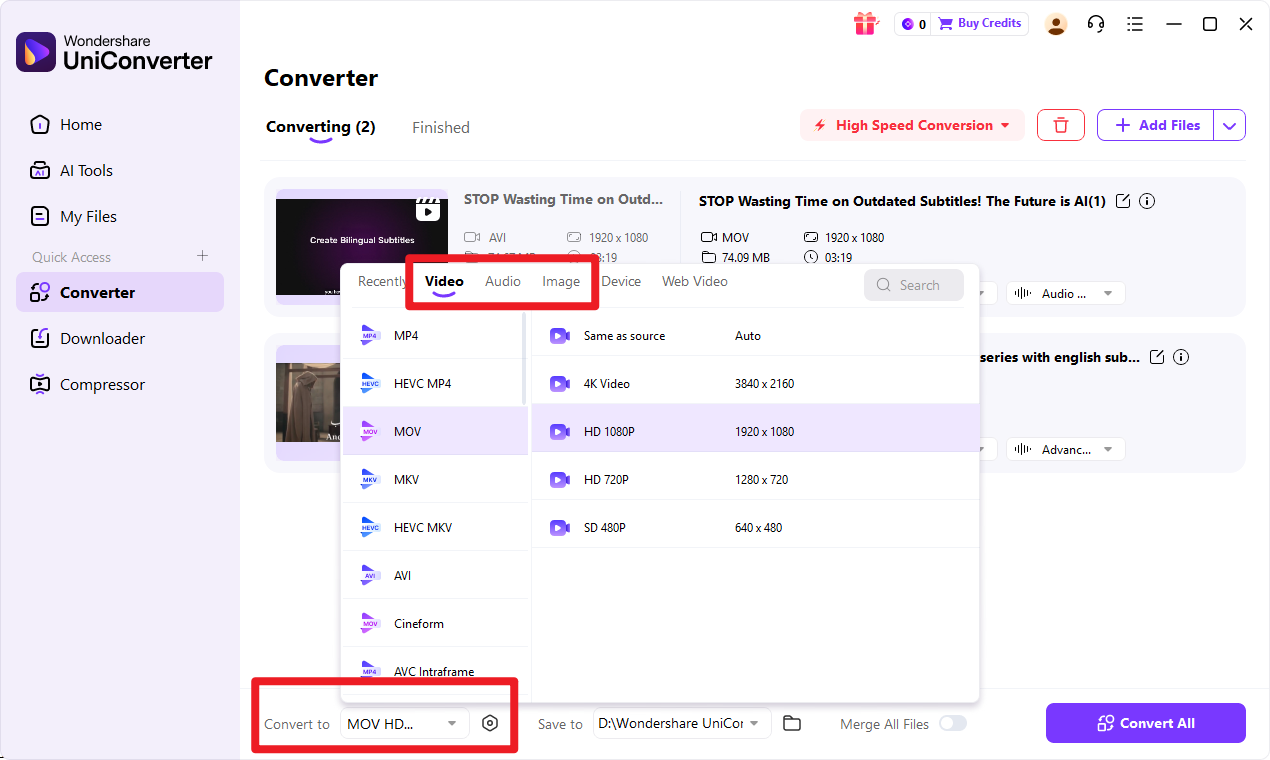
Step 3: Start the Conversion
Once you have configured the output format, you can choose a destination for your new files by using the File Location field at the bottom. When you are ready, click the Convert button for a single file or the Start All button in the bottom-right corner to begin the batch conversion process.
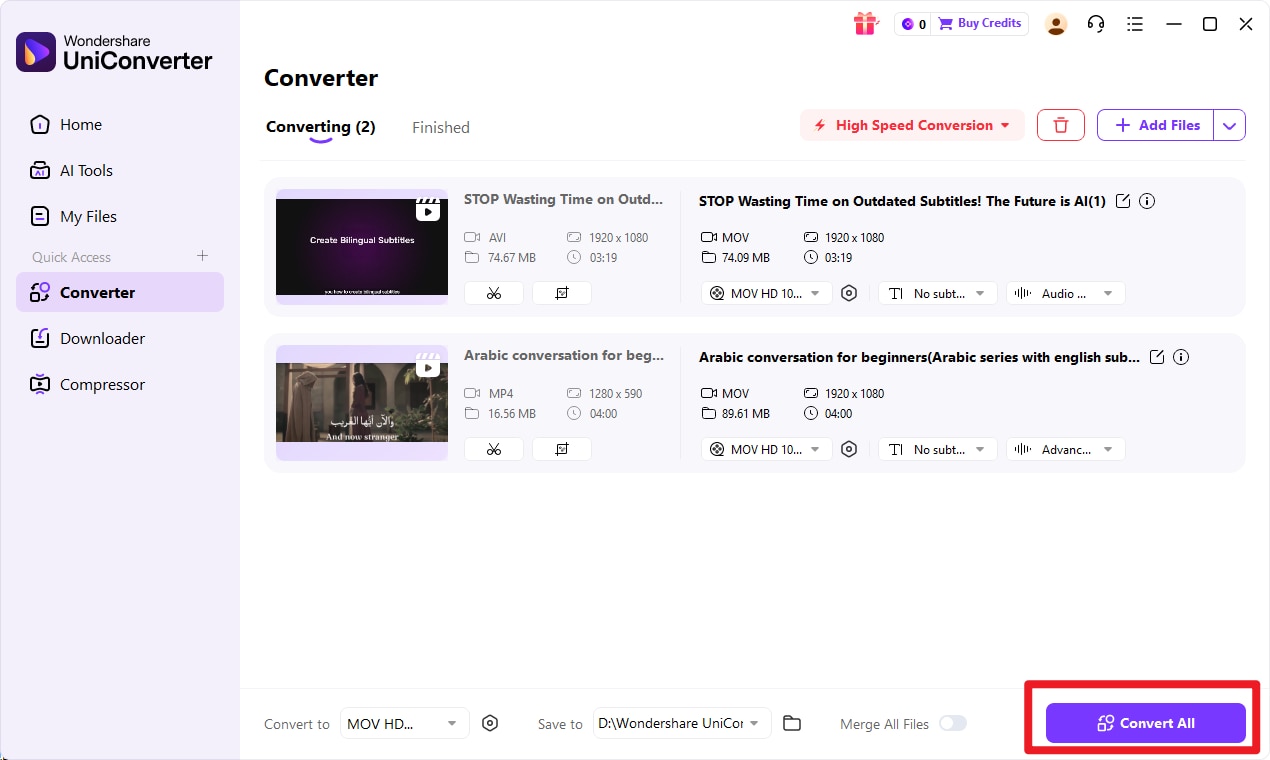
Step 4: Check Converted Files
UniConverter will now convert your H.264 videos to H.265. You can monitor the progress in the main window. Once the conversion is complete, you can find your new, smaller H.265 files by navigating to the Finished tab at the top of the screen or by opening the output folder you selected in the previous step.

Optimize Your Entire Video Workflow
Conclusion
The H.264 vs. H.265 discussion doesn't have a single winner, but it does have a clear direction. H.264 remains the king of compatibility, a reliable and universal standard that ensures your video can be played anywhere. It's the safe choice for broad distribution and for users with older hardware. H.265, however, is undeniably the future. Its incredible compression efficiency makes it the superior choice for 4K/8K video, streaming, and long-term storage, offering the same quality at half the file size.
Ultimately, the best codec depends on your specific goals. Do you need maximum compatibility or maximum efficiency? For users who need to navigate between these two standards, Wondershare UniConverter provides a powerful and intuitive solution. It allows you to easily convert videos between H.264 and H.265, ensuring your files are perfectly optimized for any device, platform, or storage need.
FAQs
-
1. Is H.265 always better than H.264?
Not always. H.265 is technologically superior in terms of compression efficiency, meaning it provides better quality at lower bitrates and creates smaller files. However, H.264 is far better for compatibility, as it is supported by nearly every device and platform. The "better" codec truly depends on your final use case—efficiency vs. compatibility. -
2. Does converting H.264 to H.265 improve video quality?
No, converting from one lossy format (H.264) to another (H.265) cannot magically add detail or improve the original video quality. The primary benefit of this conversion is to drastically reduce the file size while maintaining the same level of visual quality as the source H.264 file. -
3. Can my iPhone play H.265 videos?
Yes. Modern Apple devices have excellent support for H.265. iPhones since the iPhone 7 and iOS versions since iOS 11 include hardware acceleration for both recording and playing H.265 (HEVC) video, making it a seamless experience. -
4. What is the easiest way to convert multiple H.264 files to H.265?
The most efficient and easiest way is to use a dedicated video converter that supports batch processing. A tool like Wondershare UniConverter is perfect for this, as it allows you to add an entire folder of H.264 videos and convert them all to H.265 in a single operation, saving you significant time and effort.
