
When you're working with video, you'll inevitably encounter the term H.264. It's the backbone of modern video streaming, broadcasting, and storage. But within H.264, there are different "profiles" that can significantly impact your video's quality, file size, and compatibility. Two of the most common are the Main and High profiles. Understanding the H.264 High Profile vs Main Profile debate is crucial for anyone serious about video, from content creators to tech enthusiasts. This guide will demystify these profiles, helping you make the best choice for your projects.
In this article, you will learn:
- The fundamentals of the H.264 codec and its profiles.
- A direct comparison between the H.264 High and Main profiles.
- Which profile is superior for quality, file size, and compatibility.
- Practical use cases for choosing either the High or Main profile.
- How to easily convert videos between these profiles.
In this article
Part 1. What is H.264 High Profile? What is H.264 Main Profile?
Before we compare the High and Main profiles, it's essential to understand the foundation they are built upon: the H.264 codec and the concept of profiles.
A Brief Introduction to the H.264 Codec
H.264, also known as Advanced Video Coding (AVC), is a video compression standard that has dominated the industry for over a decade. Its primary function is to reduce the size of a digital video file while preserving as much visual quality as possible. This efficiency is why H.264 is used almost everywhere: from streaming services like YouTube and Netflix to Blu-ray discs and live television broadcasts. It strikes an excellent balance between compression, quality, and widespread device support.
Understanding H.264 Profiles
Within the H.264 standard, a "profile" is a predefined set of features and technical capabilities. Think of profiles like different trim levels for a car model. A base model car gets you from A to B, but a higher-end trim level includes advanced features like a more powerful engine, a better sound system, and more sophisticated safety features. Similarly, different H.264 profiles are tailored for specific applications by enabling or disabling certain compression tools. Lower-level profiles prioritize compatibility with less powerful devices, while higher-level profiles use more advanced techniques to achieve better compression at the cost of higher processing requirements.
What is H.264 Main Profile?
The Main Profile was developed as a significant step up from the even more basic Baseline Profile. Its key innovation was the introduction of B-frames (bi-directionally predicted frames), which allow for much more efficient compression than using only I-frames and P-frames. For a long time, the Main Profile represented the sweet spot, offering a good balance between compression efficiency and broad compatibility with devices like early smartphones, set-top boxes, and standard-definition digital television.
What is H.264 High Profile?
The High Profile is the most capable and feature-rich profile in the H.264 standard. It builds upon the Main Profile by adding more advanced compression techniques. These include features like 8x8 spatial prediction (instead of just 4x4), adaptive quantization, and more flexible intra-prediction. The primary benefit of these additions is superior compression efficiency. This means the High Profile can deliver the same visual quality as the Main Profile but at a significantly lower bitrate, resulting in smaller file sizes. It is the current standard for high-definition content, including Blu-ray discs and most online streaming platforms.
Part 2. Quick Comparison Table
To make the differences clear, let's look at a direct comparison between the two profiles.
H.264 High Profile vs Main Profile at a Glance
| Feature | Main Profile | High Profile |
| Compression Efficiency | Good | Excellent |
| Quality at Same Bitrate | Good | Higher |
| File Size at Same Quality | Larger | Smaller |
| Compatibility | Very High (including older devices) | High (standard for modern devices) |
| Encoding/Decoding Complexity | Lower | Higher |
Part 3. H.264 High Profile vs Main Profile: Which One Is Better?
While the table gives a quick overview, let's delve deeper into the key aspects to determine which profile is truly better for modern use in 2026.
Deep Dive into Compression and Quality
The single most significant advantage of the High Profile is its superior compression algorithm. The advanced features it employs, such as more sophisticated prediction methods and adaptive quantization, allow it to analyze video frames more intelligently. This results in a more efficient encoding process that can remove redundant data without sacrificing visual detail.
What does this mean in practice? If you take the same source video and encode it to both Main and High profiles at the exact same bitrate, the High Profile version will look noticeably better. It will exhibit fewer compression artifacts (like blocking or blurring) and retain more fine detail. For anyone prioritizing visual fidelity, the High Profile is the undisputed winner.
The Impact on File Size
The flip side of the quality coin is file size. The High Profile's efficiency can be leveraged to create smaller files. If your goal is to achieve a certain level of perceived quality, you can use a lower bitrate with the High Profile compared to the Main Profile.
For example, to achieve a quality level that requires a 5 Mbps bitrate with the Main Profile, you might only need a 3.5-4 Mbps bitrate with the High Profile. This can lead to file size reductions of 20-30% or more, without any noticeable drop in quality. This is incredibly valuable for streaming (where lower bandwidth is better), archiving (where storage space is a concern), and sharing files online.
Compatibility Across Devices
A decade ago, the compatibility argument was the main reason to stick with the Main Profile. Many early smartphones, tablets, and media players had hardware decoders that were only certified for the Main Profile. Playing a High Profile video on these devices would either fail or force a slow, battery-draining software decoding process.
However, in 2026, this is largely a non-issue. Virtually every modern device—including all current smartphones, tablets, PCs, Macs, smart TVs, streaming sticks (like Roku and Fire TV), and gaming consoles (like PlayStation and Xbox)—has hardware support for decoding the H.264 High Profile. It has become the de facto standard. The Main Profile's compatibility advantage now only applies to truly ancient or highly specialized low-power devices.
Processing Power Requirements
The advanced features of the High Profile come at a cost: they require more computational power to both encode and decode. Encoding a video with the High Profile will take longer and use more CPU resources than encoding with the Main Profile. Similarly, decoding (playing back) the video requires a more powerful processor.
As with compatibility, this was a bigger concern in the past. Today's multi-core CPUs and dedicated hardware decoders handle High Profile video with ease. The extra processing demand is negligible for playback on any modern device. While it can still be a factor for real-time encoding on very low-power systems, for the vast majority of users and applications, the processing overhead is not a practical limitation.
Part 4. Use Cases for H.264 High Profile and Main Profile
So, when should you choose one over the other? The decision depends entirely on your target audience and playback environment.
When to Choose H.264 Main Profile
Despite the High Profile's superiority, there are a few niche scenarios where the Main Profile is still the right choice:
- Targeting Very Old Hardware: If you need to create a video that must play on devices from the early 2010s or older (e.g., an original iPad, an iPhone 4, or a very old set-top box), the Main Profile offers the highest chance of success.
- Legacy System Integration: When working with closed, legacy video systems (perhaps in a corporate or industrial setting) that were designed before the High Profile became standard, you may be forced to use the Main Profile for compatibility.
- Extremely Limited Encoding Power: If you are performing real-time video encoding on a device with a very weak processor and cannot tolerate any dropped frames, falling back to the less demanding Main Profile might be necessary.
When to Choose H.264 High Profile
For almost every other situation in 2026, the High Profile is the clear and recommended choice. It is the modern standard for a reason. You should use the High Profile for:
- Online Video Streaming: Platforms like YouTube, Vimeo, and Twitch all recommend or require the High Profile for uploads to ensure the best quality-to-bitrate ratio.
- Creating Blu-ray Discs: The Blu-ray Disc specification mandates the High Profile for H.264 video.
- Archiving Video Files: To save significant storage space without compromising quality, encoding your video library with the High Profile is the most efficient method.
- General Video Production: For any video intended for playback on modern computers, smartphones, smart TVs, or game consoles, the High Profile provides the best results.
Part 5. Step-by-Step Guide to Convert H.264 Main Profile to High Profile Using UniConverter
If you have a library of older videos encoded with the Main Profile, or if you've accidentally exported a project with the wrong settings, you might want to convert them to the more efficient High Profile.
Why You Need to Convert Between Profiles
Converting your videos from Main to High Profile can bring several benefits. You can significantly reduce their file size, making them easier to store on your hard drive or share online. It's also a great way to modernize an old video library, bringing it up to current standards for better quality and efficiency. Finally, you might need to convert a file to ensure it meets the specific requirements of a streaming platform or playback device.
The Easiest Way to Change Video Profiles: Wondershare UniConverter
Changing a video's profile requires re-encoding, and for that, you need a powerful and reliable tool. Wondershare UniConverter is the perfect solution for this task. It features a simple, intuitive interface that makes video conversion accessible to everyone, regardless of technical skill. With its industry-leading conversion speeds, batch processing capabilities, and detailed output settings, you can easily change the H.264 profile of your videos while maintaining the highest possible quality. UniConverter allows you to dive into the settings and customize the encoder, resolution, bitrate, and more, giving you full control over the output.
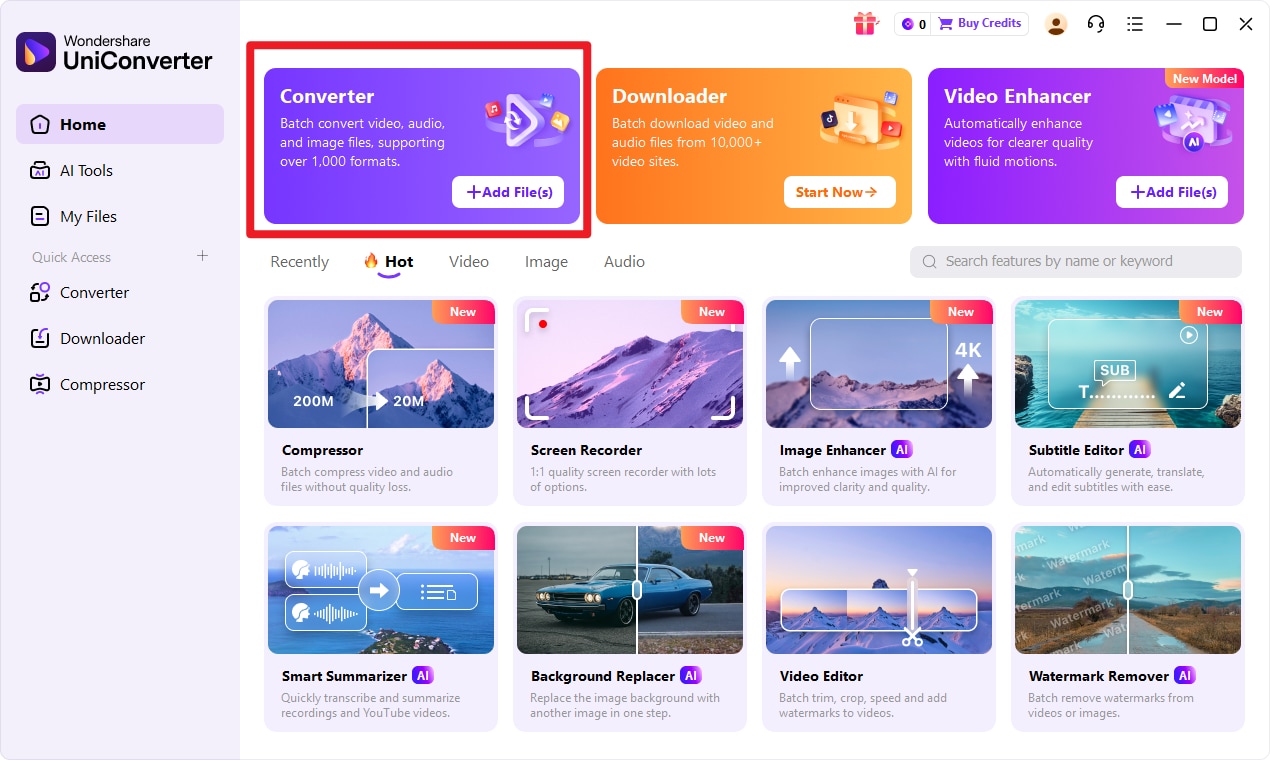
Step 1: Choose Converter in UniConverter
Launch Wondershare UniConverter on your computer. From the left-side menu, select the Converter tool.
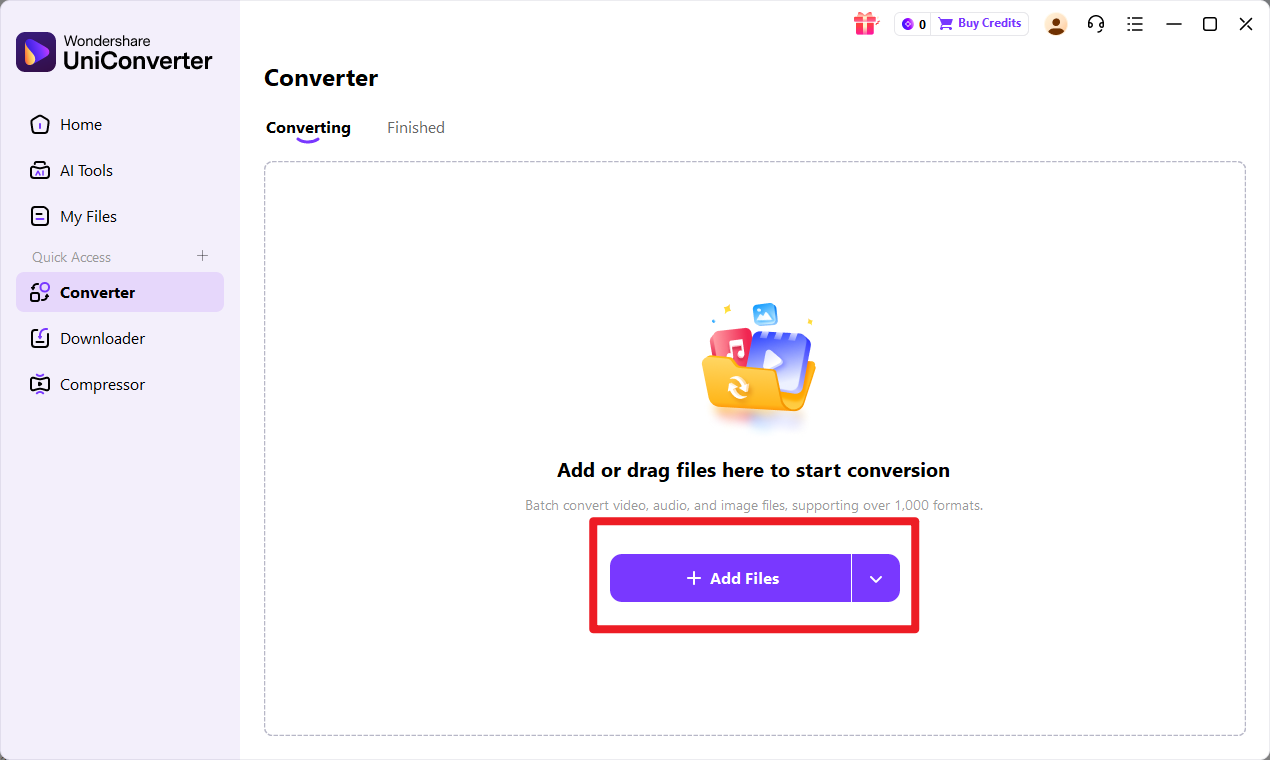
Step 2: Add Files to UniConverter
You can either drag and drop your input format video files into the right-hand window or click the Add Files icon to browse and import them.
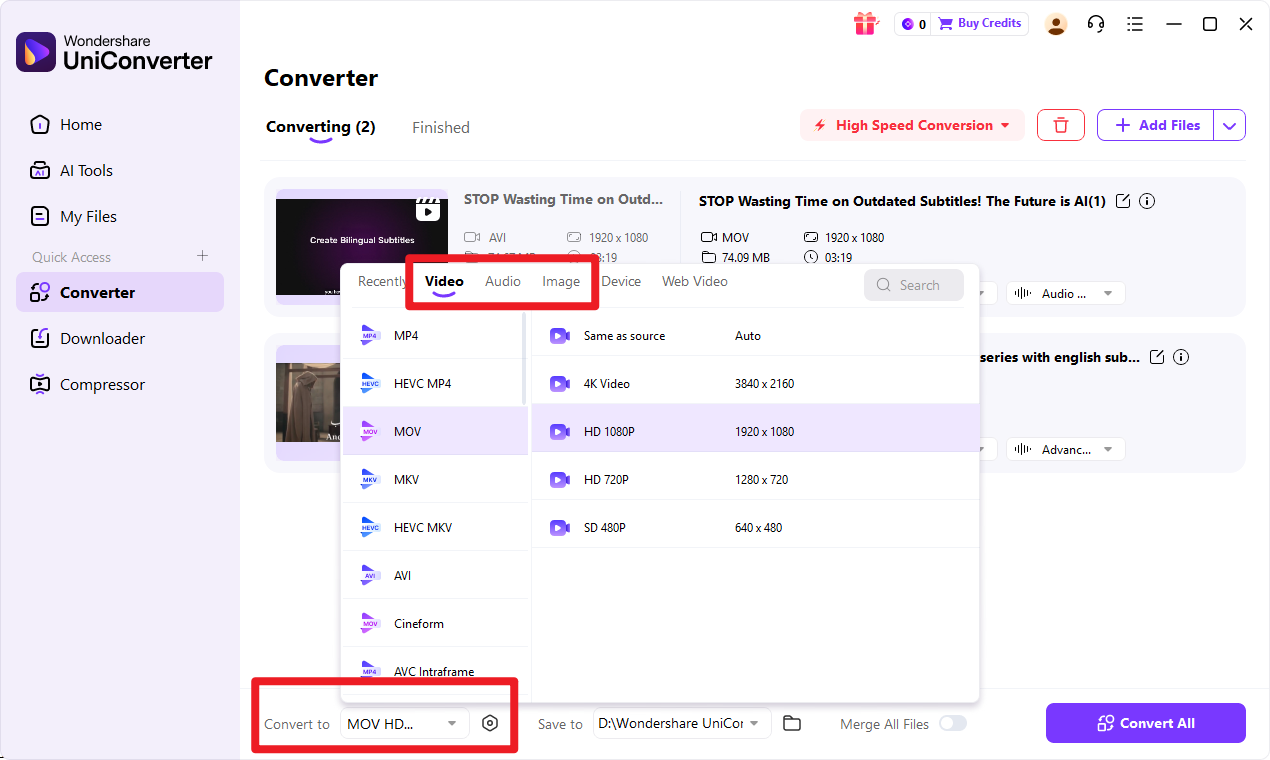
Step 3: Choose Output Format
At the bottom of the window, click the Output Format menu. Navigate to the Video tab, select your desired target format (e.g., MP4), and click the Edit icon next to the resolution to open the Quality settings window. Here, you can select the desired profile (e.g., High or Main) from the Encoder dropdown menu.
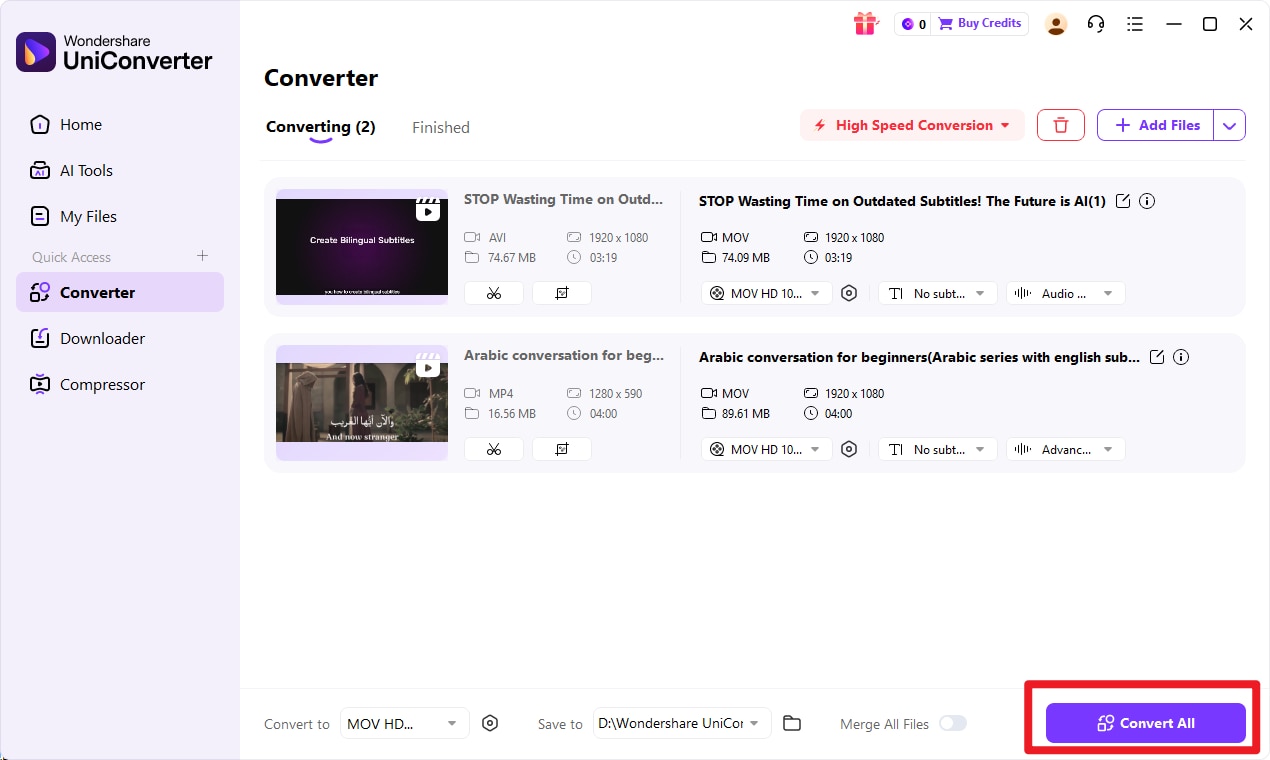
Step 4: Start the Conversion
Select a destination folder under File Location. Finally, click the Start All button to begin the process of converting your videos to the new profile.

Effortlessly Convert and Optimize Any Video
Conclusion
The debate over H.264 High Profile vs Main Profile has a clear winner in the modern era. While the Main Profile was once a crucial standard for ensuring broad compatibility, its advantages have faded over time. The High Profile offers demonstrably better compression, leading to higher quality at the same bitrate and smaller file sizes for the same quality. With near-universal support across all modern devices, the High Profile is the superior choice for nearly every application, from streaming and broadcasting to archiving and personal video projects. For those rare cases where you need to support legacy hardware, the Main Profile remains a viable fallback. And if you ever find yourself needing to switch between profiles to optimize your video library, a powerful tool like Wondershare UniConverter makes the entire process simple and efficient.
FAQs
-
1. Is H.264 High Profile backward compatible with Main Profile?
No. A device that only supports Main Profile cannot play a video encoded with High Profile. The advanced features of the High Profile require a decoder that understands them. However, the reverse is true: a device that supports High Profile can almost always play Main Profile videos, as the Main Profile's feature set is a subset of the High Profile's. -
2. Does YouTube prefer High Profile or Main Profile?
YouTube's official recommendation for uploads is to use the H.264 codec with the High Profile. This allows their system to ingest the highest quality source file possible, which then gets re-encoded into various formats and resolutions for optimal streaming across different devices and network conditions. Uploading in High Profile gives your video the best starting point. -
3. Can I change a video's profile without losing quality?
Changing a video's profile requires re-encoding the entire video, which is inherently a "lossy" process. This means some data is always lost. However, the perceived quality loss can be minimized or made imperceptible by starting with a high-quality source file and using a professional-grade converter like Wondershare UniConverter. By setting a sufficiently high bitrate for the new encode, you can ensure the final video looks virtually identical to the original. -
4. Is there a newer codec than H.264?
Yes, H.265, also known as High Efficiency Video Coding (HEVC), is the direct successor to H.264. It offers roughly double the compression efficiency, meaning it can achieve the same quality as H.264 at about half the bitrate. While H.265 is gaining traction, especially for 4K and 8K content, H.264 remains the most widely compatible and universally supported video codec on the planet today.
