
When exporting a video, you've likely navigated through a maze of settings: resolution, frame rate, bitrate, and format. But hidden within these options is a crucial setting that significantly impacts your video's quality, file size, and compatibility: the H.264 profile. The choice often comes down to H.264 Baseline vs High Profile, leaving many creators wondering which one is the right fit for their project. Are you sacrificing quality for compatibility? Or creating a file that won't play on your audience's devices?
This decision can feel technical and overwhelming, but understanding the core differences is key to optimizing your video workflow. Whether you're a professional video editor, a content creator for social media, or simply trying to archive your video library efficiently, choosing the correct profile matters. This guide will demystify the H.264 Baseline and High profiles, providing a clear, comprehensive comparison to help you make an informed decision every time.
In this article:
- An introduction to the H.264 codec and its profiles.
- A side-by-side comparison of H.264 Baseline and High profiles.
- A detailed analysis of which profile is better for specific needs.
- Common use cases for both Baseline and High profiles.
- A step-by-step guide on how to convert between profiles.
Part 1. What is H.264 Baseline Profile? What is H.264 High Profile?
Before diving into the profiles, it's essential to understand the foundation they are built on. Let's start with a quick look at the H.264 codec itself.
A Brief Introduction to H.264 Video Codec
H.264, also known as Advanced Video Coding (AVC), is a video compression standard that is one of the most commonly used formats for the recording, compression, and distribution of video content. It was developed to provide good video quality at substantially lower bitrates than previous standards without overly increasing the complexity of its design.
Think of a codec as a set of rules for shrinking and unshrinking a video file. When you record a video, it contains a massive amount of data. A codec like H.264 intelligently removes redundant information to make the file smaller and easier to store or stream. When you play the video, the codec reconstructs the image. Within H.264, "profiles" are predefined sets of these rules and capabilities, tailored for different purposes. Baseline, Main, and High are the most common profiles, each offering a different balance of features, compression efficiency, and computational demand.
What is H.264 Baseline Profile?
The H.264 Baseline Profile is the simplest and most basic profile within the H.264 standard. Its primary design goal was to ensure maximum compatibility across a wide range of devices, especially those with limited processing power.
Its core characteristic is its low computational requirement. It achieves this by forgoing some of the more advanced compression techniques found in other profiles. For example, it does not use B-frames (bi-directionally predicted frames) and relies on the less complex CAVLC (Context-Adaptive Variable-Length Coding) for entropy coding instead of the more efficient CABAC.
This simplicity makes it the perfect choice for applications where playback on older or less powerful hardware is a priority. It's the "safe bet" for ensuring your video will play almost anywhere, from old smartphones and basic set-top boxes to video conferencing applications where low latency and minimal processing are critical. The trade-off, however, is lower compression efficiency, meaning it produces larger file sizes for a given level of quality compared to more advanced profiles.
What is H.264 High Profile?
The H.264 High Profile is the most capable and feature-rich profile, designed to deliver the highest compression efficiency and video quality. It is the current standard for most high-definition video applications, from online streaming to Blu-ray discs.
The High Profile achieves its superior performance by utilizing all the advanced features of the H.264 standard. This includes B-frames, which can reference frames both before and after them, leading to much more efficient compression. It also uses CABAC (Context-Adaptive Binary Arithmetic Coding), a more sophisticated entropy coding method that results in smaller file sizes for the same visual quality compared to CAVLC. Furthermore, it supports features like 8x8 transform and scaling matrices, which help preserve fine details more effectively during compression.
This focus on maximum efficiency means you can achieve a significantly smaller file size with the High Profile than with the Baseline Profile while maintaining the same level of visual quality. Alternatively, for the same file size, a High Profile video will look noticeably better. This makes it the ideal choice for modern applications like HD streaming on platforms such as YouTube and Netflix, digital broadcasting, and creating high-quality video archives. The only downside is that it requires more processing power to encode and decode, but virtually all modern devices built in the last decade are fully equipped to handle it.
Part 2. Quick Comparison Table
To make the differences even clearer, here is a direct, side-by-side comparison of the key attributes of H.264 Baseline and High Profile.
H.264 Baseline vs High Profile: Side-by-Side Comparison
| Feature | H.264 Baseline Profile | H.264 High Profile |
| Compression Efficiency | Low | High |
| Video Quality | Good (at higher bitrates) | Excellent (at lower bitrates) |
| Device Compatibility | Maximum (including very old devices) | High (most modern devices) |
| CPU Usage (Encoding & Decoding) | Low | High |
| File Size (at similar quality) | Larger | Smaller |
| Key Features | I/P-frames, CAVLC | I/P/B-frames, CABAC, 8x8 Transform |
Part 3. H.264 Baseline Profile vs H.264 High Profile: Which One Is Better?
The question of which profile is "better" doesn't have a single answer. The optimal choice depends entirely on your specific goals, your target audience, and the platforms you're using. Let's break it down by scenario.
For Maximum Compatibility: Baseline Profile is Your Best Bet
If your absolute top priority is ensuring your video can be played by anyone, on any device, anywhere in the world, then the Baseline Profile is the undisputed champion. Its simple, low-demand structure was specifically designed for this purpose.
Imagine you are creating a video that needs to be accessible on a first-generation smartphone, an old tablet, or a basic digital signage player in a public space. These devices have limited processing power and may not support the advanced decoding features required by the High Profile. By encoding with the Baseline Profile, you guarantee a smooth playback experience without stutters or errors. This is also why it's a staple in video conferencing software, where real-time performance and low latency across a vast array of user hardware are more important than achieving the absolute smallest file size.
For the Best Quality-to-Size Ratio: High Profile is the Clear Winner
If your goal is to deliver the best possible video quality while keeping file sizes manageable, the High Profile is the superior choice. This is the reason it has become the de facto standard for virtually all modern high-definition content distribution.
The advanced compression techniques used by the High Profile, such as B-frames and CABAC, work together to intelligently reduce data redundancy far more effectively than the Baseline Profile. This means that for a video encoded at the same bitrate (e.g., 5,000 kbps), the High Profile version will look sharper, clearer, and have fewer compression artifacts. Conversely, to achieve the same visual quality as a Baseline video, the High Profile video can be encoded at a much lower bitrate, resulting in a significantly smaller file. This is crucial for streaming platforms like YouTube and Netflix, which need to deliver 1080p and 4K content to millions of users without consuming excessive bandwidth. It's also ideal for archiving your own videos, as it allows you to preserve quality while saving valuable storage space.
For Faster Encoding: Baseline Profile Has the Edge
Encoding video is a processor-intensive task. The complexity of the compression algorithm directly impacts how long it takes to convert your source video into the final H.264 file. Because the Baseline Profile uses a simpler set of tools, it requires less computational power.
If you are working on a machine with limited CPU resources or need to export a large number of videos on a tight deadline, using the Baseline Profile can significantly speed up your workflow. The encoder doesn't have to analyze future frames to create B-frames or use the more complex CABAC algorithm, leading to a much faster turnaround time. This speed advantage can be a critical factor in time-sensitive environments like news reporting or quick social media updates. However, remember that this speed comes at the cost of larger file sizes for comparable quality.
The Final Verdict: It Depends on Your Audience and Platform
Ultimately, the "better" profile is the one that best serves your specific use case. There is no one-size-fits-all answer.
- Choose Baseline Profile if: Your primary concern is compatibility with old or low-power devices, or if you need the fastest possible encoding speed.
- Choose High Profile if: Your primary concern is achieving the best video quality, the smallest possible file size, and your audience is using modern devices (which is the case for most online video in 2026).
The key is to understand your delivery target. Who will be watching your video, and on what kind of device? Answering this question will point you directly to the right profile.
Part 4. Use Cases for H.264 Baseline Profile and H.264 High Profile
To put this into a real-world context, here are some common applications where each profile excels.
Common Use Cases for H.264 Baseline Profile
The focus here is on low-latency, low-power, and broad compatibility.
- Video Conferencing: Applications like Zoom, Microsoft Teams, and Skype rely on the Baseline Profile to ensure real-time video streams can be encoded and decoded quickly on a wide variety of computers and mobile devices, minimizing lag and processing load.
- Mobile Video for Legacy Smartphones: If you need to support smartphones and tablets that are more than 5-7 years old, Baseline is the safest choice to guarantee playback without issues.
- Simple Video Messaging Apps: For short, disposable video messages sent through apps, Baseline provides a quick and reliable encoding method that works universally, even if it's not the most efficient.
- Some IP Security Cameras: To reduce the processing load on the camera hardware itself, some security cameras may use Baseline for their real-time streams.
Common Use Cases for H.264 High Profile
The focus here is on high quality and compression efficiency for modern platforms.
- High-Definition Streaming: This is the primary use case. Platforms like YouTube, Netflix, Hulu, and Vimeo all use the High Profile to deliver crisp HD, Full HD, and 4K content to viewers while optimizing bandwidth usage.
- Blu-ray Disc Authoring: The H.264 High Profile is one of the mandatory video standards for Blu-ray discs, chosen for its ability to store high-quality feature-length films efficiently.
- Digital Television Broadcasting: Over-the-air digital broadcasts (like ATSC in North America and DVB-T in Europe) widely use the High Profile to transmit high-quality television signals.
- Video Archiving: For anyone looking to store a personal or professional video library, encoding with High Profile preserves the best quality while minimizing the amount of storage space required.
Part 5. Step-by-Step Guide to Convert H.264 Baseline to High Profile Using UniConverter
What if you have a library of older videos encoded with the Baseline Profile and want to update them for more efficient storage? Or perhaps you have a source file that you want to prepare for a high-quality streaming platform. In these cases, you'll need to convert the video's profile.
Why You Might Need to Convert from Baseline to High Profile
There are two main reasons to perform this conversion:
- To Re-encode for Efficient Storage: If you have a large collection of videos saved using the Baseline Profile, they are likely taking up more space than necessary. By converting them to the High Profile, you can significantly reduce their file size without losing any of the original quality, freeing up valuable hard drive space.
- To Meet Platform Requirements: When uploading to a modern streaming service like YouTube, providing a High Profile video ensures your content is processed in the best possible way. While YouTube will re-encode whatever you upload, starting with a high-quality, efficiently compressed source file is always best practice.
How to Convert H.264 Baseline to High Profile with UniConverter
Converting between H.264 profiles is a process of re-encoding the video, and a powerful tool is needed to do this correctly. Wondershare UniConverter is a perfect solution for this task. It offers a user-friendly interface combined with detailed control over encoding settings, making it easy for anyone to change a video's profile without getting lost in technical jargon.
Here's how to convert a video from Baseline to High Profile in four simple steps.
Step 1: Add Files to UniConverter
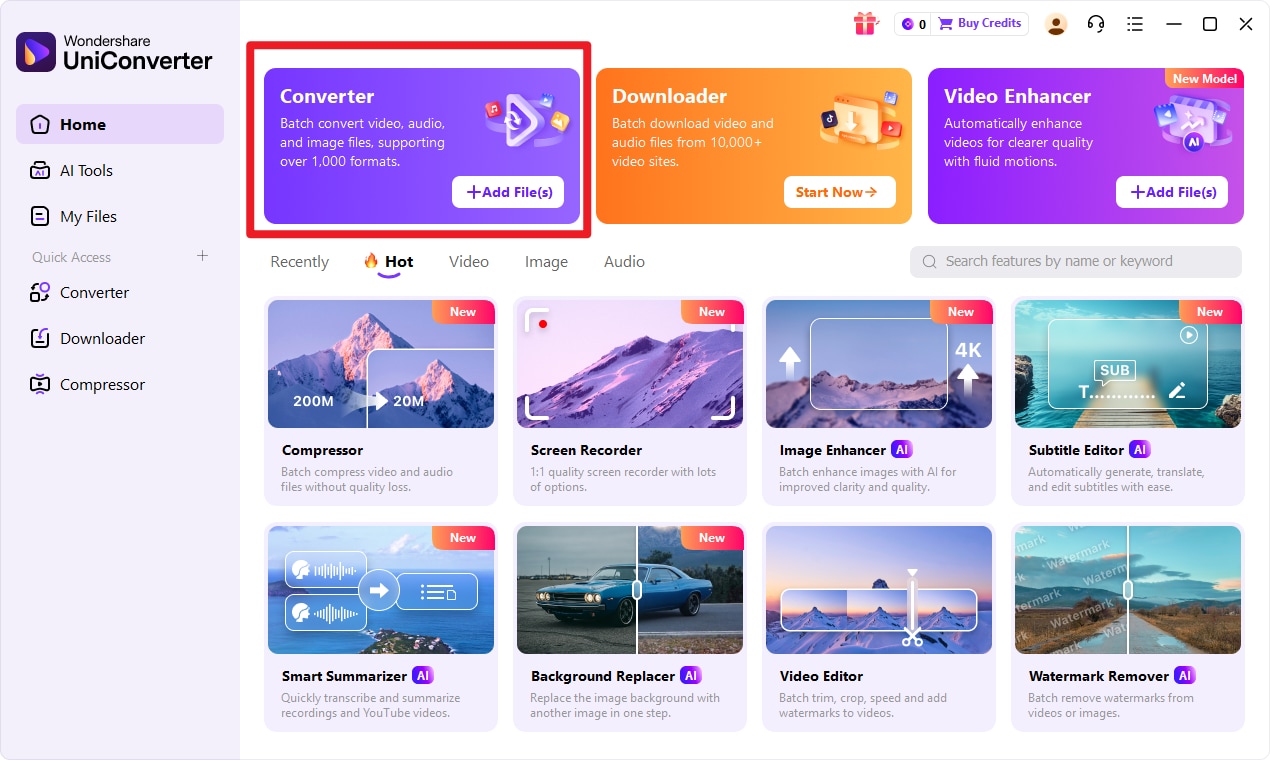
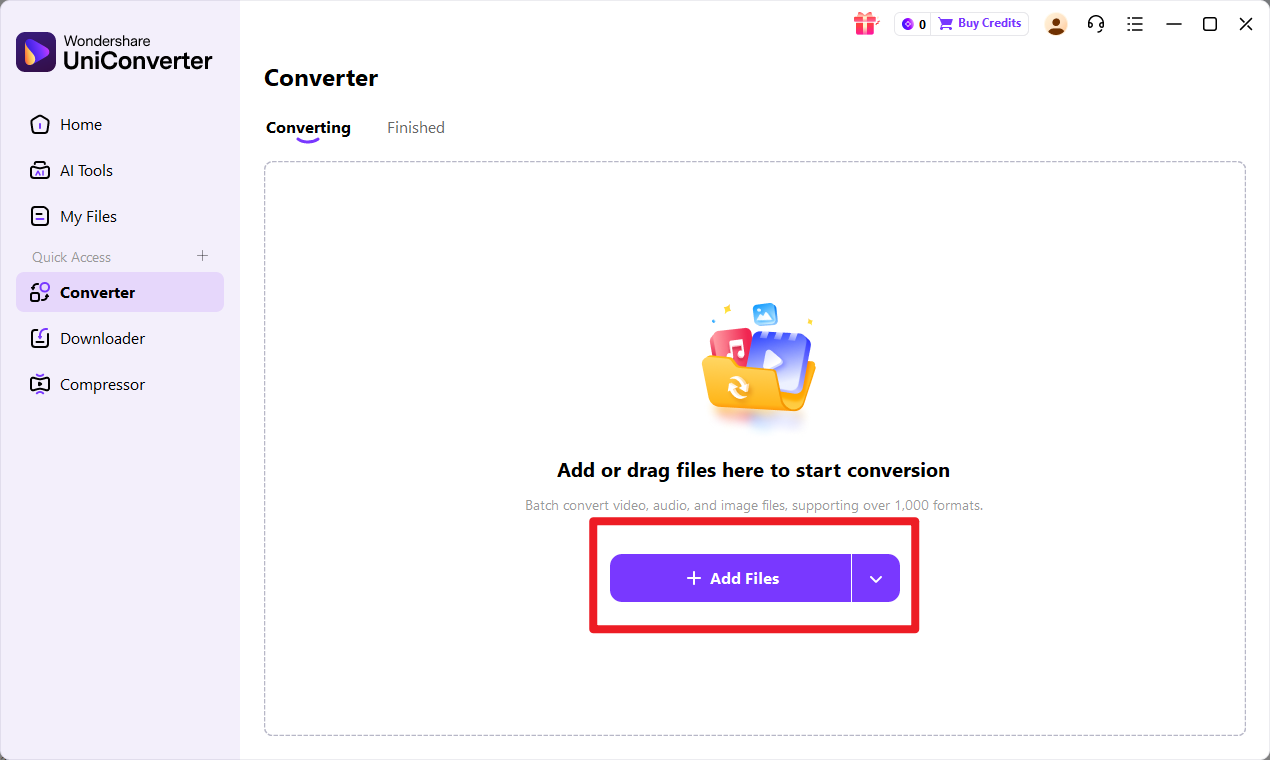
First, open Wondershare UniConverter on your computer. In the main interface, select the "Converter" tool from the left-hand menu. You can then either click the "Add Files" icon or simply drag and drop your H.264 Baseline Profile video file directly into the program window.
Step 2: Choose Output Format
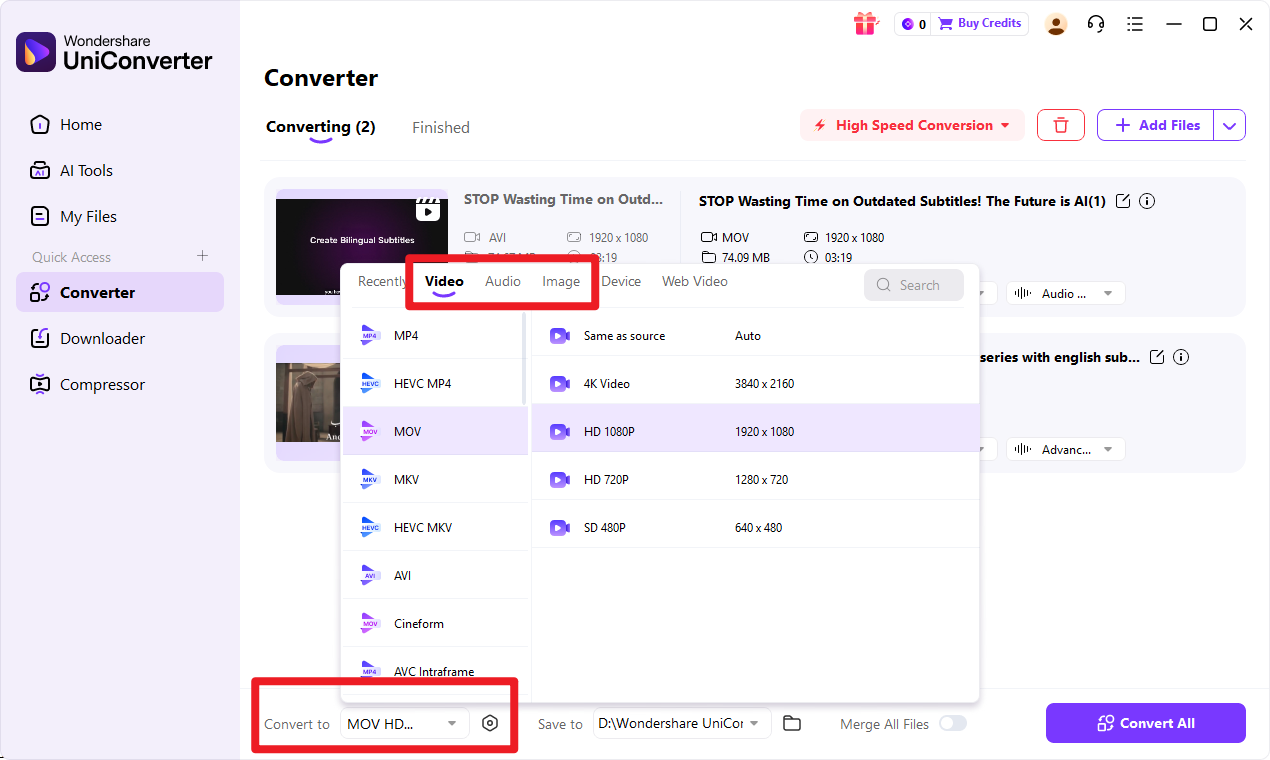
At the bottom of the window, click on the "Output Format" tab. This will open a new panel. Go to the "Video" tab and select your desired container format, such as MP4. To the right of the resolution options, click the "Edit" (pencil) icon to open the advanced settings window where you can customize the encoding parameters.
Step 3: Start the Conversion
Inside the "Settings" window, look for the "Encoder" section. You will see the codec listed as H.264. Right below it, you'll find the "Profile" dropdown menu. Click on it and change the selection from "Baseline" (or "Auto") to "High". You can also adjust other settings like bitrate or resolution if needed. Click "Create" to save your new custom profile.
Step 4: Check Converted Files
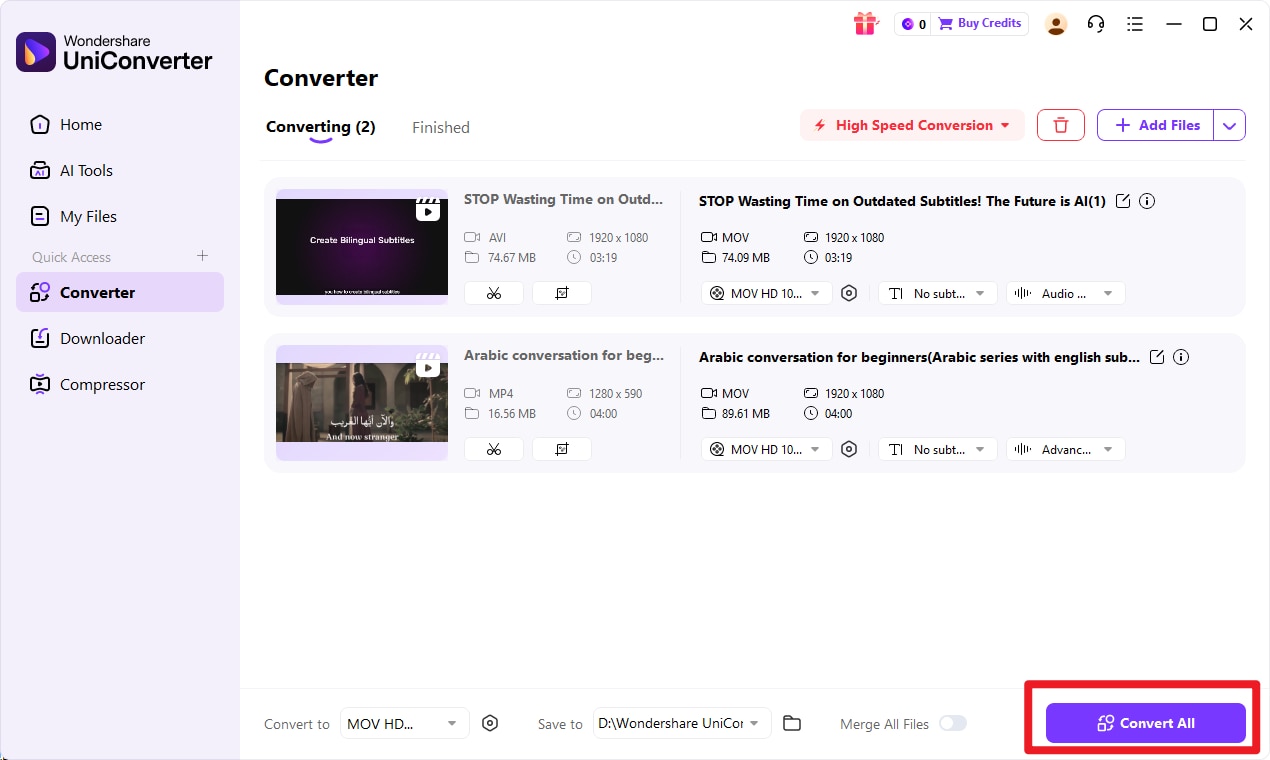
Back in the main window, select your newly created custom format. You can choose a location for the saved file using the "File Location" tab at the bottom. Finally, click the "Convert" button (or "Start All" for multiple files) to begin the re-encoding process. Once finished, you can find your new High Profile video in the "Finished" tab or the output folder you selected.

Go Beyond Simple Video Profile Conversion
Conclusion
Navigating the world of video codecs and profiles can seem daunting, but the choice between H.264 Baseline vs High Profile boils down to a simple trade-off. The Baseline Profile offers universal compatibility at the cost of efficiency, making it ideal for legacy devices and low-latency applications. The High Profile, on the other hand, provides superior compression and quality, making it the standard for virtually all modern HD video distribution and storage.
For most creators in 2026, the High Profile will be the go-to choice for delivering content online. However, the decision is never permanent. As we've shown, powerful and intuitive tools like Wondershare UniConverter make it incredibly simple to convert your videos from one profile to another. This flexibility ensures you can always adapt your content to meet any compatibility requirement or quality standard, bridging the gap between efficiency and accessibility with just a few clicks.
FAQs
-
1. Does YouTube prefer H.264 Baseline or High Profile?
YouTube strongly recommends and primarily uses the High Profile for its video processing. Uploading a video with the High Profile ensures it meets YouTube's preferred specifications for optimal quality and efficient handling, especially for HD, 4K, and HDR content. -
2. Will converting a video from Baseline to High Profile improve its visual quality?
No, converting from a lower-complexity profile to a higher one cannot magically create visual detail that wasn't present in the original source file. The process is a re-encode, not an enhancement. However, it will encode the existing data more efficiently, which can result in a smaller file size for the same visual quality. -
3. Can my computer play High Profile videos?
Almost certainly, yes. Any modern computer, smartphone, smart TV, or tablet manufactured in the last 10-12 years has built-in hardware decoding support for H.264 High Profile. Playback issues are extremely rare on contemporary devices. -
4. Why is UniConverter a good choice for changing video profiles?
Wondershare UniConverter is highly recommended because it simplifies a complex process. Its intuitive interface allows users to easily access and change advanced settings like the H.264 profile without needing expert knowledge. Combined with its fast GPU-accelerated conversion speeds and support for a vast range of formats, it's an ideal tool for both beginners who need a simple solution and professionals who require detailed control.
