
In the fast-paced world of digital video, codecs are the unsung heroes that make everything from streaming 4K movies to video conferencing possible. They compress massive video files into manageable sizes without sacrificing too much quality. For years, H.265, also known as High Efficiency Video Coding (HEVC), has been the reigning standard for high-quality video. But a new contender has emerged: H.266, or Versatile Video Coding (VVC), promising even greater efficiency. This leads to a critical question for content creators, tech enthusiasts, and everyday users: in the H.265 vs VVC debate, which one should you be using?
This comprehensive guide will break down the key differences between these two powerful codecs. We'll explore their technical specifications, real-world performance, and practical use cases to help you make an informed decision. Whether you're a professional video editor looking to future-proof your workflow or simply curious about the technology behind your favorite streaming service, we've got you covered.
In this article:
Part 1. What is H.265? What is VVC?
Before we dive into a direct comparison, it's essential to understand what each codec is and what it was designed to achieve. Both are part of a long line of video compression standards developed by the MPEG and VCEG collaboration, but they serve different stages of technological evolution.
What is H.265 (HEVC)?
H.265, officially known as High Efficiency Video Coding (HEVC) or MPEG-H Part 2, is the direct successor to the once-ubiquitous H.264/AVC. Finalized in 2013, its primary goal was to enable the next generation of video experiences, namely 4K Ultra HD.
The core innovation of H.265 was its ability to deliver the same level of video quality as H.264 while using approximately 50% less data. This remarkable efficiency was a game-changer. It made streaming 4K content over standard internet connections feasible and allowed for storing twice as much high-resolution video in the same amount of space. As a result, H.265 quickly became the industry standard for 4K UHD Blu-ray discs, premium streaming services like Netflix and Amazon Prime Video, and modern digital cameras and smartphones. Today, it represents the perfect balance of high-quality compression and widespread device support.
What is VVC (H.266)?
VVC, which stands for Versatile Video Coding (H.266) or MPEG-I Part 3, is the state-of-the-art successor to H.265/HEVC. Finalized in mid-2020, its development was driven by the need for even greater compression to handle the demands of future video technologies.
The primary objective of VVC is to achieve another significant leap in efficiency, aiming to reduce the bit rate by another 40-50% compared to H.265 for the same subjective visual quality. This makes it ideal for the next wave of ultra-high-resolution and immersive content, including 8K video, 360-degree virtual reality (VR) experiences, and advanced High Dynamic Range (HDR) applications. VVC achieves this through more complex and intelligent coding tools, allowing it to compress video data more effectively than ever before. While its adoption is still in the early stages, VVC represents the future of video compression.
Part 2. Quick Comparison Table
To get a clear overview of how these two codecs stack up, let's look at a direct, head-to-head comparison of their key attributes. This table highlights the fundamental trade-offs between the established H.265 and the next-generation VVC.
H.265 vs VVC: Head-to-Head Comparison
| Feature | H.265 (HEVC) | VVC (H.266) |
| Full Name | High Efficiency Video Coding | Versatile Video Coding |
| Compression Efficiency | High | Very High (approx. 50% better than H.265) |
| File Size | Smaller than H.264 | Smallest for the same quality |
| Compatibility | Widespread (most modern devices) | Very limited (emerging) |
| Computational Complexity | High | Very High (more demanding than H.265) |
| Primary Use | 4K streaming, video storage | Future 8K, VR, HDR streaming |
Part 3. H.265 vs VVC: Which One Is Better?
While the table gives us a quick summary, the question of which codec is "better" depends entirely on your priorities. Do you need maximum compatibility for sharing videos today, or are you focused on achieving the smallest possible file size for archival purposes? Let's break down the four most important factors.
Compression Efficiency and File Size: The VVC Advantage
This is VVC's headline feature and its most significant advantage. VVC was engineered from the ground up to be the most efficient compression standard to date. It employs more advanced coding structures, such as a more flexible quadtree with nested multi-type tree (QTMT) partitioning scheme, which allows the encoder to adapt to different types of video content more precisely.
In practical terms, this means that for the same perceived visual quality, a video encoded with VVC can be up to 50% smaller than the same video encoded with H.265. This is a monumental improvement. For streaming services, it means drastically lower bandwidth costs and the ability to deliver higher-quality streams to users with slower internet connections. For consumers, it means storing twice as many 8K movies or family videos on a hard drive. When it comes to pure compression power and minimizing file size, VVC is the undisputed winner.
Video Quality: Pushing the Boundaries
It's important to clarify that at very high bitrates, both H.265 and VVC can produce visually lossless, stunning video quality. The real difference emerges at lower and mid-range bitrates, which are more common for streaming and online distribution.
Here, VVC's main quality advantage is its ability to maintain high fidelity and avoid compression artifacts (like blockiness or blurring) at significantly lower data rates compared to H.265. This is particularly noticeable in complex scenes with high motion or intricate textures. Furthermore, VVC includes improved, specialized tools for handling screen-captured content (like software tutorials or gameplay videos), as well as enhanced support for High Dynamic Range (HDR) and Wide Color Gamut (WCG) video, ensuring that the most vibrant and lifelike images are preserved more faithfully.
Compatibility and Adoption: H.265 Is the Clear Winner Today
This is the most critical factor for most users in 2026. A video file is useless if you can't play it. H.265/HEVC has been on the market for over a decade and enjoys broad, mature support across the entire technology ecosystem.
Virtually all modern devices, including smartphones (iOS and Android), smart TVs, streaming boxes (Apple TV, Roku), and computers, have built-in hardware decoding for H.265. This means they can play HEVC files smoothly and efficiently without draining the battery or maxing out the CPU. Major web browsers and video editing software like Adobe Premiere Pro and Final Cut Pro also fully support it.
VVC, on the other hand, is still in its infancy. Hardware decoding support is not yet integrated into mainstream consumer chips. This means playing a VVC file relies on software decoding, which is incredibly demanding on the processor and impractical for most devices, especially mobile ones. For anyone looking to create, share, or distribute video content for a wide audience today, H.265 is the only practical choice.
Encoding and Decoding Requirements: The Cost of Efficiency
VVC's superior compression comes at a steep price: computational complexity. The advanced algorithms that allow VVC to shrink file sizes so effectively require immense processing power to both encode (create) and decode (play) the video.
According to some studies, encoding a video in VVC can take up to 10 times more computational resources than encoding the same video in H.265. For a content creator, this translates to dramatically longer export times. On the playback side, as mentioned above, the lack of dedicated hardware decoders means that even powerful computers can struggle to play high-resolution VVC files smoothly. H.265, while more demanding than its predecessor H.264, has reached a point where hardware acceleration makes both encoding and decoding fast and efficient on modern systems. This makes the entire workflow, from creation to consumption, far more manageable with H.265.
Part 4. Use Cases for H.265 and VVC
Based on the comparison above, the choice between H.265 and VVC becomes a matter of choosing the right tool for the right job.
When to Use H.265 (HEVC)
H.265 is the go-to codec for almost all current, real-world applications. You should use it in the following scenarios:
- Content Distribution: When creating 4K videos for platforms like YouTube or Vimeo, or for sharing with friends and family. Its wide compatibility ensures that almost everyone will be able to watch your video without issues.
- Streaming: If you are streaming content to a broad audience, H.265 provides a reliable balance of quality and accessibility across a vast range of devices.
- General Video Production: For most video editing projects, using H.265 as your final delivery format offers an excellent combination of high quality and manageable file sizes that are compatible with most players and platforms.
- Personal Archiving: If you are digitizing your home movies or storing video files, H.265 provides great compression while ensuring you'll be able to play them back on devices for years to come.
When to Use VVC (H.266)
VVC is a forward-looking codec, and its use cases today are highly specialized and future-oriented. Consider using VVC for:
- Long-Term Archival: For large institutions or individuals with massive video libraries (e.g., terabytes of 8K footage), encoding to VVC can cut storage costs in half. This is done with the assumption that compatible playback hardware will become common in the future.
- Professional, Closed-Loop Systems: In a controlled environment, such as a broadcast studio or a research lab with cutting-edge hardware, VVC can be used to test the limits of video delivery and develop next-generation services.
- Research and Development: Developers and engineers working on future streaming platforms, video conferencing tools, or VR applications will use VVC to build and test their systems for the next wave of video technology. For the average user, VVC is best thought of as a technology to watch, not one to actively use just yet.
Part 5. Step-by-Step Guide to Convert Videos Using UniConverter
Even with H.265's widespread popularity, you may still encounter situations where a specific device, older software, or a particular platform doesn't support it. A common scenario is needing to play an H.265 file on a device that only supports the older H.264 codec. In these cases, a powerful and reliable video converter is an essential tool.
Why You Need a Reliable Video Converter
Converting video files, especially high-resolution ones, can be a complex and time-consuming task. A professional tool is essential for ensuring a smooth, high-quality conversion without errors. Wondershare UniConverter stands out as a top-tier choice for these tasks. It offers a fast, intuitive, and feature-rich solution for handling over 1,000 video and audio formats. Whether you need to convert H.265 to a more universal format like H.264 (MP4), compress large files, or perform quick edits, UniConverter provides a comprehensive suite of tools in one user-friendly package.
How to Convert Videos with UniConverter
Here's how you can easily convert your video files in just four simple steps.
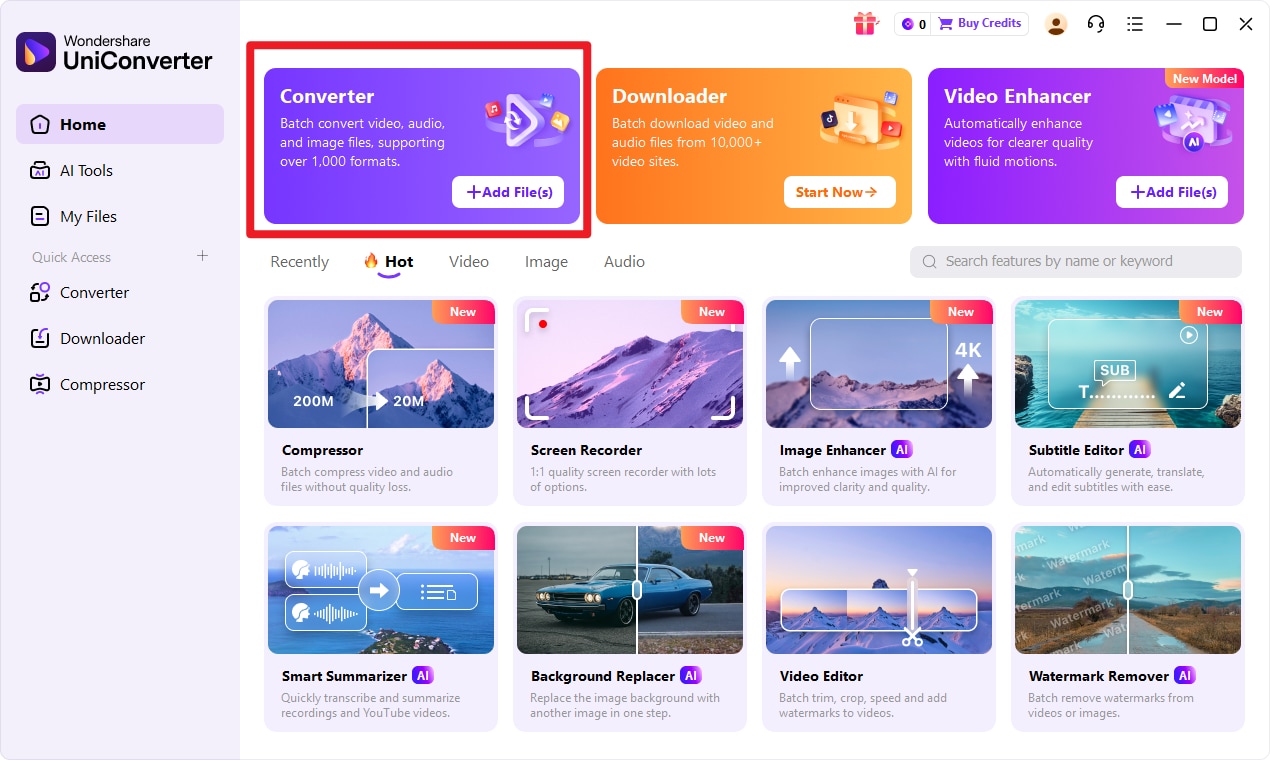
Step 1. Choose Converter in UniConverter
Launch Wondershare UniConverter on your computer. From the main interface, navigate to the left-side menu and select the Converter tool to open the conversion panel.
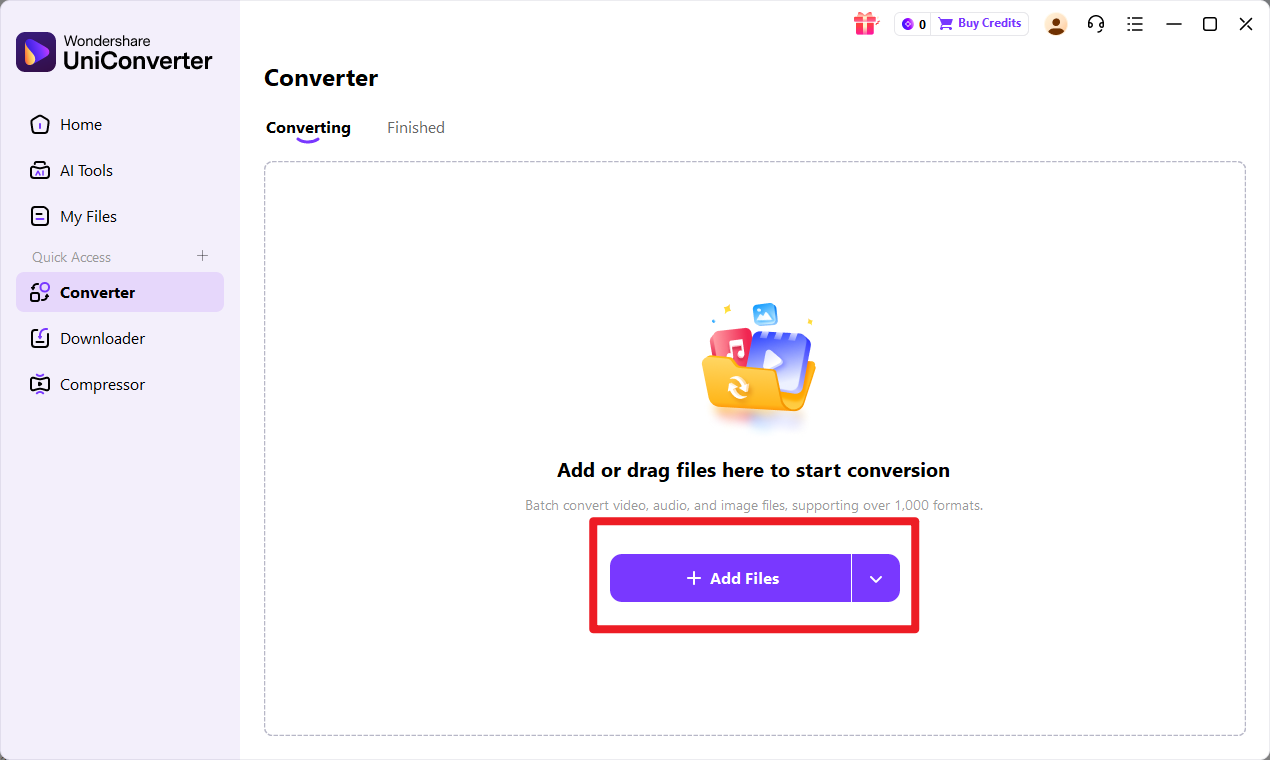
Step 2. Add Files to UniConverter
You can now import the video files you want to convert. Either drag and drop your input format files directly onto the main window or click the Add Files icon in the top-left corner to browse your computer's folders and select the files.
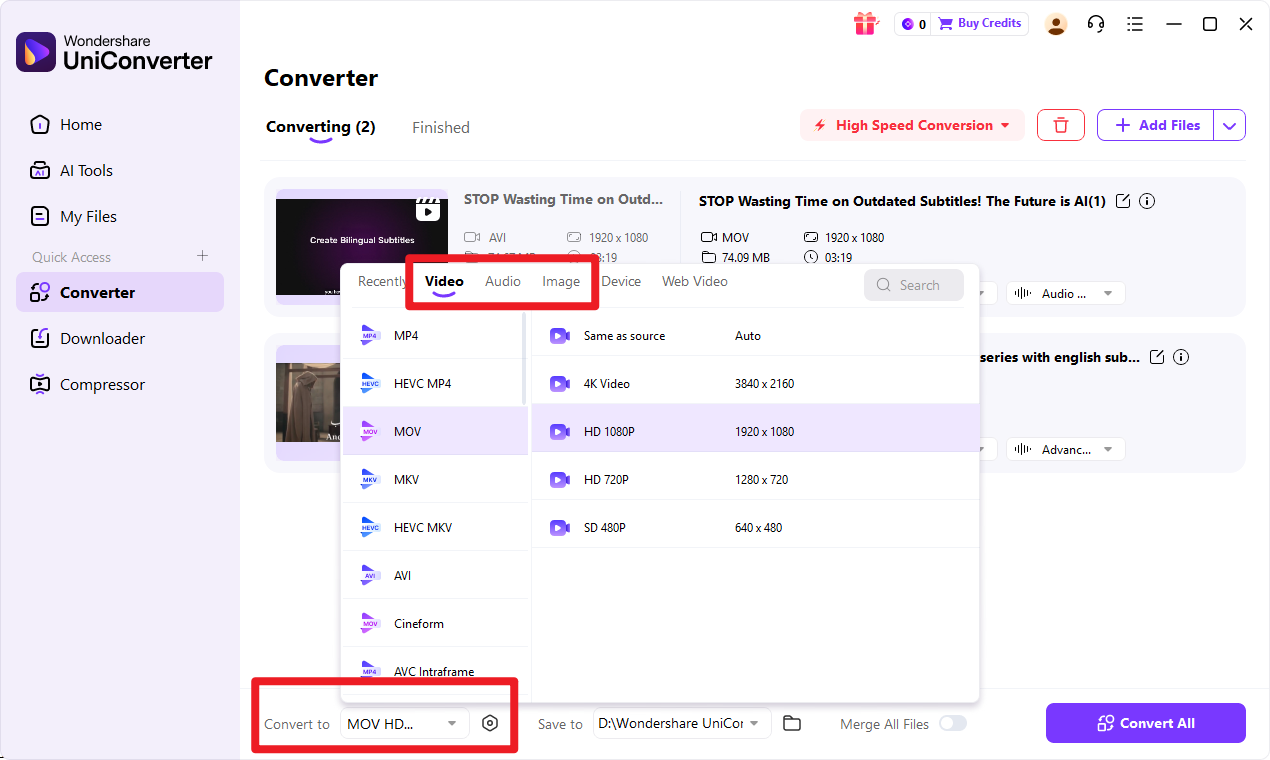
Step 3. Choose Output Format
At the bottom of the window, click on the Output Format tab. This will open a new menu. Go to the Video tab, select your desired target format from the list on the left (e.g., MP4), and then choose a resolution on the right.
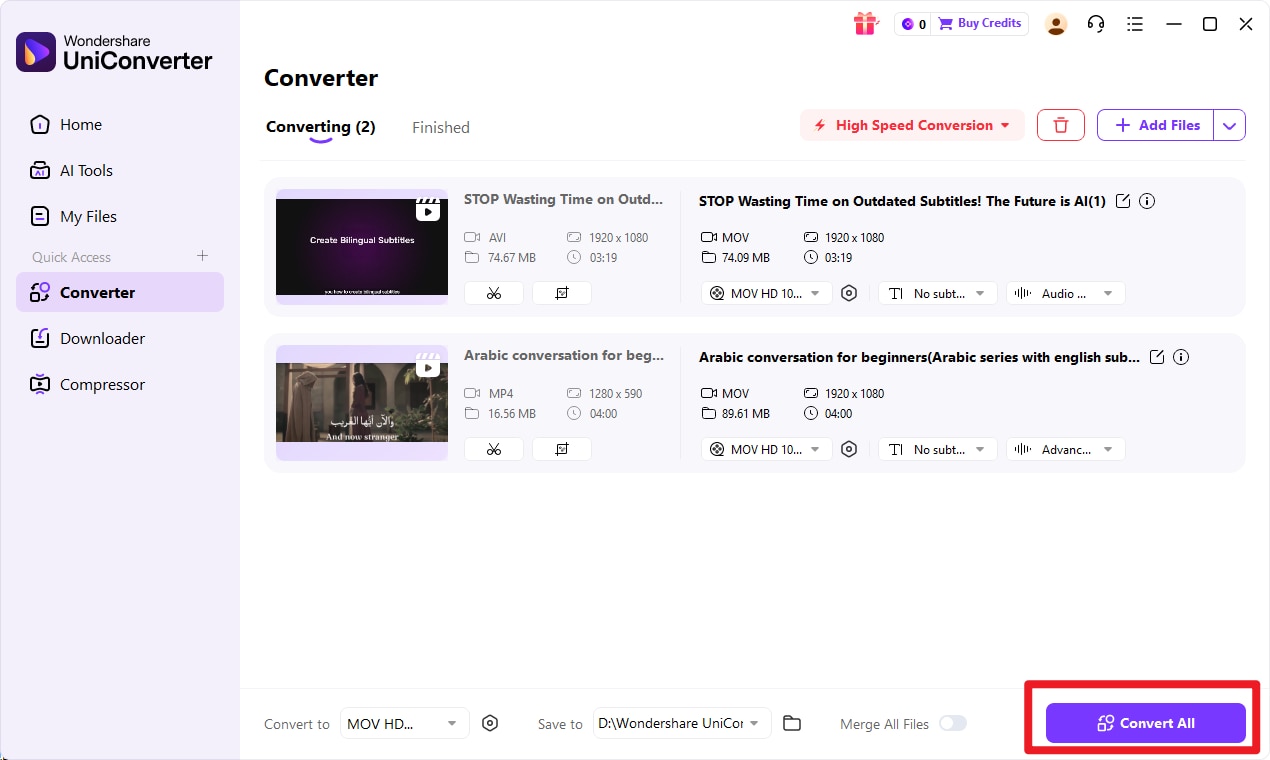
Step 4. Start the Conversion
Finally, choose a destination for your converted file by using the File Location field at the bottom. Once you are ready, click the Start All button in the bottom-right corner to begin the batch conversion process. UniConverter will process your files quickly using GPU acceleration.

Go Beyond Simple Video Conversion
Conclusion
The H.265 vs VVC discussion is ultimately a story of the present versus the future. H.265 (HEVC) is the mature, reliable, and universally supported standard for high-efficiency video today. It delivers an excellent balance of compression, quality, and compatibility, making it the practical and recommended choice for nearly all current video production and distribution needs.
VVC (H.266), on the other hand, is the clear successor and represents the future of video compression. Its ability to cut file sizes in half compared to H.265 is a technological marvel that will be essential for the era of 8K, immersive VR, and beyond. However, its high computational requirements and near-zero adoption in consumer hardware make it a niche, forward-looking choice for now.
Your decision should be guided by your specific needs: prioritize H.265 for today's compatibility and H.265 for tomorrow's efficiency. And for all the challenges in between, like managing and converting your existing video library across different formats, a versatile and powerful tool like Wondershare UniConverter is invaluable for ensuring your content is always ready for any device or platform.
FAQs
-
1. Is VVC technically better than H.265?
Yes, from a purely technical standpoint, VVC is superior to H.265 in terms of compression efficiency. It can achieve the same visual quality at a significantly lower bitrate, resulting in much smaller file sizes. However, the term "better" in a practical sense currently favors H.265 because of its universal hardware and software support, which VVC lacks. -
2. Can I play VVC videos on my computer or phone?
Most likely not without specialized software players that can handle software-based decoding. Native hardware support for VVC is not yet common in consumer devices like smartphones, smart TVs, or laptops. Attempting to play a VVC file without hardware support will likely result in high CPU usage and choppy playback. In contrast, H.265 is widely supported and plays smoothly on almost all modern devices. -
3. How much data can VVC save compared to H.265?
VVC can reduce file size and data usage by approximately 40-50% compared to H.265 while maintaining the same subjective visual quality. This means a 10 GB movie file encoded in H.265 could be compressed to around 5-6 GB using VVC with no noticeable loss in quality. -
4. What should I do if my H.265 video won't play?
If your H.265 (HEVC) video file is not playing on a specific device or in a particular media player, it's likely due to a lack of codec support on that older device. The simplest and most effective solution is to convert the video to a more universally compatible format, such as H.264, which is playable on virtually everything. Using a reliable program like Wondershare UniConverter makes this conversion process simple, fast, and quality-preserving.
