
If you've ever delved into the world of video encoding, streaming, or content creation, you've likely encountered the terms H.264 and x264. They often appear together in software settings and technical discussions, leading to a common point of confusion: are they competitors? Is one better than the other? The truth is, comparing H.264 vs x264 is like comparing the concept of a "car" to a specific engine model like a "V8." They aren't alternatives; one is a standard, and the other is a powerful tool that implements that standard.
Understanding this distinction is crucial for anyone looking to optimize their videos for quality, file size, and compatibility. Whether you're a streamer aiming for a smooth broadcast, a YouTuber uploading content, or simply archiving your personal video collection, knowing how H.264 and x264 work together will empower you to make better decisions. This guide will demystify these terms, clarify their relationship, and help you understand how to leverage them for the best possible results.
In this article:
Part 1. What is H.264? What is x264?
To resolve the confusion, let's first define each term individually. Their roles are distinct but deeply interconnected.
What is H.264 (AVC)?
H.264, also known as Advanced Video Coding (AVC) or MPEG-4 Part 10, is a video compression standard. Think of it as a detailed blueprint or a set of rules that dictates how video data should be compressed (encoded) and decompressed (decoded). Finalized in 2003, it revolutionized the video industry by offering significantly better compression efficiency than its predecessors. This meant higher-quality video could be stored in smaller files or streamed over lower-bandwidth connections.
Because it is a standard, H.264 ensures interoperability. A video encoded with an H.264-compliant encoder on one device can be played back on any other H.264-compliant device or software player. Its incredible versatility and efficiency have made it the most widely adopted video standard in the world. You can find it in virtually every aspect of digital video, including:
- Blu-ray Discs
- Streaming services like YouTube, Netflix, and Twitch
- Smartphones and digital cameras
- Webcams and video conferencing software
- Broadcast television
What is x264?
x264 is a free, open-source software library that functions as a video encoder. Its sole purpose is to take uncompressed video data and compress it into a video stream that strictly follows the H.264 standard. In our car analogy, if H.264 is the blueprint for how a car should function, x264 is a high-performance engine built to meet and exceed those specifications.
Developed by VideoLAN (the same team behind the popular VLC media player), x264 has earned a stellar reputation for its exceptional performance. It is renowned for its ability to produce very high-quality video at relatively low bitrates, meaning it can create smaller files while preserving impressive visual detail. It is also highly configurable, offering a vast array of settings that allow advanced users to fine-tune the encoding process to perfectly balance quality, file size, and encoding speed.
The Core Difference: Standard vs. Encoder
The fundamental difference is simple: H.264 is the "what," and x264 is the "how."
- H.264 is the set of rules. It defines the technical specifications for video compression. It doesn't perform any action itself; it just provides the instructions.
- x264 is a specific tool that follows those rules. It is a software implementation—an encoder—that takes raw video and applies the H.264 rules to create a compressed video file.
Therefore, you never have to choose between H.264 and x264. Instead, when you want to create an H.264 video, you must choose an H.264 encoder. x264 is simply one of the most popular and respected software-based encoders available for this task, alongside others like hardware encoders from NVIDIA (NVENC) and AMD (VCN), or Apple's AVFoundation framework.
Part 2. Quick Comparison Table
To make the distinction even clearer, here is a side-by-side comparison of their key attributes.
| Feature | H.264 | x264 |
| Definition | A video compression standard (a set of rules). | A software library that acts as an encoder. |
| Type | A set of technical specifications and algorithms. | A specific, tangible implementation of the standard. |
| Quality | The resulting quality is not inherent to the standard; it varies depending on the encoder used. | Consistently produces high-quality and efficient video output. |
| Performance | The performance (speed) depends entirely on the hardware or software encoder implementing it. | Highly configurable, with presets to balance encoding speed against compression quality. |
| Primary Role | To define compatibility and ensure video can be played back universally. | To create the compressed H.264 video file from an uncompressed source. |
Part 3. H.264 vs x264: Which One Is Better?
As we've established, this question is based on a misunderstanding. The real question is: "How does the x264 encoder compare to other H.264 encoders?" In this context, x264 consistently proves to be a top-tier choice, especially for those prioritizing quality.
For Video Quality
When it comes to visual fidelity, x264 is widely regarded as the gold standard among software-based H.264 encoders. For any given bitrate (the amount of data used to represent one second of video), x264 excels at preserving fine details, minimizing compression artifacts (like blockiness or blurring), and producing a clean, sharp image. Many other encoders, particularly older or less sophisticated hardware encoders, may need a higher bitrate to achieve the same level of quality that x264 can deliver. This makes x264 an excellent choice for archiving video where maximizing quality while minimizing file size is paramount.
For Encoding Speed
The speed of H.264 encoding is entirely dependent on the encoder you use.
- Hardware Encoders: Encoders built into modern GPUs, like NVIDIA's NVENC or AMD's VCN, are incredibly fast. They use dedicated silicon to perform the compression, which offloads the work from the main CPU. This is ideal for real-time applications like live streaming or screen recording, but they sometimes sacrifice a bit of compression efficiency for speed.
- Software Encoders (x264): As a software encoder, x264 uses the computer's CPU. Its speed is highly flexible. It offers a range of presets, from "ultrafast" to "veryslow" and "placebo."
- Ultrafast: Encodes very quickly but with lower compression efficiency (larger files for the same quality).
- Medium: A good balance between speed and quality, suitable for most general purposes.
- Slow/Veryslow: Takes much longer to encode but analyzes the video more thoroughly, resulting in better quality and smaller file sizes.
This trade-off allows users to choose what matters most for their project: rapid turnaround or maximum compression efficiency.
For Compatibility
This is one area where there is no difference. Since x264's output is a fully compliant H.264 video stream, any file it creates will be universally compatible. It will play on any smartphone, computer, smart TV, or web browser that supports H.264 video—which is practically all of them. The choice of encoder does not affect the final file's compatibility, as long as it adheres to the H.264 standard.
The Verdict: A Misleading Comparison
The debate should not be "H.264 vs. x264." The real decision is between different H.264 encoders. Your choice depends on your priorities:
- For maximum quality and file size efficiency (and you have time to spare): The x264 software encoder is often the superior choice.
- For real-time encoding and maximum speed (like live streaming): A hardware encoder like NVIDIA NVENC is typically preferred.
For most non-real-time video production, such as exporting a finished project or archiving media, x264 remains a top contender for its outstanding quality output.
Part 4. Use Cases for H.264 and x264
Understanding the roles of the standard and the encoder helps clarify when and where they are used.
Common Scenarios for H.264 Standard
Because H.264 is the universal standard, its use cases are incredibly broad. It is the default choice for nearly all consumer-facing video applications:
- Streaming Video: Platforms like YouTube, Twitch, and Vimeo rely heavily on H.264 to deliver video to billions of users across countless devices.
- Video Recording: Most digital cameras, DSLRs, and smartphones record video in an H.264 format by default due to its excellent balance of quality and file size.
- Online Distribution: When you share a video on social media or embed it on a website, H.264 ensures it will play back for the widest possible audience without compatibility issues.
Specific Scenarios to Choose the x264 Encoder
You would specifically choose the x264 encoder when you are in control of the encoding process and your primary goal is high quality and efficiency.
- Archiving Media: When converting a large video library (like Blu-ray rips or home movies) for long-term storage, using x264 with a slow preset can significantly reduce file sizes while preserving the original quality.
- Professional Video Production: In workflows where final delivery requires precise control over encoding parameters, x264's extensive options allow for meticulous optimization of the final output.
- Creating High-Quality Digital Downloads: For content creators selling or distributing video files, encoding with x264 ensures their audience receives a product with excellent visual fidelity.
Simplify Your Encoding with a Powerful Tool
Choosing an encoder and configuring its complex settings can be intimidating for many users. Presets like "medium" or "slow" are helpful, but diving into advanced parameters requires technical knowledge. For users who want the benefits of high-quality H.264 encoding without the steep learning curve, a dedicated video converter is the ideal solution.
A powerful tool like Wondershare UniConverter streamlines this entire process. It leverages a highly optimized encoding engine to produce top-tier H.264 video files through an intuitive, user-friendly interface. This allows you to easily convert your videos into the universally compatible H.264 format without needing to become an encoding expert.
Part 5. Step-by-Step Guide to Convert Video to H.264 Using UniConverter
Wondershare UniConverter makes it incredibly simple to create high-quality H.264 video files. Follow these four easy steps to convert any video.
Step 1: Add Files to UniConverter
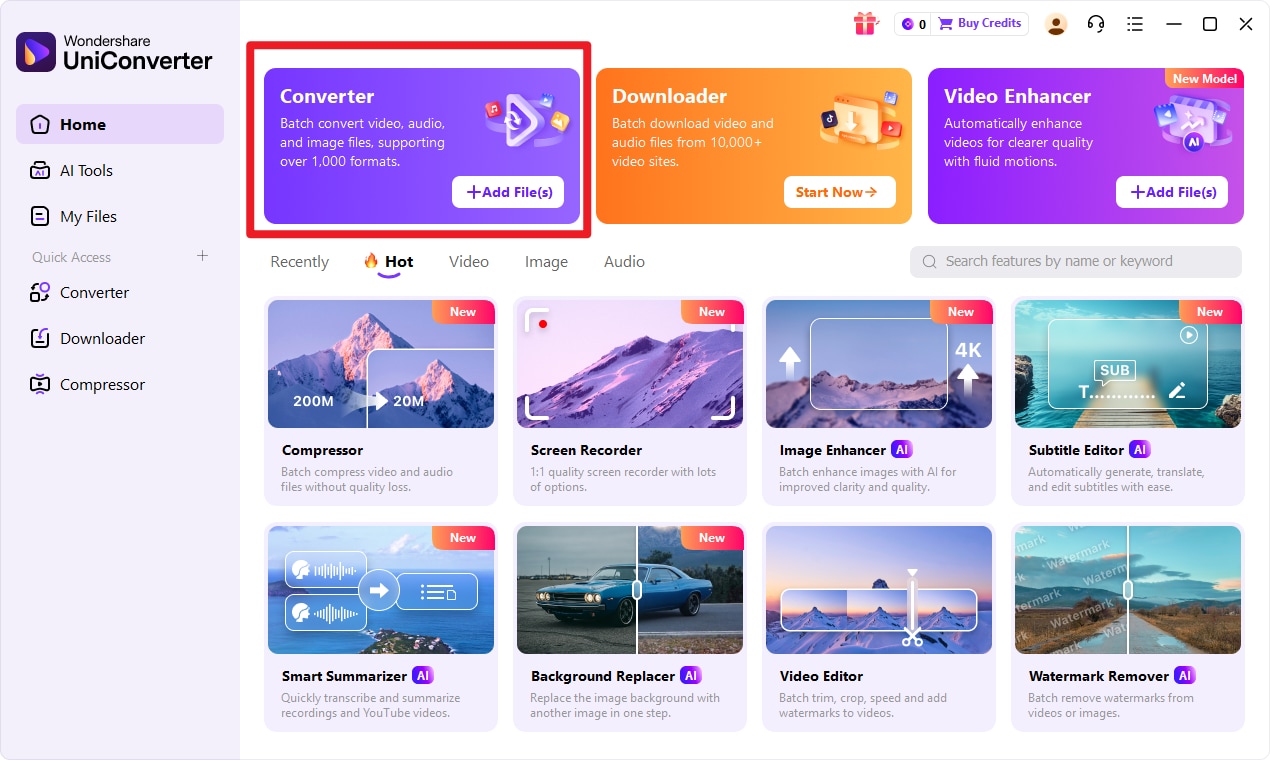
First, launch Wondershare UniConverter on your computer. In the main interface, ensure you are on the Converter tab. You can either drag and drop your source video files directly into the program window or click the Add Files icon in the top-left corner to browse and import them from your computer.
Step 2: Choose Output Format
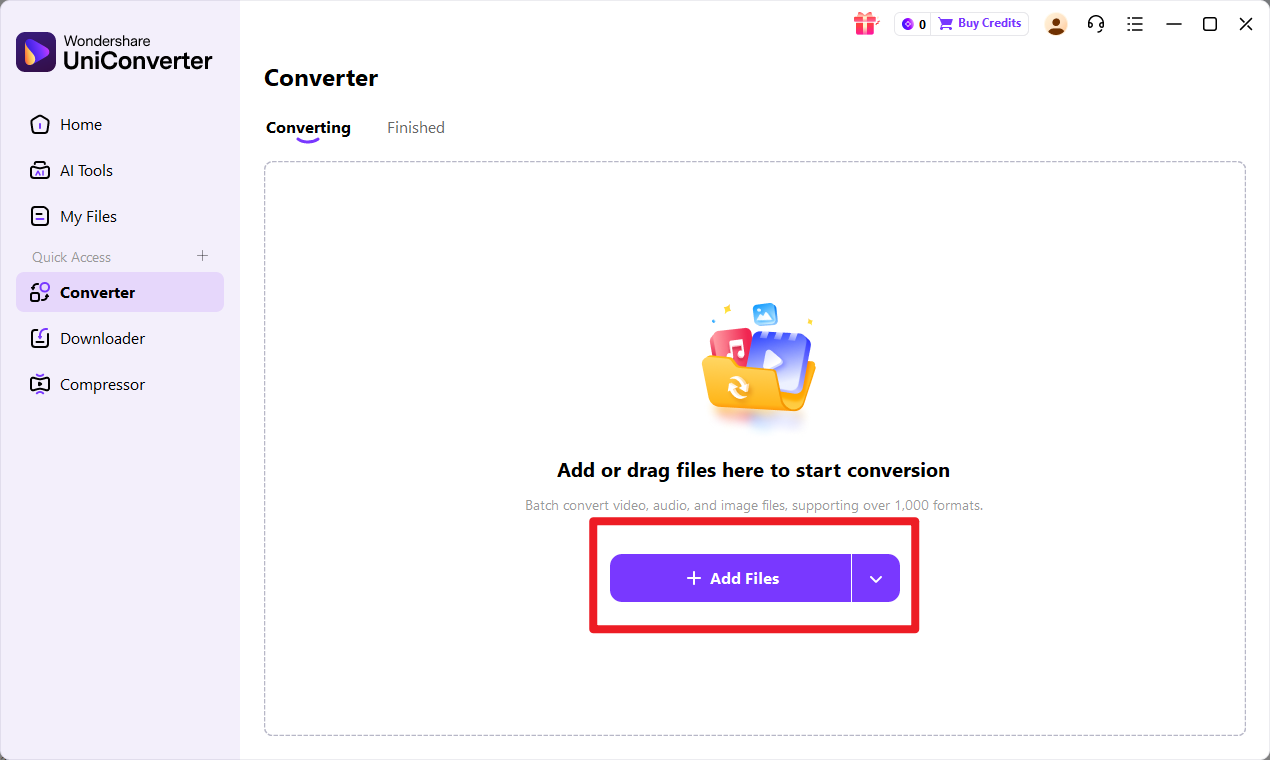
Once your files are loaded, click on the Output Format menu located at the bottom of the window. This will open a new panel. Navigate to the Video tab. Here, select a container format like MP4 from the list on the left. On the right, choose your desired resolution. Most default profiles (like MP4) use the H.264 encoder automatically. For more control, you can click the small gear or Edit icon next to the resolution to open the settings window, where you can manually adjust bitrate, frame rate, and quality.
Step 3: Start the Conversion
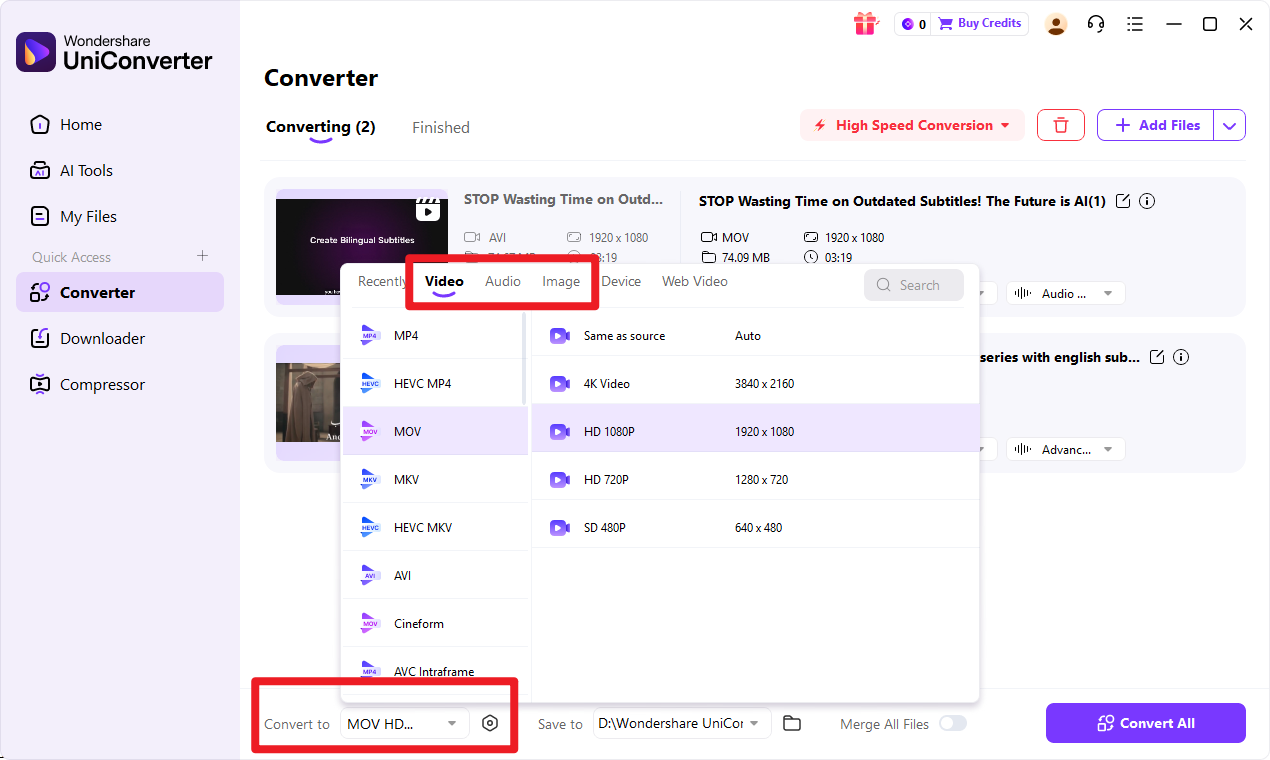
After configuring the output format, you can set a destination for your converted file by using the File Location menu at the bottom. Once you are ready, click the Convert button next to a single file or the Start All button in the bottom-right corner to begin the encoding process for all files in the queue.
Step 4: Check Converted Files
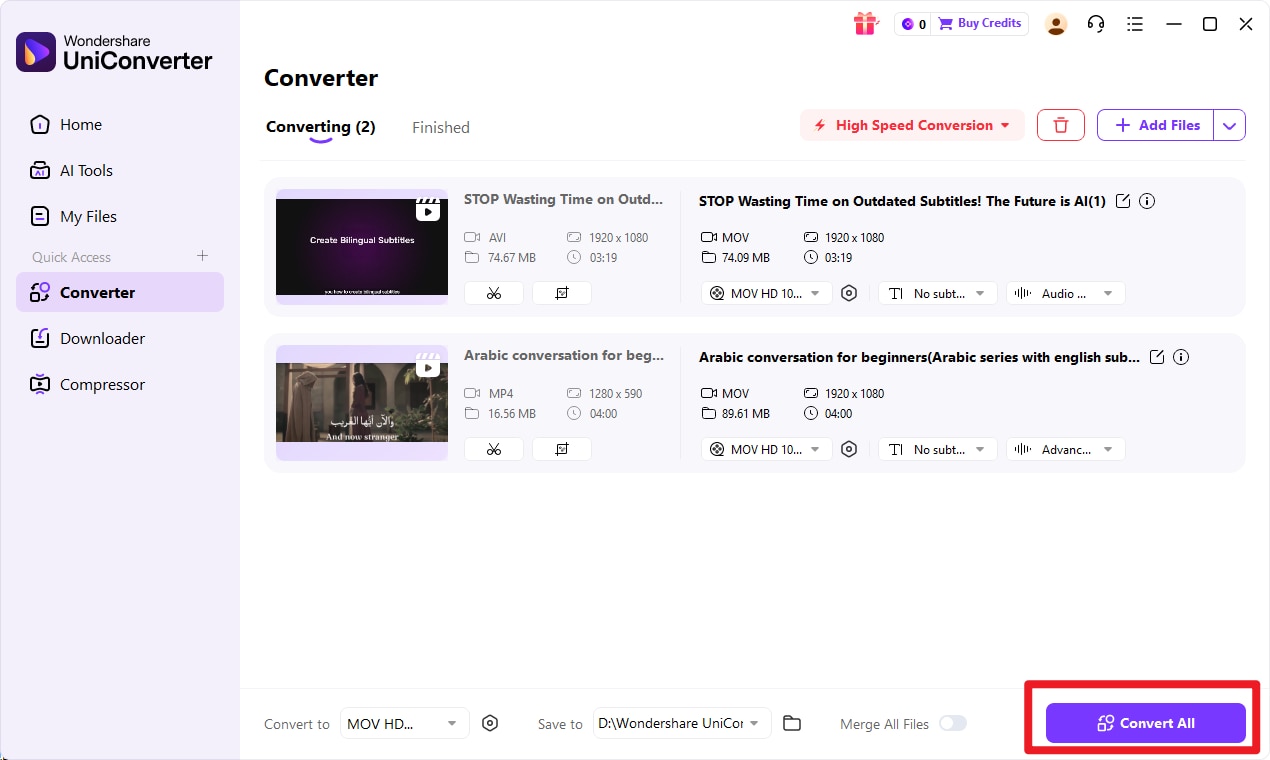
UniConverter will process your files efficiently. Once the conversion is complete, you can find your new, high-quality H.264 video files in the destination folder you selected. Alternatively, you can click on the Finished tab at the top of the window to see a list of all completed conversions and open their file location directly.

Your All-in-One Video Toolkit
Conclusion
To summarize, the H.264 vs x264 debate is built on a false premise. H.264 is the foundational video compression standard that defines the rules for compatibility and playback across the globe. x264 is a highly acclaimed software encoder—a tool—that masterfully implements those rules to create video files with exceptional quality and efficiency. The real choice isn't between the standard and the tool, but between different H.264 encoders, each with its own strengths in speed, quality, and control.
While experts may appreciate the granular control offered by command-line access to x264, most users simply want excellent results without the complexity. This is where tools like Wondershare UniConverter shine. It provides a simple, intuitive, and powerful way for everyone to access high-quality H.264 encoding. Whether you need to convert, compress, or manage your video files for any purpose, UniConverter makes the process effortless.
FAQs
-
1. Is x264 better than H.264?
This is a common misunderstanding. x264 is not an alternative to H.264; it is a tool used to create H.264 video. It is widely considered one of the best software encoders for this purpose, known for producing higher quality at lower bitrates compared to many other encoders. -
2. Is x264 still relevant in 2026?
Absolutely. While newer and more efficient standards like H.265 (HEVC) and AV1 exist, H.264 remains the most universally compatible video format by a wide margin. As long as H.264 is in widespread use, x264 will continue to be a benchmark for quality and efficiency in H.264 encoding. -
3. Does UniConverter use the x264 encoder?
Wondershare UniConverter integrates a highly optimized and powerful encoding engine to produce superior H.264 video files. It is designed to give users the benefits of efficient compression and high quality—hallmarks of a great encoder like x264—through a simple and accessible graphical interface. -
4. Can I use H.264 for free?
For consumers, watching, sharing, and creating H.264 video is effectively free. However, the technology behind H.264 is patented. Companies that build hardware or software products that encode or decode H.264 video often need to pay licensing fees to patent holders. This is why free, open-source encoders like x264, which provide a royalty-free implementation, are so valuable to the software development community.
