
For audiophiles and dedicated music collectors, the debate over audio formats is a familiar one. While casual listeners might be content with MP3s, those who seek the highest fidelity for their digital library often turn to lossless audio. This is where the FLAC vs ALAC discussion begins. Both formats promise to preserve every single bit of the original recording, delivering sound exactly as the artist intended. However, they are not interchangeable. Choosing the right one depends almost entirely on the devices you use and the software you prefer for managing your music.
This guide will demystify the two leading lossless formats. We will dive deep into their technical specifications, compare their strengths and weaknesses, and help you determine which one is the perfect fit for your high-resolution audio collection. We'll also show you how to easily convert between them if your needs change, ensuring your music is never locked into a single ecosystem.
In this article, you will learn:
- What FLAC and ALAC are and their core characteristics.
- A direct comparison of their features, including compatibility and file size.
- A detailed breakdown of which format is better based on different factors.
- Specific use cases to help you decide when to use FLAC or ALAC.
- A step-by-step guide on how to convert between FLAC and ALAC without quality loss.
Part 1. What is FLAC? What is ALAC?
Before we can compare them, it's essential to understand what each format is and what it was designed to do. Both are lossless, meaning that unlike lossy formats like MP3 or AAC, they don't discard any audio data to reduce file size. They are like ZIP files for audio; the data is compressed for storage but can be uncompressed to its original, perfect state.
What is FLAC (Free Lossless Audio Codec)?
FLAC, which stands for Free Lossless Audio Codec, is an open-source audio format developed by the Xiph.Org Foundation. Since its introduction in 2001, it has become the undisputed standard for distributing and archiving high-resolution music. Its "free" and "open" nature means that no royalties are required to use it, which has led to incredibly broad support across a vast range of hardware and software.
FLAC is renowned for its efficient compression, typically reducing the size of an original WAV or AIFF file by 50-70% without sacrificing a single bit of audio information. If you purchase and download high-resolution music from online stores like HDtracks, Qobuz, or Bandcamp, it will almost certainly be delivered in the FLAC format.
What is ALAC (Apple Lossless Audio Codec)?
ALAC, or Apple Lossless Audio Codec, is Apple's proprietary answer to lossless audio. Developed and released in 2004, it was designed to provide CD-quality and high-resolution audio to users within the Apple ecosystem. For years, it was a closed format, but Apple made it open-source and royalty-free in 2011 to encourage wider adoption.
Like FLAC, ALAC delivers a perfect, bit-for-bit copy of the original source audio. Its primary advantage is its seamless integration with all Apple hardware and software. If you use an iPhone, iPad, Mac, Apple TV, or manage your library with iTunes (or the newer Apple Music app on macOS), ALAC is the native lossless format that works without any fuss or need for third-party apps.
Part 2. Quick Comparison Table
To get a clear overview of the key differences and similarities, here is a side-by-side comparison of FLAC and ALAC.
| Feature | FLAC | ALAC |
| Developer | Xiph.Org Foundation | Apple Inc. |
| License | Open Source & Royalty-Free | Open Source (since 2011) |
| Compatibility | Wide support on Android, Windows, Linux, most high-res players. Not native on Apple devices. | Native support on all Apple devices. Limited support on non-Apple hardware. |
| Compression Ratio | Generally more efficient, reducing original file size by 50-70%. | Slightly less efficient, reducing original file size by 40-60%. |
| Audio Quality | Lossless. Identical to the original source. | Lossless. Identical to the original source. |
| Metadata Support | Robust support for tagging and cover art. | Robust support for tagging and cover art, integrates seamlessly with iTunes/Apple Music. |
Part 3. FLAC vs ALAC: Which One Is Better?
With the basics covered, let's dive into the details. The "better" format truly depends on your priorities, as the most significant differences lie not in quality but in practicality.
Audio Quality: Is There a Difference?
Let's clear this up immediately: in terms of sound quality, there is absolutely no difference between FLAC and ALAC. Both are lossless codecs. This means that when you play a FLAC or an ALAC file, the audio data is uncompressed and reconstructed to be a perfect, bit-for-bit replica of the original master recording.
Imagine you have a pristine WAV file from a studio master. If you convert it to FLAC and also convert it to ALAC, both files will sound identical to each other and identical to the original WAV file. The choice between them will never be about which one sounds better; it will always be about which one works better for you.
File Size and Compression
While both formats compress audio data, they use different algorithms, leading to a slight difference in file size. Generally, FLAC offers a more efficient compression ratio. On average, a FLAC file will be about 5-10% smaller than the same audio track saved as an ALAC file.
For a single song, this difference is negligible. However, if you are archiving a massive music library with thousands of high-resolution albums, that 5-10% can add up to many gigabytes of saved storage space. If maximizing storage efficiency is your top priority, FLAC has a slight edge.
Compatibility and Ecosystem
This is the most critical factor and the primary reason to choose one format over the other. Your decision should be based on the devices and software you use every day.
- For the Apple User: If you are deeply invested in the Apple ecosystem, ALAC is the clear winner. It is natively supported on iPhone, iPad, Mac, Apple TV, and HomePod. It integrates perfectly with the Apple Music app and iTunes, meaning your library, metadata, and album art will sync and display flawlessly across all your devices. You can play ALAC files without needing any third-party applications.
- For Everyone Else: FLAC is the universal standard for lossless audio outside of Apple's walled garden. It is supported by virtually every other platform imaginable. Android smartphones, Windows PCs, Linux systems, and a vast majority of dedicated Digital Audio Players (DAPs) from brands like Fiio, Astell&Kern, and Sony all play FLAC files natively. If you use a mix of non-Apple devices, FLAC is the most convenient and hassle-free choice.
Open Source and Future-Proofing
FLAC has been open-source since its creation, which is a major reason for its widespread adoption. Developers could freely integrate it into their products without worrying about licensing fees or restrictions.
Apple open-sourced ALAC in 2011, but by then, FLAC had already established itself as the de facto standard on non-Apple platforms. While some non-Apple devices and software can now play ALAC, support is far from universal and often requires specific players.
From a future-proofing perspective, both formats are excellent choices for archiving your music. They are well-established, widely documented, and because they are lossless, you can always convert your library from one to the other in the future without any degradation in quality.
Part 4. Use Cases for FLAC and ALAC
To make the decision even simpler, let's look at some clear-cut scenarios for choosing each format.
When to Choose FLAC
You should choose FLAC if:
- You are a Windows or Android user. Your devices will play FLAC files natively, giving you the best "out-of-the-box" experience.
- You use a dedicated high-resolution audio player (DAP). Nearly every DAP on the market is designed with FLAC as its primary supported lossless format.
- You want maximum compatibility across a wide range of non-Apple hardware. FLAC is the closest thing to a universal lossless format.
- You are archiving a very large music collection. The slightly better compression of FLAC can save you a significant amount of storage space in the long run.
When to Choose ALAC
You should choose ALAC if:
- You are a dedicated Apple user. Your entire music library is managed through the Apple Music app (on Mac) or iTunes (on Windows for syncing with Apple devices).
- Your primary listening devices are an iPhone, iPad, Mac, or HomePod. ALAC offers seamless, native playback without any third-party apps.
- You value perfect integration. You want your metadata, album art, and playlists to sync effortlessly across all your Apple devices via iCloud Music Library.
- You rip your own CDs using the Music app or iTunes. Setting the import format to Apple Lossless is the most direct way to create a high-quality library for your Apple gear.
Part 5. Step-by-Step Guide to Convert FLAC to ALAC Using UniConverter
What if you have a large library of FLAC files but just bought an iPhone? Or perhaps you're moving from an Apple-centric setup to an Android phone and a dedicated DAP. In these cases, you'll need to convert your files. Because you are converting from one lossless format to another, no audio quality will be lost. The key is to use a reliable tool that can handle the conversion accurately and efficiently.
Wondershare UniConverter is an excellent choice for this task. It's a powerful, all-in-one video and audio toolkit that makes converting between FLAC and ALAC a simple, four-step process. It supports batch conversions, so you can convert your entire library at once.
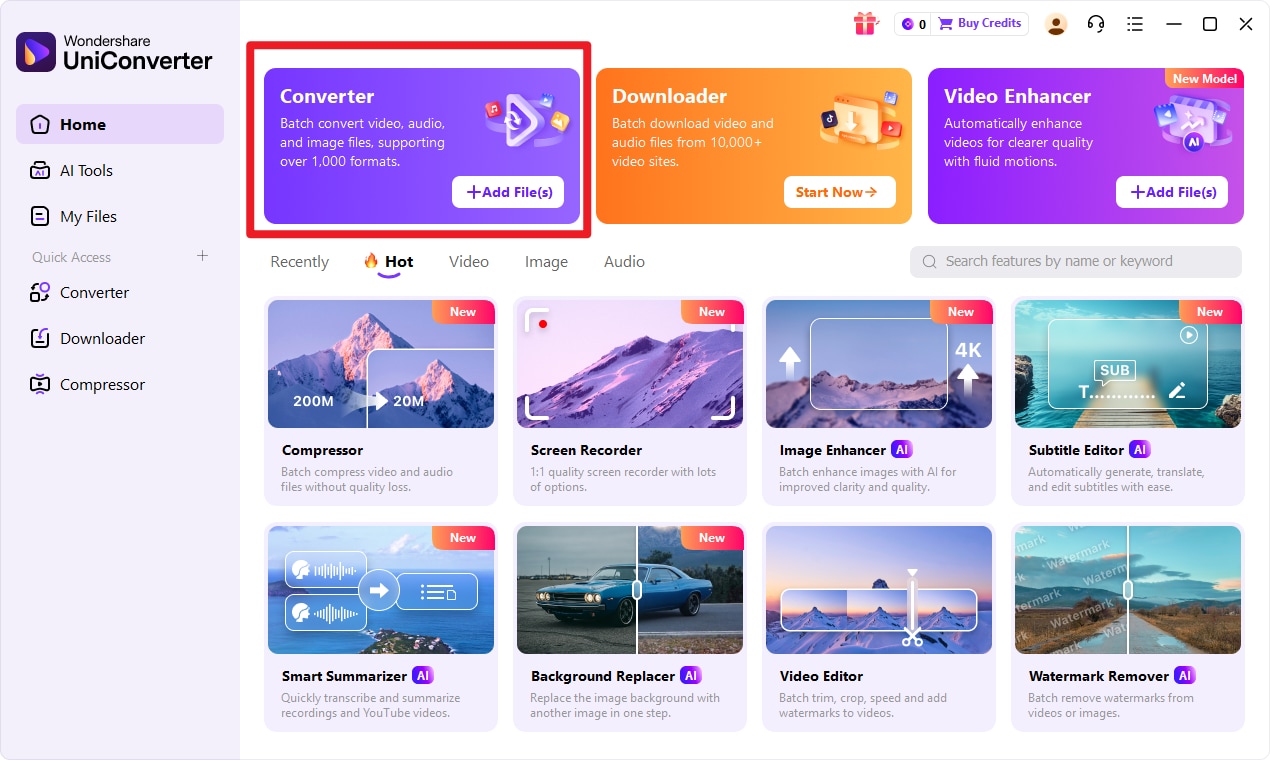
Step 1: Choose Converter in UniConverter
Launch Wondershare UniConverter on your computer. From the home screen, navigate to the left-hand menu and select the Converter tool. This is the main module for all file format conversions.
Step 2: Add Files to UniConverter
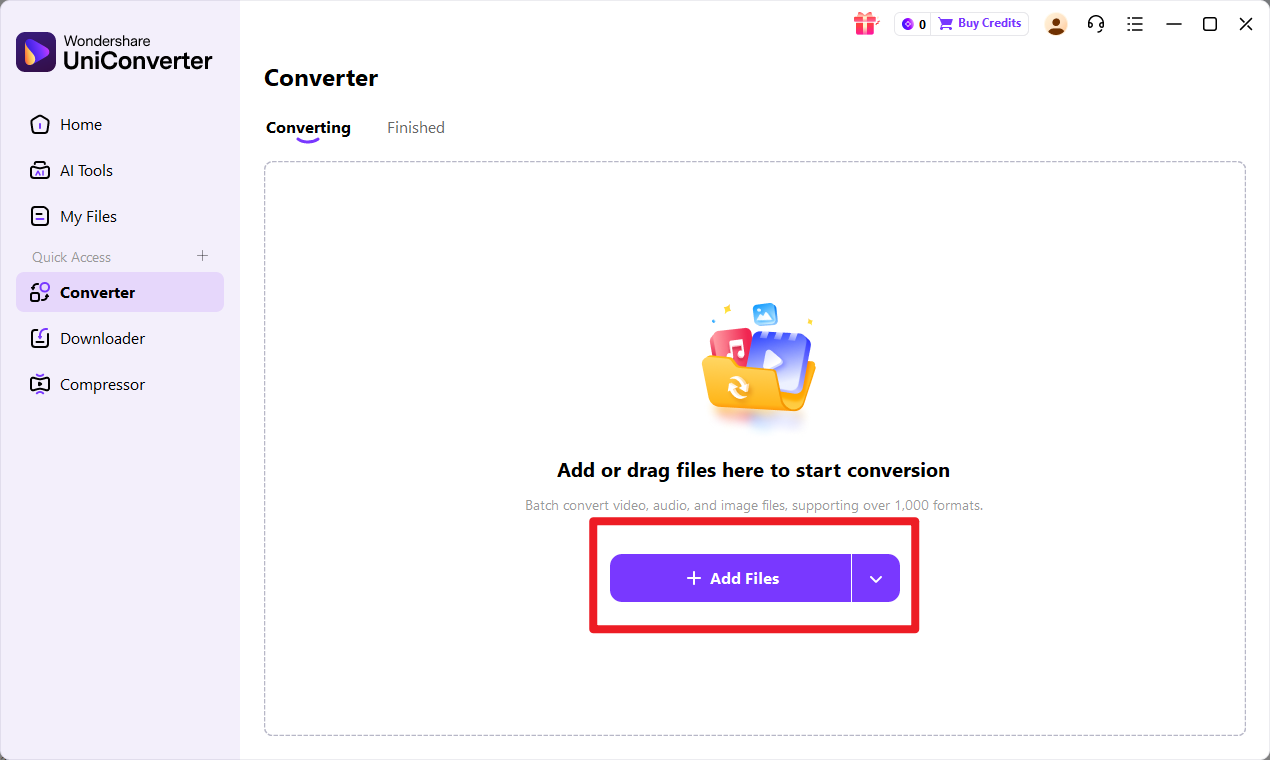
You can now import your audio files. Click the Add Files icon in the center or top-left of the screen to browse your computer for the input format files you want to convert. Alternatively, you can simply drag and drop the files directly into the UniConverter window. The software supports adding multiple files for batch processing.
Step 3: Choose Output Format
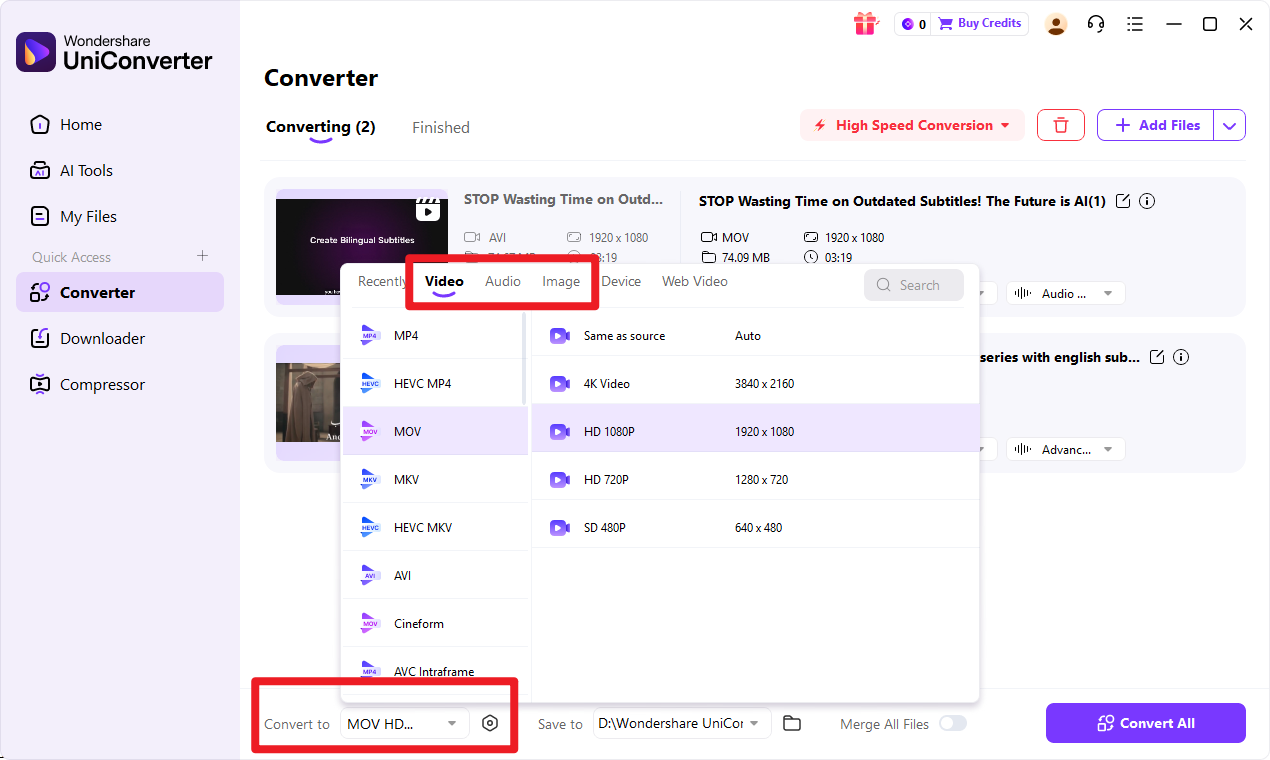
At the bottom of the window, click on the Output Format menu. This will open a new window with a list of available formats. Select the Audio tab. From the list on the left, choose your desired target format. To ensure a perfect lossless conversion, select the Same as source quality option on the right.
Step 4: Start the Conversion
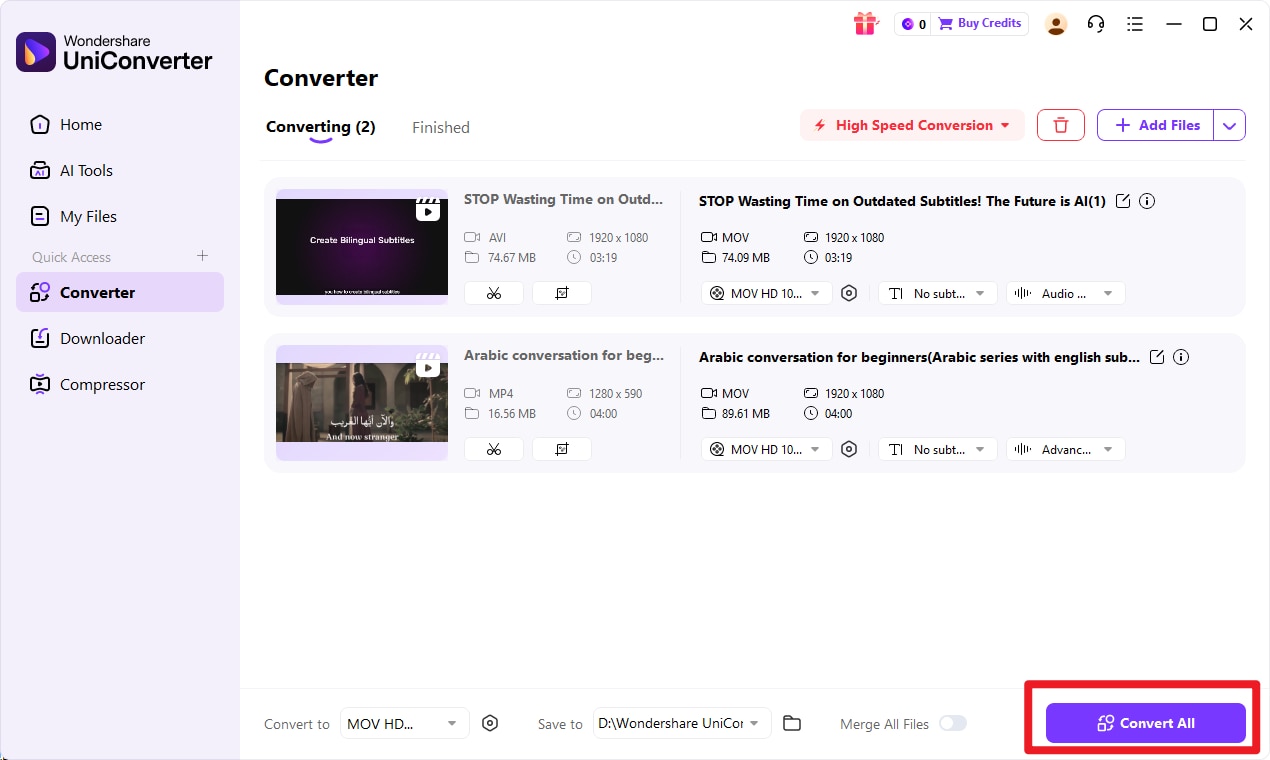
Before starting, you can choose where to save your converted files by using the File Location field at the bottom. Once you are ready, click the Start All button in the bottom-right corner. UniConverter will begin converting all your files quickly and without any loss of quality.

Go Beyond Simple Audio Conversion
Conclusion
The debate between FLAC and ALAC is not about which format sounds better—they are audibly identical. The decision rests entirely on your personal technology ecosystem. If you live in Apple's world of iPhones, Macs, and the Music app, ALAC is the logical, seamless choice. For virtually everyone else using Android, Windows, or dedicated audio players, FLAC is the universal standard that offers maximum compatibility and slightly better storage efficiency.
The best part is that you are never permanently locked into one format. As your hardware changes, your audio library can change with it. With a versatile and reliable tool like Wondershare UniConverter, you can easily convert your entire music collection between FLAC and ALAC (or any other format) whenever you need to, ensuring your high-fidelity music is always accessible, no matter what device you're using.
FAQs
-
1. Is FLAC higher quality than ALAC?
No. Both FLAC and ALAC are lossless audio formats. This means they are both bit-perfect reconstructions of the original master recording. When created from the same source, their sound quality is identical. -
2. Can iTunes or an iPhone play FLAC files?
No, Apple's native music apps like iTunes and the iOS Music app cannot play FLAC files. To play FLAC files on an iPhone or manage them in iTunes, you must first convert them to a compatible format such as ALAC, AAC, or MP3. -
3. Is it safe to convert from FLAC to ALAC?
Yes, it is perfectly safe and does not result in any quality loss. Since both are lossless formats, converting from one to the other is simply a process of decompressing the audio data and re-compressing it with a different algorithm. The underlying audio information remains unchanged. Using a professional tool like UniConverter ensures this process is done accurately.
