
In the world of digital audio, the debate between quality and convenience is constant. Two of the most prominent contenders in this discussion are FLAC and AAC. Whether you're an audiophile chasing pristine sound, a casual listener managing your phone's storage, or a creator distributing your work, choosing the right audio format is crucial. The FLAC vs AAC decision can significantly impact your listening experience, storage space, and device compatibility. But what exactly sets these two formats apart, and which one is the right choice for you in 2026?
This comprehensive guide will demystify these formats, breaking down their technical differences into easy-to-understand concepts. We'll explore their respective strengths and weaknesses to help you make an informed decision based on your specific needs, not just on technical jargon.
In this article
Part 1. What is FLAC? What is AAC?
Before we can compare them, it's essential to understand the fundamental nature of each format. They are both methods of "compressing" audio files to make them smaller, but they achieve this in very different ways.
What is FLAC (Free Lossless Audio Codec)?
FLAC stands for Free Lossless Audio Codec. The key word here is "lossless." This means that when an original audio source (like a track from a CD) is compressed into a FLAC file, its file size is reduced without discarding a single bit of the original audio data.
Think of it like a ZIP file for music. You can compress a folder of documents into a ZIP archive to make it smaller and easier to send, but when the recipient unzips it, every document is restored perfectly, identical to the original. FLAC does the same for audio. This process ensures that the audio quality is a perfect, bit-for-bit replica of the master recording. Because of this, FLAC is the format of choice for archiving music and for critical listening where sound fidelity is the absolute top priority. The trade-off is that FLAC files are significantly larger than their compressed counterparts.
What is AAC (Advanced Audio Coding)?
AAC, or Advanced Audio Coding, is a "lossy" compression format. The term "lossy" might sound negative, but it's a highly intelligent process. AAC reduces file size by permanently removing parts of the audio data that are considered least perceptible to the average human ear.
This process, known as psychoacoustics, analyzes the sound and discards information that is likely to be masked by other, louder sounds. The result is a file that is dramatically smaller than the original, yet for most listeners, it sounds nearly identical. AAC is a more modern and efficient codec than the older MP3 format, providing better sound quality at the same bitrate. It has become the standard for major platforms like Apple's iTunes, Apple Music, and YouTube due to its excellent balance of quality and file size efficiency.
Part 2. Quick Comparison Table
For a quick overview, here's a side-by-side comparison of the key attributes of FLAC and AAC.
| Feature | FLAC (Free Lossless Audio Codec) | AAC (Advanced Audio Coding) |
| Compression Type | Lossless | Lossy |
| Audio Quality | Perfect, bit-for-bit copy of the original source. | Near-original, perceptually transparent at high bitrates. |
| Average File Size | Large (~30MB for a 3-minute song) | Small (~3MB for a 3-minute song at 128kbps) |
| Compatibility | Good, but may require third-party apps on some devices (e.g., iOS). | Universal support across nearly all modern devices and platforms. |
| Primary Use Case | Archiving master copies, professional audio work, critical listening. | Streaming, portable devices (smartphones, tablets), general listening. |
Part 3. FLAC vs AAC: Which One Is Better?
Declaring one format as definitively "better" isn't straightforward. The best choice depends on what you value most: absolute quality, storage space, or universal convenience. Let's break it down.
Head-to-Head on Audio Quality
On a purely technical level, FLAC is the undisputed winner. Because it's lossless, a FLAC file is a perfect representation of the original master audio. There is no data loss, no approximation, and no compromise. For an audiophile with a high-end audio system—comprising a dedicated digital-to-analog converter (DAC), a powerful amplifier, and high-fidelity headphones or speakers—the subtle nuances and dynamic range preserved in a FLAC file can provide a richer, more detailed listening experience.
However, the practical reality is different for most people. High-bitrate AAC files (typically 256 kbps or 320 kbps) are often "perceptually transparent." This means that for the vast majority of listeners, using common playback devices like smartphone earbuds, Bluetooth speakers, or car stereos, it is extremely difficult, if not impossible, to reliably tell the difference between a 256 kbps AAC file and its lossless FLAC source in a blind A/B test.
Conclusion: FLAC is technically superior and guarantees perfect fidelity. AAC offers practically excellent quality that is indistinguishable from lossless for most listeners in most situations.
The Battle for Storage Space: File Size
This is where AAC has a massive advantage. Due to its lossy compression, AAC files are a fraction of the size of FLAC files. A typical 3-minute song in FLAC format might take up 25-40MB of space. The same song encoded as a high-quality 256kbps AAC file would only be around 5-7MB.
This difference is monumental when you scale it up to an entire music library. A collection of 1,000 songs in FLAC could easily consume over 30GB of storage. In AAC, that same library would take up a mere 6GB. For users with limited storage on their smartphones, tablets, or laptops, this is a game-changer. It means you can store five times more music, podcasts, or audiobooks in the same amount of space. This also impacts cloud storage costs and data usage when streaming.
Conclusion: AAC is the clear and undeniable winner for anyone concerned with saving storage space or minimizing data consumption.
Device and Software Compatibility
Convenience often comes down to whether your files will play without any extra effort. In this category, AAC reigns supreme. As the standard audio format for the entire Apple ecosystem (iPhone, iPad, Mac, Apple Music), it is universally supported. It's also natively supported on Android, Windows, and virtually every modern web browser and media player. You can be confident that an AAC file will play anywhere.
FLAC compatibility has improved significantly over the years. Android and Windows have offered native support for a while, and many third-party music players and high-end audio devices handle it perfectly. However, it can still be a hurdle in some ecosystems. For instance, to play FLAC files on an iPhone, you still need to use a third-party app; the native Apple Music app won't play them.
Conclusion: AAC offers hassle-free, universal compatibility, making it the most convenient format for playback across a wide range of devices.
Part 4. Use Cases for FLAC and AAC
Based on the comparisons above, here's a simple guide on when to use each format.
When You Should Choose FLAC
- Archiving Your Collection: If you are digitizing your precious CD or vinyl collection, FLAC is the perfect format. It creates a perfect "digital master" that preserves the full quality of the original. You can always create smaller, lossy copies from these masters later.
- Professional Audio Production: For musicians, audio engineers, and producers working in a studio environment, every bit of data matters. FLAC is an excellent choice for storing project stems and final masters before distribution.
- Critical Listening: If you have invested in a high-end audio system and your goal is to sit down and actively listen to music with the highest possible fidelity, FLAC will ensure you are hearing the music exactly as the artist and engineer intended.
When You Should Choose AAC
- Your Smartphone or Portable Player: When you want to load up your phone with thousands of songs for your commute, workout, or travel, AAC is the ideal choice. It maximizes your storage space without a noticeable drop in quality for on-the-go listening.
- Streaming Services: The efficiency of AAC is why it's used by major streaming platforms. It allows them to deliver high-quality audio to millions of users without consuming excessive bandwidth, ensuring a smooth, buffer-free experience.
- Sharing and Uploading: If you're sharing a song with a friend or uploading an audio file to a website, the smaller file size of AAC makes the process faster and more convenient for both you and the recipient.
Part 5. Step-by-Step Guide to Convert FLAC to AAC Using UniConverter
What if you want the best of both worlds? You might have an archive of FLAC files for home listening but need a portable AAC version for your iPhone. This is where a reliable file converter becomes essential. Wondershare UniConverter is a powerful and intuitive tool that handles this task perfectly. It excels with its high-speed batch processing, allowing you to convert your entire library quickly and easily while maintaining excellent quality.
Step 1: Launch Wondershare UniConverter
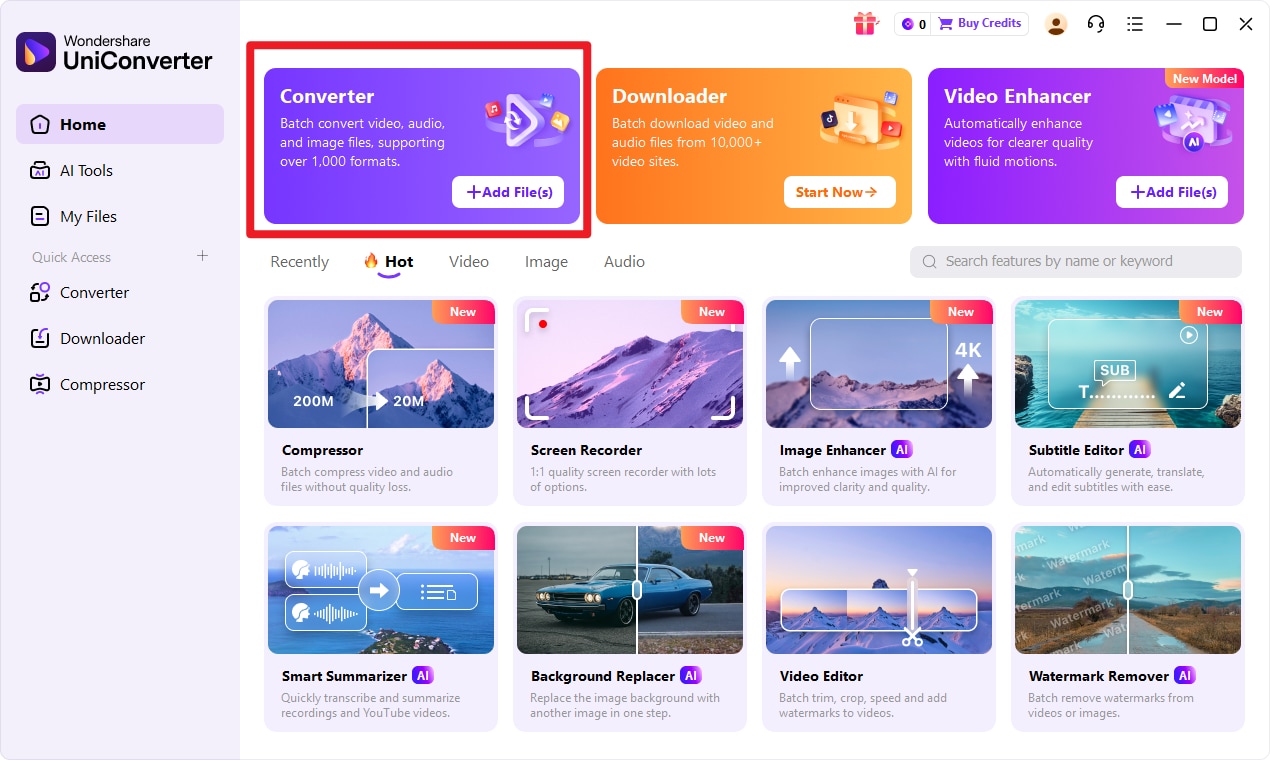
Launch Wondershare UniConverter on your computer. In the main interface, select the Converter tool from the left-hand menu.
Step 2: Add Files to UniConverter
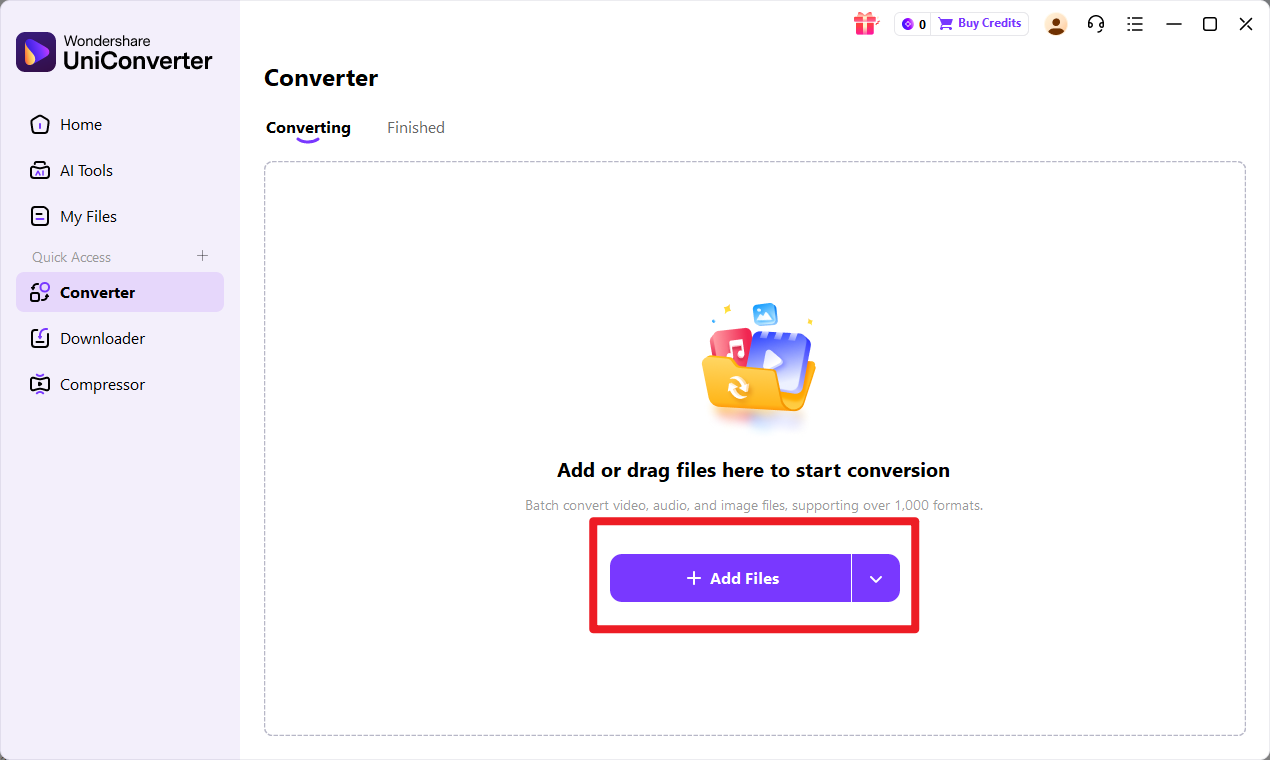
You can then either click the "Add Files" icon to browse for your FLAC files or simply drag and drop your files or entire folders directly into the program window.
Step 3: Choose Output Format
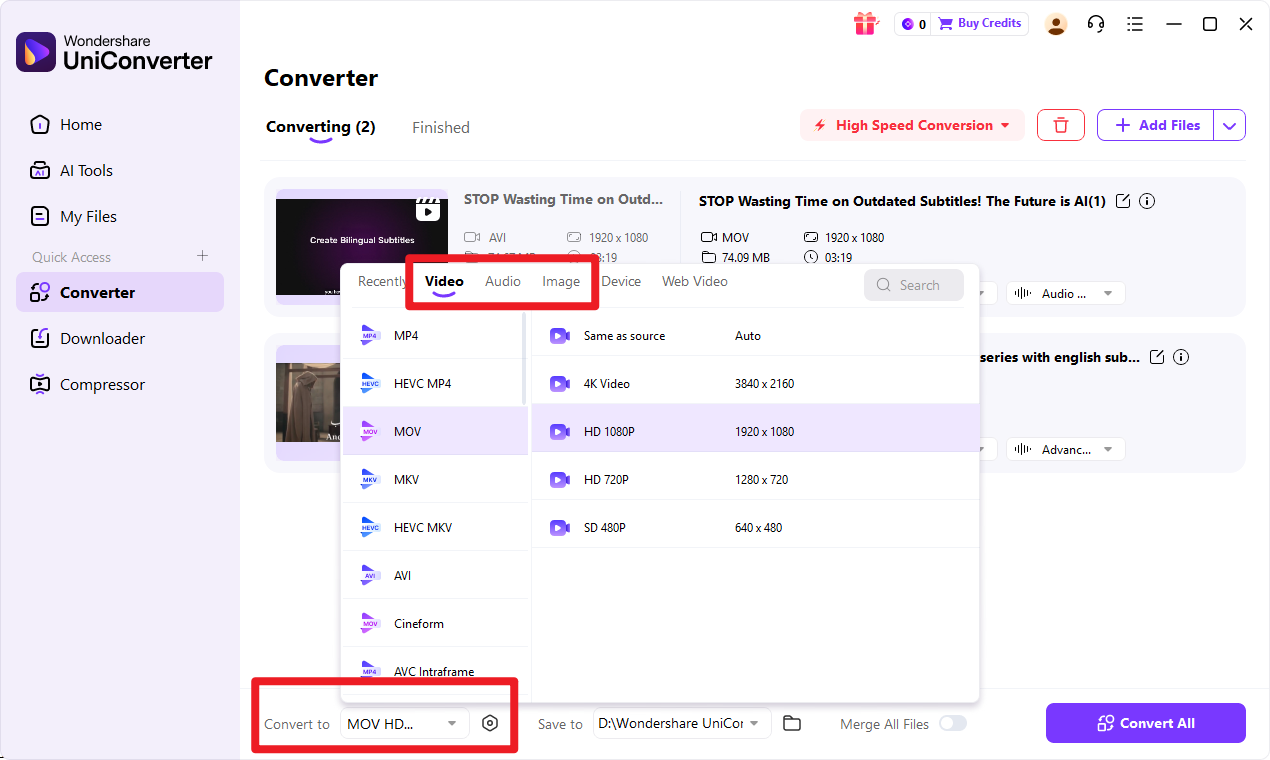
Click on the Output Format menu located at the bottom of the window. This will open a new panel with format options. Navigate to the Audio tab, and from the list of formats on the left, select AAC.On the right side of the AAC format selection, you can choose a quality preset. For a great balance of size and quality, selecting a high bitrate like 256kbps or 320kbps is recommended.
Step 4: Check Converted Files
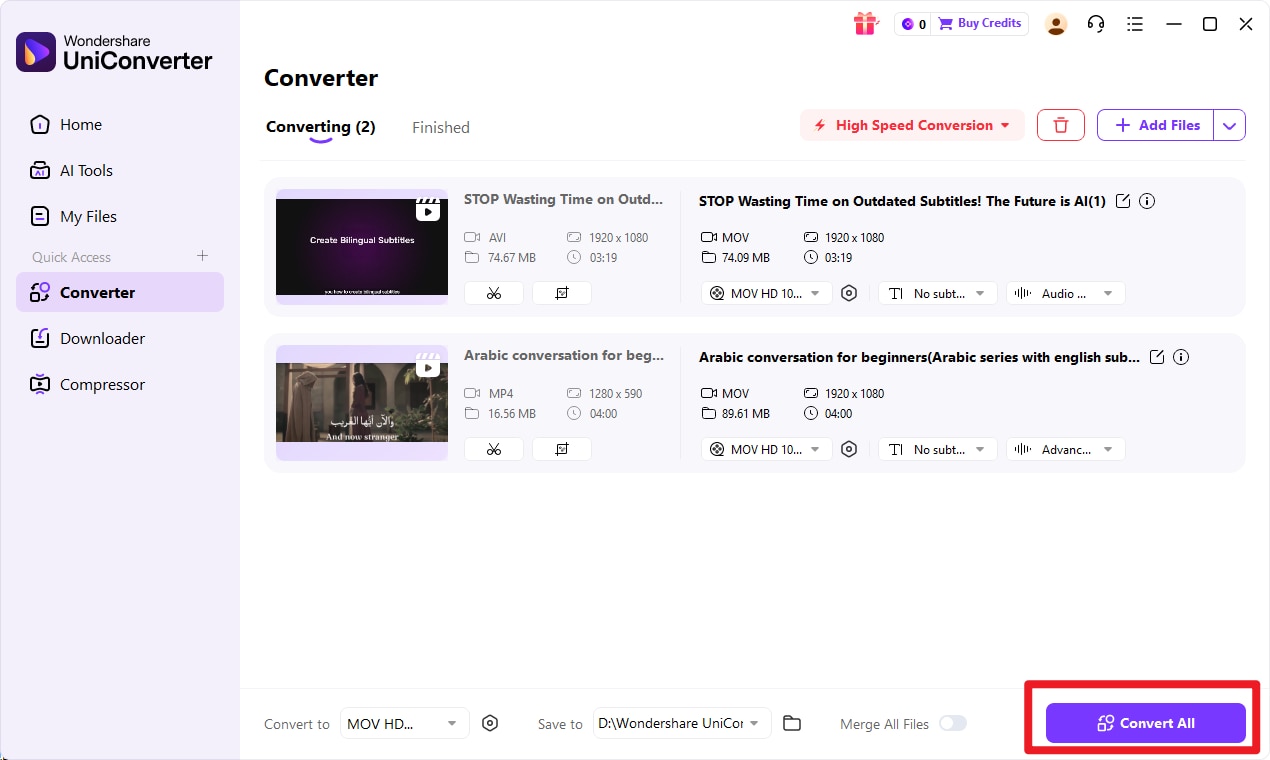
Next, choose a destination for your converted files using the File Location menu at the bottom. Once everything is set, click the Convert button for a single file or Start All to begin the batch conversion process.
UniConverter will process your files at high speed. Once the conversion is complete, you can find your new, high-quality AAC files by clicking the Finished tab at the top of the screen or by navigating directly to the output folder you selected in the previous step.

More Than Just a File Converter
Conclusion
The FLAC vs AAC debate doesn't have a single winner, only a right choice for a specific situation. FLAC is the champion of pure, uncompromised audio quality, making it the gold standard for archiving and critical listening. AAC is the master of efficiency, delivering excellent sound in a small, universally compatible package, making it perfect for portable devices and streaming. The best format for you depends entirely on how and where you plan to listen to your music. For those who need to bridge the gap and enjoy the benefits of both, a versatile tool like Wondershare UniConverter provides a simple, fast, and effective solution to manage and convert your audio library for any device or occasion.
FAQs
-
1. Can you really hear the difference between FLAC and a high-bitrate AAC?
For most people using standard equipment like earbuds, Bluetooth headphones, or laptop speakers, it is very difficult, if not impossible, to reliably distinguish a high-quality 256kbps AAC file from a lossless FLAC file. The subtle differences that do exist are typically only audible to trained ears using high-end audio gear in a quiet listening environment. -
2. Does converting FLAC to AAC degrade the audio quality?
Yes, technically it does. The conversion from a lossless format (FLAC) to a lossy one (AAC) involves permanently removing some audio data. However, when using a high-quality converter and selecting a high bitrate (like 256kbps or 320kbps), this degradation is engineered to be minimal and often completely inaudible to the human ear. -
3. Can I convert AAC back to FLAC to restore the original quality?
No. This is a common misconception. Once audio data has been removed to create a lossy AAC file, that data is gone forever. You can convert an AAC file into the FLAC format, but the result will simply be a much larger file that contains the exact same lossy-quality audio. It does not "add back" or restore the lost information. -
4. Is AAC better than MP3?
Generally, yes. AAC is a more modern and advanced audio codec than MP3. At the same bitrate (e.g., 128kbps), AAC is widely considered to provide slightly better audio quality and compression efficiency. This is why it was chosen by Apple and many other streaming services as the successor to MP3.
