
In the world of digital video, the codec you choose can make or break your workflow. From the initial edit to the final delivery, codecs dictate file size, playback performance, and visual quality. Two prominent names often come up in professional circles: DNxHR and H.265. However, they are designed for vastly different purposes, and understanding their roles is crucial for an efficient production pipeline. The DNxHR vs H.265 debate isn't about which one is universally "better," but about which one is right for the specific task at hand. Whether you're a seasoned filmmaker, a content creator, or a film student, making the correct codec choice will save you time, frustration, and storage space.
This guide will provide a comprehensive breakdown of both codecs, helping you understand their core technologies, ideal use cases, and how they fit together in a modern video workflow. We'll explore why one is a champion in the editing suite while the other reigns supreme for streaming and distribution.
In this article
Part 1. What is DNxHR? What is H.265?
Before we can compare these two codecs, it's essential to understand what they are and the fundamental technology that drives them. They represent two different philosophies in video compression, each optimized for a specific stage of the video production process.
What is DNxHR (Digital Nonlinear Extensible High Resolution)?
DNxHR is a high-quality intermediate or mezzanine codec developed by Avid, a leading company in professional video editing tools. The term "intermediate" is key here; it's designed to be a middleman format, bridging the gap between the highly compressed files from your camera and the final file you deliver to your audience.
Its primary purpose is to facilitate a smooth and responsive post-production workflow. To achieve this, DNxHR has several defining characteristics:
- Intra-frame Compression: This is the secret to its editing performance. DNxHR compresses each video frame individually, without referencing any other frames. Think of it as a sequence of high-quality JPEGs. Because each frame is self-contained, your editing software doesn't need to do complex calculations to display a frame; it can just grab it and show it instantly.
- Low CPU Demand for Decoding: The simplicity of intra-frame compression means it requires very little processing power to play back. This allows for real-time, multi-stream editing, smooth timeline scrubbing, and instant responsiveness, even with high-resolution 4K or 8K footage.
- Visually Lossless Quality: While it is a compressed format, DNxHR is designed to be "visually lossless." This means it preserves nearly all of the original image data, making it perfect for intensive tasks like color grading, visual effects, and compositing where image fidelity is paramount.
- Large File Sizes: The trade-off for this incredible performance and quality is file size. Because each frame is stored with so much information, DNxHR files are significantly larger than camera-native or delivery formats.
In short, DNxHR is built for editors. It prioritizes performance and quality over file size, making it the go-to choice for the post-production stage.
What is H.265 (HEVC - High Efficiency Video Coding)?
H.265, also known as High Efficiency Video Coding (HEVC), is the successor to the widely used H.264 (AVC). It is a final delivery or distribution codec, meaning its main goal is to package a finished video into the smallest possible file size while maintaining the highest possible quality.
It achieves this through a much more complex compression method:
- Inter-frame Compression: Unlike DNxHR, H.265 uses a sophisticated "long-GOP" (Group of Pictures) inter-frame compression. It analyzes a group of frames and only stores the full data for one keyframe (an I-frame). For the subsequent frames (P-frames and B-frames), it only records the changes or differences from the keyframe. This is incredibly efficient, as most video scenes don't change completely from one frame to the next.
- High Compression Efficiency: This advanced method allows H.265 to achieve roughly a 50% file size reduction compared to H.264 at the same visual quality. This is a game-changer for streaming 4K and HDR content over the internet and for storing large video libraries.
- Processor-Intensive: The complexity of inter-frame compression comes at a cost. Encoding and decoding H.265 requires significant CPU power. Your computer has to work hard to reconstruct each frame by referencing other frames in the group. This is why trying to edit H.265 files directly often results in laggy playback, dropped frames, and a frustrating experience.
- Small File Sizes: This is H.265's superpower. Its ability to create small, high-quality files makes it the industry standard for online streaming platforms like YouTube and Netflix, as well as for Blu-ray discs and digital storage.
In essence, H.265 is built for the audience. It prioritizes storage and bandwidth efficiency, making it the perfect codec for delivering your finished masterpiece to the world.
Part 2. Quick Comparison Table
To make the differences even clearer, here is a quick comparison table summarizing the key attributes of DNxHR and H.265.
| Feature | DNxHR (Digital Nonlinear Extensible High Resolution) | H.265 (HEVC) |
| Primary Use | Editing & Post-Production (Intermediate) | Final Delivery, Streaming & Archiving |
| Compression Type | Intra-frame (Each frame is independent) | Inter-frame (Analyzes changes between frames) |
| File Size | Very Large | Very Small |
| Editing Performance | Excellent (Smooth, responsive scrubbing) | Poor (Laggy, computationally intensive) |
| Quality | Visually Lossless | High-Quality Lossy |
| CPU Load (Playback) | Low | High |
| Ideal For | Professional editing workflows, mastering files | Web uploads, streaming, space-saving storage |
Part 3. DNxHR vs H.265: Which One Is Better?
As the table shows, neither codec is inherently "better" than the other; they excel in different areas. The right choice depends entirely on what you are trying to accomplish in your video workflow.
For Editing and Post-Production: DNxHR is the Clear Winner
When you are in the editing suite, performance is king. You need to be able to scrub through your timeline, play back multiple layers of video, and apply effects in real-time without your system grinding to a halt. This is where DNxHR shines.
Because DNxHR uses intra-frame compression, your non-linear editing software (NLE) like Avid Media Composer, DaVinci Resolve, or Adobe Premiere Pro can access any given frame instantly. It doesn't need to decompress a group of pictures to find the frame you've landed on. This direct access translates into a fluid, responsive editing experience. Trying to perform the same actions on a highly compressed H.265 file would force your CPU to work overtime, constantly decoding complex groups of frames, leading to stuttering playback and a frustratingly slow workflow.
For any serious editing, color grading, or VFX work, transcoding your original camera footage (which is often H.264 or H.265) to an intermediate codec like DNxHR is a standard professional practice. The time spent transcoding upfront is more than paid back by the smooth performance during the creative process.
For Final Delivery and Streaming: H.265 is Superior
Once your edit is complete, your priorities shift from performance to efficiency. You need to export a final file that looks great but is small enough to upload quickly and stream smoothly over various internet connections. This is H.265's domain.
The incredible compression efficiency of H.265 is unmatched for final distribution. It allows you to deliver stunning 4K HDR video at bitrates that are manageable for most viewers. Platforms like YouTube and Vimeo love H.265 because it reduces their storage and bandwidth costs, and they will often re-encode your upload to an efficient format anyway. By providing them with a high-quality H.265 file to begin with, you give their encoders the best possible source to work from.
Furthermore, the small file sizes are a huge benefit for anyone managing a library of finished videos. You can store significantly more content on your hard drives or Network Attached Storage (NAS) system, saving you money and space in the long run.
For Archiving: It Depends on Your Priority
Archiving presents a more nuanced choice. The decision between DNxHR and H.265 for long-term storage depends on your primary goal: absolute quality preservation or space efficiency.
- For a "Digital Master" Archive: If you want to preserve your project in the highest possible quality for future use (e.g., creating a new edit, remastering, or extracting clips), archiving the DNxHR master file is the best practice. This file is a "digital negative" that contains the maximum amount of image information, ensuring you have the most flexibility down the road. The downside is the immense storage space required.
- For a "Space-Saving" Archive: If your main concern is storing a large volume of finished projects and storage space is limited, archiving a high-bitrate H.265 file can be a very practical compromise. By encoding the H.265 file with generous settings (high bitrate, quality-focused presets), you can create a file that is visually indistinguishable from the DNxHR master for most viewing purposes but is a fraction of the size. This is often a good solution for archiving final delivery versions of projects.
Part 4. Use Cases for DNxHR and H.265
To put it all together, let's look at some concrete, real-world scenarios where you would use each codec in a professional workflow in 2026.
Common Use Cases for DNxHR
- Creating Edit-Friendly Proxies or Intermediates: A videographer shoots a wedding in 4K H.265 on their mirrorless camera. Before starting the edit, they transcode all the footage to DNxHR. This allows them to edit the entire project smoothly on their laptop without any performance issues.
- Mastering a Final Edit: After completing the picture lock and color grade on a short film, the editor exports a DNxHR file. This file serves as the final, high-quality master. All subsequent versions (for web, for festivals, etc.) will be created from this master file.
- Collaborative Workflows: A video editor working on a commercial sends the DNxHR master file to a visual effects artist. The VFX artist can work with the high-quality footage to create complex effects and then send a DNxHR file back to the editor to be integrated into the final timeline. This ensures consistent quality throughout the collaborative process.
Common Use Cases for H.265
- Uploading to Streaming Platforms: A YouTuber has just finished their latest video. They export their final timeline from their DNxHR master file to a high-quality H.265 (HEVC) MP4 file. This small file size allows for a quick upload to YouTube, and the high efficiency ensures their 4K video looks crisp for their audience.
- Building a Digital Video Library: A filmmaker wants to keep a digital library of all their completed films on a personal server. Instead of storing the massive multi-terabyte DNxHR master files, they create high-bitrate H.265 versions for long-term storage, allowing them to fit their entire filmography on a single large hard drive.
- Live Streaming and Video Conferencing: A company is hosting a live webinar in 2026. They use a streaming service that encodes the video feed in real-time to H.265 to ensure a stable, high-quality stream can be delivered to hundreds of attendees with varying internet speeds.
Part 5. Step-by-Step Guide to Convert DNxHR to H.265 Using UniConverter
The bridge between the editing world of DNxHR and the delivery world of H.265 is a reliable video converter. For video professionals who need to perform this crucial step without compromising quality or dealing with complex settings, Wondershare UniConverter is an invaluable tool. It provides a fast, intuitive, and powerful solution for converting your DNxHR master files into web-ready H.265 formats.
Here's how to easily convert your files.
Step 1: Launch Wondershare UniConverter
First, launch Wondershare UniConverter on your computer. In the main interface, select the Converter tool from the left-hand menu.

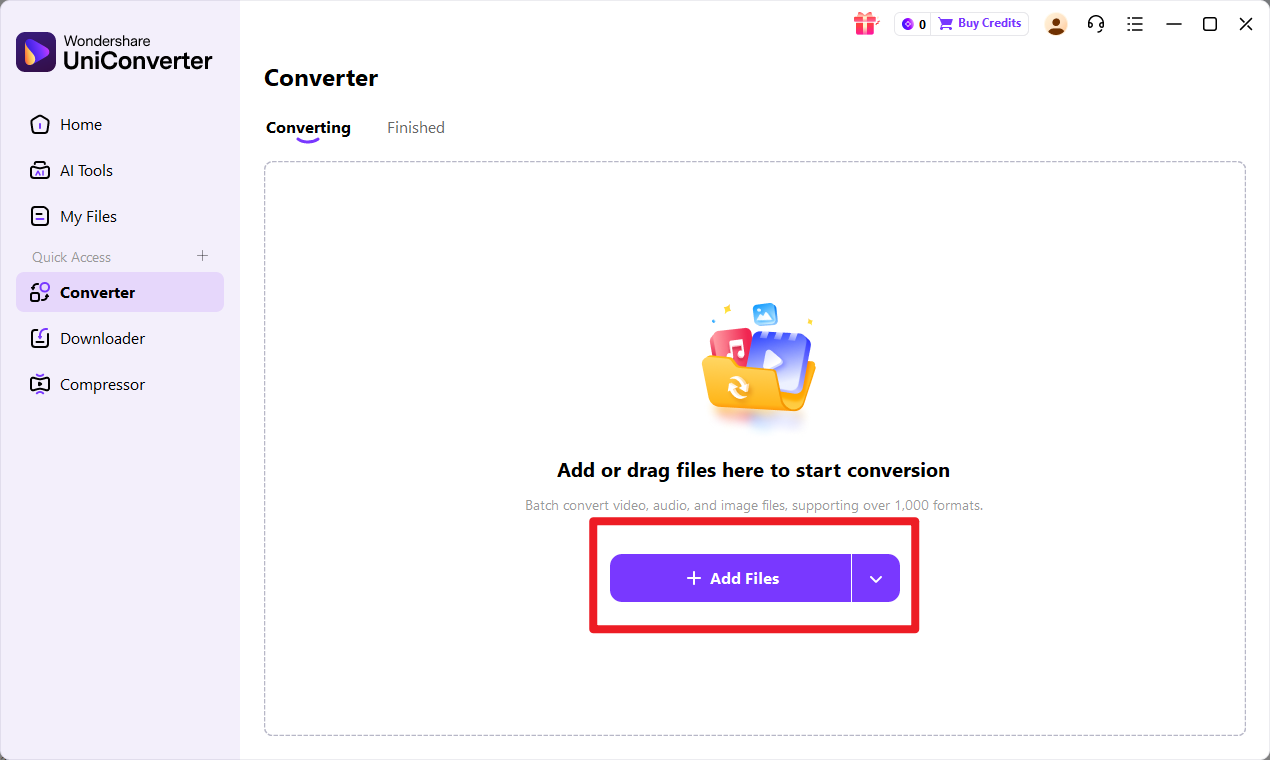
Step 2: Add Files to UniConverter
You can now import your DNxHR file (often in a .MOV container). Either drag and drop the video file directly onto the UniConverter window or click the "Add Files" icon to browse your computer and select it.
Step 3: Choose Output Format
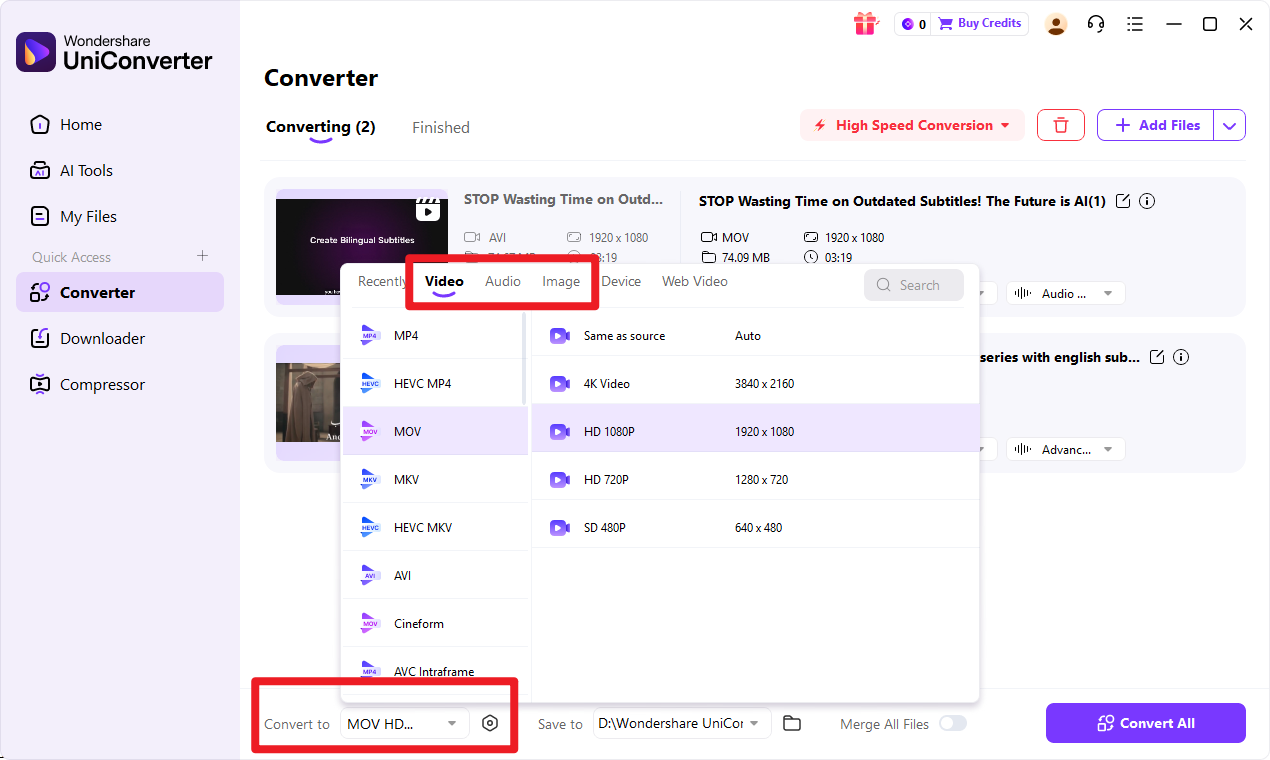
With your file loaded, click on the Output Format menu located at the bottom of the window. This will open a new panel with format options. Navigate to the Video tab. Select a suitable container format like MP4. Then, click the small edit/pencil icon next to the resolution preset to open the detailed settings window. Here, find the Encoder dropdown menu and select HEVC, which is the technical name for H.265. You can also adjust settings like bitrate and resolution here if needed.
Step 4: Start the Conversion
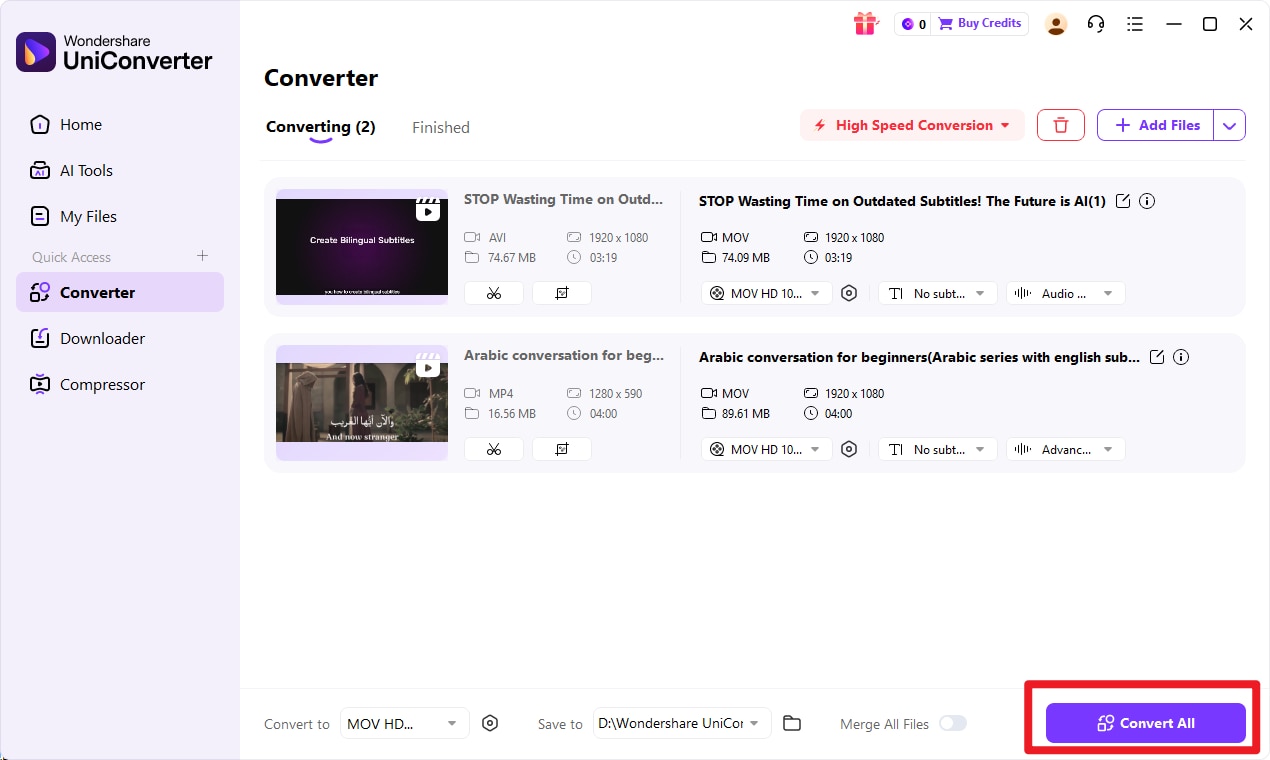
Before starting, you can specify where you want to save the converted file using the File Location menu at the bottom. Once you are satisfied with your settings, click the Convert button next to the individual file. If you have loaded multiple files for a batch conversion, you can click the Start All button in the bottom-right corner to process them all at once.
UniConverter will now begin the conversion process, leveraging hardware acceleration to complete the task quickly. You can monitor the progress on the screen. Once finished, you can find your new H.265 file in the destination folder you selected earlier. Alternatively, you can click on the Finished tab at the top of the window to see a list of all completed conversions and open the file location directly from there.

More Than Just a Video Converter
Conclusion
Ultimately, the DNxHR vs H.265 discussion reveals that these two codecs are not adversaries but essential partners in a streamlined, professional video workflow. They are specialized tools designed for different, yet equally important, stages of production. DNxHR is your workhorse for post-production, providing the raw performance and quality needed for a creative and efficient editing process. H.265 is your delivery vehicle, expertly compressing your final product for efficient distribution and storage without a significant sacrifice in visual quality.
Understanding when and why to use each codec is a hallmark of a knowledgeable video professional. By using DNxHR for editing and mastering, and H.265 for delivery and archiving, you optimize your entire pipeline for both quality and efficiency. And for the crucial step of transitioning between these two worlds, a powerful and user-friendly tool like Wondershare UniConverter is an indispensable asset in any editor's toolkit.
FAQs
-
1. Can I edit H.265 video files directly?
While some of the latest NLEs and extremely powerful computers in 2026 can handle H.265 files to a certain extent, it is still not recommended for serious editing projects. The inter-frame compression of H.265 is computationally demanding, and you will likely experience poor performance, laggy timeline scrubbing, dropped frames, and potential software crashes, especially with 4K or higher resolutions. The industry-standard best practice remains to transcode H.265 source footage to an intermediate codec like DNxHR or ProRes before you begin editing. -
2. Is DNxHR the same as Apple ProRes?
DNxHR and Apple ProRes are direct competitors that serve the exact same purpose. They are both high-quality, intra-frame intermediate codecs designed for professional post-production. The main difference is their origin: DNxHR was developed by Avid, while ProRes was developed by Apple. For years, ProRes was more common in Final Cut Pro workflows, while DNxHR was the native choice for Avid Media Composer. Today, most major NLEs support both codecs. The choice between them often comes down to specific workflow requirements, platform preference (macOS vs. Windows), or client delivery specifications. In terms of quality and performance, they are very comparable. -
3. Does converting from DNxHR to H.265 cause a loss in quality?
Yes, technically, any conversion from a visually lossless codec like DNxHR to a lossy delivery codec like H.265 involves some data being discarded. H.265 achieves its small file sizes by intelligently removing visual information that the human eye is least likely to notice. However, the term "loss" can be misleading. When the conversion is done correctly using a high-quality converter like UniConverter and appropriate bitrate settings, the resulting H.265 file can be virtually indistinguishable from the DNxHR source to the naked eye. The key is to provide a high enough bitrate to preserve the necessary detail for your intended viewing platform.
