
Choosing the right video format is a critical decision that can impact everything from editing performance to final delivery. In the vast landscape of digital video, two formats that often come up in different contexts are DNxHD and WMV. While both are used to store video data, they are designed for fundamentally different purposes and workflows. Understanding the core distinctions in the DNxHD vs WMV debate is essential for video editors, content creators, and media professionals who want to optimize their production pipeline.
This guide will provide a detailed comparison, breaking down their technical specifications, ideal use cases, and key differences. Whether you're working on a high-end film project or preparing a video for web distribution, this article will help you determine which format is the right tool for the job.
In this article
Quick Note:
- DNxHD is a high-quality, visually lossless codec from Avid, designed for professional video editing and post-production. It prioritizes quality, resulting in very large file sizes.
- WMV (Windows Media Video) is a highly compressed, lossy format from Microsoft, created for web streaming and distribution. It prioritizes small file sizes for easy sharing.
- The choice between them depends entirely on your specific needs: DNxHD for editing, WMV for delivery.
- Converting from DNxHD to WMV is a common workflow step, easily accomplished with a tool like Wondershare UniConverter.
Part 1. What is DNxHD? What is WMV?
Before we dive into a direct comparison, it's crucial to understand the identity and purpose of each format individually. They originate from different developers with distinct goals in mind, which explains their contrasting characteristics.
What is DNxHD?
DNxHD, an acronym for Digital Nonlinear Extensible High Definition, is a high-definition video codec engineered by Avid Technology. It was developed to serve as an "intermediate" or "mezzanine" codec. This means it's not typically used for capturing video directly from a camera or for final delivery to an audience. Instead, its primary purpose is to facilitate a smooth and efficient editing process within professional post-production workflows.
When you edit highly compressed camera formats like H.264, your computer has to work hard to decompress each frame, which can lead to laggy playback and slow performance. DNxHD solves this problem by using a much lower level of compression. While this results in larger files, it makes the video data much easier for editing software to process, ensuring real-time playback and a seamless experience, even with complex effects and multiple layers. Its visually lossless nature ensures that video quality is preserved through multiple generations of rendering and compositing, making it a staple in professional film and television production.
What is WMV?
WMV, which stands for Windows Media Video, is a video compression format developed by Microsoft. Unlike DNxHD, WMV was designed from the ground up as a "delivery" or "distribution" format. Its main goal is to make video files small enough for efficient streaming over the internet and for easy playback on computers, particularly those running the Windows operating system.
To achieve its small file sizes, WMV uses a lossy compression algorithm. This means it intelligently removes some video data that the human eye is less likely to notice, significantly reducing the file's size. While this inevitably leads to a reduction in overall quality compared to the original source, the trade-off is often acceptable for its intended purpose. Its high compression ratio makes it an excellent choice for online video platforms, email attachments, and corporate presentations where bandwidth and storage space are primary concerns.
Part 2. Quick Comparison Table
For a quick overview, this table highlights the key differences between the DNxHD codec and the WMV format at a glance.
| Feature | DNxHD | WMV |
| Developer | Avid Technology | Microsoft |
| Primary Use | Professional Editing, Post-Production | Web Streaming, Distribution |
| Compression | Low, Visually Lossless | High, Lossy |
| Quality | Excellent, Master-Level | Good, Optimized for Web |
| File Size | Very Large | Small to Medium |
| Platform Compatibility | Professional Software (Avid, DaVinci) | Windows, Web Browsers |
| Editing Friendliness | Excellent | Poor |
Part 3. DNxHD vs WMV: Which One Is Better?
The question of which format is "better" is entirely subjective and depends on the specific task at hand. One is built for quality and performance in a professional environment, while the other is built for efficiency and accessibility in a consumer environment. Let's break down their differences across key criteria.
Quality and Compression
This is the most significant point of divergence between the two.
- DNxHD: This codec prioritizes quality above all else. It uses a form of compression that is "visually lossless," meaning that while there is some compression applied, the resulting image is virtually indistinguishable from the uncompressed original to the human eye. This is critical in post-production, where a video file might be exported, color-graded, have effects applied, and then re-exported multiple times. DNxHD's robust nature ensures that quality degradation is minimized throughout this multi-generational process.
- WMV: This format prioritizes small file sizes. To achieve this, it employs a "lossy" compression scheme. It permanently discards video information to reduce the amount of data that needs to be stored. While modern WMV codecs are quite efficient and can produce good-looking video at reasonable bitrates, there is an inherent loss of quality. This makes WMV unsuitable for the editing process, as each re-export would further degrade the image. It is designed to be the final step—a compressed version for the end-user to watch.
File Size
The difference in compression philosophy directly translates to a massive difference in file size.
- DNxHD: Files encoded with the DNxHD codec are extremely large. A few minutes of high-definition footage can easily consume several gigabytes of storage space. This is a necessary trade-off for maintaining quality and editing performance. Professionals using this codec rely on high-capacity, high-speed storage solutions like RAID arrays to manage these files effectively. Transferring DNxHD files over the internet can be slow and impractical.
- WMV: Files in the WMV format are significantly smaller and more manageable. The same few minutes of footage that took up gigabytes in DNxHD might only be a few dozen megabytes as a WMV file. This efficiency is what makes it so practical for web delivery. Smaller files upload faster, download quicker, and consume less bandwidth when streamed, making for a better user experience on websites and social media platforms.
Compatibility and Usability
Where and how you can use these formats also differs greatly.
- DNxHD: As a professional codec, DNxHD is natively supported in most major non-linear editing systems (NLEs) like Avid Media Composer, DaVinci Resolve, and Adobe Premiere Pro. However, it is not a consumer-friendly format. Standard media players like Windows Media Player or VLC may not be able to play DNxHD files out of the box and often require the installation of special codec packs. Its use is largely confined to professional production environments.
- WMV: Being a Microsoft product, WMV enjoys excellent native compatibility with the Windows operating system. Most Windows PCs can play WMV files without needing any additional software. It is also well-supported by many web browsers and was once a dominant format for online video. While its popularity has waned in favor of MP4 (H.264/H.265), it remains a viable option for distribution, especially in Windows-centric corporate environments. It is less common in macOS and Linux workflows.
Part 4. Use Cases for DNxHD and WMV
Understanding the strengths and weaknesses of each format helps clarify their ideal applications. Using the right format at the right stage of your workflow is key to efficiency and quality.
When to Use DNxHD
DNxHD is the format of choice when quality and editing performance are non-negotiable. You should use it in the following scenarios:
- Creating Intermediate Files: When you're working on a project with footage from various cameras in different formats, it's a common practice to transcode everything to a single, consistent intermediate codec like DNxHD. This standardizes the media and ensures smooth, real-time editing performance throughout the post-production process.
- Editing in Professional Software: If you are editing high-definition or 4K footage in software like Avid Media Composer or DaVinci Resolve, working with DNxHD will provide a much more responsive and stable experience compared to editing heavily compressed formats directly.
- Archiving Master Files: Once a project is complete, exporting a final master version in DNxHD is an excellent way to archive it. This high-quality master file can be used to create all other delivery formats in the future without having to go back to the original project timeline, preserving the highest possible fidelity.
When to Use WMV
WMV is the go-to format when you need to distribute a finished video in a small, accessible package. Consider using it for:
- Streaming on a Website: If you need to embed a video on a website and are concerned about loading times and bandwidth usage, WMV can be an effective choice, particularly if your target audience primarily uses Windows devices.
- Sending Previews to Clients: When you need to send a draft of a video to a client for review, a small WMV file is easy to attach to an email. The client can likely play it on their Windows PC without any technical hurdles, making the feedback process smoother.
- Corporate Training and Presentations: For internal corporate videos, training modules, or presentations that need to be distributed across a company network, WMV is a practical format. Its small file size makes it easy to store on shared drives and its compatibility with Windows is a major advantage in most office environments.
Part 5. Step-by-Step Guide to Convert DNxHD to WMV Using UniConverter
When your professional edit in DNxHD is complete and you need to deliver a smaller, more accessible file, converting it to WMV is a common final step. Wondershare UniConverter is a powerful tool that handles this conversion process quickly and efficiently while preserving as much quality as possible. It is the recommended tool for this task, offering a user-friendly interface and robust features for professionals and beginners alike.
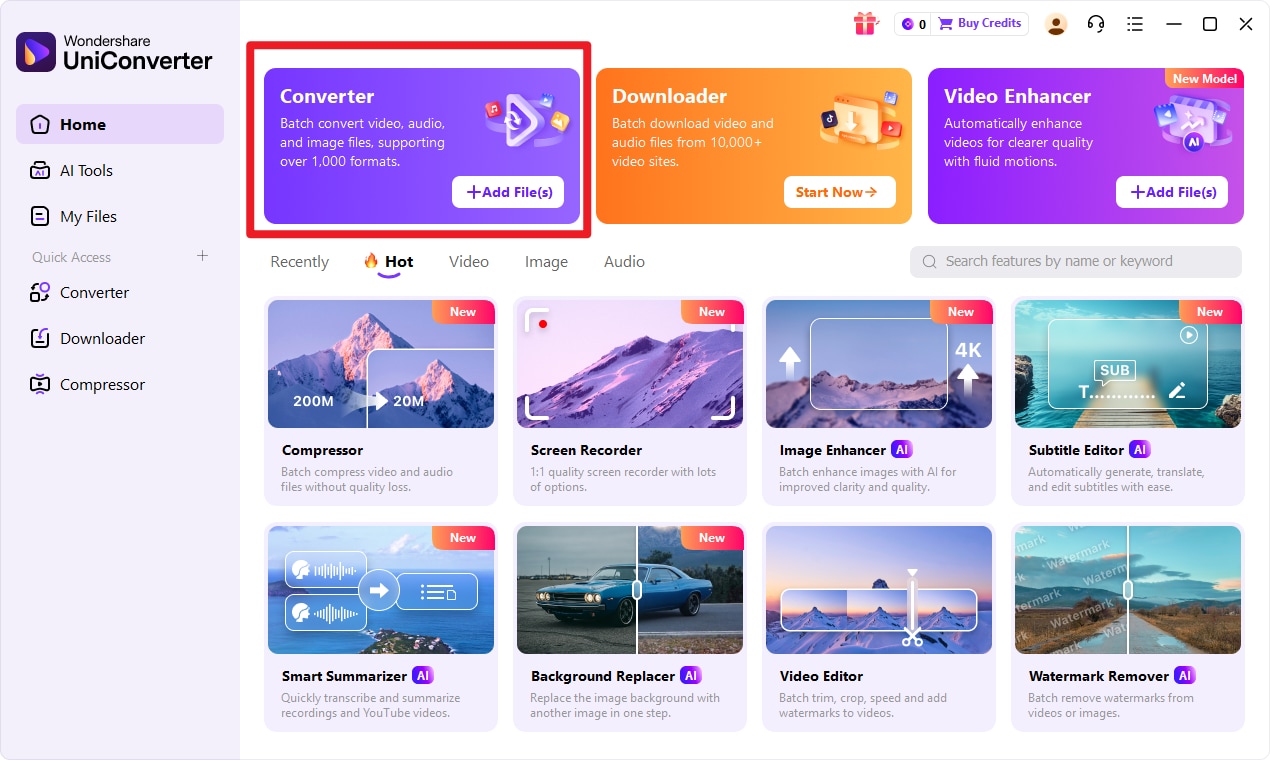
Step 1. Choose Converter in UniConverter
Launch Wondershare UniConverter on your computer. On the main interface, you will see a list of tools on the left-hand side. Click on the Converter option to open the primary video conversion window.
Step 2. Add Files to UniConverter
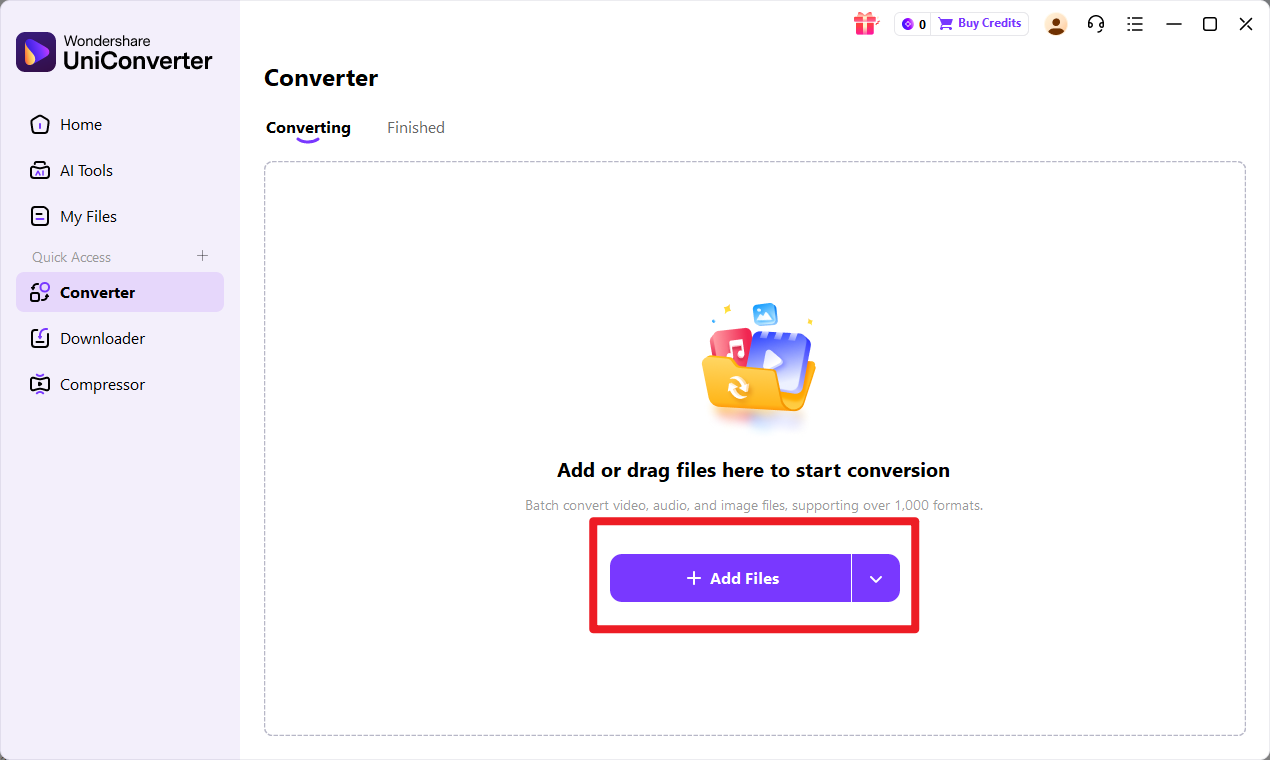
Next, you need to import your DNxHD source file. You can do this in two ways: either drag and drop your DNxHD video file (often in a .mov or .mxf container) directly onto the program window, or click the "Add Files" icon in the top-left corner to browse your computer's folders and select the file manually.
Step 3. Choose Output Format
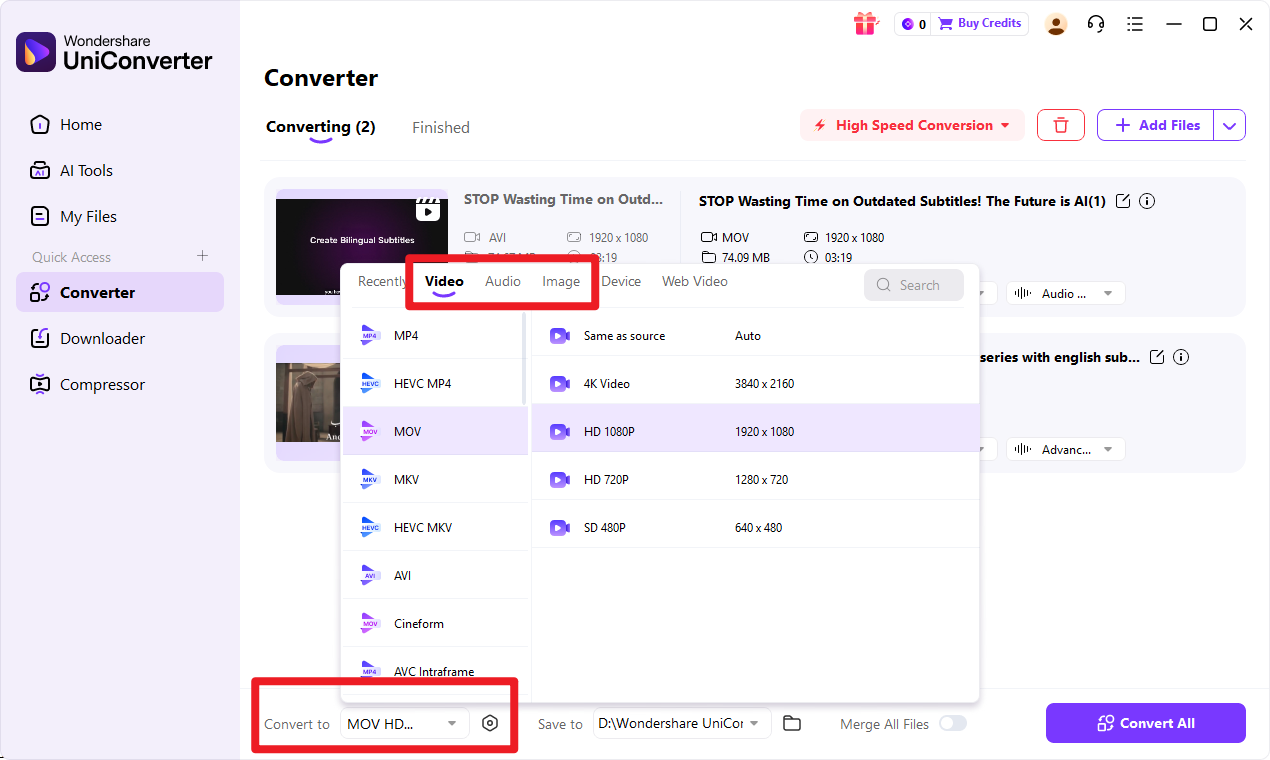
With your file loaded, click on the Output Format menu at the bottom of the window. This will open a new dialog box with a list of available formats. Go to the Video tab, find WMV in the list on the left, and then select your desired resolution on the right (e.g., "Same as source" or "1080p").
Step 4. Start the Conversion
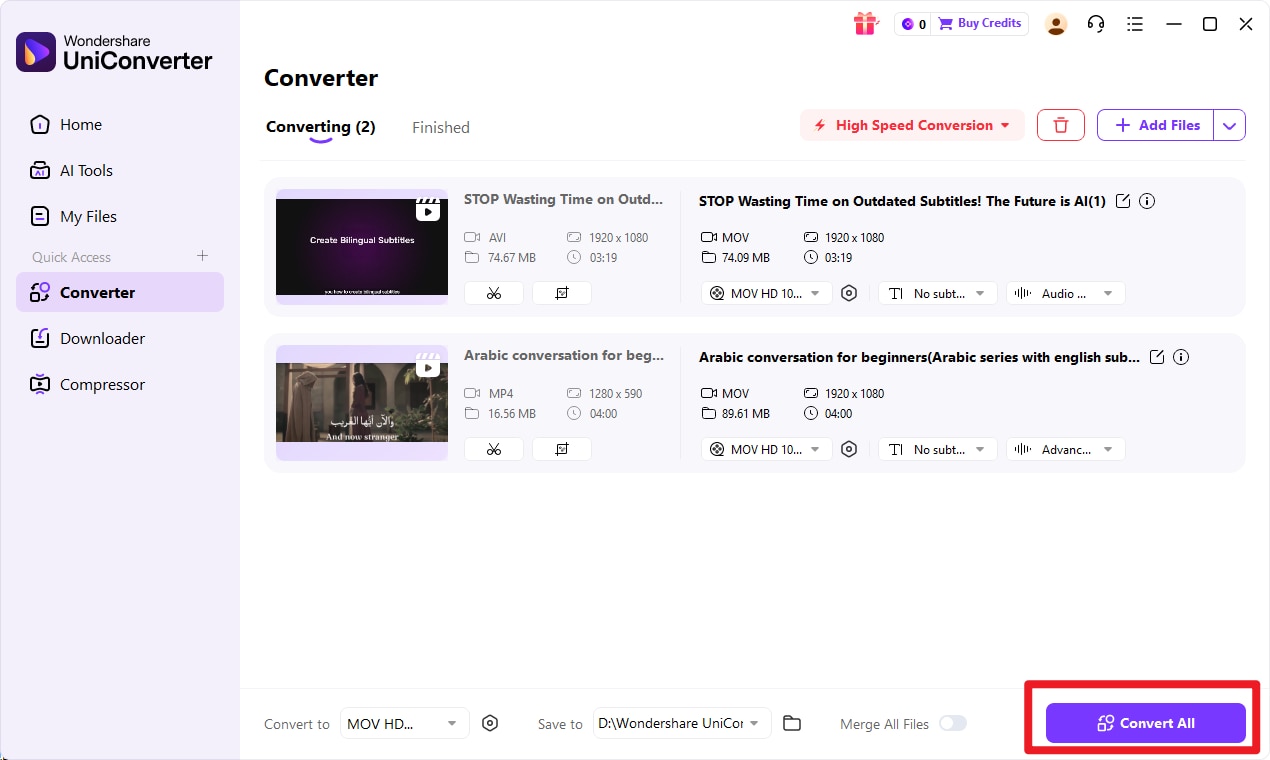
Before starting, you can specify where you want to save the converted file using the File Location option at the bottom. Once you are ready, click the Start All button (or the Convert button next to the individual file) to begin the conversion process. UniConverter will quickly process your file and save the new WMV video to your chosen destination.

Go Beyond Simple Video Conversion
Conclusion
In summary, DNxHD and WMV are two formats built for opposite ends of the video production spectrum. DNxHD is an uncompromising, high-quality codec that serves as the workhorse for professional editing and archiving, ensuring visual fidelity and smooth performance. In contrast, WMV is a highly efficient distribution format designed for accessibility, prioritizing small file sizes for easy streaming and sharing, especially within the Windows ecosystem.
Neither format is inherently better than the other; their value is determined by the context of their use. The best workflow often involves using both: DNxHD during post-production and WMV for final delivery. For the crucial task of bridging this gap—converting your pristine DNxHD master file into a lightweight WMV for distribution—a reliable and powerful tool is indispensable. Wondershare UniConverter provides a seamless, fast, and high-quality solution, making it the perfect companion for all your video conversion needs.
FAQs
-
1. Is DNxHD a container or a codec?
DNxHD is a codec. A codec is the algorithm used to compress and decompress video data. This codec is then stored inside a media container file. The most common container formats for DNxHD are MOV (.mov) and MXF (.mxf). So, when you have a "DNxHD file," you typically have a MOV or MXF file that contains video data compressed with the DNxHD codec. -
2. Can I upload a DNxHD file to YouTube?
While YouTube's uploader might technically accept a DNxHD file (likely in a .mov container), it is highly discouraged. The file sizes are enormous, which means your upload time will be extremely long, potentially lasting many hours or even days depending on the video length and your internet connection. It is always better to first convert the DNxHD master file to a web-optimized delivery format like MP4 (using the H.264 codec) before uploading to YouTube for the best results and efficiency. -
3. Does converting DNxHD to WMV reduce quality?
Yes, converting from a visually lossless codec like DNxHD to a lossy format like WMV will always result in some reduction of quality. This is because the WMV compression algorithm must discard some video information to achieve its small file size. However, by using a high-quality conversion program like Wondershare UniConverter, you can control the settings (such as bitrate) to manage this quality loss effectively. This allows you to find the best possible balance between file size and visual quality for your specific needs.
