
In the world of professional video editing, performance and quality are paramount. While modern cameras capture stunning high-resolution footage, their native formats are often heavily compressed and not designed for the rigors of post-production. This is where intermediate codecs come in. They act as a bridge, converting camera-native files into an edit-friendly format that preserves image quality while demanding less processing power from your computer. For years, the debate has centered on two industry powerhouses. The central question for many editors remains: in the CineForm vs ProRes showdown, which codec is the right choice for your specific workflow?
Choosing the wrong codec can lead to frustrating lag, compatibility roadblocks, and potential quality loss. The right one, however, can unlock a smooth, efficient, and high-fidelity editing experience. This guide will demystify these two formats, providing a clear, practical comparison to help you make an informed decision for your projects in 2026 and beyond.
In this article, you will learn:
- What GoPro CineForm and Apple ProRes are and their technical foundations.
- A direct, feature-by-feature comparison in a quick-scan table.
- A deep dive into performance, image quality, file size, and compatibility.
- Specific use cases to help you decide when to use each codec.
- How to easily convert between CineForm and ProRes to overcome any workflow challenge.
Part 1. What is GoPro CineForm? What is Apple ProRes?
Before we can compare them, it's essential to understand what each codec is and where it came from. Both were designed to solve the same problem—inefficient editing—but they approach it from different technical standpoints.
What is GoPro CineForm?
GoPro CineForm is a high-performance, cross-platform intermediate codec. It was originally developed by CineForm Inc. as a solution for creating high-quality, edit-friendly files from various camera sources. In 2011, GoPro acquired the technology, integrating it deeply into its own ecosystem and making it a popular choice for action camera workflows.
One of CineForm's defining characteristics is its cross-platform nature; it works natively and efficiently on both Windows and macOS. This makes it a highly flexible option for teams with mixed operating systems. Technically, CineForm is built on a wavelet compression foundation. Unlike the more common DCT-based compression, wavelet compression is particularly efficient at decoding video at multiple resolutions. This means your editing software can easily play back a lower-resolution version of the file for smooth timeline scrubbing without decoding the entire full-resolution frame, significantly boosting real-time performance. Its primary use cases include GoPro-centric workflows and serving as a robust intermediate format for editors on Windows machines.
What is Apple ProRes?
Apple ProRes is a family of intermediate codecs developed by Apple Inc. that has become a true industry standard in professional post-production. Since its introduction, ProRes has been the backbone of countless films, television shows, and commercials, prized for its excellent image quality and performance, especially within the Apple ecosystem.
ProRes is deeply integrated into Apple's professional applications, most notably Final Cut Pro, where it delivers unparalleled real-time editing performance on Mac hardware. The technical foundation of ProRes is DCT (Discrete Cosine Transform) compression, the same core technology used in formats like H.264 and JPEG. However, ProRes uses a much less aggressive, intra-frame version of it, ensuring that each frame is compressed independently to maintain high fidelity through multiple generations of encoding. It comes in several flavors—including ProRes 422 LT, 422, 422 HQ, 4444, and 4444 XQ—offering a spectrum of data rates to balance quality and file size. Its primary use cases are editing in Final Cut Pro, creating master files for delivery to broadcasters and streaming services, and long-term project archiving.
Part 2. Quick Comparison Table
For a quick overview, this table breaks down the key differences and similarities between GoPro CineForm and Apple ProRes.
Feature Comparison: CineForm vs ProRes
| Feature | GoPro CineForm | Apple ProRes |
| Platform Compatibility | Excellent: Fully supported on both Windows and macOS. | Good: Native and highly optimized for macOS. Windows support is available in major NLEs but can be less performant. |
| Compression Technology | Wavelet | DCT (Discrete Cosine Transform) |
| Quality & Bit Depth | High quality, supporting up to 12-bit color depth and an alpha channel for transparency. | A family of codecs with varying quality levels. Supports up to 12-bit color depth and an alpha channel (ProRes 4444 / 4444 XQ). |
| File Size | Generally comparable to ProRes at similar quality levels. Can sometimes be slightly smaller. | Varies significantly by version. ProRes 422 HQ and 4444 versions produce very large files, while ProRes 422 LT is more storage-friendly. |
| Software Integration | Good support in Adobe Premiere Pro and DaVinci Resolve. Native to the GoPro ecosystem. | Excellent and ubiquitous. The standard for Final Cut Pro and universally supported across nearly all professional video software. |
Part 3. CineForm vs ProRes: Which One Is Better?
The "better" codec is not a one-size-fits-all answer. It depends entirely on your hardware, software, and project requirements. Let's break down the comparison across four critical areas.
Performance and Editing Speed
Performance is where the differences between these codecs become most apparent.
- On macOS with Final Cut Pro: Apple ProRes is the undisputed champion. Because Apple controls the hardware, operating system, and codec, ProRes is meticulously optimized for the Metal graphics API and Apple Silicon chips. This results in incredibly smooth timeline scrubbing, multi-stream playback, and faster render times within Final Cut Pro.
- On Windows with Adobe Premiere Pro: Here, the story often flips. GoPro CineForm frequently provides a smoother, more responsive editing experience. Its wavelet compression seems to be more efficiently handled by Premiere Pro on Windows systems, leading to better real-time playback, especially with 4K and higher resolution footage. While Premiere Pro supports ProRes on Windows, it's not as optimized as it is on a Mac, and editors may experience some choppiness.
- In DaVinci Resolve: Performance is generally excellent with both codecs on both platforms, as Blackmagic Design has invested heavily in optimizing its software for a wide range of formats. However, subtle advantages may still lean towards ProRes on Mac and CineForm on Windows.
Image Quality and Compression Artifacts
For all practical purposes, both CineForm and high-bitrate versions of ProRes (like 422 HQ and 4444) are considered "visually lossless." This means that after transcoding from your original camera footage, you are unlikely to see any degradation in image quality with the naked eye. Both codecs provide ample color information (10-bit or higher) to withstand heavy color grading and visual effects work without introducing banding or other artifacts.
The subtle difference lies in their compression technology. DCT compression (ProRes) works on small blocks of pixels (typically 8x8). Wavelet compression (CineForm) analyzes the image at different scales. Some argue that wavelet compression can be more forgiving over many re-compression generations, but in a standard post-production workflow, this difference is largely academic. Both codecs will preserve the fidelity of your footage exceptionally well.
File Size and Storage Considerations
Intermediate codecs prioritize quality and performance over file size, so be prepared for large files with either choice.
A one-minute 4K (3840x2160) clip at 29.97 fps can give you a rough idea:
- GoPro CineForm (Film Scan 1): Approximately 5-6 GB
- Apple ProRes 422 HQ: Approximately 5.5-6.5 GB
- Apple ProRes 422: Approximately 3.5-4.5 GB
As you can see, CineForm's file size is very comparable to the popular ProRes 422 HQ. If storage is a major concern, you might consider using a lower-bitrate version of ProRes like ProRes 422 or ProRes 422 LT, which offer a great balance of quality and smaller file sizes. However, for maximum quality, CineForm and ProRes 422 HQ are in the same ballpark. Always factor in the cost of high-capacity hard drives or RAID systems when planning a project with these codecs.
Compatibility and Workflow Ecosystem
This is perhaps the most significant deciding factor for many professionals.
- Apple ProRes: ProRes is the lingua franca of the professional video world. If you need to deliver a final master file to a broadcast network, a major streaming service (like Netflix), or a professional color grading or finishing house, the delivery specifications will almost certainly demand or prefer Apple ProRes. Its ubiquity makes it the safest and most reliable choice for collaboration and final delivery.
- GoPro CineForm: While not as universally mandated for delivery, CineForm's strength is its superior cross-platform flexibility. It is an ideal choice for internal workflows, especially for teams where some editors are on Windows PCs and others are on Macs. It eliminates the compatibility headaches and performance discrepancies that can arise when sharing ProRes files across different operating systems.
Part 4. Use Cases for CineForm and ProRes
To make the choice even clearer, let's look at specific scenarios where one codec is the obvious choice over the other.
When to Choose CineForm
You should opt for GoPro CineForm in the following situations:
- Cross-Platform Collaboration: If your editing team consists of both Windows and Mac users, CineForm is the perfect unifying codec. It ensures everyone has a smooth, consistent editing experience without any platform-specific issues.
- GoPro-Heavy Workflows: If the majority of your source footage comes from GoPro cameras, using CineForm is a natural fit. The workflow is seamless from camera to edit.
- Windows-Based Editing: If you are a primary Windows user working in Adobe Premiere Pro or DaVinci Resolve, CineForm will often provide better real-time playback performance than ProRes, making it the superior choice for your intermediate format.
When to Choose ProRes
You should select Apple ProRes for these scenarios:
- Apple-Exclusive Ecosystem: If you and your entire team work exclusively on Macs and use Final Cut Pro, there is no better choice than ProRes. The optimization is unmatched.
- Industry-Standard Delivery: When your project's final destination is a broadcaster, streaming platform, or post-production house, ProRes is the professional standard. Using it from the start simplifies the final delivery process.
- Long-Term Archiving: Due to its widespread, long-term industry support and backing from Apple, ProRes is an excellent choice for archiving completed projects. You can be confident that the format will remain accessible for decades to come.
Bridging the Gap: The Need for Conversion
What happens when these worlds collide? A Windows editor might receive a hard drive full of ProRes files from a client. A Mac-based editor might need to incorporate CineForm footage from a second unit. In these common scenarios, codec incompatibility can bring a project to a grinding halt.
This is where a professional video converter becomes an indispensable tool. It's not just about changing a file extension; it's about transcoding the footage from one complex codec to another without compromising the visual data. For reliable, fast, and high-quality transcoding, a tool like Wondershare UniConverter is an essential part of any modern editor's toolkit, allowing you to bridge the gap between CineForm and ProRes workflows seamlessly.
Part 5. Step-by-Step Guide to Convert CineForm to ProRes Using UniConverter
When you need to convert your CineForm files to the industry-standard Apple ProRes for delivery or for editing in Final Cut Pro, Wondershare UniConverter is the ideal tool. It supports batch processing, leverages GPU acceleration for incredible speed, and is specifically designed to convert to professional codecs like ProRes without any perceptible quality loss.
How to Convert CineForm to ProRes in 4 Easy Steps
Follow this simple guide to get your files converted quickly and efficiently.
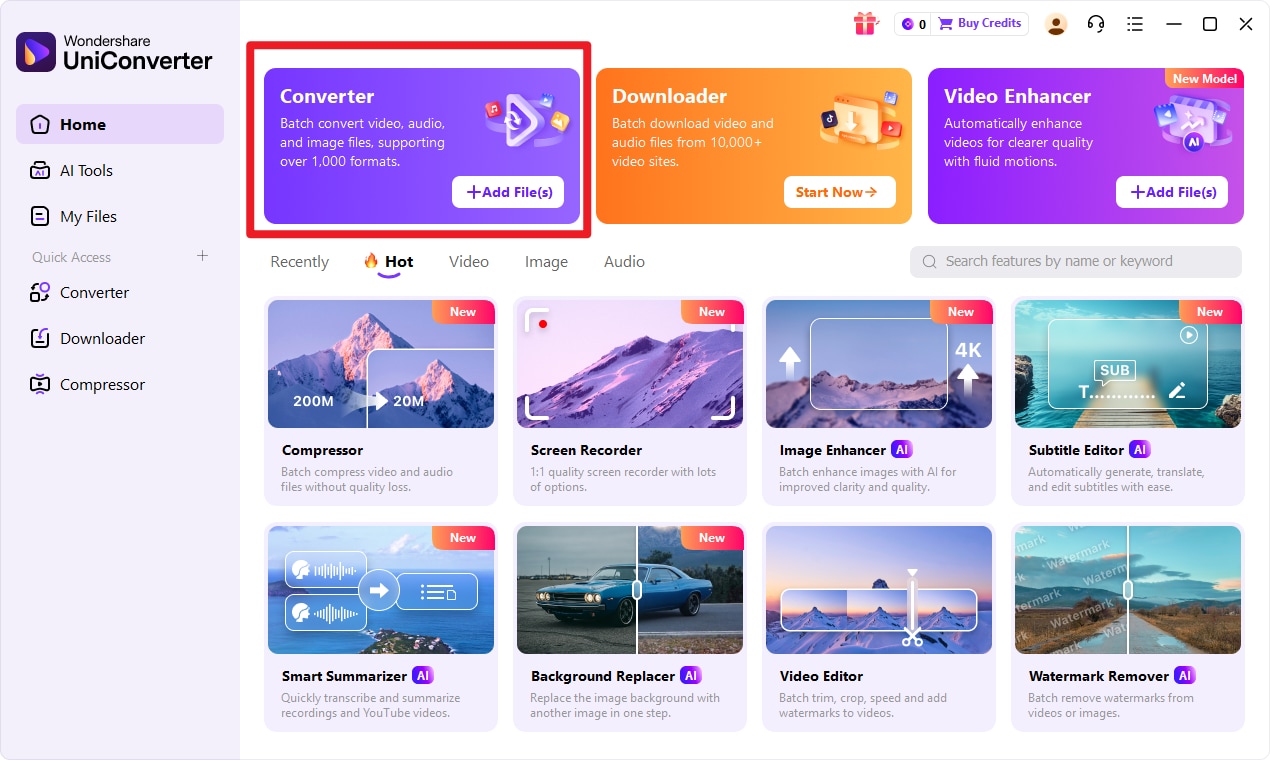
Step 1: Launch the Wondershare UniConverter
First, launch the Wondershare UniConverter application on your computer. In the main interface, ensure you are in the "Converter" section.
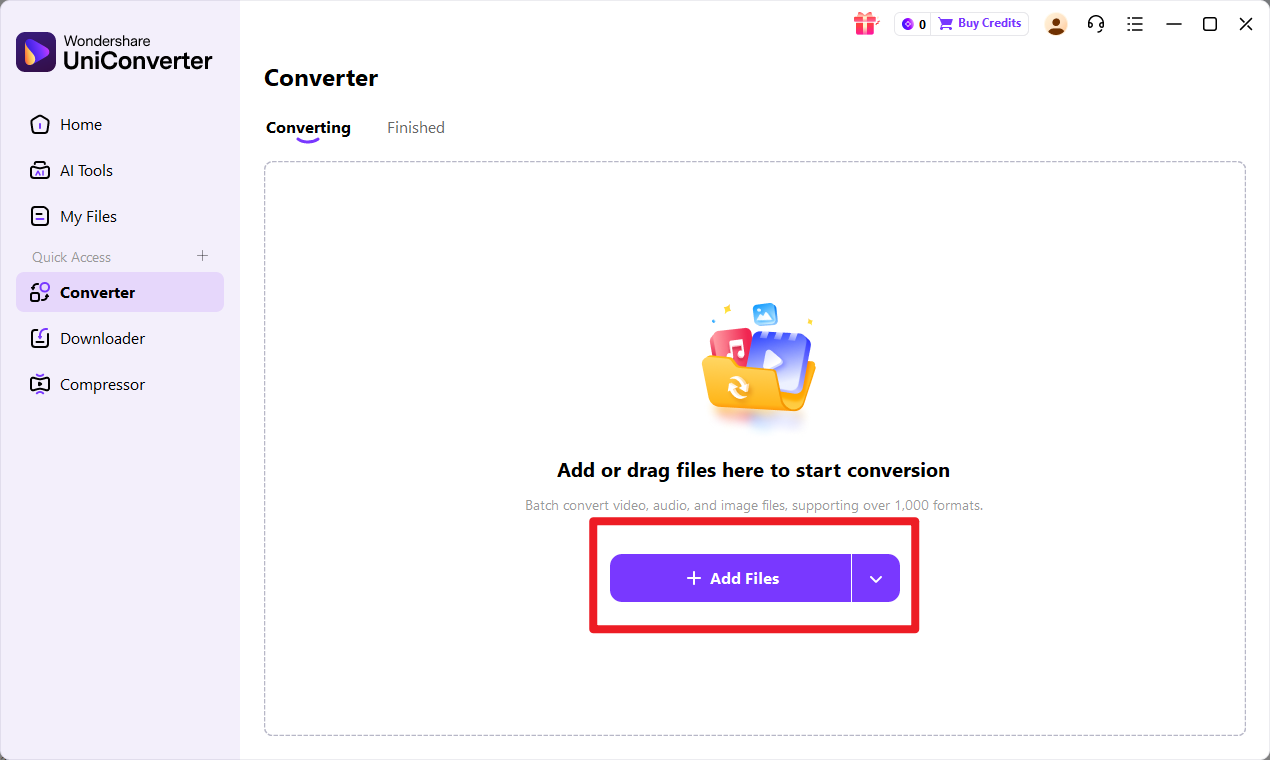
Step 2: Add Files to UniConverter
You can either click the "Add Files" button in the center or top-left corner to browse for your CineForm files, or you can simply drag and drop them directly into the program window.
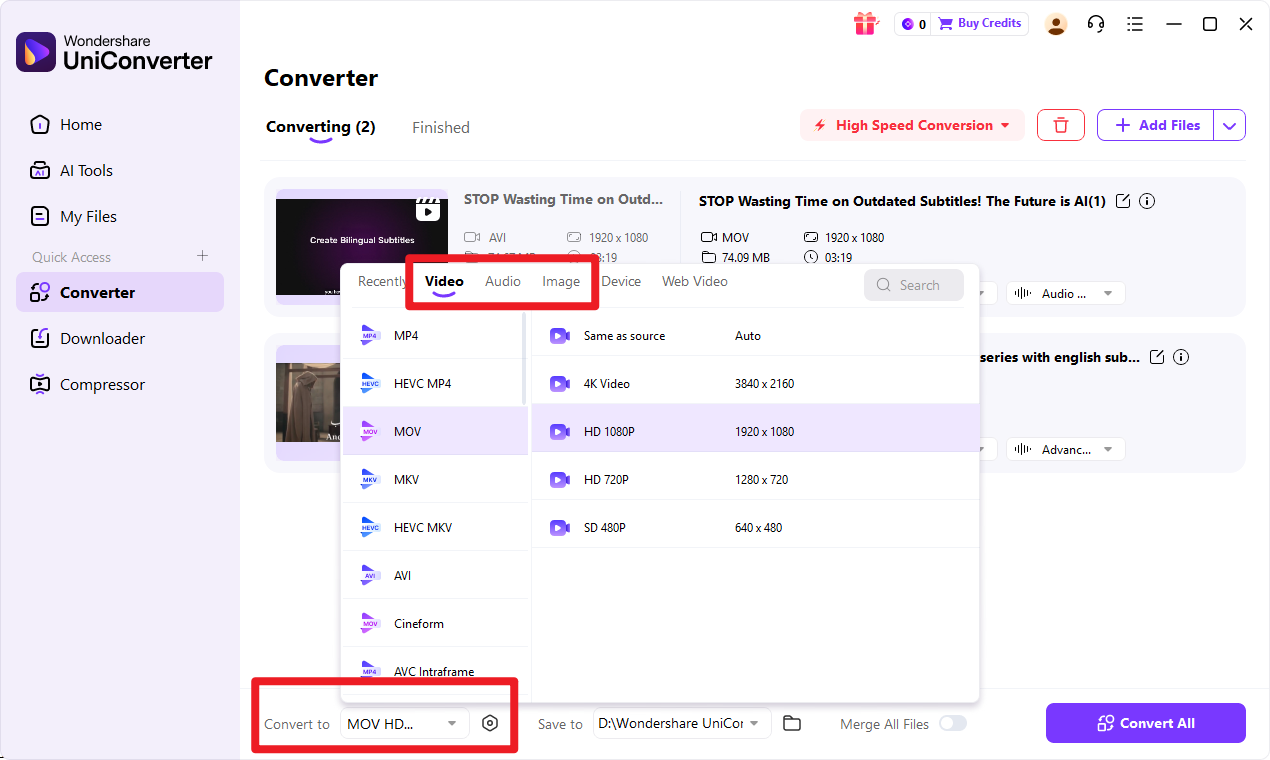
Step 3: Choose Output Format
With your files loaded, click on the "Output Format" menu located at the bottom of the window. This will open a new panel with a wide range of format options. Navigate to the "Editing" tab. From the list on the left, select "Apple ProRes" and then choose the specific preset you need on the right, such as "ProRes 422 HQ" or "ProRes 422," to match your project's requirements.
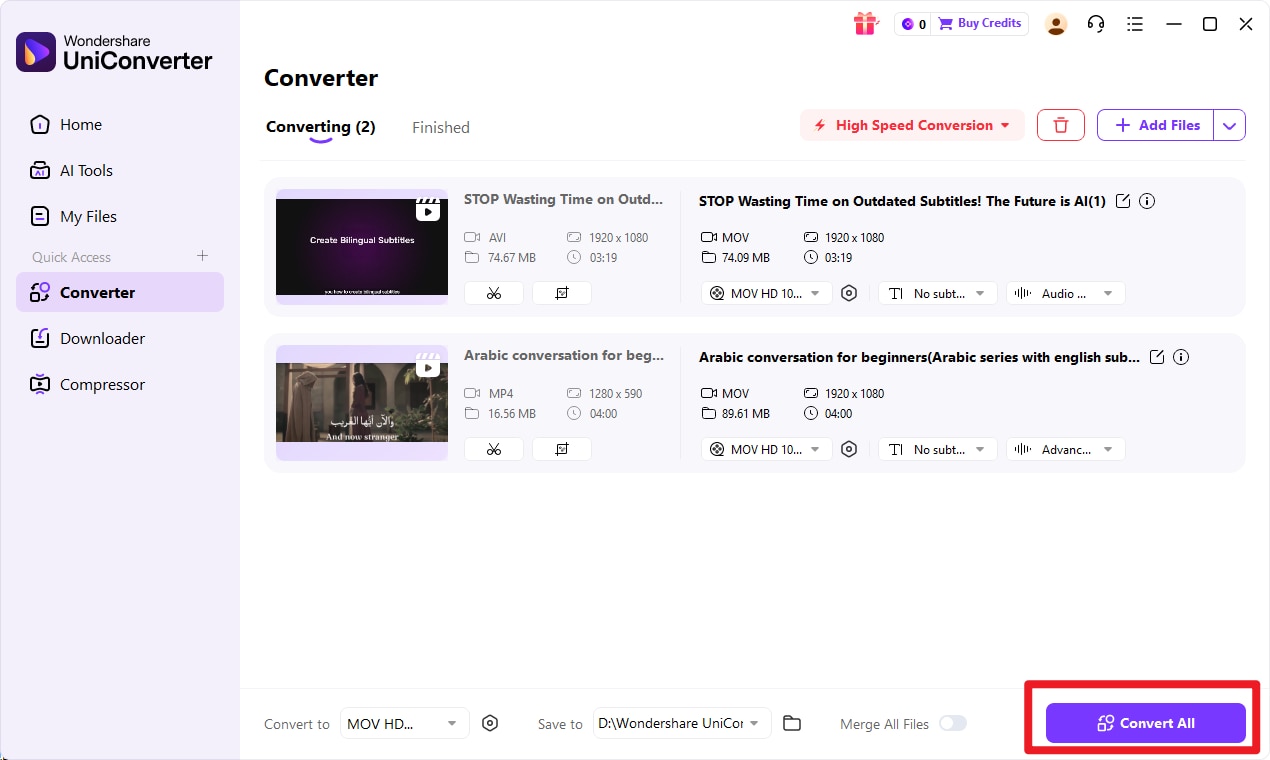
Step 4: Start the Conversion
Before starting, you can specify where you want to save your new files using the "File Location" field at the bottom. Once you are ready, click the "Convert" button next to an individual file or click the "Start All" button in the bottom-right corner to begin the batch conversion process.

More Than Just a Video Format Converter
Conclusion
To summarize, the CineForm vs ProRes debate doesn't have a single winner because the best codec is the one that best serves your specific project and technical environment. Apple ProRes rightfully maintains its crown as the king of the post-production industry, especially for Mac-based professionals and for meeting final delivery specifications. It is the safe, reliable, and universally accepted standard. On the other hand, GoPro CineForm stands as an outstanding and highly flexible alternative, offering exceptional quality and its killer feature: seamless cross-platform compatibility for teams working across Windows and macOS.
Ultimately, true workflow mastery comes from flexibility. In a world where you'll inevitably encounter both formats, equipping yourself with a powerful conversion tool is not a luxury but a necessity. Wondershare UniConverter stands out as a fast, reliable, and user-friendly solution for seamlessly converting between CineForm, ProRes, and over 1,000 other formats, ensuring that no codec incompatibility ever slows you down.
FAQs
-
1. Is CineForm a good intermediate codec?
Yes, CineForm is an excellent, high-quality intermediate codec. It is visually lossless, supports up to 12-bit color, and is particularly strong in cross-platform workflows involving both Windows and Mac computers due to its great performance on both operating systems. -
2. Can I use Apple ProRes on a Windows PC?
Yes, you can both encode and decode Apple ProRes on a Windows PC. Modern versions of professional software like Adobe Premiere Pro, DaVinci Resolve, and conversion tools like Wondershare UniConverter fully support the codec. However, real-time editing performance is generally more optimized and smoother on macOS. -
3. Which codec is smaller, CineForm or ProRes?
File sizes are often very comparable at similar quality settings. For example, a file encoded in GoPro CineForm will be roughly the same size as one encoded in Apple ProRes 422 HQ. However, the ProRes family offers lower bitrate versions like ProRes 422 LT, which can create smaller files, while higher-end versions like ProRes 4444 XQ will be significantly larger. -
4. Does converting from CineForm to ProRes reduce quality?
When you use a professional-grade conversion tool like Wondershare UniConverter, the process is designed to be visually lossless. The software re-encodes the video data while preserving the maximum amount of visual information. For all practical purposes, the resulting ProRes file will have no perceptible loss of quality compared to the original CineForm source.
